
HRID 35412반응물로

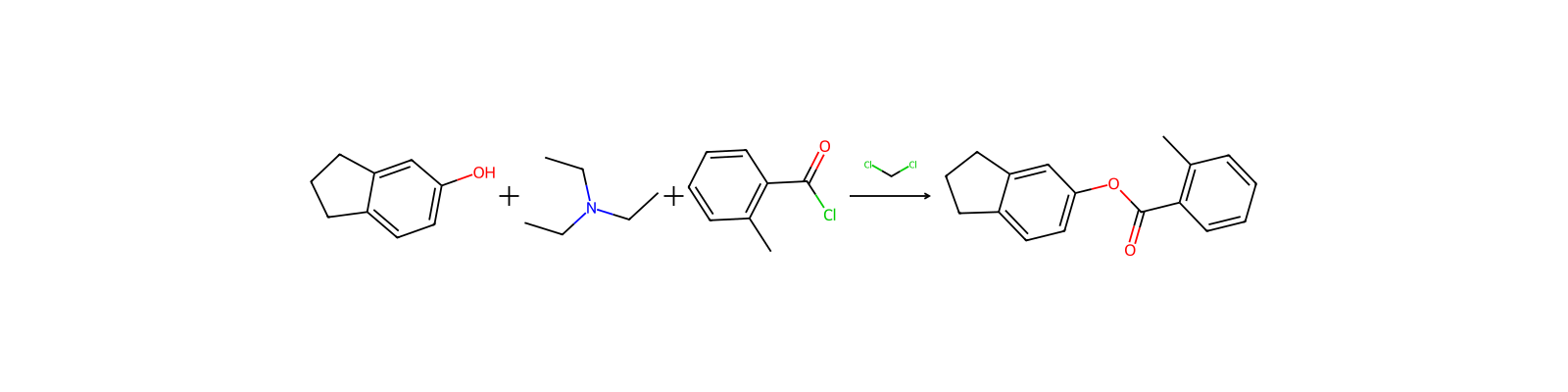
1470-94-6Oc1ccc2c(c1)CCC2PEHSSTUGJUBZBI-UHFFFAOYSA-NIndan-5-ol is a member of the class of phenols that is indan which has been hydroxylated at position 5. It is a member of phenols and a member of indanes.
1470-94-6DTXSID0051732CHEMBL3218378CHEBI:59311안전 정보는 참고용이며, 공급업체의 물질안전보건자료(SDS), 관련 법규 및 전문가 평가를 대체하지 않습니다.
Danger
H311 (100%): Toxic in contact with skin [Danger Acute toxicity, dermal]
P262, P264, P264+P265, P270, P280, P302+P352, P305+P351+P338, P316, P321, P332+P317, P337+P317, P361+P364, P362+P364, P405, and P501 (click each P-code to see the statement)
Aggregated GHS information provided per 45 reports by companies from 3 notifications to the ECHA C&L Inventory. Each notification may be associated with multiple companies.
개요5-Indanol, mp 54–55 ℃, bp 255 ℃, is produced from indan [496-11-7] by a sulfonation–alkali-fusion process. A synthesis for 1,1,3,3-tetraalkylindanols was developed by Bayer, which involves the reaction of isoolefins with secondary alkenylphenols (or compounds generating them under the reaction conditions) at 100–250 ℃ and in the presence of acidic catalysts. An example is the reaction of isobutene with bisphenol A in the presence of acid-activated clays which yields 1,1,3,3-tetramethyl-5-indanol [53718-26-6], mp 115 ℃, bp (2.66 kPa) 156 ℃, in a yield of 80% of the theoretical, and 4-tert-butylphenol as a coproduct.


light brown to grey-brown crystalline powder or
정의ChEBI: A member of the class of phenols that is indan which has been hydroxylated at position 5.