
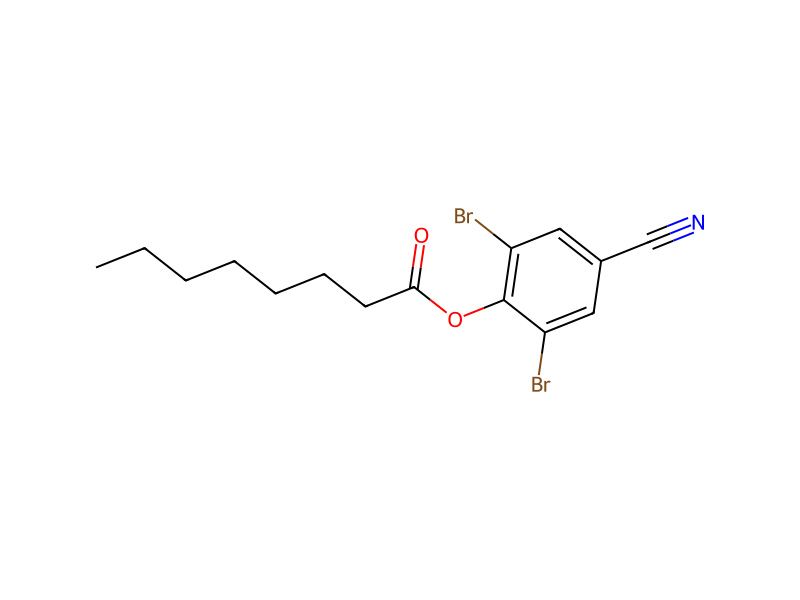
기본 정보
- 표준 SMILES
CCCCCCCC(=O)Oc1c(Br)cc(C#N)cc1Br- InChIKey
DQKWXTIYGWPGOO-UHFFFAOYSA-N- 분자식
- C15H17Br2NO2
- 평균 분자량
- 403.11 g/mol
- 단동위원소 질량
- 400.96260298
개요
Bromoxynil Octanoate can cause developmental toxicity according to The Environmental Protection Agency (EPA).
이름 및 식별자
- 우선 이름
- Bromoxynil octanoate
- IUPAC
- (2,6-dibromo-4-cyanophenyl) octanoate
- 현지명
- 2,6-다이브로모-4-시아노페닐옥타노에이트
- 영어명
- Bromoxynil octanoate
- 분자식
- C15H17Br2NO2
- 분자량
- 403.11
이름 및 동의어
Bromoxynil octanoate1689-99-22,6-DIBROMO-4-CYANOPHENYL OCTANOATEBrominal WOctanoic acid, 2,6-dibromo-4-cyanophenyl esterDTXSID7023932NPH 1320Bromoxynil octanoic acid ester9HL5XAW9SK4-Cyano-2,6-dibromophenyl octanoateDTXCID803932Octanoic acid ester of 3,5-dibromo-4-hydroxybenzonitrile
이름 더 보기
2,6-다이브로모-4-시아노페닐옥타노에이트4-시아노-2,6-다이아이오도페닐옥타노에이트nph1320rp-16272brominalw'LGC' (1610)Bromoxynil-octBromoxynil octanoaBromoxynil Octanoate ECChlorpyrifos Impurity 49bromoxyniln-octanoylester
RefChem:1216593,5-Dibromo-4-octanoyloxybenzonitrile216-885-3M&B 10731Bromoxynil-octanoate(2,6-dibromo-4-cyanophenyl) octanoateBromoxynil octanoate [ISO]Benzonitrile, 3,5-dibromo-4-octanoyloxy-
데이터베이스 식별자
- CAS
1689-99-2- PubChem CID
- 15533
- DTXSID
DTXSID7023932- ChEMBL
CHEMBL1903970- UNII
- 9HL5XAW9SK
- EC Number
- 216-885-3
- Nikkaji
- J7.559K
물성
구조 계산 물성
- XLogP
- 5.8
- 극성 표면적
- 50.1 Ų
- 수소 결합 공여자 수
- 0
- 수소 결합 수용자 수
- 3
- 회전 가능 결합 수
- 8
- 무거운 원자 수
- 20
- 형식 전하
- 0
- 복잡도
- 341
실험 및 물리화학적 성질
SpringerMaterials PropertiesFusion temperature
Pesticides
Pesticide -> EPA IRIS
Pesticides -> Herbicides, Other
Environmental transformation -> Pesticides (parent, predecessor)
LogP
log Kow = 5.4
6.1
OdorCharacteristic odor
Color/Form
Cream, waxy solid
Clear, amber waxy solid
Solubility
In water, 0.08 mg/L at 25 °C
In chloroform 800, xylene, dimethylformamide 700, ethyl acetate 620, cyclohexanone 550, carbon tetrachloride 500, n-propanol 120, acetone, ethanol 100 (all in g/L 20-25 °C)
Flash Point102 °F, 39 °C (TCC)
DecompositionWhen heated to decomposition it emits toxic fumes of /nitrogen oxide and hydrogen bromide/.
Melting Point45-46 °C
Vapor Pressure
0.0000048 [mmHg]
0.64 mPa (4.8X10⁻⁶ mm Hg) at 25 °C
Henry's Law ConstantHenry's Law constant = 3.2X10⁻⁵ atm cu m/mol at 25 °C /Estimated/
Physical Description
Bromoxynil octanoate, [solid] appears as a solid. Used as a selective contact herbicide.
Solid; [Merck Index] Nearly white crystalline solid; [MSDSonline]
물리화학적 성질
- 녹는점
- 45 · 45-46°C
- 끓는 점
- 424.6 · 424.6±45.0 °C(Predicted)
- 밀도
- 1.604 · 1.6040 (rough estimate)
- 증기압
- 0 Pa · 0Pa at 40℃
- 굴절률
- 1.622 · 1.6220 (estimate)
- 저장 조건
- Sealed in dry,Room Temperature
- 물리적 상태
- Solid
- 색상
- White to off-white
- 수용성
- 30 μg/L · 30μg/L at 20℃
- BRN
- 2756636 · 2756636
- Henry's Law Constant
- 3.1 · 3.1×10-1 mol/(m3Pa) at 25℃, Duchowicz et al. (2020)
- InChI
- InChI=1S/C15H17Br2NO2/c1-2-3-4-5-6-7-14(19)20-15-12(16)8-11(10-18)9-13(15)17/h8-9H,2-7H2,1H3
- InChIKey
- DQKWXTIYGWPGOO-UHFFFAOYSA-N
- SMILES
- C(OC1=C(Br)C=C(C#N)C=C1Br)(=O)CCCCCCC
- LogP
- 5.9 at · 5.9 at 20℃
- NIST
- 2 · octanoic acid, 2,6-dibromo-4-cyanophenyl ester(1689-99-2)
- EPA
- Bromoxynil octanoate (1689-99-2)
화학적 성질
Bromoxynil is a colorless to white crystalline solid or tan powder. Odorless (pure).
안전 및 규제
GHS 분류
GHS Classification
Danger
H302: Harmful if swallowed [Warning Acute toxicity, oral]
P203, P261, P264, P270, P271, P272, P273, P280, P301+P317, P302+P352, P304+P340, P316, P318, P321, P330, P333+P317, P362+P364, P391, P403+P233, P405, and P501 (click each P-code to see the statement)
Danger
H301+H331 (20.7%): Toxic if swallowed or if inhaled [Danger Acute toxicity, oral; acute toxicity, inhalation]
P203, P261, P264, P270, P271, P272, P273, P280, P301+P316, P301+P317, P302+P352, P304+P340, P316, P317, P318, P321, P330, P333+P317, P362+P364, P391, P403+P233, P405, and P501 (click each P-code to see the statement)
유해성 정보
Regulatory Information
Hazard Traits - Developmental Toxicity
Commission Regulation No 844/2012
Status: Active Update: 13-01-2022 https://echa.europa.eu/registration-dossier/-/registered-dossier/33062
Bromoxynil octanoate: Does not have an individual approval but may be used under an appropriate group standard
The New Jersey Worker and Community Right to Know Act requires public and private employers to provide information about hazardous substances at their workplaces. (N.J.S.A. 34:5A-1 et. seq.)
Other Safety InformationIMAP assessments - Octanoic acid, 2,6-dibromo-4-cyanophenyl ester: Environment tier I assessment
DOT LabelPoison
Fire HazardsExcerpt from ERG Guide 151 [Substances - Toxic (Non-Combustible)]:
Health HazardsExcerpt from ERG Guide 151 [Substances - Toxic (Non-Combustible)]:
Hazards Summary
A mild skin and eye irritant; May cause skin sensitization; Effects in a 13 week feeding study with rats include decrease in body weight (not associated with decrease in food intake), increased kidney and liver weights, hematological changes, and myocardial degeneration and necrosis; Four workers in a manufacturing plant making both bromoxynil and ioxynil developed typical symptoms of uncoupler poisoning including excessive perspiration, thirst, fever, emesis, myalgia, and weight loss. ... The effects reversed rapidly after exposure ceased. [HSDB] May cause skin sensitization; [eChemPortal: ESIS] May cause irritation; May cause skin sensitization; [MSDSonline] See Bromoxynil.
Reactive GroupEsters, Sulfate Esters, Phosphate Esters, Thiophosphate Esters, and Borate Esters
Special Reports
USEPA/Office of Pesticide Programs; Reregistration Eligibility Decision Document - Bromoxynil. EPA738-R-98-013 December 1998. The RED summarizes the risk assessment conclusions and outlines any risk reduction measures necessary for the pesticide to continue to be registered in the U.S.[Available from, as of February 1, 2005: http://www.epa.gov/pesticides/reregistration/status.htm]
FIFRA Requirements
Based on the reviews of the generic data for the active ingredient bromoxynil, the Agency has sufficient information on the health effects of bromoxynil and on its potential for causing adverse effects in fish and wildlife and the environment. The Agency has determined that bromoxynil products, labeled and used as specified in this Reregistration Eligibility Decision, will not pose unreasonable risks to humans or the environment. Therefore, the Agency concludes that products containing bromoxynil for all uses are eligible for reregistration, provided the registrant follows all requirements as set forth in this document.
As the federal pesticide law FIFRA directs, EPA is conducting a comprehensive review of older pesticides to consider their health and environmental effects and make decisions about their future use. Under this pesticide reregistration program, EPA examines health and safety data for pesticide active ingredients initially registered before November 1, 1984, and determines whether they are eligible for reregistration. In addition, all pesticides must meet the new safety standard of the Food Quality Protection Act of 1996. Pesticides for which EPA had not issued Registration Standards prior to the effective date of FIFRA '88 were divided into three lists based upon their potential for human exposure and other factors, with List B containing pesticides of greater concern and List D pesticides of less concern. Bromoxynil octanoate is found on List B. Case No: 2070; Pesticide type: herbicide; Case Status: OPP is reviewing data from the pesticide's producers regarding its human health and/or environmental effects, or OPP is determining the pesticide's eligibility for reregistration and developing the RED document.; Active ingredient (AI): bromoxynil octanoate; Data Call-in (DCI) Date(s): 6/5/91, 10/13/95; AI Status: The producers of the pesticide have made commitments to conduct the studies and pay the fees required for reregistration, and are meeting those commitments in a timely manner.
Tolerances are established for residues of the herbicide bromoxynil (3,5-dibromo-4-hydroxybenzonitrile) resulting from application of its octanoic and/or heptanoic acid ester in or on the following commodities: alfalfa, seeding; barley, grain; barley, straw; canarygrass, annual, seed; corn, field, stover; corn, fodder (green); corn, grain; corn, grain, field; corn, stover; flax, seed; flax, straw; garlic; grass, canary, annual, straw; mint hay; oat, forage; oat, grain; oat, straw; onion, dry bulb; rye, forage; rye, grain; rye, straw; sorghum, forage; sorghum, grain; sorghum, grain, stover; wheat, forage; wheat, grain; and wheat, straw.
Tolerances are established for residues of the herbicide bromoxynil (3,5-dibromo-4-hydroxybenzonitrile) and its metabolite 3,5-dibromo-4-hydroxybenzoic acid (DBHA) resulting from application of its octanoic and/or heptanoic acid ester in or on the following commodities: cattle, fat; cattle, meat byproducts; cattle, meat; cotton gin byproducts; cotton, hulls; cotton, undelinted seed; egg; goat, fat; goat, meat byproducts; goat, meat; hot, fat; hog, meat byproducts; hog, meat; horse, fat; horse, meat byproducts; horse, meat; milk; poultry, fat; poultry, meat byproducts; poultry, meat; sheep, fat; sheep, meat byproducts; and sheep, meat.
Reactivity ProfileBROMOXYNIL OCTANOATE, [SOLID] is an ester. Readily hydrolyzed to bromoxynil and octanoate at pH's exceeding 9.
Air and Water ReactionsNo rapid reaction with air. No rapid reaction with water.
Hazard Classes and Categories
Acute Tox. 3 (31.4%)
Reproductive toxicity - category 2
Repr. 2
안전 및 보호
Fire FightingExcerpt from ERG Guide 151 [Substances - Toxic (Non-Combustible)]:
First AidExcerpt from ERG Guide 151 [Substances - Toxic (Non-Combustible)]:
Exposure Control and Personal Protection2.0 [mg/m3], inhalable fraction, as CN[German Research Foundation (DFG)]
Fire Fighting Procedures
If material on fire or involved in fire: Extinguish fire using agent suitable for type of surrounding fire. (Material itself does not burn or burns with difficulty.) Use water in flooding quantities as fog. Use "alcohol" foam, dry chemical or carbon dioxide.
Carbon dioxide or dry chemical for small fires. Water-spray or alcohol type foam for large fires.
Storage ConditionsHandle carefully ... Do not use or store near heat or open flame. Store at temperature above 3 °F. If allowed to freeze, remix before using. Do not contaminate water, food or feed by storage or disposal of this chemical.
Cleanup Methods
Environmental considerations: Land spill: Dig a pit, pond, lagoon, holding area to contain liquid or solid material. /SRP: If time permits, pits, ponds, lagoons, soak holes, or holding areas should be sealed with an impermeable flexible membrane liner./ Cover solids with a plastic sheet to prevent dissolving in rain or fire fighting water.
Environmental considerations: Water spill: Use natural barriers or oil spill control booms to limit spill travel. Use natural deep water pockets, excavated lagoons, or sand bag barriers to trap material at bottom. Use mechanical dredges or lifts to remove immobilized masses of pollutants and precipitates.
Nonfire Spill ResponseExcerpt from ERG Guide 151 [Substances - Toxic (Non-Combustible)]:
Disposal Methods
SRP: The most favorable course of action is to use an alternative chemical product with less inherent propensity for occupational exposure or environmental contamination. Recycle any unused portion of the material for its approved use or return it to the manufacturer or supplier. Ultimate disposal of the chemical must consider: the material's impact on air quality; potential migration in soil or water; effects on animal, aquatic, and plant life; and conformance with environmental and public health regulations.
Preventive Measures
SRP: Contaminated protective clothing should be segregated in such a manner so that there is no direct personal contact by personnel who handle, dispose, or clean the clothing. Quality assurance to ascertain the completeness of the cleaning procedures should be implemented before the decontaminated protective clothing is returned for reuse by the workers. Contaminated clothing should not be taken home at end of shift, but should remain at employee's place of work for cleaning.
SRP: The scientific literature for the use of contact lenses in industry is conflicting. The benefit or detrimental effects of wearing contact lenses depend not only upon the substance, but also on factors including the form of the substance, characteristics and duration of the exposure, the uses of other eye protection equipment, and the hygiene of the lenses. However, there may be individual substances whose irritating or corrosive properties are such that the wearing of contact lenses would be harmful to the eye. In those specific cases, contact lenses should not be worn. In any event, the usual eye protection equipment should be worn even when contact lenses are in place.
If material not on fire and not involved in fire: Keep sparks, flames, and other sources of ignition away. Keep material out of water sources and sewers.
Personnel protection: Avoid breathing dusts, and fumes from burning material. Keep upwind. Avoid bodily contact with the material. ... Do not handle broken packages unless wearing appropriate personal protective equipment. Wash away any material which may have contacted the body with copious amounts of water or soap and water. If contact with the material anticipated, wear appropriate chemical protective clothing.
Isolation and EvacuationExcerpt from ERG Guide 151 [Substances - Toxic (Non-Combustible)]:
Allowable Tolerances
Tolerances are established for residues of the herbicide bromoxynil (3,5-dibromo-4-hydroxybenzonitrile) resulting from application of its octanoic and/or heptanoic acid ester in or on the following commodities: alfalfa, seeding 0.1 ppm; barley, grain 0.1 ppm; barley, straw 0.1 ppm; canarygrass, annual, seed 0.1 ppm; corn, field, stover 0.1 ppm; corn, fodder (green) 0.1 ppm; corn, grain 0.1 ppm; corn, grain, field 0.1 ppm; corn, stover 0.1 ppm; flax, seed 0.1 ppm; flax, straw 0.1 ppm; garlic 0.1 ppm; grass, canary, annual, straw 0.1 ppm; mint hay 0.1 ppm; oat, forage 0.1 ppm; oat, grain 0.1 ppm; oat, straw 0.1 ppm; onion, dry bulb 0.1 ppm; rye, forage 0.1 ppm; rye, grain 0.1 ppm; rye, straw 0.1 ppm; sorghum, forage 0.1 ppm; sorghum, grain 0.1 ppm; sorghum, grain, stover 0.1 ppm; wheat, forage 0.1 ppm; wheat, grain 0.1 ppm; and wheat, straw 0.1 ppm.
Tolerances are established for residues of the herbicide bromoxynil (3,5-dibromo-4-hydroxybenzonitrile) and its metabolite 3,5-dibromo-4-hydroxybenzoic acid (DBHA) resulting from application of its octanoic and/or heptanoic acid ester in or on the following commodities: cattle, fat 1 ppm; cattle, meat byproducts 3.5 ppm; cattle, meat 0.5 ppm; cotton gin byproducts 7.0 ppm; cotton, hulls 5.0 ppm; cotton, undelinted seed 1.5 ppm; egg 0.05 ppm; goat, fat 1 ppm; goat, meat byproducts 3.5 ppm; goat, meat 0.5 ppm; hot, fat 1 ppm; hog, meat byproducts 3.5 ppm; hog, meat 0.5 ppm; horse, fat 1 ppm; horse, meat byproducts 3.5 ppm; horse, meat 0.5 ppm; milk 0.1 ppm; poultry, fat 0.05 ppm; poultry, meat byproducts 0.3 ppm; poultry, meat 0.05 ppm; sheep, fat 1 ppm; sheep, meat byproducts 3.5 ppm; and sheep, meat 0.5 ppm.
Permissible Exposure Limit (PEL)5.0 [mg/m3], as CN
독성 정보
Ecotoxicity Values
LD50 Anas platyrhynchos (Mallard duck) oral 200 mg/kg/10 days
LC50 Anas platyrhynchos (Mallard duck) dietary 2150 ppm/8 days
LD50 Apis mellifera (Honey bee) topical 2 ug/bee/48 hr
LD50 Colinus virginianus (Northern bobwhite) oral 170 mg/kg/21 days
For more Ecotoxicity Values (Complete) data for BROMOXYNIL OCTANOATE (17 total), please visit the HSDB record page.
Environmental Fate
TERRESTRIAL FATE: Based on a classification scheme(1), an estimated Koc value of 21,000(SRC), determined from a log Kow of 5.4(2) and a regression-derived equation(3), indicates that bromoxynil octanoate is expected to be immobile in soil(SRC). In an aged soil leaching study, bromoxynil octanoate residues were found to not be mobile in four soils and aquatic sediment(4). A Kd of 7 mL/g (Koc = 1,003) was reported in soils with 1.2% organic matter(4). Volatilization of bromoxynil octanoate from moist soil surfaces is expected(SRC) given an estimated Henry's Law constant of 3.2X10⁻⁵ atm-cu m/mole(SRC), derived from its vapor pressure, 4.8X10⁻⁶ mm Hg(5), and water solubility, 0.08 mg/L(5). However, adsorption to soil is expected to attenuate volatilization(SRC). Bromoxynil octanoate is not expected to volatilize from dry soil surfaces(SRC) based upon its vapor pressure of 4.8X10⁻⁶ mm Hg(5) Chemical hydrolysis, photolytic degradation, and microbially-mediated degradation are important environmental processes for bromoxynil octanoate(4). 14C labeled bromoxynil octanoate was reported to degrade in sandy loam soil with a half-life of 2 days; the major degradation product was CO2, which accounted for 64.28% of the applied radioactivity after 90 days(4). In soil photolysis experiments, bromoxylnil octanoate was found to degrade with a half-life of 2.6 days when irradiated with a xenon arc lamp; a degradation half-life of 3.6 days was observed in a dark control(4). Degradation in the dark control suggests that degradation processes in addition to photolysis (e.g., hydrolysis or microbial degradation) were also occurring (4). A half-life of <12 hrs was reported when treated sandy loam soil was flooded with pond water and then aerobically incubated; test compound concn was 87% of applied at time zero, declining to undetectable levels in 48 hrs(4). Field dissipation half-lives ranging from 0.5 to 28 days have been reported(5). In degradation experiments using 5 soil types (sandy loam, acid sand, organic silt, sandy loam, and clay) in a soil perfusion apparatus and C14 (cyano) bromoxynil octanoate half-lives ranged from 7 to 22 days(6). In experiments using C14 (ring) bromoxynil octanoate half-live ranged from 10-12 days in clay and sandy loam soils(6). The degradation of bromoxynil octanoate in two soils, a heavy clay and a sandy loam, at 85% of field capacity moisture and at 20 °C, was studied(7). In both soils bromoxynil octanoate was rapidly degraded to bromoxynil, which was then also rapidly degraded; after 7 days >90% of the original application had disappeared(7). Three pesticides, including bromoxynil octanoate, were applied to two field plots in Saskatchewan; after 10 weeks none of the pesticides could be detected in the top 10 cm of soil(7).
AQUATIC FATE: Based on a classification scheme(1), an estimated Koc value of 21,000(SRC), determined from a log Kow of 5.4(2) and a regression-derived equation(3), indicates that bromoxynil octanoate is expected to adsorb to suspended solids and sediment(SRC). Volatilization from water surfaces is expected(3) based upon an estimated Henry's Law constant of 3.2X10⁻⁵ atm-cu m/mole(SRC), derived from its vapor pressure, 4.8X10⁻⁶ mm Hg(3), and water solubility, 0.08 mg/L(3). Using this Henry's Law constant and an estimation method(4), volatilization half-lives for a model river and model lake are 2.5 and 25 days, respectively(SRC). However, volatilization from water surfaces is expected to be attenuated by adsorption to suspended solids and sediment in the water column(SRC). The volatilization half-life from a model pond is about 130 years when adsorption is considered(5). In addition the rapid hydrolysis and photolysis of bromoxynil octanoate may attenuate its volatilization from water surfaces(SRC). Hydrolysis half-lives of 34.1, 11.5, and 1.7 days at pH 5, 7, and 9 have been reported for bromoxynil octanoate(6). A photolytic half-life of 4.6 days at pH 5 was reported for bromoxynil octanoate(6). A BCF of 230 (whole fish) was reported in bluegill sunfish when continuously exposed to 14C radiolabeled bromoxynil octanoate at 1.3-4.6 ug/L(6). According to a classification scheme(7), this BCF suggests the potential for bioconcentration in aquatic organisms is high, provided the compound is not metabolized by the organism(SRC). Bromoxynil octanoate added to sandy loam soil flooded with pond water degraded with a half-life of <12 hours under aerobic conditions at 25 °C in the dark (6). Bromoxynil octanoate was reported to degrade with a half-life of 3.7 days in a sandy loam sediment under anaerobic conditions(6). The environmental fate of bromoxynil octanoate was investigated in small ponds in the wetland area of the Delta Waterfowl and Wetlands Research Station in Canada(8). Bromoxynil octanoate, along with bromoxynil butyrate were sprayed on the ponds; sampling showed that bromoxynil octanoate persisted in the surface microlayer (0-1 mm) with half-lives of 0.8-2.5 hours(8). In subsurface waters (10-20 cm depth) the major forms of the pesticides were bromoxynil (phenol) and its monobromo analog(8).
ATMOSPHERIC FATE: According to a model of gas/particle partitioning of semivolatile organic compounds in the atmosphere(1), bromoxynil octanoate, which has a vapor pressure of 4.6X10⁻⁶ mm Hg at 25 °C(2), will exist in both the vapor and particulate phases in the particulate phase. Vapor-phase bromoxynil octanoate is degraded in the atmosphere by reaction with photochemically-produced hydroxyl radicals(SRC); the half-life for this reaction in air is estimated to be 2.2 days(SRC), calculated from its rate constant of 7.4X10⁻¹² cu cm/molecule-sec at 25 °C(SRC) that was derived using a structure estimation method(3). Particulate-phase bromoxynil octanoate may be removed from the air by wet and dry deposition(SRC). While bromoxynil octanoate undergoes aqueous photolysis with half-lives of 4-5 hours(4), no data were found regarding direct photolysis in air(SRC).
Adverse EffectsOccupational hepatotoxin - Secondary hepatotoxins: the potential for toxic effect in the occupational setting is based on cases of poisoning by human ingestion or animal experimentation.
Ecotoxicity Excerpts
/AQUATIC SPECIES/ Fathead minnows showed decreased larval growth, survival and embryo hatching success when tested in fish early life stage tests. NOEL=18 ppb; LOEL=39 ppb; MATC=26 ppb. /97.2% Bromoxynil octanoate/ /from table/
/AQUATIC SPECIES/ The acute toxicities of technical grade bromoxynil octanoate and two commercial formulations, Buctril and Bronate, to <24 hr old neonate Daphnia magna (Straus) were determined in soft, hard, and oligosaline water. In addition, effects of life stage, feeding, aging the herbicide, and exposure duration on bromoxynil octanoate toxicity to daphnids were investigated. Regardless of formulation, life stage, and water quality, bromoxynil octanoate was found to be extremely to highly toxic to daphnids in standard tests; 48 hr EC50 values ranged from 41 to 161 ug/l. Bromoxynil octanoate was the most toxic to neonates in soft water and the least toxic in hard water. The acute toxicities of the three bromoxynil herbicides to a given age group of daphnids were similar within the same water type. Overall, neonates and 7 day old adults were more sensitive than 14 or 15 day old adults to each herbicide. Feeding daphnids during the toxicity test significantly decreased bromoxynil octanoate toxicity compared to not feeding them. Aging bromoxynil octanoate (as Buctril) in hard water decreased its toxicity, and the rate of deactivation was rapid, with an estimated half-life of biological activity of 13 hr. Daphnids immobilized by exposures to toxic bromoxynil octanoate concn for : 6 hr recovered their mobility, whereas exposures of 18 and 24 hr to bromoxynil octanoate produced toxic effects in daphnids similar to those exposed for 48 hr. These results indicated that standard continuous exposure tests may not adequately predict the acute toxicity of bromoxynil octanoate to freshwater animals in the field.
/AQUATIC SPECIES/ Two chronic toxicity tests were conducted in which Daphnia magna were either continuously or intermittently exposed to bromoxynil octanoate (as Buctril) for 28 days. In the intermittent exposure test, daphnids were exposed to daily pulses of bromoxynil octanoate with 24 hr mean concentration equal to those in the continuous exposure test, and the peak concentration were three times the 24 hr mean values. After 28 days of continuous exposure to bromoxynil octanoate, survival of daphnids was reduced at 80 ug/L, whereas mean number of young per adult, intrinsic rate of natural increase, and mean weight of adults were all reduced at 40 ug/L. Intermittent exposures to daily pulses of bromoxynil octanoate for 28 days caused reduced survival of daphnids at 24 hr mean concentration : 40 ug/L and reduced mean number of young per adult, intrinsic rate of natural increase, and mean weight of adults at 24 hr mean concentration 20 ug/L. The estimated geometric mean-maximum acceptable toxicant concentration of bromoxynil octanoate based on 24 hr mean nominal values were 28 ug/L for continuous exposures and 14 ug/L for intermittent exposures. These results demonstrated that continuous exposure studies may not be adequate in assessing herbicide toxicity to aquatic biota when concentrations fluctuate temporally.
/FIELD STUDIES/ The toxicity of a single spray application of a 1:1 mixture of bromoxynil octanoate and bromoxynil butyrate were studied in fifteen 0.01 ha ponds located in the Delta marsh area of Manitoba. Two ponds were treated at 2.5 ug/L and two treated at 50 ug/L (nominal concentration). Complete mortality of brook sticklebacks (Culaea inconstans), held in cages in subsurface waters, occurred within 24 hr at the two highest treatment levels (nominal concentration of 100 and 500 ug/L). Mortality of caged Hyalella azteca at the highest dose levels ranged from 85 to 95% at 50 hr.
EPA IRIS Information
Bromoxynil octanoate
2 x 10 ^-2 mg/kg-day
Soil Adsorption/Mobility
The Koc of bromoxynil octanoate is estimated as 21,000(SRC), using a log Kow of 5.4(1)and a regression-derived equation(2). According to a classification scheme(3), this estimated Koc value suggests that bromoxynil ocatonate is expected to be immobile mobility in soil. In an aged soil leaching study, bromoxynil octanoate residues were found to not be mobile in four soils and aquatic sediment(4). A Kd of 7 mL/g (Koc = 1,003) was reported in soils with 1.2% organic matter(4).
Human Toxicity Excerpts
/SIGNS AND SYMPTOMS/ Four workers in a manufacturing plant making both bromoxynil and ionoxynil developed typical symptoms of uncoupler poisoning including excessive perspiration, thirst, fever, emesis, myalgia, and weight loss. ... The effects reversed rapidly after exposure ceased.
Artificial Pollution SourcesBromoxynil octanoate's production may result in its release to the environment through various waste streams; its use as a herbicide(1) will result in its direct release to the environment(SRC).
Environmental Biodegradation
14C-Labeled bromoxynil octanoate was reported to degrade in sandy loam soil with a half-life of 2 days; the major degradation product was CO2, which accounted for 64.28% of the applied radioactivity after 90 days(1). In soil photolysis experiments, bromoxylnil octanoate was found to degrade with a half-life of 2.6 days when irradiated with a xenon arc lamp; a degradation half-life of 3.6 days was observed in a dark control(1). Degradation in the dark control suggests that degradation processes in addition to photolysis (e.g., hydrolysis or microbial degradation) were occurring(1). A half-life of <12 hrs was reported when treated sandy loam soil was flooded with pond water and then aerobically incubated; test compound concn was 87% of applied at time zero, declining to undetectable levels in 48 hrs(1). Field dissipation half-lives ranging from 0.5 to 28 days have been reported(2). In degradation experiments using 5 soil types (sandy loam, acid sand, organic silt, sandy loam, and clay) in a soil perfusion apparatus and C14 (cyano) bromoxynil octanoate half-lives ranged from 7 to 22 days(3). In experiments using C14 (ring) bromoxynil octanoate half-live ranged from 10-12 days in clay and sandy loam soils(3). The degradation of bromoxynil octanoate in two soils, a heavy clay and a sandy loam, at 85% of field capacity moisture and at 20 °C, was studied(4). In both soils bromoxynil octanoate was rapidly degraded to bromoxynil, which was then also rapidly degraded; after 7 days >90% of the original application had disappeared(4). Three pesticides, including bromoxynil octanoate, were applied to two field plots in Saskatchewan; after 10 weeks none of the pesticides could be detected in the top 10 cm of soil(4). Bromoxynil octanoate was reported to degrade with a half-life of 3.7 days in a sandy loam sediment under anaerobic conditions(1). The environmental fate of bromoxynil octanoate was investigated in small ponds in the wetland area of the Delta Waterfowl and Wetlands Research Station in Canada(5). Bromoxynil octanoate, along with bromoxynil butyrate were sprayed on the ponds; sampling showed that bromoxynil octanoate persisted in the surface microlayer (0-1 mm) with half-lives of 0.8-2.5 hours(5). In subsurface waters (10-20 cm depth) the major forms of the pesticides were bromoxynil (phenol) and its monobromo analog(5).
Environmental Bioconcentration
A BCF of 230 (whole fish) was reported in bluegill sunfish when continuously exposed to 14C radiolabeled bromoxynil octanoate at 1.3-4.6 ug/L(1). According to a classification scheme(2), this BCF suggests the potential for bioconcentration in aquatic organisms is high, provided the compound is not metabolized by the organism(SRC).
Volatilization from Water/Soil
The Henry's Law constant for bromoxynil octanoate is estimated as 3.2X10⁻⁵ atm-cu m/mole(SRC) derived from its vapor pressure, 4.8X10⁻⁶ mm Hg(1), and water solubility, 0.08 mg/L(1). This Henry's Law constant indicates that bromoxynil octanoate is expected to volatilize from water surfaces(2). Based on this Henry's Law constant, the volatilization half-life from a model river (1 m deep, flowing 1 m/sec, wind velocity of 3 m/sec)(3) is estimated as 2.5 days(SRC). The volatilization half-life from a model lake (1 m deep, flowing 0.05 m/sec, wind velocity of 0.5 m/sec)(2) is estimated as 25 days(SRC). However, volatilization from water surfaces is expected to be attenuated by adsorption to suspended solids and sediment in the water column(SRC). The estimated volatilization half-life from a model pond is 130 years if adsorption is considered(3). Bromoxynil octanoate is not expected to volatilize from dry soil surfaces(SRC) based upon its vapor pressure(3).
Non-Human Toxicity Excerpts
/LABORATORY ANIMALS: Subchronic or Prechronic Exposure/ Bromoxynil octanoate technical grade powder (no purity stated); doses of 0, 20, 50, 125, 312, 781 or 1953 ppm fed in the diet to groups of 10/sex Sprague-Dawley rats per group with 30/sex in controls, for 13 weeks. Increased kidney and liver weights at 781 and 1953 ppm in males and females and changed blood profile at 1953 ppm. The absolute weight of the thyroid and pituitary were decreased in the males; the respective LOELs were 125 ppm and 312 ppm. Paradoxically, increased absolute thyroid weight was seen in the 20 ppm and 50 ppm female groups and increased absolute pituitary weight was seen in the 50 ppm female group. Since an increasing dose response was not seen, both of these increases may be spurious. However, the magnitude of the difference from the control values was impressive and may be indicative of a significant biological effect.
/LABORATORY ANIMALS: Subchronic or Prechronic Exposure/ Bromoxynil Octanoate (95.2% purity) was administered in the diet at 0, 150, 600, 1100 and 2100 ppm to 20-30 Crl:CD BR VAF/Plus rats/sex/group /for a period of 13-weeks/. The only deaths in the study occurred in the groups given the 2100 ppm diet. Twenty six females and nine males in the 2100 ppm groups (30/sex) were found dead, mainly on study days 3-5. The survivors in the 2100 ppm groups were sacrificed on study day 9. Each of the survivors had lost 6-34 grams in bodyweight during the first study week. Other findings for the survivors(both sexes) included: greatly decreased platelet count; increased RBC count, hemoglobin concentration and hematocrit; increased blood urea nitrogen, SGOT and SGPT; decreased serum globulin; lymphocytic necrosis and degeneration in the spleen, thymus, and mesenteric lymph node; hematopoietic depletion in the bone marrow; and stomach hemorrhages and congestion. Bodyweight effects also were seen in the lower dose groups: the 600 ppm and 1100 ppm females had mean BWs during study weeks 2-14 that were 90-94% and 78-81% of the control values, respectively; the 1100 ppm males had mean BWs during study weeks 2-14 that were 84-87% of the control values. These BW effects were not accompanied by a decrease in food consumption, except for the first study week. The 1100 ppm female group exhibited the following hematological effects: decreased platelet count and increased RBC count, hemoglobin concentration and hematocrit in the testing done at study week 5; and an increased lymphocyte count in the testing done at study week 14. The following clinical chemistry effects were seen at study week 5, but not study week 14: an increase in serum albumin in the 150 ppm and 600 ppm female groups and in the 600 ppm male group; decreased total bilirubin in the 600 ppm and 1100 ppm female groups; decreased serum potassium in the 1100 ppm female group; decreased serum chloride in the 600 ppm and 1100 ppm female groups. The following clinical chemistry effects were seen at study weeks 5 and 14: a decrease in total serum protein in the 1100 ppm groups (both sexes); a decrease in the globulin concentration in the 1100 ppm groups (both sexes). At study week 14, the 1100 ppm groups (both sexes) also exhibited an increase in serum alkaline phosphatase. No effects on blood urea nitrogen, SGOT or SGPT were noted in the testing done at study weeks 5 and 14. Increased absolute liver weight and decreased absolute right adrenal weight were seen in the 600 and 1100 ppm female groups; Organ weight was not determined for the heart, pituitary or thyroid. Myocardial degeneration and necrosis were observed in both sexes. The incidence rate in the males was: 0 ppm, 5/30; 150 ppm, 7/20; 600 ppm, 8/20 (p = 0.066); and 1100 ppm, 11/20(p = 0.006). The incidence rate in the females was: 0 ppm, 3/30; 150 ppm, 3/20; 600 ppm, 3/20; and 1100 ppm, 10/20 (p = 0.002). Myocardial lesions also were noted in two 2100 ppm females that were found dead on study days 3 and 4. Retinal degeneration was seen in two 1100 ppm males (10% incidence rate); given the rarity of this lesion in rats of this age, this may be an incipient effect. NOAEL = 150 ppm (myocardial degeneration and necrosis in males, liver hypertrophy in females).
/LABORATORY ANIMALS: Subchronic or Prechronic Exposure/ In a 13-wk subchronic feeding study, technical grade bromoxynil octanoate was administered in the diet to groups of 20-30 male and 20-30 female Sprague Dawley rats at dose levels of 0 (control), 150, 600 or 1100 ppm (equivalent to 0, 11, 45 or 91 mg/kg/day in males and 0, 13, 55 or 111 mg/kg/day in females). An additional group of 30 male and 30 female rats was started at a dose level of 2100 ppm, but was sacrificed during the first week of the study due to high mortality and signs of severe toxicity. No treatment related signs of toxicity were observed in males at 150 or 600 ppm. At 1100 ppm, the following effects were observed in males: decreased body weight gain, decreased serum total protein, decreased globulins, possibly increased thymic lymphocyte necrosis, and increased degeneration/necrosis of cardiac myofibers. No treatment-related effects were observed in females at 150 ppm. At 600 ppm, decreased body weight gain and increased liver weights were observed in females. At 1100 ppm, the following additional effects were also noted in females: decreased serum total protein, decreased globulins, possibly increased thymic lymphocyte necrosis, and increased degeneration/necrosis of cardiac myofibers. For male rats, the NOEL is 600 ppm (45 mg/kg/day) and the LOEL is 1100 ppm (91 mg/kg/day), based on decreased body weight gain, decreased serum total protein, decreased globulins and increased degeneration/necrosis of cardiac myofibers. For female rats, the NOEL is 150 ppm (13 mg/kg/day) and the LOEL is 600 ppm (55 mg/kg/day), based on decreased body weight gain and increased liver weights.
/LABORATORY ANIMALS: Subchronic or Prechronic Exposure/ In a 13-wk subchronic oral study, technical grade bromoxynil octanoate was administered orally in gelatin capsules to groups of 2 male and 2 female beagle dogs at dose levels of 0 (control), 0.43, 1.43 or 7.14 mg/kg/day. The only treatment-related effect observed in males and females in this study was decreased body weight gain. For males, mean absolute body weight gains from 0-13 weeks were +3.60, +2.80, +2.20 and +1.15 kg for the control, low, mid and high dose level groups respectively. These gains corresponded to 78%, 61% and 32% of the male control group (100%) for the low, mid and high dose level groups respectively. For females, the comparable mean absolute body weight gains were +2.90, +2.05, +1.75 and +0.55 kg. These gains corresponded to 71%, 60% and 19% of the female control group (100%). Although the % of body weight gain compared to controls was 78% for low dose level males and 71% for low dose level females, the corresponding differences in absolute body weight gains were actually <1 kg and since the low dose level animals appeared healthy throughout the entire study and showed no other sign of toxicity, it was concluded that the NOEL for both males and females in this study is 0.43 mg/kg/day and the LOEL is 1.43 mg/kg/day, based on decreased body weight gain.
For more Non-Human Toxicity Excerpts (Complete) data for BROMOXYNIL OCTANOATE (18 total), please visit the HSDB record page.
규제 정보
FIFRA Requirements
Based on the reviews of the generic data for the active ingredient bromoxynil, the Agency has sufficient information on the health effects of bromoxynil and on its potential for causing adverse effects in fish and wildlife and the environment. The Agency has determined that bromoxynil products, labeled and used as specified in this Reregistration Eligibility Decision, will not pose unreasonable risks to humans or the environment. Therefore, the Agency concludes that products containing bromoxynil for all uses are eligible for reregistration, provided the registrant follows all requirements as set forth in this document.
As the federal pesticide law FIFRA directs, EPA is conducting a comprehensive review of older pesticides to consider their health and environmental effects and make decisions about their future use. Under this pesticide reregistration program, EPA examines health and safety data for pesticide active ingredients initially registered before November 1, 1984, and determines whether they are eligible for reregistration. In addition, all pesticides must meet the new safety standard of the Food Quality Protection Act of 1996. Pesticides for which EPA had not issued Registration Standards prior to the effective date of FIFRA '88 were divided into three lists based upon their potential for human exposure and other factors, with List B containing pesticides of greater concern and List D pesticides of less concern. Bromoxynil octanoate is found on List B. Case No: 2070; Pesticide type: herbicide; Case Status: OPP is reviewing data from the pesticide's producers regarding its human health and/or environmental effects, or OPP is determining the pesticide's eligibility for reregistration and developing the RED document.; Active ingredient (AI): bromoxynil octanoate; Data Call-in (DCI) Date(s): 6/5/91, 10/13/95; AI Status: The producers of the pesticide have made commitments to conduct the studies and pay the fees required for reregistration, and are meeting those commitments in a timely manner.
Tolerances are established for residues of the herbicide bromoxynil (3,5-dibromo-4-hydroxybenzonitrile) resulting from application of its octanoic and/or heptanoic acid ester in or on the following commodities: alfalfa, seeding; barley, grain; barley, straw; canarygrass, annual, seed; corn, field, stover; corn, fodder (green); corn, grain; corn, grain, field; corn, stover; flax, seed; flax, straw; garlic; grass, canary, annual, straw; mint hay; oat, forage; oat, grain; oat, straw; onion, dry bulb; rye, forage; rye, grain; rye, straw; sorghum, forage; sorghum, grain; sorghum, grain, stover; wheat, forage; wheat, grain; and wheat, straw.
Tolerances are established for residues of the herbicide bromoxynil (3,5-dibromo-4-hydroxybenzonitrile) and its metabolite 3,5-dibromo-4-hydroxybenzoic acid (DBHA) resulting from application of its octanoic and/or heptanoic acid ester in or on the following commodities: cattle, fat; cattle, meat byproducts; cattle, meat; cotton gin byproducts; cotton, hulls; cotton, undelinted seed; egg; goat, fat; goat, meat byproducts; goat, meat; hot, fat; hog, meat byproducts; hog, meat; horse, fat; horse, meat byproducts; horse, meat; milk; poultry, fat; poultry, meat byproducts; poultry, meat; sheep, fat; sheep, meat byproducts; and sheep, meat.
안전 데이터
- wgk
- 3
- tsca
- TSCA listed
- rtecs
- DI3325000
- ridadr
- 2588
- 독성
- LC50 (48-hour) for rainbow trout 150 μg/L (Hartley and Kidd, 1987), goldfish 460 μg/L and catfish 63 μg/L (Worthing and Hance, 1991); acute oral LD50 for rats 365 mg/kg (Hartley and Kidd, 1987).
- risk_code
- 22-23-43-50/53-63
- hazard_code
- T;N,N,T
- safety_code
- 36/37-45-60-61-63
- 포장분류
- III
- 위험 등급
- 6.1(b)
- 유해 물질 데이터
- 1689-99-2(Hazardous Substances Data)
화학 및 산업
약리 정보
Mechanism of Action
The pricipal action of the benzonitriles is to uncouple oxidative phosphorylation.
Bromoxynil octanoate is a fairly potent mitochondrial uncoupler in vitro with a UC50 value in rat liver mitochondria of 3.2 to 5 micro molar... The signs and symptoms of acute poisoning in vertebrates (including humans) are in reasonable accord with uncoupling being the primary mechanism of toxic action.
Metabolism/Metabolites
The absorption, distribution, excretion and metabolism of bromoxynil octanoate were studied in male and female Sprague Dawley rats given single oral doses of 14C-bromoxynil octanoate by gavage at dose levels of 2 or 20 mg/kg or at a dose level of 2 mg/kg following 14 days of unlabeled bromoxynil octanoate administered by oral gavage at a dose level of 2 mg/kg/day. Results were similar regardless of the dosing regimen. ...Essentially all bromoxynil octanoate was rapidly and nearly completely converted to bromoxynil phenol via ester hydrolysis. In special studies, the only chemical species identified in tissues was bromoxynil phenol per se; no bromoxynil octanoate was identified in tissues. In urine, the only major species was free and conjugated bromoxynil phenol with no bromoxynil octanoate present. In feces, however, some bromoxynil octanoate was identified.
The octanoate ester was rapidly and completely converted to the phenol and excreted in the urine as either the phenol or it conjugates.
Absorption, Distribution and Excretion
The absorption, distribution, excretion and metabolism of bromoxynil octanoate were studied in male and female Sprague Dawley rats given single oral doses of 14C-bromoxynil octanoate by gavage at dose levels of 2 or 20 mg/kg or at a dose level of 2 mg/kg following 14 days of unlabeled bromoxynil octanoate administered by oral gavage at a dose level of 2 mg/kg/day. Results were similar regardless of the dosing regimen. The rate of absorption was moderate in both males and females. Peak plasma concentrations of radioactivity were not reached until 7-10 hours after dosing. Radioactivity was widely distributed in most tissues. The highest concentrations were observed in blood, plasma, liver, kidneys and thyroid (especially in females). Levels of radioactivity in tissues were generally higher in females than in males. Most radioactivity was excreted in the urine (about 84-89% in males and 76-80% in females at 7 days) and considerably lesser amounts in the feces (about 6-10% in both males and females at 7 days). Excretion was more rapid in males than in females. Retention of radioactivity in tissues after 7 days was about 2-3% in males and 7-9% in females.
14C-Bromoxynil octanoate, incorporated into the end-use product Buctril, which contained 33.4% bromoxynil octanoate as the active ingredient, was topically applied to the skin of male Sprague Dawley rats at doses of 0.08, 0.4 or 3.4 mg/rat for durations of exposure of 0.5, 1, 2, 4, 10 or 24 hours (4 rats/dose/duration of exposure). The quantity of radioactivity absorbed increased with dose and duration of exposure. Percent dermal absorption at 10 hours was 10.32%, 7.07% and 4.51% for doses of 0.08, 0.4 and 3.4 mg/rat respectively. Following a soap and water wash (at 10 hours), 6.46%, 8.06% and 6.13% of the respective doses remained in/on the skin. Percent dermal absorption at 24 hours was 17.58%, 18.43% and 10.88% for doses of 0.08, 0.4 and 3.4 mg/rat respectively. Following a soap and water wash (at 24 hours), 7.91%, 9.50% and 4.97% of the respective doses remained in/on the skin.
A study with the octanoate ester in rats showed that after an oral dose, uptake was moderate. Peak plasma levels were attained 7 to 10 hours after dosing. Most of the dose was eliminated within 7 days, primarily in the urine.
Dermal uptake studies in rats show an absorption in 24 hr of 11 to 18 % for the octanoate ester depending on concentration...
용도 및 제조
Uses
Used as herbicide for cereals, field corn, popcorn, other crops, and alfalfa in Conservation Reserve Program; [HSDB]
Farming (Pesticides) [Category: Industry]
For bromoxynil octanoate (USEPA/OPP Pesticide Code: 035302) ACTIVE products with label matches. /SRP: Registered for use in the U.S. but approved pesticide uses may change periodically and so federal, state and local authorities must be consulted for currently approved uses./
Herbicide ... for barley, field corn, flax, garlic, mint, oats, onions, popcorn, rye, seedling alfalfa, sorghum, triticale, wheat, forage grasses, grass for sod and seed protection and alfalfa in Conservation Reserve Program.
Methods of ManufacturingBromoxynil octanoate is made from bromoxynil by reacting it with octanoic acid or with octanoyl chloride in the presence of pyridine.
Formulations/Preparations
Broclean, Bromox, Brominex, Bromolex, Bromolex and Bromoxymobeed
Buctril
Formulation Types Registered: Technical: Crystalline/Solid 87.30-95.00%; Liquid 87.30%. End Use Product: Emulsifiable Concentrate 15.74-33.40%; Liquid 15.74-33.40%.
Mixtures: 'B-4' (+2,4-D-2-ethylhexyl+ bromoxynil heptanoate); 'Bison' (+MCPA-2-ethylhexyl); 'Blespring Combi' (+dicamba+ MCPA+ mecoprop); 'Brioxil Super' (+ioxynil octanoate+ MCPA); 'Bronate Gel' (+MCPA-2-ethylhexyl+ bromoxynil heptanoate); 'Brox-AT' (+atrazine); 'Brox-M' (+ MCPA-2-ethylhexyl); 'Buctril 4' (+bromoxynil heptanoate); 'Buctril Gel' (+bromoxynil heptanoate); 'Buctril M' (+MCPA-2-ethylhexyl+ bromoxynil heptanoate); 'Clark' (+atrazine); 'Compas' (+clethodim); 'Gardobuc' (+terbuthylazine); 'Mextrol Biox' (+ioxynil octanoate); 'Oxytril' (+ioxynil octanoate).
Use ClassificationEnvironmental transformation -> Pesticides (parent, predecessor)
General Manufacturing InformationOctanoic acid, 2,6-dibromo-4-cyanophenyl ester: ACTIVE
응용 분야
용도Herbicide.
일반 설명A solid. Used as a selective contact herbicide.
상·하류 제품 정보
상류 원료
하류 제품
공급사50 곳
阿诺西(上海)生物技术有限公司400-1107768 15058188853 · [email protected]
郑州阿尔法化工有限公司+86-18530059196 · [email protected]
上海阿拉丁生化科技股份有限公司400-6206333 13167063860 · [email protected]
江苏瑞点药业有限公司15896106238 · [email protected]
湖北威德利化学试剂有限公司181-6332-1995 18062128043 · [email protected]
山东泰诚生物科技有限公司18769832557 18769832557 · [email protected]
盐城通铭生物科技有限公司15195160625 · [email protected]
山东海舟生物工程有限公司130-0567-0367 13006570367 · [email protected]
上海毕得医药科技股份有限公司400-1647117 13681763483 · [email protected]
苏州市森菲达化工有限公司18796480002 18796480002 · [email protected]
Qingdao Trust Agri Chemical Co.,Ltd+86-008615963231493 +86-008613573296305 · [email protected]
宁波季诺化学品有限公司0574-87314919 057487319282 · [email protected]
Dayang Chem (Hangzhou) Co.,Ltd.+86-0571-88938639 17705817739 · [email protected]
Syntechem Co.,Ltd[email protected]
北京索莱宝科技有限公司010-50973130 17801761073 · [email protected]
梯希爱(上海)化工贸易有限公司021-61109150 · [email protected]
湖北长耀生物科技有限公司17683887209 17683887209 · [email protected]
湖北魏氏化学试剂股份有限公司027-59102966 18717199209 · [email protected]
泰安鑫润生物科技有限公司15318133072 15318133072 · [email protected]
武汉贝乐叶生物医药科技有限公司15871353653 18086118076 · [email protected]
四川库利南科技有限公司400-1166-196 18981987031 · [email protected]
Xiamen AmoyChem Co., Ltd+86-86-5926051114 · [email protected]
ZHEJIANG JIUZHOU CHEM CO., LTD+86-0576225566889 +86-13454675544 · [email protected];[email protected];[email protected]
TargetMol 中国(陶术生物)400-821-0310 15002144251 · [email protected]
艾科试剂4008-755-333 18080918076 · [email protected]
成都思天德生物科技有限公司028-83243028 19136088901 · [email protected]
深圳振强药物研发有限公司0755-66853366 13670046396 · [email protected]
南京生利德生物科技有限公司025-57798810 18652991625 · [email protected]
上海丽康新材料有限公司+86-16631818819 +86-17736933208 · [email protected]
上海将来实业股份有限公司400-0066400 13621662912 · [email protected]
上海将来实业股份有限公司021-61552785 · [email protected]
天津普西唐生物医药科技有限公司010-60605840 · [email protected]
江苏艾康生物医药研发有限公司025-66028182 17714375163 · [email protected]
天津阿尔塔科技有限公司022-6537-8550 15522853686 · [email protected]
TargetMol中国(陶术生物)021-021-33632979 15002134094 · [email protected]
上海昕凯医药科技有限公司21-619849051-1 18521059765 · [email protected]
湖北玖丰隆化工有限公司13277936479 · [email protected]
厦门志信化学有限公司+86-5922680277 +86-13806087780 · [email protected]
安耐吉化学&3A(安徽泽升科技股份有限公司)400-0056266 · [email protected]
湖北川合化工有限公司187-7130-7593 18672969259 · [email protected]
泰安市江舟生物科技有限公司1385-13854830759 13854830759 · [email protected]
艾吉析科技(上海)有限公司17721401538;17717235263 17721401538 · [email protected]
南京科晟祥科技有限公司18252089365 · [email protected]
湖北万业众诚化学试剂有限责任公司18671296875 · [email protected]
上海玖巨化工科技有限公司021-54290889 18117093889;17717355955 · [email protected]
南通市苏北化工原料有限公司0513-85290972 18762756250 · [email protected]
上海西陇生化科技有限公司021-52907766-8042
上海源叶生物科技有限公司13636370518 · [email protected]
山东西亚化学有限公司4009903999 13395398332 · [email protected]
河北贞佳新材料有限公司0319-5925599 13315915972
관련 반응
3건


연결된 노트
불러오는 중…