
2-브로모-4,6-디나이트로아닐린
2-Bromo-4,6-dinitroaniline

기본 정보
- CAS
1817-73-8- 표준 SMILES
Nc1c(Br)cc([N+](=O)[O-])cc1[N+](=O)[O-]- InChIKey
KWMDHCLJYMVBNS-UHFFFAOYSA-N- 분자식
- C6H4BrN3O4
- 평균 분자량
- 262.02 g/mol
- 단동위원소 질량
- 260.93852
개요
2-bromo-4,6-dinitroaniline is a bright yellow powder. (NTP, 1992)
이름 및 식별자
- 우선 이름
- 2-Bromo-4,6-dinitroaniline
- IUPAC
- 2-bromo-4,6-dinitroaniline
- 현지명
- 2-브로모-4,6-디나이트로아닐린
- 영어명
- 2-Bromo-4,6-dinitroaniline
- 분자식
- C6H4BrN3O4
- 분자량
- 262.02
이름 및 동의어
2-BROMO-4,6-DINITROANILINE1817-73-8Benzenamine, 2-bromo-4,6-dinitro-6-Bromo-2,4-dinitroaniline2,4-Dinitro-6-bromoanilineBromo DNA2-Bromo-4,6-dinitroaminobenzeneAniline, 2-bromo-4,6-dinitro-NCI-C60844DTXSID40246462,4-Dinitro-6-bromoanilinBenzenamide, 2-bromo-4,6-dinitro-
이름 더 보기
2-브로모-4,6-디나이트로아닐린2-브로모-4,6-디니트로아닐린2-브로모-4,6-디나이트로아닐린(2-BROMO-4,6-DINITROANILINE)bromodna2-Bromo-4,6-dinitroa2-bromo-4,6-dinitro-anilin2-BROMO-4,6-DINITRONANILINE2,4-DINITRO-6-BROMO ANILINE2-Bromo-4,6-dinitroaniline,97%
NSC-16572DTXCID204646105X73C593RefChem:466406217-329-22,4-Dinitro-6-bromanilinAniline, 2,4-dinitro-6-bromo-MFCD00007146
데이터베이스 식별자
- CAS
1817-73-8- PubChem CID
- 15752
- DTXSID
DTXSID4024646- ChEMBL
CHEMBL167513- UNII
- 105X73C593
- EC Number
- 217-329-2
- Nikkaji
- J38.265E
물성
구조 계산 물성
- XLogP
- 2.1
- 극성 표면적
- 118 Ų
- 수소 결합 공여자 수
- 1
- 수소 결합 수용자 수
- 5
- 회전 가능 결합 수
- 0
- 무거운 원자 수
- 14
- 형식 전하
- 0
- 복잡도
- 250
실험 및 물리화학적 성질
Chemical ClassesNitrogen Compounds -> Nitroanilines
Color/FormYELLOW NEEDLES FROM ACETIC ACID OR ALCOHOL
Solubility
less than 1 mg/mL at 70 °F (NTP, 1992)
SOL IN HOT ACETIC ACID; VERY SOL IN HOT ALCOHOL & ACETONE
Boiling PointSublimes (NTP, 1992)
Melting Point
307 to 309 °F (NTP, 1992)
153 °C
Physical Description
2-bromo-4,6-dinitroaniline is a bright yellow powder. (NTP, 1992)
Yellow solid; [HSDB] Powder; [MSDSonline]
Other Experimental PropertiesSUBLIMES BEFORE REACHING BP
물리화학적 성질
- 녹는점
- 151 · 151-153 °C (lit.)
- 끓는 점
- 400.8 · 400.8±40.0 °C(Predicted)
- 밀도
- 2.1534 · 2.1534 (rough estimate)
- 굴절률
안전 및 규제
안전 정보는 참고용이며, 공급업체의 물질안전보건자료(SDS), 관련 법규 및 전문가 평가를 대체하지 않습니다.
GHS 분류
GHS Classification
Danger
H228 (16.7%): Flammable solid [Danger Flammable solids]
P203, P210, P240, P241, P261, P264, P264+P265, P271, P280, P302+P352, P304+P340, P305+P351+P338, P318, P319, P321, P332+P317, P337+P317, P362+P364, P370+P378, P403+P233, P405, and P501 (click each P-code to see the statement)
Aggregated GHS information provided per 6 reports by companies from 3 notifications to the ECHA C&L Inventory. Each notification may be associated with multiple companies.
유해성 정보
Regulatory Information
REACH registered substance: 2-bromo-4,6-dinitroaniline (EC: 217-329-2)
Benzenamine, 2-bromo-4,6-dinitro-: Does not have an individual approval but may be used under an appropriate group standard
Fire HazardsFlash point data for this chemical are not available, but it is probably combustible. (NTP, 1992)
Health HazardsSYMPTOMS: Symptoms following exposure to this compound may include eye irritation.
Hazards SummaryA mutagen and mild eye irritant; Causes somnolence and weight loss in lethal-dose feeding studies of rats; [RTECS] Emergency treatment: Methemoglobinemia; [HSDB] An eye irritant; [CAMEO] An irritant; [MSDSonline]
Reactive GroupNitro, Nitroso, Nitrate, and Nitrite Compounds, Organic
Reactivity Profile
A halogenated and nitrated aryl amine. Amines are chemical bases. They neutralize acids to form salts plus water. These acid-base reactions are exothermic. The amount of heat that is evolved per mole of amine in a neutralization is largely independent of the strength of the amine as a base. Amines may be incompatible with isocyanates, halogenated organics, peroxides, phenols (acidic), epoxides, anhydrides, and acid halides. Flammable gaseous hydrogen is generated by amines in combination with strong reducing agents, such as hydrides.
화학 및 산업
용도 및 제조
Uses
Used in the synthesis of monoazo dyes; [ChemIDplus] Used as a chemical intermediate for azo derivatives; [HSDB]
CHEM INT FOR AZO DERIVS (PROBABLE AZO DYE INT)
CHEM INT FOR DISPERSE VIOLET 7 & 24-NO CURRENT U.S. PRODN
U.S. Exports
(1979) No Data
(1981) No Data
U.S. Imports
(1979) 1.25X10+7 GRAMS (PRINCPL CUSTMS DISTS)
(1981) 4.54X10+7 GRAMS (PRINCPL CUSTMS DISTS)
U.S. Production
(1979) PROBABLY GREATER THAN 4.54X10+6 GRAMS
(1981) PROBABLY GREATER THAN 4.54X10+6 GRAMS
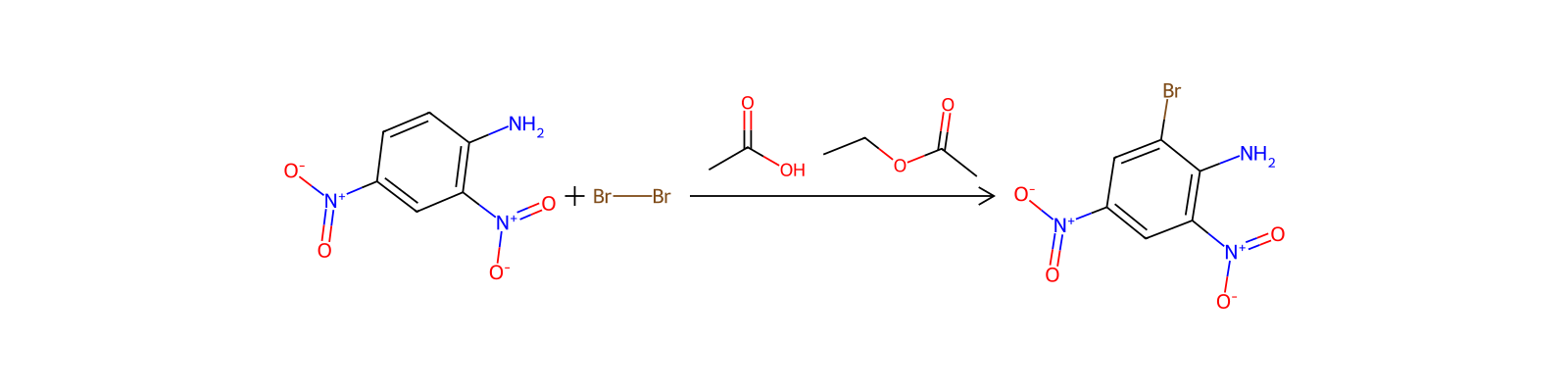
Methods of ManufacturingBROMINATION OF 2,4-DINITROANILINE SUSPENDED IN WATER
General Manufacturing InformationBenzenamine, 2-bromo-4,6-dinitro-: ACTIVE
응용 분야
용도2-Bromo-4,6-dinitroaniline was used as a model chemical in the inter-laboratory evaluation of the bioluminescent Salmonella reverse mutation assay for detecting mutagenicity.
일반 설명Bright yellow powder.
상·하류 제품 정보
상류 원료
관련 반응
17건



화합물 노트
불러오는 중…