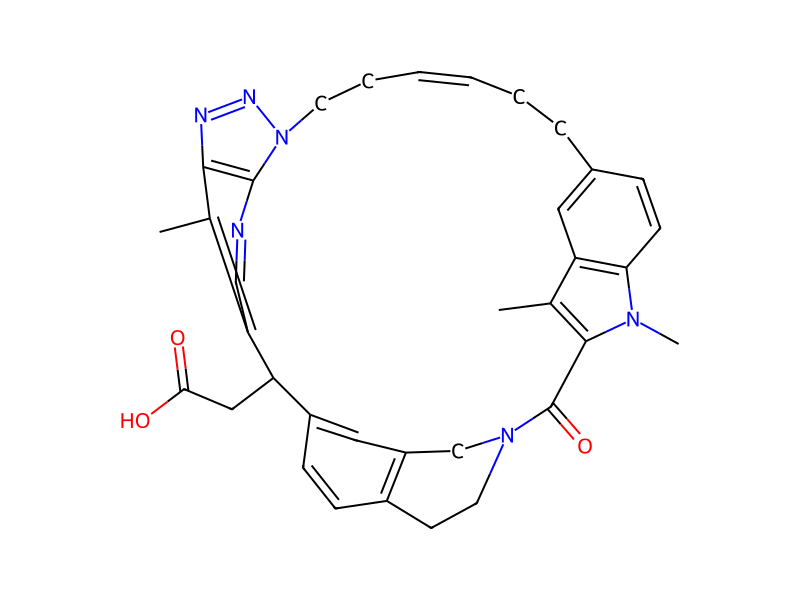
기본 정보
- CAS
9029-44-1- 표준 SMILES
Cc1c2n(C)c3ccc(cc13)CCC=CCCn1nnc3c(C)c(cnc31)C(CC(=O)O)c1ccc3c(c1)CN(CC3)C2=O- InChIKey
IJDQXSQWJLQCRL-UHFFFAOYSA-N- 분자식
- C35H36N6O3
- 평균 분자량
- 588.7 g/mol
- 단동위원소 질량
- 588.28488903
개요
An enzyme that converts ascorbic acid to dehydroascorbic acid. EC 1.10.3.3.
이름 및 식별자
- 우선 이름
- Ascorbate Oxidase
- IUPAC
- 2-(4,34,36-trimethyl-2-oxo-1,16,17,18,21,36-hexazaheptacyclo[23.5.3.13,6.15,9.119,23.016,20.028,32]hexatriaconta-3,5,7,9(35),12,17,19(34),20,22,25(33),26,28(32)-dodecaen-24-yl)acetic acid
- 현지명
- 아스코르베이트옥시데이트
- 영어명
- ASCORBATE OXIDASE
- 분자식
- N/A
- 분자량
- 0
이름 및 동의어
Ascorbate OxidaseOxidase, ascorbateascorbaseL-ascorbate oxidaseL Ascorbate OxidaseOxidase, L-AscorbateAscorbino DehydrogenaseDehydrogenase, AscorbinoRefChem:388810L-Ascorbate:oxygen oxidoreductaseDTXSID901057500EINECS 232-852-6
이름 더 보기
아스코르베이트옥시데이트ASOAOXASODC:C&B8ASO-311EC 1.10.3.3EC: 1.10.3.3Ascorbic oxidase
232-852-69029-44-1ascorbic acid oxidaseAscorbate Oxidase from microorganismAscorbate oxidase (lyophilized powder)2-[(12Z,24R)-4,34,36-trimethyl-2-oxo-1,16,17,18,21,36-hexazaheptacyclo[23.5.3.13,6.15,9.119,23.016,20.028,32]hexatriaconta-3,5,7,9(35),12,17,19(34),20,22,25(33),26,28(32)-dodecaen-24-yl]acetic acid
데이터베이스 식별자
- CAS
9029-44-1- PubChem CID
- 168009863
- EC Number
물성
구조 계산 물성
- XLogP
- 5.1
- 극성 표면적
- 106 Ų
- 수소 결합 공여자 수
- 1
- 수소 결합 수용자 수
- 6
- 회전 가능 결합 수
- 2
- 무거운 원자 수
- 44
- 형식 전하
- 0
- 복잡도
- 1,090
물리화학적 성질
- 저장 조건
- 2 · 2-8°C
- 용해도
- 수성 완충액에 용해됩니다.
- 물리적 상태
- 가루
- 색상
- 희미하게 푸르스름한
- 생물학적 소스
- plant (Cucurbita spp.)
- Specific Activity
- 1 · 1,000-3,000units/mg protein
화학적 성질
Appearance : Light blue amorphous powder, lyophilized Stability : Store at -20℃ (A decrease in activity of ca.20% may occur at 5℃ within 6 months.) Molecular weight : 132,000, 140,000 Isoelectric point : between 6.0 and 7.8 , 8.2 Michaelis constant : 2.5×10⁻⁴M (Ascorbate) Structure : 8 copper atoms per mol of enzyme Inhibitors : cyanide, Na2S, diethyldithiocarbamate (Na) Optimum pH : 5.6 Optimum temperature : approx. 30℃ pH Stability : pH 7.0-10.0 (25℃, 17hr) Thermal stability : below 40℃ (pH 8.0, 30min) Substrate specificity : This enzyme oxidizes ascorbic acid and several ascorbic derivatives.
안전 및 규제
안전 정보는 참고용이며, 공급업체의 물질안전보건자료(SDS), 관련 법규 및 전문가 평가를 대체하지 않습니다.
GHS 분류
GHS Classification
This chemical does not meet GHS hazard criteria for 14.3% (1 of 7) of reports.
Danger
H334 (85.7%): May cause allergy or asthma symptoms or breathing difficulties if inhaled [Danger Sensitization, respiratory]
P233, P260, P271, P284, P304+P340, P342+P316, P403, and P501 (click each P-code to see the statement)
Aggregated GHS information provided per 7 reports by companies from 2 notifications to the ECHA C&L Inventory.
유해성 정보
Regulatory InformationOxidase, ascorbate: Does not have an individual approval but may be used under an appropriate group standard
Hazard Classes and CategoriesResp. Sens. 1 (85.7%)
안전 데이터
- wgk
- 3
- HS 번호
- 35079090
- safety_code
- 24/25
- 기존화학 물질
- KE-01946
- F 고인화성물질
- 10-21
- Hazard Classifications
- Resp. Sens. 1
- 스토리지 클래스
- 11 - Combustible Solids
화학 및 산업
응용 분야
용도Ascorbate oxidase, from Cucurbita sp., may be used to study oxidative stress and heat stress response and tolerance. Also used in ascorbic acid assays to study the heat stress response of Arabidopsis and useful for enzymatic determination of ascorbic acid and for eliminating the interference of ascorbic acid in clinical analysis.
일반 설명Ascorbate oxidase is a homodimeric enzyme, which comprises 552 amino acid residues per subunit (zucchini). It corresponds to a molecular mass of 70kDa per subunit. This enzyme is mainly found in plants, fungi and eubacteria.
공급사100 곳
湖南韵邦生物科技股份有限公司0731-88532326 13319508186 · [email protected]
南通飞宇生物科技有限公司0513-68819626 15152877458 · [email protected]
湖北威德利化学试剂有限公司186-02735115 18062128043 · [email protected]
上海康朗生物科技有限公司021-61998208 18217752821 · [email protected]
上海哲研生物科技有限公司021-18017610038 18017610038 · [email protected]
江苏星科元信息科技有限公司400-605-7200 15335295587 · [email protected]
湖北研科时代科技有限公司15780669880 · [email protected]
Dayang Chem (Hangzhou) Co.,Ltd.+86-0571-88938639 17705817739 · [email protected]
上海弘顺生物科技有限公司15901914505 · [email protected]
湖南瑞威尔生物科技有限公司
관련 반응
0건
현재 필터 조건에 해당하는 반응 기록이 없습니다.
화합물 노트
불러오는 중…