
2,5-디-t-부틸하이드로퀴논
2,5-Di-tert-butylhydroquinone
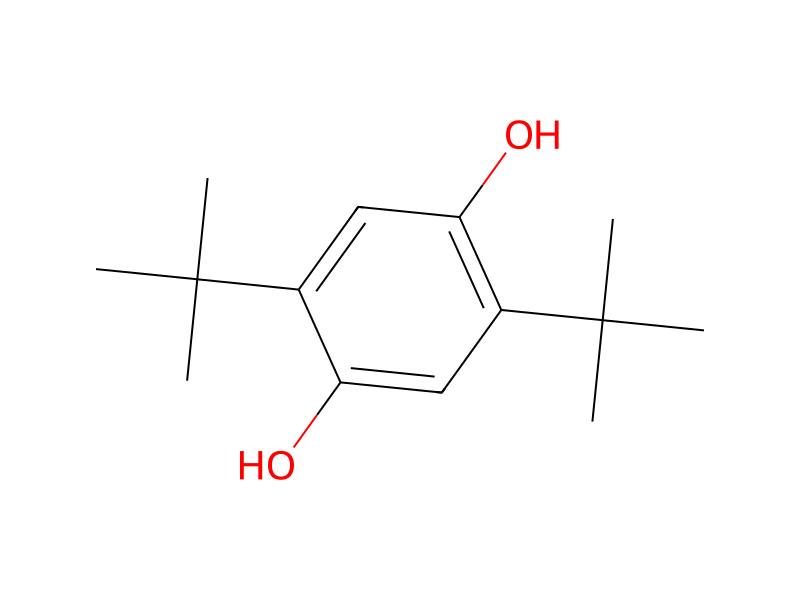
기본 정보
- CAS
1322-72-1- 표준 SMILES
CC(C)(C)c1cc(O)c(C(C)(C)C)cc1O- InChIKey
JZODKRWQWUWGCD-UHFFFAOYSA-N- 분자식
- C14H22O2
- 평균 분자량
- 222.32 g/mol
- 단동위원소 질량
- 222.16197994
개요
2,5-di-tert-butylbenzene-1,4-diol is a member of the class of hydroquinones that is benzene-1,4-diol substituted by tert-butyl groups at position 2 and 5.
이름 및 식별자
- 우선 이름
- 2,5-Di-tert-butylhydroquinone
- IUPAC
- 2,5-ditert-butylbenzene-1,4-diol
- 현지명
- 2,5-디-t-부틸하이드로퀴논
- 영어명
- 2,5-Di-tert-butylhydroquinone
- 분자식
- C14H22O2
- 분자량
- 222.32
이름 및 동의어
2,5-Di-tert-butylhydroquinone88-58-42,5-Di-tert-butylbenzene-1,4-diolDTBHQDibugDybugDi-t-butylhydroquinoneSantovar O2,5-Di-tert-butylquinolNonflex AlbaNaugard 451Antage DBH
이름 더 보기
2,5-디-t-부틸하이드로퀴논다이-t-부틸하이드로퀴논2,5-디-tert-부틸히드로퀴논BHQDBHQBlack Hole QuencherProbesANTIOXIDANT DTBHQDibutylhydroquinone2,5-ditertiary butyl hydroquinone2-carbamoyl-2-propylpentanoic acid
Nocrac NS 71,4-Benzenediol, 2,5-bis(1,1-dimethylethyl)-2,5-Di-tert-butyl-1,4-benzenediol2,5-Di-tert-butyl-1,4-hydroquinonedi-tert-butylhydroquinone1,4-Dihydroxy-2,5-di-tert-butylbenzene2,5-Di-tert-butyl-1,4-benzohydroquinoneDTXSID8041248
데이터베이스 식별자
- CAS
1322-72-1、88-58-4- PubChem CID
- 2374
- DTXSID
DTXSID8041248- ChEMBL
CHEMBL480626- ChEBI
CHEBI:41094- UNII
- 26XK13B61B
- EC Number
- 201-841-8
- Nikkaji
- J3.545I
물성
구조 계산 물성
- XLogP
- 4.6
- 극성 표면적
- 40.5 Ų
- 수소 결합 공여자 수
- 2
- 수소 결합 수용자 수
- 2
- 회전 가능 결합 수
- 2
- 무거운 원자 수
- 16
- 형식 전하
- 0
- 복잡도
- 208
실험 및 물리화학적 성질
Chemical ClassesOther Classes -> Phenols
DrugsPharmaceuticals -> Listed in ZINC15
Cosmetics
Cosmetic ingredients (Di-t-Butylhydroquinone) -> CIR (Cosmetic Ingredient Review)
Antioxidant
Food Contact SubstancesFCS -> FDA Inventory of Food Contact Substances Listed in 21 CFR
Physical Description
CBI
Off-white crystalline powder; [Alfa Aesar MSDS]
Collision Cross Section155.1 Ų [M]+ [CCS Type: DT; Buffer gas: N2; Ionization: APCI+; Dataset: TOXCAST; Source Identifier: DTXSID8041248]
물리화학적 성질
- 녹는점
- 216 · 216-218 °C(lit.)
- 끓는 점
- 321 °C · 321°C
- 밀도
- 1 · 1,07 g/cm3
- 굴절률
- 1.4576 · 1.4576 (estimate)
- 인화점
- 216 °C · 216 °C
- 저장 조건
- 30 °C · Store below +30°C.
- 용해도
안전 및 규제
안전 정보는 참고용이며, 공급업체의 물질안전보건자료(SDS), 관련 법규 및 전문가 평가를 대체하지 않습니다.
GHS 분류
GHS Classification
This chemical does not meet GHS hazard criteria for 0.7% (2 of 279) of reports.
Danger
H301 (46.6%): Toxic if swallowed [Danger Acute toxicity, oral]
P260, P261, P264, P264+P265, P270, P271, P272, P273, P280, P301+P316, P301+P317, P302+P352, P304+P340, P305+P351+P338, P319, P321, P330, P332+P317, P333+P317, P337+P317, P362+P364, P391, P403+P233, P405, and P501 (click each P-code to see the statement)
Aggregated GHS information provided per 279 reports by companies from 19 notifications to the ECHA C&L Inventory. Each notification may be associated with multiple companies.
유해성 정보
Regulatory Information
Chemical: 1,4-Benzenediol, 2,5-bis(1,1-dimethylethyl)-
1,4-Benzenediol, 2,5-bis(1,1-dimethylethyl)- is listed on the EPA's Chemical Data Reporting (CDR) system. Manufacturers and importers of 1,4-Benzenediol, 2,5-bis(1,1-dimethylethyl)- are required to report information about their production and use of this chemical to the EPA under the Toxic Substances Control Act (TSCA). (40 eCFR Part 711)
REACH registered substance: 2,5-di-tert-butylhydroquinone (EC: 201-841-8)
2,5-Di-tert-butylhydroquinone: Does not have an individual approval but may be used under an appropriate group standard
Hazards Summary
Causes lung and liver changes in 2-day intermittent oral studies of mice; Causes changes in clotting factors in 3-week constant oral studies rats; [RTECS] A skin and strong eye irritant; Harmful by ingestion; [Alfa Aesar MSDS] See t-Butylhydroquinone. See 2,5-Di-t-pentylhydroquinone.
Hazard Classes and CategoriesAcute Tox. 3 (46.6%)
안전 및 보호
Protective Action Criteria (PAC)
화학 및 산업
약리 정보
MeSH Pharmacological Classification
Naturally occurring or synthetic substances that inhibit or retard oxidation reactions. They counteract the damaging effects of oxidation in animal tissues.
Compounds or agents that combine with an enzyme in such a manner as to prevent the normal substrate-enzyme combination and the catalytic reaction.
용도 및 제조
Uses
CIR ingredient: Di-t-Butylhydroquinone
Ca2+-ATPase antagonist. [ChemIDplus]
U.S. Production2023: 75,000 - <500,000 lb
Consumer UsesNot Known or Reasonably Ascertainable
Industry UsesNot Known or Reasonably Ascertainable
Use ClassificationCosmetics -> Antioxidant
General Manufacturing Information
All Other Basic Organic Chemical Manufacturing
1,4-Benzenediol, 2,5-bis(1,1-dimethylethyl)-: ACTIVE
응용 분야
개요2,5-Di-tert-butylhydroquinone, also known as 2,5-TBHQ or DTBHQ, belongs to the class of organic compounds known as phenylpropanes. These are organic compounds containing a phenylpropane moiety. It is a phenol derivative containing 2 phenol groups and 2 alkyl groups, each consisting of three methyl groups.
용도2,5-Di-tert-butylhydroquinone is the oxidation substrate used to measure the catalytic activity of the copper(II) enzyme-like catalysts.
일반 설명Mobilizes Ca2+ specifically from the Ins(1,4,5)P3-sensitive Ca2+ stores by inhibiting microsomal and sarcoplasmic reticulum Ca2+-ATPase activity. Does not affect mitochondrial Ca2+ fluxes or plasma membrane Ca2+/Mg2+ ATPase activity. Useful for the study of endomembrane Ca2+ stores and plasma membrane Ca2+ permeability pathways.
관련 반응
22건





화합물 노트
불러오는 중…