Sodium Dithionite
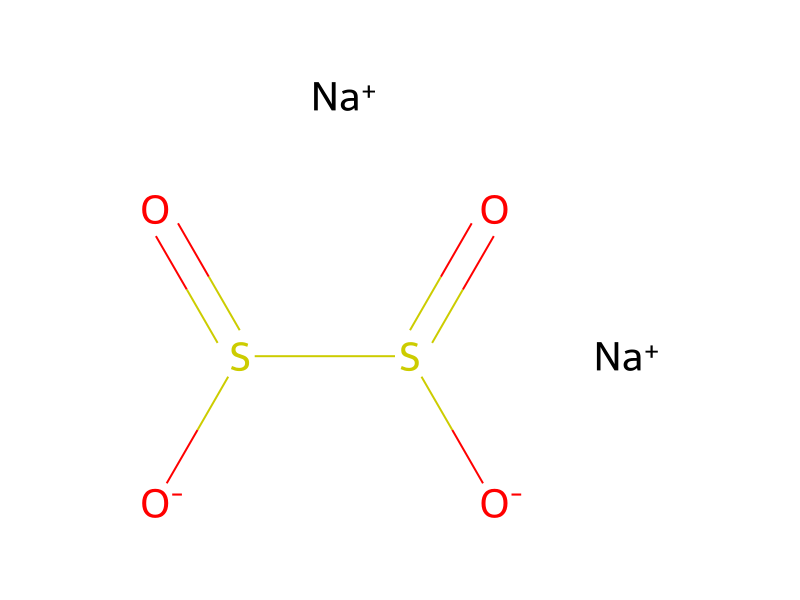
7775-14-6O=S([O-])S(=O)[O-].[Na+].[Na+]JVBXVOWTABLYPX-UHFFFAOYSA-LSodium dithionite is a whitish to light yellow crystalline solid having a sulfur dioxide-like odor. It spontaneously heats on contact with air and moisture. This heat may be sufficient to ignite surrounding combustible materials. Under prolonged exposure to fire or intense heat containers of this material may violently rupture. It is used in dyeing and to bleach paper pulp.
Metals -> Hydrosulfites
Reactive agents - 2nd degree
Cosmetic ingredients (Sodium Hydrosulfite) -> CIR (Cosmetic Ingredient Review)
Viscosity controlling; Reducing
Faint sulfurous
Slight characteristic odor
2.38 g/cu cm
Na2S2O4.2H2O, mol wt 210.146 ... crystallizes in thin, yellowish shiny, soft prisms of density 1.58 g/cu cm /Dihydrate/
2.4 g/m³
White or grayish-white crystalline powder
Light-lemon-colored solid in powder or flake form
White, colorless or yellow-white crystals
Slightly sol in alcohol; very soluble in water
Slightly sol in cold water; insoluble in acids
At 20 °C, 24.1 g/100 g water
Solubility in water, g/100ml at 20 °C: 25 (moderate)
안전 정보는 참고용이며, 공급업체의 물질안전보건자료(SDS), 관련 법규 및 전문가 평가를 대체하지 않습니다.
Danger
H251: Self-heating; may catch fire [Danger Self-heating substances and mixtures]
P235, P264, P270, P280, P301+P317, P330, P407, P410, P413, P420, and P501 (click each P-code to see the statement)
Danger
H251 (100%): Self-heating; may catch fire [Danger Self-heating substances and mixtures]
P235, P264, P264+P265, P270, P280, P301+P317, P302+P352, P305+P351+P338, P321, P330, P332+P317, P337+P317, P362+P364, P407, P410, P413, P420, and P501 (click each P-code to see the statement)
Water-reactive material (WR)
Chemical: Dithionous acid, disodium salt
Dithionous acid, sodium salt (1:2) is listed on the EPA's Chemical Data Reporting (CDR) system. Manufacturers and importers of Dithionous acid, sodium salt (1:2) are required to report information about their production and use of this chemical to the EPA under the Toxic Substances Control Act (TSCA). (40 eCFR Part 711)
REACH registered substance: Sodium dithionite (EC: 231-890-0)
Dithionous acid, disodium salt: Does not have an individual approval but may be used under an appropriate group standard
The New Jersey Worker and Community Right to Know Act requires public and private employers to provide information about hazardous substances at their workplaces. (N.J.S.A. 34:5A-1 et. seq.)
Excerpt from ERG Guide 135 [Substances - Spontaneously Combustible]:
· Flammable/combustible material.
Sodium dithionite is not stable under physiological conditions, with the rate of decomposition increasing with increasing acidity. Upon contact with moisture, it is oxidized to hydrogen sulfite, sulfite and hydrogen sulfate, and under strongly acidic conditions it may liberate sulfur dioxide. Under anaerobic conditions (such as in the lower gastrointestinal tract), hydrogen sulfite and thiosulfate may be formed. Hydrogen sulfite can be absorbed after ingestion. It is efficiently metabolized, and the major part rapidly excreted as sulfate into the urine.
As sodium dithionite is chemically unstable in the presence of water and oxygen, in particular under acidic conditions, rapid conversion of sodium dithionite into various related sulfite species is expected to occur under physiological conditions. Therefore, it is justified to take account of toxicological data of sodium sulfite, sodium hydrogen sulfite, and disodium disulfite (= sodium metabisulfite) in the human health assessment of dithionite ... In this context, sodium sulfite and sodium hydrogen sulfite are considered to be the predominant chemicals that are systemically available to the body.
CIR ingredient: Sodium Hydrosulfite
Used to dye fibers and textiles, to strip dyes from fabrics, and to bleach sugar, soap, oils and wood pulp; Used as a chemical reagent and an oxygen scavenger in the production of synthetic rubber; [Hawley]
Pulp and Paper Processing [Category: Industry]
Reducing agent to strip certain dyes from fabrics and in vat dyeing; bleaching agent for ground wood pulp, soap, straws, sugar reducing agent to strip certain dyes from fabrics and in vat dyeing; bleaching agent for ground wood pulp, soap, straws, sugar
Oxygen scavenger for synthetic rubbers; vat dyeing of fibers and textiles; stripping agent for dyes; reagent; bleaching of sugar, soap, oils, and groundwood.
As reducing agent, particularly in dyeing with indigo and vat dyes; bleaching soaps, straw; removing dyes from dyed fabrics.
불러오는 중…
7775-14-6DTXSID9029697CHEMBL3410462CHEBI:66870about 100 °C (open cup)
>100 °C o.c.
A batch decomposed violently during drying in graining bowl. No explanation was offered but contamination with water and/or oxidant seems likely. Thermal decomposition occurs violently at 190 °C.
>100 °C
White solid
· Flammable/combustible material.
Combustible. Gives off irritating or toxic fumes (or gases) in a fire.
Combustible solid. Easily oxidized. Heats spontaneously in contact with moisture and air, and may ignite surrounding combustible materials. Closed containers may rupture violently when heated.
Flammable when exposed to heat or flame. Ignites on contact with water or sodium chorite.
Excerpt from ERG Guide 135 [Substances - Spontaneously Combustible]:
· Fire will produce irritating, corrosive and/or toxic gases.
1384 135
1384 135
Excerpt from ERG Guide 135 [Substances - Spontaneously Combustible]:
Use carbon dioxide, dry sand, special powder, water in large amounts.
Fresh air, rest. Seek medical attention if you feel unwell.
Remove contaminated clothes. Rinse and then wash skin with water and soap.
Rinse with plenty of water (remove contact lenses if easily possible). Refer for medical attention.
Rinse mouth. Do NOT induce vomiting. Give one or two glasses of water to drink.
· CALL 911. Then call emergency response telephone number on shipping paper. If shipping paper not available or no answer, refer to appropriate telephone number listed on the inside back cover.
· ELIMINATE all ignition sources (no smoking, flares, sparks or flames) from immediate area.
· CALL 911. Then call emergency response telephone number on shipping paper. If shipping paper not available or no answer, refer to appropriate telephone number listed on the inside back cover.
· ELIMINATE all ignition sources (no smoking, flares, sparks or flames) from immediate area.
Excerpt from ERG Guide 135 [Substances - Spontaneously Combustible]:
General First Aid:
General First Aid:
· Wear positive pressure self-contained breathing apparatus (SCBA).
TIH (Toxic Inhalation Hazard) - Term used to describe gases and volatile liquids that are toxic when inhaled. Some are TIH materials themselves, e.g., chlorine, and some release TIH gases when spilled in water, e.g., chlorosilanes. [ERG 2016].
Special protective equipment for fire-fighters: Wear self contained breathing apparatus for fire fighting if necessary.
Use only flooding quantities of water. Monitor temperature of containers exposed to fire for at least 48 hours to verify decomposition has not begun in the sealed container.
Store in cool place. Keep container tightly closed in a dry and well-ventilated place. Do not store near acids. Air sensitive. Heat sensitive. Moisture sensitive. Handle under inert gas. Protect from moisture.
Store in a cool, dry, well-ventilated location. Outside or detached storage is preferred. Separate from combustibles and oxiding materials. Immediately remove and properly dispose of any spilled material.
Materials to avoid: strong oxidizing agents, acids.
Keep water away from release. Prompt cleanup and removal are necessary. Control runoff and isolate discharged material for proper disposal.
Personal precautions: Wear respiratory protection. Avoid dust formation. Avoid breathing dust. Ensure adequate ventilation.
Methods for cleaning up: Pick up and arrange disposal without creating dust. Keep in suitable, closed containers for disposal.
SRP: Wastewater from contaminant suppression, cleaning of protective clothing/equipment, or contaminated sites should be contained and evaluated for subject chemical or decomposition product concentrations. Concentrations shall be lower than applicable environmental discharge or disposal criteria. Alternatively, pretreatment and/or discharge to a permitted wastewater treatment facility is acceptable only after review by the governing authority and assurance that "pass through" violations will not occur. Due consideration shall be given to remediation worker exposure (inhalation, dermal and ingestion) as well as fate during treatment, transfer and disposal. If it is not practicable to manage the chemical in this fashion, it must be evaluated in accordance with EPA 40 CFR Part 261, specifically Subpart B, in order to determine the appropriate local, state and federal requirements for disposal.
Dissolve or mix the material with a combustible solvent and burn in a chemical incinerator equipped with an afterburner and scrubber. Observe all federal, state, and local environmental regulations. Contact a licensed professional waste disposal service to dispose of this material.
SRP: The most favorable course of action is to use an alternative chemical product with less inherent propensity for occupational harm/injury/toxicity or environmental contamination. Recycle any unused portion of the material for its approved use or return it to the manufacturer or supplier. Ultimate disposal of the chemical must consider: the material's impact on air quality; potential migration in soil or water; effects on animal and plant life; and conformance with environmental and public health regulations.
Personal protection: particulate filter respirator adapted to the airborne concentration of the substance. Do NOT let this chemical enter the environment. Sweep spilled substance into covered containers. Carefully collect remainder. Then store and dispose of according to local regulations. Do NOT absorb in saw-dust or other combustible absorbents.
Sodium hyposulfite at a concentration of 1 x 10⁻⁵ M decreased the number of chromosome fragments produced by cobalt 60 gamma rays in Tradescantia paludosa (clone B2-2) root tip by 46%. Concentrations of 1 x 10⁻⁴ or 1 x 10⁻³ M were no more effective, and the 1 x 10⁻³ M concentration was toxic to the root tips.
LC50 Species; Leuciscus idus (ide, freshwater fish); Conditions: German Industrial Standard DIN 38 412, Part 15; Concentration: 63.2 mg/L (nominal) for 96 hr
EC50; Species: Daphnia magna (water flea); Conditions: Directive 79.831 EEC, C2; Concentration: 98.3 mg/L for 48 hr, endpoint: immobilization /Effect not given in source/
Human Health: Sodium dithionite is not stable under physiological conditions, with the rate of decomposition increasing with increasing acidity. Upon contact with moisture, it is oxidized to hydrogen sulfite, sulfite and hydrogen sulfate, and under strongly acidic conditions it may liberate sulfur dioxide. Under anaerobic conditions (such as in the lower gastrointestinal tract), hydrogen sulfite and thiosulfate may be formed. Hydrogen sulfite can be absorbed after ingestion. It is efficiently metabolized, and the major part rapidly excreted as sulfate into the urine. The acute oral LD50 of sodium dithionite in rats was about 2500 mg/kg bw, with atony, gastro-intestinal irritation, diarrhea and dyspnea as the main clinical and pathological signs at doses near to or exceeding the LD50. There were no acute dermal and no valid acute inhalation studies available. Sodium dithionite was slightly irritating to the skin, and strongly irritating to the eyes of rabbits. Under acidic conditions, sodium dithionite may liberate sulfur dioxide, which is known to induce respiratory irritation in humans. There was no animal data available regarding sensitization. In humans, allergic dermatitis from exposure to sulfites is rare and, consequently, sodium dithionite is not considered to possess a significant skin sensitization potential. Although there were no specific reports with regard to sodium dithionite available, the potential for allergoid reactions ("sulfite-asthma") should be assumed in sensitive individuals following oral or inhalation exposure. Sodium dithionite was not tested for its toxicity after repeated dosing. Due to its rapid degradation under in vivo conditions, the toxicity data on its decomposition products were used for the evaluation of this endpoint. The conversion products, including sulfite, hydrogen sulfite, sulfate and thiosulfate, are considered as substances of very low order systemic toxicity. It should be noted that sulfites, in general, reduce the thiamine content in food. For disodium disulfite, oral NOAELs (30 and 104 weeks) of 942 mg/kg bw/day and 217 mg/kg bw/day were obtained for systemic toxicity and local gastrointestinal toxicity in rats, respectively. These results appear to be sufficiently representative also for the assessment of sodium dithionite. Repeated dose studies in animals using the dermal or respiratory routes were not available. Sodium dithionite was not mutagenic in standard bacterial tests with and without metabolic activation (OECD TG 471, 472). No experimental data was available on the potential of sodium dithionite to induce chromosomal aberrations in vitro. An increase in the frequency of micronuclei in bone marrow cells of mice was found after intraperitoneal injection of high doses (2 x 500 or 2 x 750 mg/kg bw) of a mixture of sodium hydrogen sulfite and sodium sulfite, the degradation products of sodium dithionite under physiological conditions. No experimental data were available on the carcinogenic potential of sodium dithionite. In 1992, IARC concluded that degradation products of dithionite, i.e. sulfur dioxide, sulfites, hydrogen sulfites and metabisulfites "are not classifiable as to their carcinogenicity to humans (Group 3)". Sodium dithionite has not been tested for its effects on reproduction and development. Based on its physicochemical behavior and its rapid conversion in the body, it is not expected that the intact molecule reaches the reproductive organs, or has any direct effect on reproduction and development. Data relating to the degradation products of sodium dithionite do also not indicate any adverse effects. At high dietary doses, which can cause maternal malnutrition and destruction of thiamine, fetal growth retardation was however observed. In a rat dietary study with sodium sulfite (similar to OECD TG 414), the NOAEL for developmental toxicity was at 5 % (about 1450 mg/kg bw/day; highest tested dose). At this dose clear signs of maternal toxicity were observed (LOAEL, maternal toxicity: 5 % in diet = about 1450 mg/kg bw/day). The NOAEL for maternal toxicity was at 2.5 % in feed (about 850 mg/kg bw/day). Environment: From acute toxicity test to fish (Leuciscus idus), 96-hr LC50 was 62.3 mg/L. For algae (Scenedesmus subspicatus), 72-hr ErC50 was 206 mg/L and 72-hr NOErC was 62.5 mg/L (corresponding values for biomass are 135 and 62.5 mg/L respectively; nominal concentration). For Daphnia magna, the acute toxicity value of 48-hr EC50 was 98.3 mg/L, and the chronic value of 21-day NOEC was > 10 mg/L. Due to oxygen concentrations < 1 mg/L at test start in high test concentrations in the fish and acute daphnia test, it cannot be excluded that the effect values found in these studies are at least partly caused by oxygen deficiency. A PNEC of 0.1 mg/L for the aquatic organisms was calculated from the chronic value (NOEC for daphnia > 10 mg/L) using an assessment factor of 100.
/AQUATIC SPECIES/ A test following Directive 79/831/EEC, C2, with Daphnia magna with 10 nominal concentrations, plus a control ranging from 0.976 - 500 mg/L, resulted in an EC50 (48 hr, immobilization) of 98.3 mg/L. As oxygen values in the 250 mg/L and 500 mg/L test solutions were below 1 mg/L at the beginning of the test, it cannot be excluded that the toxicity was in part due to oxygen deficiency effects.
/AQUATIC SPECIES/ In a study with Leuciscus idus, following the German Industrial Standard DIN 38 412, Part 15, six concentrations from 21.5 - 147 mg/L (nominal), plus a control and pH adjusted 147 mg/L and 500 mg/L group, were tested. An LC50 (96 hr) of 63.2 mg/L (nominal) was calculated. All fish in the pH adjusted 147 mg/L and 500 mg/L concentration groups died within one hour. Less than 1 mg/L oxygen was measured in those test solutions at test start. In a pre-test in which the fish were placed into the aquaria 1 hr after preparation of the test solution the initial oxygen consumption was compensated by the continuous aeration and the concentration of 100 mg/L did not cause any mortality or symptoms. Therefore, the toxic effect may be, in part, due to oxygen deficiency.
/AQUATIC SPECIES/ Acute toxicity to Scenedesmus subspicatus was determined in a study, following the German Industrial Standard DIN 38 412 Part 9, with 7 nominal concentrations ranging from 7.81 -500 mg/L, plus a control. The ErC50 (72 hr) for growth rate was 206 mg/L (nominal concentration) and the NOEC 62.5 mg/L (nominal concentration); corresponding values for the endpoint biomass were 135 mg/L and 62.5 mg/L respectively.
/AQUATIC SPECIES/ The following chronic toxicity test with aquatic organisms is available: Water flea (Daphnia magna): NOEC (21 d) > 10 mg/L. Three concentrations (1, 5, and 10 mg/L) were tested.
Cough. Sore throat.
Redness. Pain.
Nausea. Abdominal pain. Vomiting. Diarrhoea.
/SIGNS AND SYMPTOMS/ Probable oral lethal dose (human) 0.5-5 g/kg bw. Because of rapid oxidation to sulfates, sulfites are well tolerated until large dises are reached; then violent colic and diarrhea, circulatory disturbances, central nervous depression, and death are described.
/SIGNS AND SYMPTOMS/ May cause respiratory tract irritation ... May cause skin irritation. May cause eye irritation.
/CASE REPORTS/ ... A female dry cleaner is reported to have developed hand dermatitis presumably due to regular preparation of sodium sulfite solutions. Patch testing gave a positive response on application of a 0.5% and 1% solution of sodium dithionite.
/ALTERNATIVE and IN VITRO TESTS/ Incubation of normal human erythrocytes with sodium dithionite resulted in the formation of Heinz bodies. Addition of superoxide dismutase to the incubation medium incr the formation of Heinz bodies by sodium dithionite.
/OTHER TOXICITY INFORMATION/ Under acidic conditions, sodium dithionite may liberate sulfur dioxide (SO2). Sulfur dioxide is known to induce respiratory irritation and in disposed humans also bronchospasms. The hypersensitivity reaction is also known as "sulfite-asthma" and linked to SO2 exposure or the use of SO2 or bisulfite as antioxidants in foodstuffs. About 10 % of asthmatic humans are reportedly sulfite- or SO2-sensitive.
/LABORATORY ANIMALS: Acute Exposure/ 2% aq soln of sodium hydrosulfite adjusted to pH 7 with sodium bicarbonate tested on rabbit eyes by irrigation of surface of eye for 10 min after removal of corneal epithelium caused slight corneal edema ...
/LABORATORY ANIMALS: Acute Exposure/ For sodium dithionite (tested as suspension in aqueous carboxymethylcellulose), an oral LD50 of about 2500 mg/kg bw was determined for rats. No clinical signs were noted at doses up to and including 1600 mg/kg bw. At higher doses (>= 2000 mg/kg bw), clinical signs included atony, dyspnea and diarrhea. Gross pathology revealed acute hyperemic congestion, cardiac dilatation, gastrointestinal irritation and dilatation, associated with bloody ulceration in animals administered doses of 2500 mg/kg bw or higher.
/LABORATORY ANIMALS: Acute Exposure/ An 80% aqueous suspension of sodium dithionite tested in two rabbits under occlusive conditions for 20 hours produced mild skin erythema. The mild erythema seen at 24 hours post-treatment did not persist to 8 days. With an exposure time of 20 hours (instead of 4 hours), and occlusive conditions (instead of semi-occlusive), the test conditions were more stringent than those required in the current OECD TG 404.
/LABORATORY ANIMALS: Acute Exposure/ Sodium dithionite was tested for its effects on the eye of rabbits in a study performed in accordance with OECD TG 405. 97 mg of the finely powdered test substance (purity 88%) were instilled in the conjunctival sac of three rabbits, and washed out with physiological saline after one hour of exposure. In all animals, moderate to severe erythema and slight edema were found after 1 hour and persisted until 72 and 48 hours, respectively. Mean scores for erythema were 3.0 (24 hr), 3.0 (48 hr), and 2.3 (72 hr), and for edema 1.3 (24 hr), 0.67 (48 hr), and 0.33 (72 hr). No changes were noted in the cornea and iris. All effects were completely reversible by day 7 after exposure except for 1 animal which still showed slight conjunctival redness.
For more Non-Human Toxicity Excerpts (Complete) data for Sodium hydrosulfite (9 total), please visit the HSDB record page.
Sodium hydrosulfite
A Commercial Grade
A Placarded Amount
Chemical or material that can be mixed with readily available materials.
(1972) 1.63X10+9 grams
(1975) 3.9X10+9 grams
CHEMICAL PROFILE: Sodium Hydrosulfite. US Exports: 2001: 8,000 short tons; 2002: 9,000 short tons.
CHEMICAL PROFILE: Sodium Hydrosulfite. US Exports: 2004: 8,300 short tons; 2005: 7,900 short tons.
(1972) 6.35X10+8 grams
(1975) 9.08X10+7 grams
CHEMICAL PROFILE: Sodium Hydrosulfite. US Imports: 2001: 18,000 short tons; 2002: 17,000 short tons.
CHEMICAL PROFILE: Sodium Hydrosulfite. US Imports: 2004: 35,300 short tons; 2005: 33,500 short tons.
2023: 100,000,000 - <500,000,000 lb
(1972) 4.26X10+10 grams
(1975) 4.54X10+10 grams
Production volumes for non-confidential chemicals reported under the Inventory Update Rule. [Table#2081]
Production volume for non-confidential chemicals reported under the 2006 Inventory Update Rule. Chemical: Dithionous acid, sodium salt (1:2). Aggreated National Production Volume: 100 to <500 million lbs.
For more U.S. Production (Complete) data for Sodium hydrosulfite (13 total), please visit the HSDB record page.
70% as a reducing agent in vat dyeing; 15% as a bleaching agent for pulp; 15% in misc bleaching, reducing, and dyestripping applications (1972)
CHEMICAL PROFILE: Sodium Hydrosulfite. End-use pattern for sodium hydrosulfite in 1985.
CHEMICAL PROFILE: Sodium Hydrosulfite. End-use pattern for sodium hydrosulfite in 1988.
CHEMICAL PROFILE: Sodium Hydrosulfite. End-use pattern for sodium hydrosulfite in 1991.
For more Consumption Patterns (Complete) data for Sodium hydrosulfite (17 total), please visit the HSDB record page.
Zinc dust process: ... An aqueous slurry of zinc dust is treated in a stirred reactor with cooling at ca. 40 °C with liquid or gaseous sulfur dioxide to give zinc dithionite. After completion of the reaction the solution is passed through a filter press to remove unreacted zinc dust and impurities from the zinc. The zinc is then precipitated from the zinc dithionite by adding sodium carbonate or sodium hydroxide in stirred vessels. The zinc carbonate or hydroxide is removed in filter presses. Anhydrous sodium dithionite is precipitated from the clarified sodium dithionite solution by concentration under vacuum and addition of sodium chloride at > 60 °C. It is filtered, washed with methanol, and dried at 90 - 100 °C. Besides the evaporation process the salting out process, which was more widely used previously, is still known. In this process the dithionite is obtained from the solution by the addition of sodium chloride and methanol.
Amalgam Process. In the amalgam process, sodium hydrogensulfite is reduced to sodium dithionite in aqueous solution in a cooled, stirred vessel using the sodium amalgam of a chloralkali electrolysis cell. The sodium-free mercury is returned to the electrolysis cell where it is recharged with sodium. During reaction of the amalgam with the hydrogensulfite solution a pH of 5 - 6 must be maintained. The product is obtained by precipitation with salts or methanol or both.
Formate Process: Sodium formate, dissolved in 80% aqueous methanol, is charged to a stirred vessel. At a pressure of 2 - 3 bar sulfur dioxide and sodium hydroxide are introduced into this solution such that a pH of 4 - 5 is maintained.
Sodium Borohydride Process Sodium borohydride is stable in strong aqueous alkali and can be used in this form for the production of sodium dithionite by adding SO2 and sodium hydroxide.
For more Methods of Manufacturing (Complete) data for Sodium hydrosulfite (8 total), please visit the HSDB record page.
Commercial sodium dithionite generally has a purity of about 88%. It contains about 3% of each of the following: sodium disulfite, sodium sulfite, sodium sulfate, and sodium carbonate. The latter stabilizes the Na2S2O4. The total heavy metal content is generally < 20 ppm. The product from the zinc-dust process has a zinc content of up to 300 ppm.
Grades: technical; reagent. /Dihydrate/
Blankit
Burmol
For more Formulations/Preparations (Complete) data for Sodium hydrosulfite (17 total), please visit the HSDB record page.
용도Sodium dithionite is a reducing agent for vat dyes,reducing hair bleaching agents,vat dyes printing auxiliaries, silk scouring and bleaching agents, coloring agents and objects stripping vat cleaning agent, particularly in dyeing with indigo and vat dyes; bleaching soaps, straw; removing dyes from dyed fabrics.
일반 설명Sodium dithionite is a whitish to light yellow crystalline solid having a sulfur dioxide-like odor. Sodium dithionite spontaneously heats on contact with air and moisture. This heat may be sufficient to ignite surrounding combustible materials. Sodium dithionite is soluble in water. Under prolonged exposure to fire or intense heat containers of Sodium dithionite may violently rupture. Sodium dithionite is used in dyeing and to bleach paper pulp.
생산 방법An alternative route for dithionite production is the reduction of sodium bisulfite with sodium borohydride. Sodium borohydride is obtained by reacting boron trimethyl ester, B(OCH3)3, with sodium hydride, NaH. The resulting product is hydrolyzed with water, and methanol is evaporated. An alkaline, aqueous solution is obtained, containing about 12% NaBH4 and 40% NaOH. This solution is commercially available. Reaction to dithionite is made on-site by adding sulfur dioxide and some additional caustic soda. Storages, handling and mixing of sulfur dioxide and of the Borol® liquid are not everywhere cost competitive. NaBH4+8NaOH+8SO2 → 4Na2S2O4+NaBO2+6H2O.
Sodium dithionite is today produced mainly from sodium formate and sulfur dioxide. Zinc dithionite, prepared on-site from sulfur dioxide and zinc dust, was formerly more important than the sodium salt. The heavy metal zinc ended up in the effluent, which caused environmental problems. Today in pulp mills on-site production of zinc dithionite is no longer practiced. The number of plants using sodium amalgam and sulfur dioxide for dithionite production is decreasing with the number of amalgam cells in electrolysis. On-site generation of dithionite from alkaline sodium borohydride solution, sodium bisulfite, and sulfur dioxide is used by some mills. Sodium dithionite is available as crystalline powder (&90% Na2S2O4) or as a refrigerated 150 g/L solution stabilized with alkali. The white crystals can decompose on heating. Low alkalinity, pH8 to 13, stabilizes dithionite solution at low temperature. These solutions should be kept well below 10 °C with the exclusion of air. In presence of air, oxidation rapidly yields sulfate and sulfite. The powder product prepared via the amalgam route dissolves into an alkaline solution as it contains sodium carbonate and sulfite. This can trigger the precipitation of calcium carbonate (water hardness) in the solution tank. Therefore, it is recommended to add small amounts of chelants during the dissolution step. (Chelants are not required to stabilize the bleaching reaction.) Sodium dithionite prepared by the formate route dissolves into a slightly acidic solution. Dithionite powder can ignite if exposed to high humidity or elevated temperature.
순도시험(1) 용상 : 포르말린 10mL에 물 10mL를 가하여 수산화나트륨시액으로 중화하고 그 액 10mL에 이 품목 0.5g을 가하여 녹이고 5분간 방치할 때, 그 탁도는 미탁 이하이어야 한다. (2) 비소 : 이 품목을 비소시험법에 따라 시험할 때, 그 양은 4.0ppm 이하이어야 한다. (3) 납 : 「메타인산나트륨」의 순도시험 (2)에 따라 시험한다(2.0ppm 이하). (4) 아연 : 위 (3)의 A액 5mL에 암모니아시액 0.1mL를 가하여 여과하고 여액에 물을 가하여 20mL로 하고 묽은염산 5mL 및 페로시안화칼륨용액 0.1mL를 가하여 15분간 방치할 때, 그 탁도는 아연표준용액 8mL에 물을 가하여 20mL로 하고 묽은염산 5mL 및 페로시안화칼륨시액 0.1mL를 가하여 15분간 방치한 액의 탁도 이하이어야 한다. (5) 에틸렌디아민사초산이나트륨 : 이 품목 0.5g을 물 5mL에 녹이고 0.5% 크롬산칼륨용액 2mL 및 아비산시액 2mL를 가하여 수욕중에서 2분간 가열할 때, 자색을 나타내어서는 아니 된다. (6) 개미산 : 이 품목의 수용액(1→1,000) 10mL에 염산(1→2) 5mL를 가하고 다음에 마그네슘가루 0.3g을 소량씩 가하여 거품이 거의 발생하지 않으면 시계접시를 덮고 2시간 방치한다. 그 중 1mL를 취해 황산 2mL 및 크로모트로프산시액 0.5mL를 가하고 수욕중에서 10분간 가열할 때, 그 액의 색은 따로 검체대신 묽은포름알데히드표준용액 1mL를 취해 검체와 같이 조작하여 얻은 액의 색보다 진하여서는 아니 된다.
확인시험(1) 이 품목의 수용액(1→100) 10mL에 황산동시액 1mL를 가하면 시액의 색을 나타낸다. (2) 이 품목의 수용액(1→100) 10mL에 과망간산칼륨시액 1mL를 가하면 시액의 색은 곧 없어진다. (3) 이 품목은 확인시험법 중 나트륨염의 (가) 및 (나)의 반응을 나타낸다.
정량법포르말린 10mL에 물 10mL를 가하여 수산화나트륨시액으로 중화하고 이에 이 품목 약 2g을 정밀히 달아 가하고, 물을 가하여 녹여 500mL로 한다. 그 중 25mL에 염산(1→10)을 가하여 pH 1.1~1.5로 한 다음 0.1N 요오드용액으로 적정한다(지시약 : 전분시액).0.1N 요오드용액 1mL = 4.353mg Na2S2O4
정의ChEBI: An inorganic sodium salt that is the disodium salt of dithionous acid.