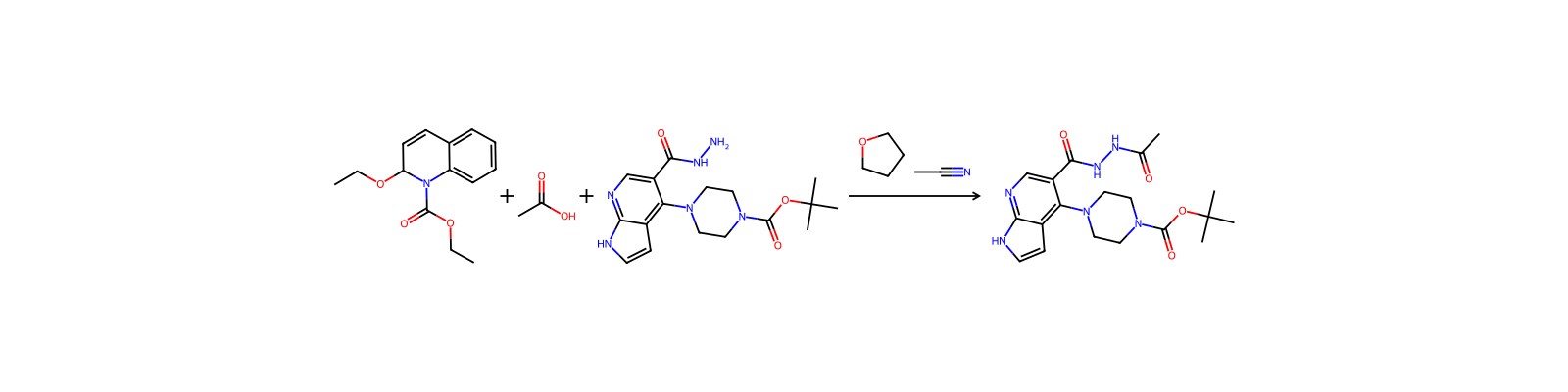

기본 정보
- 표준 SMILES
CCOC(=O)N1c2ccccc2C=CC1OCC- InChIKey
GKQLYSROISKDLL-UHFFFAOYSA-N- 분자식
- C14H17NO3
- 평균 분자량
- 247.29 g/mol
- 단동위원소 질량
- 247.1208434
개요
peptide coupling reagent
이름 및 식별자
- 우선 이름
- 2-Ethoxy-1-(ethoxycarbonyl)-1,2-dihydroquinoline
- IUPAC
- ethyl 2-ethoxy-2H-quinoline-1-carboxylate
- 영어명
- N-Ethoxycarbonyl-2-ethoxy-1,2-dihydroquinoline
- 분자식
- C14H17NO3
- 분자량
- 247.29
이름 및 동의어
16357-59-8EEDQ1(2H)-QUINOLINECARBOXYLIC ACID, 2-ETHOXY-, ETHYL ESTER2-Ethoxy-1(2H)-quinolinecarboxylic acid, ethyl esterN-carbethoxy-2-ethoxy-1,2-dihydroquinolineDTXSID5087196960O971AN192-ethoxy-1-(ethoxycarbonyl)-1,2-dihydroquinolineRefChem:471395DTXCID408195772-Ethoxy-1-ethoxycarbonyl-1,2-dihydroquinolineN-Ethoxycarbonyl-2-ethoxy-1,2-dihydroquinoline
이름 더 보기
ETHYL 1,2-DIHYDRO-2-ETHOXY-1-QUINOLINECARBOXYLATEETHYL 2-ETHOXY-1,2-DIHYDRO-1-QUINOLINECARBOXYLATE2-Ethoxy-2H-quinoline-1-carboxylic acid ethyl esterEEDQ extrapure
ethyl 2-ethoxyquinoline-1(2H)-carboxylateethyl 2-ethoxy-2H-quinoline-1-carboxylateethyl 2-ethoxy-1,2-dihydroquinoline-1-carboxylate1-Ethoxycarbonyl-2-ethoxy-1,2-dihydroquinolineMFCD00006703MLS000069601BC 681NSC 147831
데이터베이스 식별자
- CAS
16357-59-8- PubChem CID
- 27833
- DTXSID
DTXSID50871969- ChEMBL
CHEMBL1527785- UNII
- 60O971AN19
- EC Number
- 240-418-2
- Nikkaji
- J14.768K
물성
구조 계산 물성
- XLogP
- 2.8
- 극성 표면적
- 38.8 Ų
- 수소 결합 공여자 수
- 0
- 수소 결합 수용자 수
- 3
- 회전 가능 결합 수
- 4
- 무거운 원자 수
- 18
- 형식 전하
- 0
- 복잡도
- 316
실험 및 물리화학적 성질
Chemical ClassesOther Uses -> Biochemical Research
Solubility8 [ug/mL] (The mean of the results at pH 7.4)
Endocrine DisruptorsPotential endocrine disrupting compound
Physical DescriptionOff-white powder; [Alfa Aesar MSDS]
물리화학적 성질
- 녹는점
- 62 · 62-67 °C(lit.)
- 끓는 점
- 125 · 125-128 °C (0.1 mmHg)
- 밀도
- 1.1173 · 1.1173 (rough estimate)
- 굴절률
- 1.53 · 1.5300 (estimate)
- 인화점
- 125 · 125-128°C/0.1mm
- 저장 조건
- 2 · 2-8°C
- 용해도
- 클로로프롬 (약간 용해됨), 에틸아세테이트 (약간 용해됨), 메탄올 (약간 용해됨)
- 산도 계수 (pKa)
- -1.27 · -1.27±0.40(Predicted)
- 물리적 상태
- 결정성 분말
- 색상
- 흰색에서 베이지색
- 수용성
- 불용성
- Merck
- 14 · 14,3518
- BRN
- 533048 · 533048
- 주요 응용
- 펩타이드 합성
- InChI
- 1S/C14H17NO3/c1-3-17-13-10-9-11-7-5-6-8-12(11)15(13)14(16)18-4-2/h5-10,13H,3-4H2,1-2H3
- InChIKey
- GKQLYSROISKDLL-UHFFFAOYSA-N
- SMILES
- CCOC1C=Cc2ccccc2N1C(=O)OCC
- EPA
- 1 · 1(2H)-Quinolinecarboxylic acid, 2-ethoxy-, ethyl ester (16357-59-8)
화학적 성질
White to pale yellow solid
안전 및 규제
GHS 분류
GHS Classification
This chemical does not meet GHS hazard criteria for 1.1% (1 of 87) of reports.
Warning
H302 (90.8%): Harmful if swallowed [Warning Acute toxicity, oral]
P261, P264, P264+P265, P270, P271, P280, P301+P317, P302+P352, P304+P340, P305+P351+P338, P319, P321, P330, P332+P317, P337+P317, P362+P364, P403+P233, P405, and P501 (click each P-code to see the statement)
Aggregated GHS information provided per 87 reports by companies from 10 notifications to the ECHA C&L Inventory. Each notification may be associated with multiple companies.
유해성 정보
Regulatory Information1(2H)-Quinolinecarboxylic acid, 2-ethoxy-, ethyl ester: Does not have an individual approval but may be used under an appropriate group standard
Hazards SummaryCauses other degenerative changes to brain and effects on proteins in acute intraperitoneal studies of rats; Intraperitoneal LD50 (mouse) = 32 mg/kg; [RTECS] A skin and strong eye irritant; [Alfa Aesar MSDS]
Hazard Classes and CategoriesAcute Tox. 4 (90.8%)
안전 데이터
- wgk
- 3
- tsca
- TSCA listed
- rtecs
- VB2010000
- 독성
- mouse,LD50,intraperitoneal,32mg/kg (32mg/kg),Journal of Medicinal Chemistry. Vol. 14, Pg. 49, 1971.
- HS 번호
- 29334990
- risk_code
- 38-36/37/38-20/21/22
- hazard_code
- Xi,Xn
- safety_code
- 22-24/25-36/37/39-26-36
- F 고인화성물질
- 9-21
- 스토리지 클래스
- 11 - Combustible Solids
화학 및 산업
약리 정보
MeSH Pharmacological Classification
Drugs that bind to but do not activate alpha-adrenergic receptors thereby blocking the actions of endogenous or exogenous adrenergic agonists. Adrenergic alpha-antagonists are used in the treatment of hypertension, vasospasm, peripheral vascular disease, shock, and pheochromocytoma.
Highly reactive chemicals that introduce alkyl radicals into biologically active molecules and thereby prevent their proper functioning. Many are used as antineoplastic agents, but most are very toxic, with carcinogenic, mutagenic, teratogenic, and immunosuppressant actions. They have also been used as components in poison gases.
Drugs that bind to but do not activate serotonin receptors, thereby blocking the actions of serotonin or SEROTONIN RECEPTOR AGONISTS.
Drugs that bind to but do not activate DOPAMINE RECEPTORS, thereby blocking the actions of dopamine or exogenous agonists. Many drugs used in the treatment of psychotic disorders (ANTIPSYCHOTIC AGENTS) are dopamine antagonists, although their therapeutic effects may be due to long-term adjustments of the brain rather than to the acute effects of blocking dopamine receptors. Dopamine antagonists have been used for several other clinical purposes including as ANTIEMETICS, in the treatment of Tourette syndrome, and for hiccup. Dopamine receptor blockade is associated with NEUROLEPTIC MALIGNANT SYNDROME.
용도 및 제조
UsesUsed as a coupling agent in peptide synthesis; [Merck Index]
General Manufacturing Information1(2H)-Quinolinecarboxylic acid, 2-ethoxy-, ethyl ester: ACTIVE
응용 분야
용도Peptide condensing agent with little or no racemization. Amidation coupling reagent.
상·하류 제품 정보
상류 원료
공급사50 곳
国药集团化学试剂有限公司86-21-63210123 · [email protected]
北京华美互利生物化工010-56205725 · [email protected]
梯希爱(上海)化成工业发展有限公司021-67121386 · [email protected]
衢州润东化工有限公司0570-8789886 18892685668 · [email protected]
上海阿拉丁生化科技股份有限公司400-6206333 13167063860 · [email protected]
爱斯特(成都)生物制药股份有限公司+86-28-85122536 85324413 · [email protected]
韶远科技(上海)有限公司021-50795510 4000665055 · [email protected]
科瑞迪化学400-821-5857 021-64326257 · [email protected]
Syntechem Co.,Ltd[email protected]
上海迈瑞尔生化科技有限公司4006356688 18621169109 · [email protected]
北京华威锐科化工有限公司0757-86329057 18934348241 · [email protected]
宁波亿诺化学品有限公司86-574-27787657 · [email protected]
北京东华力拓科技发展有限公司010-88425576 · [email protected]
阿法埃莎(中国)化学有限公司400-6106006 · [email protected]
安耐吉化学&3A(安徽泽升科技股份有限公司)400-0056266 · [email protected]
武汉凯威斯科技有限公司86-027-67849912 · [email protected]
上海瀚鸿科技股份有限公司021-54306202 13764082696 · [email protected]
嘉兴市艾森化工有限公司0573-85285100 18627885956 · [email protected]
上海隆盛化工有限公司58099637 13585536065 · [email protected]
上海攀鸿化工科技有限公司021-56491756 13512199871 · [email protected]
杭州东帆化学有限公司86-0571-85151182
山东西亚化学有限公司13355009207 13355009207 · [email protected]
玛雅试剂+86 (573) 82222445 (0)18006601000 452520369 · [email protected]
四川库利南科技有限公司400-1166-196 18981987031 · [email protected]
天津希恩思生化科技有限公司400 638 7771 · [email protected]
湖南汇百侍生物科技有限公司0731-85526065 13308475853 · [email protected]
北京泰亚杰科技有限公司021-33690831-8001 13552411790;18616022633 · [email protected]
上海源叶生物科技有限公司13636370518 · [email protected]
艾科试剂4008-755-333 18080918076 · [email protected]
上海思域化工科技有限公司86-21-34053660 · [email protected]
赛默飞世尔科技(中国)有限公司800-810-5118 · [email protected]
北京伊诺凯科技有限公司400-810-7969 010-59572699 · [email protected]
上海特伯化学科技有限公司+86-21-60341587 · [email protected]
TCI AMERICA800-4238616 · [email protected]
TOKYO CHEMICAL INDUSTRY CO., LTD.03-36680489 · [email protected]
TCI Europe320-37350700 · [email protected]
上海贤鼎生物科技有限公司4009209199 · [email protected]
上海仁曲医药科技有限公司18171398856 2968382473 · [email protected]
深圳康特腾科技有限公司86-0755-86635001 · [email protected]
越林试剂021-62960152 · [email protected]
上海睿升化工科技有限公司+86-021-50935922
无锡中坤生化科技有限公司+86 0510-85629785
上海倍卓生物科技有限公司021-61119791,13386096464 · [email protected]
北京环宇世纪化学科技有限公司hysj_bj.com
湖北鑫源顺医药化工有限公司13971561712, 13995564702, 027-50664929 · [email protected]
上海湄水化工科技有限公司021-60549325 18616193163
上海将来实业股份有限公司400-0066400 13621662912 · [email protected]
上海将来实业股份有限公司021-61552785 · [email protected]
安徽科迪达化工有限公司0554-2106669 · [email protected]
上海笛柏生物科技有限公司400-008-9730,021-54359730 400-008-9730 · [email protected]
관련 반응
776건






연결된 노트
불러오는 중…