
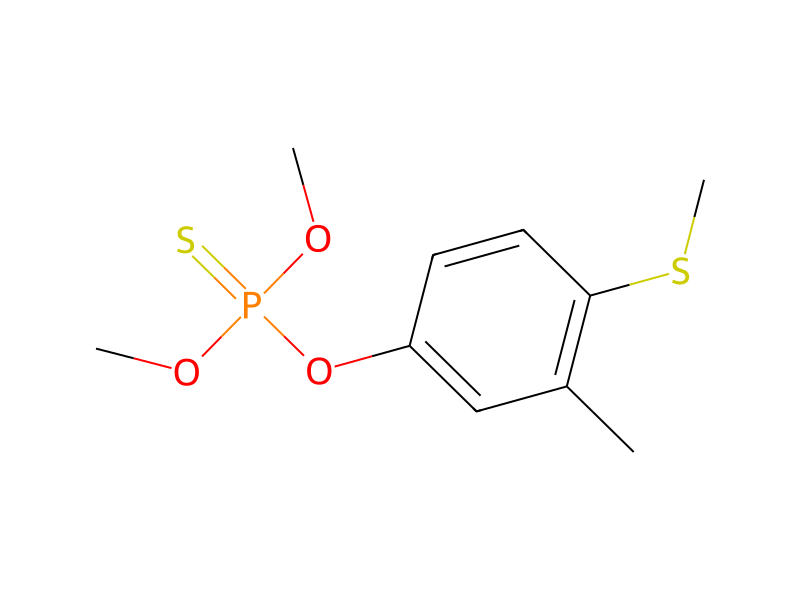
기본 정보
- 표준 SMILES
COP(=S)(OC)Oc1ccc(SC)c(C)c1- InChIKey
PNVJTZOFSHSLTO-UHFFFAOYSA-N- 분자식
- C10H15O3PS2
- 평균 분자량
- 278.3 g/mol
- 단동위원소 질량
- 278.02002368
이름 및 식별자
- 우선 이름
- Fenthion
- IUPAC
- dimethoxy-(3-methyl-4-methylsulfanylphenoxy)-sulfanylidene-lambda5-phosphane
- 현지명
- 펜티온
- 영어명
- Fenthion
- 분자식
- C10H15O3PS2
- 분자량
- 278.33
이름 및 동의어
fenthion55-38-9LebaycidSpottonBaytexQueletoxBaycidTiguvonEntexFenthionePhenthionFiguron
이름 더 보기
펜티온펜티온및그염류MPPoms2OMS 2FENTANYLCITRATEFASTERS 1752BaycinBayten
TalodexSulfidophosFenthion-methylBayer 29493Pro-SpotFenthion 4EMPP (pesticide)Bay-Bassa
데이터베이스 식별자
- CAS
55-38-9- PubChem CID
- 3346
- DTXSID
DTXSID8020620- ChEMBL
CHEMBL1604375- ChEBI
CHEBI:34761- UNII
- BL0L45OVKT
- EC Number
- 200-231-9
- Nikkaji
- J2.314K
물성
구조 계산 물성
- XLogP
- 4.1
- 극성 표면적
- 85.1 Ų
- 수소 결합 공여자 수
- 0
- 수소 결합 수용자 수
- 5
- 회전 가능 결합 수
- 5
- 무거운 원자 수
- 16
- 형식 전하
- 0
- 복잡도
- 254
실험 및 물리화학적 성질
LogP
log Kow= 4.091
4.09
3.17-4.8
Odor
Slight garlic odor
Slight, garlic-like odor.
Density
1.25 at 68 °F (NTP, 1992) - Denser than water; will sink
1.250 AT 20 °C/4 °C
Relative density (water = 1): 1.25
1.25
1.25 @25 °C
1.25
Color/Form
COLORLESS LIQUID
Colorless to brown liquid.
Solubility
Insoluble (<1 mg/ml at 72.5 °F) (NTP, 1992)
READILY SOL IN GLYCERIDE OILS
SOL IN METHANOL, ETHANOL, ETHER, ACETONE, & MANY ORGANIC SOLVENTS, ESPECIALLY CHLORINATED HYDROCARBONS
Slightly sol in petroleum ether
Solubility (20 °C): 2 mg/kg water; >1 kg/kg dichloromethane, propan-2-ol.
For more Solubility (Complete) data for FENTHION (6 total), please visit the HSDB record page.
CorrosivityNON-CORROSIVE
Flash Point170 °C
Boiling Point
189 °F at 0.01 mmHg (NTP, 1992)
87 °C AT 0.01 MM HG
Bp: 105 °C @ 0.01 mm Hg /Commercial product/
DecompositionWhen heated to decomposition it emits very toxic fumes of /phosphorus oxides and sulfur oxides/.
Melting Point
43 °F (NIOSH, 2024)
7 °C
7.5 °C
7.5 °C
43 °F
7 °C
Vapor DensityRelative vapor density (air = 1): 9.6
Vapor Pressure
3e-05 mmHg at 68 °F (NTP, 1992)
0.00003 [mmHg]
4 mPa at 20 °C; 10 mPa at 30 °C
Vapor pressure at 25 °C: negligible
0.0003 mmHg
0.0003 mmHg
물리화학적 성질
- 녹는점
- 7.5 °C · 7.5°C
- 끓는 점
- 87 °C · 87°C (0.01 mmHg)
- 밀도
- 1.25 · 1.25
- 증기압
- 7.4 x · 7.4 x 10-4 Pa (20 °C)
- 굴절률
- 20 · nD20 1.5698
- 인화점
- 100 °C · >100 °C
- 저장 조건
- 2 · 2-8°C
- 용해도
- 클로로포름(약간 용해됨), DMSO(약간 용해됨)
- 물리적 상태
- 액체
- 수용성
- 0.0055 g/100mL · 0.0055g/100mL
- Merck
- 13 · 13,4030
- BRN
- 1974129 · 1974129
- Henry's Law Constant
- 6.8 · 6.8×100 mol/(m3Pa) at 25℃, HSDB (2015)
- 안정성
- 안정적인. 강한 산화제와 호환되지 않습니다.
- 주요 응용
- 농업청소용품화장품환경음식 및 음료개인 위생 관리
- InChI
- 1S/C10H15O3PS2/c1-8-7-9(5-6-10(8)16-4)13-14(15,11-2)12-3/h5-7H,1-4H3
- InChIKey
- PNVJTZOFSHSLTO-UHFFFAOYSA-N
- SMILES
- COP(=S)(OC)Oc1ccc(SC)c(C)c1
- NIST
- Fenthion(55-38-9)
- EPA
- Fenthion (55-38-9)
화학적 성질
Pure fenthion is a colorless liquid. Technical fenthion is a yellow or brown oily liquid with a weak garlic odor. It is insoluble or very sparingly soluble in water, but soluble in all organic solvents, alcohols, ethers, esters, halogenated aromatics, and petroleum ethers. It is grouped by the US EPA under RUP and hence requires handling by qualifi ed, certifi ed, and trained workers. Fenthion is used for the control of sucking and biting pests, i.e., fruit fl ies, stem borers, mosquitoes, and cereal bugs. In mosquitoes, it is toxic to both the adult and immature forms (larvae). The formulations of fenthion include dust, emulsifi able concentrate, granular, liquid concentrate, spray concentrate, ULV, and wettable powder.
안전 및 규제
GHS 분류
GHS Classification
Danger
H302: Harmful if swallowed [Warning Acute toxicity, oral];H312: Harmful in contact with skin [Warning Acute toxicity, dermal];H331: Toxic if inhaled [Danger Acute toxicity, inhalation];H341: Suspected of causing genetic defects [Warning Germ cell mutagenicity];H372 **: Causes damage to organs through prolonged or repeated exposure [Danger Specific target organ toxicity, repeated exposure];H400: Very toxic to aquatic life [Warning Hazardous to the aquatic environment, acute hazard];H410: Very toxic to aquatic life with long lasting effects [Warning Hazardous to the aquatic environment, long-term hazard]
P203, P260, P261, P264, P270, P271, P273, P280, P301+P317, P302+P352, P304+P340, P316, P317, P318, P319, P321, P330, P362+P364, P391, P403+P233, P405, and P501 (click each P-code to see the statement)
Danger
유해성 정보
Regulatory Information
Hazard Traits - Developmental Toxicity; Environmental tox; Neurotoxicity;Authoritative List - CECBP - Priority Chemicals; CWA 303(d);Report - if used as a fragrance or flavor ingredient
Regulation (EC) No 1107/2009 (amended)
Fenthion is listed in the dataset of EPA Human Health Benchmarks for Pesticides under the Safe Drinking Water Act (40 eCFR 141)
04/140/EC
Fenthion: HSNO Approval: HSR002850 Approved with controls
The New Jersey Worker and Community Right to Know Act requires public and private employers to provide information about hazardous substances at their workplaces. (N.J.S.A. 34:5A-1 et. seq.)
Other Safety Information
IMAP assessments - Phosphorothioic acid, O,O-dimethyl O-[3-methyl-4-(methylthio)phenyl] ester: Human health tier I assessment;IMAP assessments - Phosphorothioic acid, O,O-dimethyl O-[3-methyl-4-(methylthio)phenyl] ester: Environment tier I assessment
DOT LabelPoison
Fire Hazards
This compound is probably combustible. (NTP, 1992)
Combustible. Liquid formulations containing organic solvents may be flammable. Gives off irritating or toxic fumes (or gases) in a fire.
Health Hazards
Excerpt from NIOSH Pocket Guide for Fenthion:;Exposure Routes: Inhalation, skin absorption, ingestion, skin and/or eye contact;Symptoms: Nausea, vomiting, abdominal cramps, diarrhea, salivation; headache, dizziness, lassitude (weakness, exhaustion); rhinorrhea (discharge of thin nasal mucus), chest tightness; blurred vision, miosis; cardiac irregularities; muscle fasciculation; dyspnea (breathing difficulty);Target Organs: Respiratory system, central nervous system, cardiovascular system, plasma cholinesterase (NIOSH, 2024)
Hazards Summary
Classified as moderately toxic; All bird control products and nondomestic, nongranular formulations of greater than 70% fenthion may be used only by certified applicators; it is not licensed for use on food crops; [EXTOXNET] The average of two baseline respective cholinesterase activity determinations three days apart, with no exposures to enzyme inhibiting pesticides for at least 30 days, is recommended for each worker prior to exposure to cholinesterase inhibitors because of large inter-individual differences in published baseline values. To be established at least once a year. Removal from workplace exposures is recommended until the cholinesterase activity returns to within 20% of baseline. [TLVs and BEIs]
FDA RequirementsOphthalmic and topical dosage form new animal drugs not subject to certification. Specifications and conditions of use provided for the control of grubs and lice in beef, nonlactating, and dairy cattle.
Reactive GroupEsters, Sulfate Esters, Phosphate Esters, Thiophosphate Esters, and Borate Esters;Sulfides, Organic
EC ClassificationSymbol: T, N; R: 21/22-23-48/25-50/53-68; S: (1/2)-36/37-45-60-61
UN ClassificationUN Hazard Class: 6.1; UN Pack Group: III
Special Reports
DHEW/NCI; Bioassay of Fenthion for Possible Carcinogenicity (1979) Technical Rpt Series No. 103 DHEW Pub No. (NIH) 79-1353
Maroni M, Fait A; Health effects in man from long-term exposure to pesticides; A review of the 1975-1991 literature. Toxicology 78 (1-3): 1-180 (1993). Review of human cancer, carcinogenicity, cytogenic effect, reproductive system pathology mortality occupational health.
FIFRA Requirements
As the federal pesticide law FIFRA directs, EPA is conducting a comprehensive review of older pesticides to consider their health and environmental effects and make decisions about their future use. Under this pesticide reregistration program, EPA examines health and safety data for pesticide active ingredients initially registered before November 1, 1984, and determines whether they are eligible for reregistration. In addition, all pesticides must meet the new safety standard of the Food Quality Protection Act of 1996. Fenthion is found on List A, which contains most food use pesticides and consists of the 194 chemical cases (or 350 individual active ingredients) for which EPA issued registration standards prior to FIFRA, as amended in 1988. Case No: 0290; Pesticide type: insecticide, avicide; Registration Standard Date: 06/01/88; Case Status: OPP is reviewing data from the pesticide's producers regarding its human health and/or environmental effects, or OPP is determining the pesticide's eligibility for reregistration and developing the Reregistration Eligibility Decision (RED) document.; Active ingredient (AI): Fenthion; Data Call-in (DCI) Date(s): 12/02/92; AI Status: The producers of the pesticide has made commitments to conduct the studies and pay the fees required for reregistration, and are meeting those commitments in a timely manner.
Tolerances are established for residues of the insecticide fenthion (O,O-dimethyl O-[4-(methylthio)-m-toyl] phosphorothioate) and its cholinesterase-inhibiting metabolites in or on the following raw agricultural commodities: alfalfa, alfalfa (hay), cattle (fat, meat, and mbyp), grass, grass (hay), hogs (fat, meat, and mbyp), milk, poultry (fat, meat, and mbyp), rice, and rice (straw).
안전 및 보호
Fire Fighting
Fires involving this material can be cntrolled with a dry chemical. carbon dioxide, foam or Halon extinguisher. (NTP, 1992)
Use water spray, foam, powder, carbon dioxide.
First Aid Measures
Fresh air, rest. Refer immediately for medical attention.
Remove contaminated clothes. Rinse and then wash skin with water and soap. Refer for medical attention . Wear protective gloves when administering first aid.
First rinse with plenty of water for several minutes (remove contact lenses if easily possible), then refer for medical attention.
Rinse mouth. Give a slurry of activated charcoal in water to drink. Refer immediately for medical attention.
First Aid
EYES: First check the victim for contact lenses and remove if present. Flush victim's eyes with water or normal saline solution for 20 to 30 minutes while simultaneously calling a hospital or poison control center. Do not put any ointments, oils, or medication in the victim's eyes without specific instructions from a physician. IMMEDIATELY transport the victim after flushing eyes to a hospital even if no symptoms (such as redness or irritation) develop.;SKIN: IMMEDIATELY flood affected skin with water while removing and isolating all contaminated clothing. Gently wash all affected skin areas thoroughly with soap and water. IMMEDIATELY call a hospital or poison control center even if no symptoms (such as redness or irritation) develop. IMMEDIATELY transport the victim to a hospital for treatment after washing the affected areas.;INHALATION: IMMEDIATELY leave the contaminated area; take deep breaths of fresh air. IMMEDIATELY call a physician and be prepared to transport the victim to a hospital even if no symptoms (such as wheezing, coughing, shortness of breath, or burning in the mouth, throat, or chest) develop. Provide proper respiratory protection to rescuers entering an unknown atmosphere. Whenever possible, Self-Contained Breathing Apparatus (SCBA) should be used; if not available, use a level of protection greater than or equal to that advised under Protective Clothing.;INGESTION: CHOLINESTERASE INHIBITORS ARE EXTREMELY TOXIC AND FAST-ACTING POISONS. IMMEDIATELY call a hospital of poison control center and transport the victim to a hospital. Atropine is an antidote for cholinesterase inhibitors but should only be administered by properly trained personnel. In the absence of this option and if the victim is conscious and not convulsing, it may be worth considering the risk of inducing vomiting, even though the induction of vomiting is not usually recommended outside of a physician's care. Ipecac syrup or salt water may be used to induce vomiting in such an emergency. If the victim is convulsing or unconscious, do not give anything by mouth, assure that the victim's airway is open and lay the victim on his/her side with the head lower than the body. DO NOT INDUCE VOMITING. IMMEDIATELY transport the victim to a hospital. (NTP, 1992)
(General first aid procedures);Eye: Irrigate immediately - If this chemical contacts the eyes, immediately wash (irrigate) the eyes with large amounts of water, occasionally lifting the lower and upper lids. Get medical attention immediately.;Skin: Soap flush immediately - If this chemical contacts the skin, immediately flush the contaminated skin with soap and water. If this chemical penetrates the clothing, immediately remove the clothing and flush the skin with water. If irritation persists after washing, get medical attention.;Breathing: Respiratory support;Swallow: Medical attention immediately - If this chemical has been swallowed, get medical attention immediately.
Safe StorageSeparated from strong oxidants and food and feedstuffs. Well closed. Keep in a well-ventilated room. Provision to contain effluent from fire extinguishing. Store in an area without drain or sewer access.
Exposure Control and Personal Protection
Biological Exposure Indices (BEI) [ACGIH] - Acetylcholinesterase activity in red blood cells = 70% of individual's baseline; Butylcholinesterase activity in serum or plasma = 60% of individual's baseline; Sample at end of shift; [TLVs and BEIs]
0.2 [mg/m3], inhalable fraction[German Research Foundation (DFG)]
Fire Fighting Procedures
Dry chemicals, carbon dioxide for small fires. Water spray, foam for large fires. /Malathion/
AREA SURROUNDING FIRE SHOULD BE DIKED TO PREVENT WATER RUNOFF. /MALATHION/
WEAR SELF CONTAINED BREATHING APPARATUS (OR RESPIRATOR FOR ORGANOPHOSPHATE PESTICIDES) AND RUBBER CLOTHING WHILE FIGHTING FIRES OF MALATHION WITH CHLORINE BLEACH SOLN. ALL CLOTHING CONTAMINATED BY FUMES AND VAPORS MUST BE DECONTAMINATED. /MALATHION/
Extinguish fire using agent suitable for type of surrounding fire. /Malathion/
Storage ConditionsStore in original container, preferably in a locked area, away from children, food, feed.
Cleanup Methods
1. VENTILATE AREA OF SPILL OR LEAK. 2. COLLECT FOR RECLAMATION OR ABSORB IN VERMICULITE, DRY SAND, EARTH, OR A SIMILAR MATERIAL. /MALATHION/
Environmental consideration: Landspill: Dig a pit, pond, lagoon, or holding areato contain liquid or solid material /SRP: If time permits, pits, ponds, lagoons, soak holes, or holding areas should be sealed with an impermeable flexible membrane liner./ Dike surface flow using soil, sand bags, foamed polyurethane, or foamed concrete. Absorb bulk liquid with fly ash or cement powder. /Malathion/
Environmental consideration: Water spill: If dissolved ... apply activated carbon at ten times the spilled amount /in region of 10 ppm or greater concentration/. Remove trapped material with suction hoses. Use mechanical dredges, or lifts to remove immobilized masses of pollutants and precipitates. /Malathion/
Spills of malathion on floors shall be absorbed with absorbing clay. Sweeping compound may be utilized to facilitate the removal of all visible traces of malathion contaminated clay. Equipment and fixtures contaminated with malathion shall be decontaminated with an alkaline solution (5% sodium hydroxide). /Malathion/
For more Cleanup Methods (Complete) data for FENTHION (6 total), please visit the HSDB record page.
Nonfire Spill Response
SMALL SPILLS AND LEAKAGE: If you spill this chemical, use absorbent paper to pick up all liquid spill material. Your contaminated clothing and absorbent paper should be sealed in a vapor-tight plastic bag for eventual disposal. Solvent wash all contaminated surfaces with alcohol followed by washing with a strong soap and water solution. Do not reenter the contaminated area until the Safety Officer (or other responsible person) has verified that the area has been properly cleaned.;STORAGE PRECAUTIONS: You should store this material in a refrigerator. (NTP, 1992)
Disposal Methods
Hydrolysis & landfill: Mix fenthion with excess CaO /calcium oxide/ or NaOH /sodium hydroxide/ and sand or other adsorbent in a pit or trench at least 0.5 m deep in a clay soil. NaOH (or Na2CO3) /sodium carbonate/ can also be added to the mixture to help speed the reactions when CaO is used as the main alkali. The amt of CaO or NaOH to use depends on the amt of pesticide to be disposed of and, to some extent, the concentration of active ingredient in the pesticide and the actual chemical nature of the active ingredient. A practical guideline, in the absence of specific directions, is to use an approx volume or weight of alkali from one-half of to the same as that of the pesticide. For dilute formulations, such as a 1% soln or dust, the amount of CaO of NaOH can be reduced by one-half. For very concentrated pesticides (over 80% active ingredient) the amount of CaO or NaOH can be doubled, but the concentrate should be mixed first with water (or soapy water) before reaction with the alkali. For safety, a preliminary test should be made in which very small amt of the pesticide and alkali are mixed and observed briefly to make sure it does not react too vigorously. Sizable quantities of pesticides can be disposed of in several smaller batches, rather than all at once, for added safety. 50% hydrolysis at 80 °C in acid medium requires 36 hr, or 95 min in alkaline medium. Recommendable method: Incineration. Peer-review: For large amt incineration in a unit with effluent gas scrubbing is recommendable. (Peer-review conclusions of an IRPTC expert consultation (May 1985))
MALATHION MAY BE DISPOSED OF BY ABSORBING IN VERMICULITE, DRY SAND, EARTH, OR A SIMILAR MATERIAL ... & /DISPOSING OF SO AS TO MEET LOCAL, STATE, & FEDERAL REGULATIONS/. /MALATHION/
Incineration together with flammable solvent in furnace equipped with afterburner and scrubber is recommended. /Malathion/
The following wastewater treatment technologies have been investigated for Malathion: Biological treatment and reverse osmosis. /Malathion/
For more Disposal Methods (Complete) data for FENTHION (7 total), please visit the HSDB record page.
Spillage Disposal
Personal protection: chemical protection suit, protective gloves and filter respirator for organic gases and particulates adapted to the airborne concentration of the substance. Do NOT let this chemical enter the environment. Collect leaking and spilled liquid in sealable containers as far as possible. Absorb remaining liquid in dry sand or inert absorbent. Then store and dispose of according to local regulations.
Preventive Measures
The worker should immediately wash the skin when it becomes contaminated.
Work clothing that becomes wet or significantly contaminated should be removed and replaced.
Workers whose clothing may have become contaminated should change into uncontaminated clothing before leaving the work premises.
독성 정보
Treatment
If the compound has been ingested, rapid gastric lavage should be performed using 5% sodium bicarbonate. For skin contact, the skin should be washed with soap and water. If the compound has entered the eyes, they should be washed with large quantities of isotonic saline or water. In serious cases, atropine and/or pralidoxime should be administered. Anti-cholinergic drugs work to counteract the effects of excess acetylcholine and reactivate AChE. Atropine can be used as an antidote in conjunction with pralidoxime or other pyridinium oximes (such as trimedoxime or obidoxime), though the use of '-oximes' has been found to be of no benefit, or possibly harmful, in at least two meta-analyses. Atropine is a muscarinic antagonist, and thus blocks the action of acetylcholine peripherally.
Interactions
The equitoxic coadministration of 2-sec-butylphenyl N-methylcarbamate and fenthion resulted in only a 1.6 fold potentiation compared to the expected /acute oral/ LD50 /of the methyl carbamate/. However, 1 hr oral pretreatment with 3 (1/100 LD50), 7.5, 15, and 30 mg/kg of fenthion resulted in 5, 9, 12, and 15 fold potentiation of the acute oral toxicity of 2-sec-butylphenyl N-methylcarbamate, respectively. These fenthion pretreatments caused significant incr in the 2-sec-butylphenyl N-methylcarbamate plasma concn and in the area under the concentration-time curve. These results suggested that fenthion pretreatment caused the potentiation of the acute toxicity of 2-sec-butylphenyl N-methylcarbamate partially by the inhibition of detoxication of 2-sec-butylphenyl N-methylcarbamate.
Target Organsrespiratory system, central nervous system, cardiovascular system, plasma cholinesterase
Health Effects
Acute exposure to cholinesterase inhibitors can cause a cholinergic crisis characterized by severe nausea/vomiting, salivation, sweating, bradycardia, hypotension, collapse, and convulsions. Increasing muscle weakness is a possibility and may result in death if respiratory muscles are involved. Accumulation of ACh at motor nerves causes overstimulation of nicotinic expression at the neuromuscular junction. When this occurs symptoms such as muscle weakness, fatigue, muscle cramps, fasciculation, and paralysis can be seen. When there is an accumulation of ACh at autonomic ganglia this causes overstimulation of nicotinic expression in the sympathetic system. Symptoms associated with this are hypertension, and hypoglycemia. Overstimulation of nicotinic acetylcholine receptors in the central nervous system, due to accumulation of ACh, results in anxiety, headache, convulsions, ataxia, depression of respiration and circulation, tremor, general weakness, and potentially coma. When there is expression of muscarinic overstimulation due to excess acetylcholine at muscarinic acetylcholine receptors symptoms of visual disturbances, tightness in chest, wheezing due to bronchoconstriction, increased bronchial secretions, increased salivation, lacrimation, sweating, peristalsis, and urination can occur. Certain reproductive effects in fertility, growth, and development for males and females have been linked specifically to organophosphate pesticide exposure. Most of the research on reproductive effects has been conducted on farmers working with pesticides and insecticdes in rural areas. In females menstrual cycle disturbances, longer pregnancies, spontaneous abortions, stillbirths, and some developmental effects in offspring have been linked to organophosphate pesticide exposure. Prenatal exposure has been linked to impaired fetal growth and development. Neurotoxic effects have also been linked to poisoning with OP pesticides causing four neurotoxic effects in humans: cholinergi
Ecotoxicity Values
LD50 ANAS PLATYRHYNCHOS (MALLARD DUCK) MALE ORAL 5.94 MG/KG (95% CONFIDENCE LIMIT 4.28-8.23 MG/KG) 4 MO OLD /SAMPLE 90% PURE/
LD50 PHASIANUS COLCHICUS (PHEASANT) FEMALE ORAL 17.8 MG/KG (95% CONFIDENCE LIMIT 9.33-34 MG/KG) 7-22 MO OLD /SAMPLE 99% PURE/
LD50 ALECTORIS CHUKAR (CHUKAR) ORAL 25.9 MG/KG (95% CONFIDENCE LIMIT 15.8-42.7 MG/KG) 3 MO OLD /SAMPLE 90% PURE/
LD50 COTURNIX JAPONICA (JAPANESE QUAIL) FEMALE ORAL 10.6 MG/KG (95% CONFIDENCE LIMIT 8.41-13.3 MG/KG) 3 MO OLD /SAMPLE 99% PURE/
For more Ecotoxicity Values (Complete) data for FENTHION (38 total), please visit the HSDB record page.
Environmental Fate
TERRESTRIAL FATE: Biodegradation and photooxidation are expected to be important degradation processes in the terrestrial environment. Laboratory studies have shown that fenthion undergoes a photosensitized oxidation on soil surfaces exposed to sunlight (probably via singlet oxygen) with the formation of fenthion sulfoxide(1), and that the conversion rate is sufficiently rapid to make photooxidation an important transformation pathway(1). Biodegradation screening studies have demonstrated that fenthion can biodegrade under environmental conditions(2-4). The US Dept of Agric's Pesticide Properties Database reports a soil half-life of 34 days for fenthion(5). Based upon a Koc of 1500(5), fenthion is expected to have very low mobility in soil(6,SRC). In plants, fenthion oxidizes to the sulfoxide and sulfone which are both highly insecticidal(7).
AQUATIC FATE: Various screening studies have shown that fenthion can degrade via photodegradation and biodegradation in the aquatic environment(1-3). Photodegradation is the dominant transformation pathway when sunlight exposure is present(1-3); degradation rates can increase by as much as 3 to 8-fold in sunlight as compared to dark conditions(2). The persistence half life of fenthion in water under field conditions has been reported to range from 2.9 to 21.1 days for various ocean, river, swamp, lake and canal waters(1,4). However, it may be more persistent in some environments, such as salt marsh sediments (below several mm deep), where light and oxygen are limited(2-3). Aqueous hydrolysis is usually too slow to have any environmental importance(1); at 23.5 °C, the hydrolysis half-life is approximately 101 days in distilled water and 69 days in salt water(1). One screening study measured a BCF of 16,600 in guppies (extractable lipid basis)(5) which indicates that bioconcentration in aquatic organisms may be somewhat important(SRC).
ATMOSPHERIC FATE: Based upon a reported vapor pressure of 3X10⁻⁵ mm Hg at 20 °C(1), fenthion can exist in both the vapor and particulate phases in the ambient atmosphere, although the vapor phase can be expected to dominate(2,SRC). It will degrade rapidly in the vapor phase by reaction with photochemically produced hydroxyl radicals with an estimated half-life of about 5 hr(3,SRC). Particulate phase fenthion and aerosols released to air during spray applications of fenthion insecticide will be removed from air physically by dry and wet deposition(SRC).
Food Survey Values
Virgin olive oil samples collected during two sampling periods between 1988 and 1990 in Greece, contained mean fenthion concns of 0.216 and 0.256 mg/kg(1); 50-79% of the 630 samples had detectable (detection limit of 0.005 mg/kg) fenthion residues(1); in addition to fenthion, the metabolites fenthion sulfoxide and the oxygen analogue (P=O) of fenthion were detected(1). In a US monitoring survey of 6970 produce samples (fruits and vegetables) collected between 1989 and 1991, fenthion was not detected in any sample at a detection limit of 0.200 ppm(2). As part of the FDA's Total Diet Study (Market Basket Survey) of the American diet for fiscal year 1978, fenthion was detected in only one food composite for the infant and toddler age classes(3); the concn was reported as a trace (detection limit not given)(3); no fenthion was detected (detection limit not given) for fiscal years 1979-1982(4).
Fenthion has been detected, by FDA's pesticide residue monitoring program, in American foods during fiscal years 1983-1990(1-3); however, the concns and the frequencies of occurrence were not reported(1-3).
Adverse EffectsOther Poison - Organophosphate;ACGIH Carcinogen - Not Classifiable.
Exposure Routes
The substance can be absorbed into the body in hazardous amounts by inhalation, through the skin and by ingestion.
inhalation, skin absorption, ingestion, skin and/or eye contact
Oral (L1681
Milk Concentrations
Following dermal application of (32)P fenthion /to cows/ at the rate of 9 mg/kg, ... 1.5-2.0% /primarily in the form of water-soluble hydrolysis products/ was recovered in the milk.
LACTATING JERSEY COWS WERE FED DIETS CONTAINING FENTHION. MILK CONTAINED TRACES OF FENTHION & SMALL AMOUNTS OF FENTHION SULFOXIDE & SULFONE & SULFOXIDE OF OXYGEN ANALOG. SULFONE & SULFOXIDE OF FENTHION & ITS OXYGEN ANALOG WERE FOUND IN URINE.
Toxicity Summary
Fenthion is a cholinesterase or acetylcholinesterase (AChE) inhibitor. A cholinesterase inhibitor (or 'anticholinesterase') suppresses the action of acetylcholinesterase. Because of its essential function, chemicals that interfere with the action of acetylcholinesterase are potent neurotoxins, causing excessive salivation and eye-watering in low doses, followed by muscle spasms and ultimately death. Nerve gases and many substances used in insecticides have been shown to act by binding a serine in the active site of acetylcholine esterase, inhibiting the enzyme completely. Acetylcholine esterase breaks down the neurotransmitter acetylcholine, which is released at nerve and muscle junctions, in order to allow the muscle or organ to relax. The result of acetylcholine esterase inhibition is that acetylcholine builds up and continues to act so that any nerve impulses are continually transmitted and muscle contractions do not stop. Among the most common acetylcholinesterase inhibitors are phosphorus-based compounds, which are designed to bind to the active site of the enzyme. The structural requirements are a phosphorus atom bearing two lipophilic groups, a leaving group (such as a halide or thiocyanate), and a terminal oxygen.
Average Daily Intake
Based upon an avg olive oil concn of 0.236 mg fenthion/kg olive oil(1) and an estimated consumption of 20 kg olive oil/yr for people in Greece(1), the daily dietary exposure has been estimated to be 0.0002 mg/kg body weight(1). Based upon monitoring in FDA's Total Diet Study for fiscal year 1978, the avdi for US toddlers was estimated to be <0.001 ug/kg body weight/day(2); in fiscal years 1979-82, fenthion was not detected in infant and toddler food composites so the estimated avdi was 0.0(2).
규제 정보
Regulatory Information
Hazard Traits - Developmental Toxicity; Environmental tox; Neurotoxicity;Authoritative List - CECBP - Priority Chemicals; CWA 303(d);Report - if used as a fragrance or flavor ingredient
Regulation (EC) No 1107/2009 (amended)
Fenthion is listed in the dataset of EPA Human Health Benchmarks for Pesticides under the Safe Drinking Water Act (40 eCFR 141)
04/140/EC
Fenthion: HSNO Approval: HSR002850 Approved with controls
The New Jersey Worker and Community Right to Know Act requires public and private employers to provide information about hazardous substances at their workplaces. (N.J.S.A. 34:5A-1 et. seq.)
FDA RequirementsOphthalmic and topical dosage form new animal drugs not subject to certification. Specifications and conditions of use provided for the control of grubs and lice in beef, nonlactating, and dairy cattle.
FIFRA Requirements
As the federal pesticide law FIFRA directs, EPA is conducting a comprehensive review of older pesticides to consider their health and environmental effects and make decisions about their future use. Under this pesticide reregistration program, EPA examines health and safety data for pesticide active ingredients initially registered before November 1, 1984, and determines whether they are eligible for reregistration. In addition, all pesticides must meet the new safety standard of the Food Quality Protection Act of 1996. Fenthion is found on List A, which contains most food use pesticides and consists of the 194 chemical cases (or 350 individual active ingredients) for which EPA issued registration standards prior to FIFRA, as amended in 1988. Case No: 0290; Pesticide type: insecticide, avicide; Registration Standard Date: 06/01/88; Case Status: OPP is reviewing data from the pesticide's producers regarding its human health and/or environmental effects, or OPP is determining the pesticide's eligibility for reregistration and developing the Reregistration Eligibility Decision (RED) document.; Active ingredient (AI): Fenthion; Data Call-in (DCI) Date(s): 12/02/92; AI Status: The producers of the pesticide has made commitments to conduct the studies and pay the fees required for reregistration, and are meeting those commitments in a timely manner.
Tolerances are established for residues of the insecticide fenthion (O,O-dimethyl O-[4-(methylthio)-m-toyl] phosphorothioate) and its cholinesterase-inhibiting metabolites in or on the following raw agricultural commodities: alfalfa, alfalfa (hay), cattle (fat, meat, and mbyp), grass, grass (hay), hogs (fat, meat, and mbyp), milk, poultry (fat, meat, and mbyp), rice, and rice (straw).
안전 데이터
- wgk
- 3
- rtecs
- TF9625000
- ridadr
- UN 2810/3017
- 독성
- LD50 in male, female rats (mg/kg): 215, 245 orally (Gaines)
- HS 번호
- 29309090
- risk_code
- 21/22-23-48/25-50/53-68-67-65-38-11
- hazard_code
- T;N,N,T,Xn,F
- safety_code
- 36/37-45-60-61-62
- 포장분류
- III
- 위험 등급
- 6.1(b)
- 기존화학 물질
- KE-28691
- Hazard Classifications
- Acute Tox. 2 InhalationAcute Tox. 3 DermalAcute Tox. 3 OralAquatic Acute 1Aquatic Chronic 1Muta. 2STOT RE 1 Oral
- 스토리지 클래스
- 6.1A - Combustible acute toxic Cat. 1 and 2very toxic hazardous materials
- 유해 물질 데이터
- 55-38-9(Hazardous Substances Data)
- 함량 및 규제정보
- 물질구분: 유독물질; 혼합물(제품)함량정보: 펜티온 및 이를 2% 이상 함유한 혼합물
- 유해화학물질 필터링
- 97-1-341
화학 및 산업
약리 정보
ATC CodeQP - Antiparasitic products, insecticides and repellents;QP53 - Ectoparasiticides, insecticides and repellents;QP53B - Ectoparasiticides for systemic use;QP53BB - Organophosphorous compounds;QP53BB02 - Fenthion
Mechanism of ActionOrganophosphates poison insects and humans primarily by phosphorylation of the acetylcholinesterase enzyme at nerve endings. /Organophosphate Cholinesterase-inhibiting pesticides/
Metabolism/Metabolites
... FENTHION IS METABOLIZED IN PLANTS INITIALLY TO SULFOXIDE. THE METABOLIC CONVERSION OF THIOETHER GROUP TO SULFOXIDE IS RAPID & SUBSEQUENT METAB TO SULFONE & DESULFURATION TO PHOSPHATE SULFOXIDE & SULFONE IS SLOWER.
... STABLE FLY & BED BUG RAPIDLY METABOLIZED FENTHION. OXIDATION OCCURRED AT THIOPHOSPHORYL & THIOETHER POSITIONS. LATTER PATH PRODUCED FENTHION SULFOXIDE & FENTHION SULFONE. OTHER PATH GAVE RISE TO FENOXON & 4-METHYLSULFONYL-M-CRESOL. THE SULFINYL CRESOL ANALOG WAS ALSO OBSERVED. THE HYDROLYTIC PRODUCTS WERE CONJUGATED & EXCRETED. FOLLOWING CONVERSION TO THE OXYGEN ANALOG, OXIDATION OF THIOETHER WAS MORE RAPID.
FOURTEEN DAYS AFTER APPLICATION /TO RICE PLANTS/, WATER SOL METABOLITES WERE FOUND IN RICE GRAINS: PHOSPHATE & THIOPHOSPHATE, DIMETHYL PHOSPHATE & THIOPHOSPHATE, DEMETHYL FENTHION, & UNKNOWN CMPD.
FENTHION SULFOXIDE & SULFONE & FENTHION PHOSPHATE SULFOXIDE OR SULFONE HAVE BEEN IDENTIFIED IN HOUSEFLIES AFTER TOPICAL APPLICATION ... . AT LEAST 5 INTACT ESTER DERIVATIVES OF FENTHION HAVE BEEN ISOLATED FROM BOLL WEEVIL, GERMAN COCKROACHES, & RATS.
For more Metabolism/Metabolites (Complete) data for FENTHION (10 total), please visit the HSDB record page.
Fenthion has known human metabolites that include Fenthion oxon.
MeSH Pharmacological Classification
Drugs that inhibit cholinesterases. The neurotransmitter ACETYLCHOLINE is rapidly hydrolyzed, and thereby inactivated, by cholinesterases. When cholinesterases are inhibited, the action of endogenously released acetylcholine at cholinergic synapses is potentiated. Cholinesterase inhibitors are widely used clinically for their potentiation of cholinergic inputs to the gastrointestinal tract and urinary bladder, the eye, and skeletal muscles; they are also used for their effects on the heart and the central nervous system.
Pesticides designed to control insects that are harmful to man. The insects may be directly harmful, as those acting as disease vectors, or indirectly harmful, as destroyers of crops, food products, or textile fabrics.
Absorption, Distribution and Excretion
LACTATING JERSEY COWS WERE FED DIETS CONTAINING FENTHION. MILK CONTAINED TRACES OF FENTHION & SMALL AMOUNTS OF FENTHION SULFOXIDE & SULFONE & SULFOXIDE OF OXYGEN ANALOG. SULFONE & SULFOXIDE OF FENTHION & ITS OXYGEN ANALOG WERE FOUND IN URINE. FENTHION SULFOXIDE WAS FOUND IN FECES.
... In cows, about the same percentage of various metabolic fractions derived from (32)P fenthion appeared in the feces following dermal application as appeared after im injection, indicating that the dermally applied material had been ... absorbed, whether from the skin or from the GI tract, after being licked from the skin.
ON RICE PLANTS, ONLY ABOUT 10% OF APPLIED MATERIAL REMAINED AFTER 6 HR. ... USING LABELED MATERIAL, ALMOST HALF OF ACTIVITY WAS FOUND IN BRAN; 6.5% IN HUSK, & 14.7% IN POLISHED RICE.
... Fenthion has lipophilic properties, it deposits in adipose tissue.
For more Absorption, Distribution and Excretion (Complete) data for FENTHION (7 total), please visit the HSDB record page.
Cellular LocationsMembrane
용도 및 제조
Uses
Used to kill fruit flies, stem borers, mosquitoes, and Eurygaster cereal bugs; it is also applied as paste to bird roosting areas to kill pigeons and other bird pests; [EXTOXNET]
Farming (Pesticides) [Category: Industry]
The general population is not likely to be exposed to large amounts of fenthion. Occupational exposure to fenthion occurs through dermal contact and inhalation of dust and sprays, especially to workers applying the compound as an insecticide. Because fenthion has been detected in American foods, exposure to the general population can occur through consumption of foods containing fenthion residues. (L1682)
ImpuritiesThe S-methyl isomer ... is a known contaminant in technical fenthion ... .
U.S. Production(1974) 9.1X10+7 G (CONSUMPTION)
Consumption PatternsABOUT 40% APPLIED TO AQUATIC AREAS IN CA AS AN INSECTICIDE FOR CONTROL OF MOSQUITOES; MOST OF THE BALANCE IS BELIEVED TO HAVE BEEN USED FOR MOSQUITO CONTROL ELSEWHERE IN THE US (1974).
Methods of Manufacturing
CONDENSATION OF 4-METHYLMERCAPTO-M-CRESOL & O,O-DIMETHYL PHOSPHOROCHLORIDOTHIOATE
Fenthion may be made by the condensation of 4-methylmercapto-m-cresol and dimethylphosphorochloridothionate.
Formulations/Preparations
BAYTEX, WETTABLE POWDER (400 G/KG), FOGGING CONCENTRATE (600 G/L), EMULSIFIABLE CONCENTRATE (500 OR 1000 G/L) & GRANULAR (20 G/KG) FOR HOUSEHOLD USE; LEBAYCID, WETTABLE POWDER (250 OR 400 G/KG), EMULSIFIABLE CONCENTRATE (500 OR 1000 G/L), ULV (1000 G/L) & DUST (30 G/KG) FOR USE AGAINST CROP PESTS; QUELETOX FOR USE AGAINST WEAVER BIRDS; TIGUVON VARIOUS FORMULATIONS AGAINST ANIMAL PARASITES.
Fenthion is available as 25 and 40% wettable powders, 60% fogging concentrates, 50% emulsifiable concentrates, 100% ultralow-volume spray, 3% dust, and 2% granules.
Mixtures include: Bay-Bassa, EC (fenthion + fenobucarb).
liquid concentrates, spray concentrates
Use Classification
Animal Drugs -> FDA Approved Animal Drug Products (Green Book) -> Active Ingredients
INSECTICIDES
General Manufacturing Information
The WHO Recommended Classification of Pesticides by Hazard identifies Fenthion (technical grade) as Class II: moderately hazardous; Main Use: insecticide, larvicide.
... CONTACT & STOMACH INSECTICIDE WITH USEFUL PENETRANT & PERSISTENT ACTION. IT IS EFFECTIVE, FOR EXAMPLE, AGAINST FRUIT FLIES, LEAF HOPPERS & CEREAL BUGS.
COMPATIBLE WITH MOST INSECTICIDES & FUNGICIDES, EXCEPT ALKALINE MATERIALS.
Fenthion (Tiguvon) is poured along the backline of cattle before migrating larvae of Hypoderma lineatum and H bovis reach this region. The migrating larvae are killed before they inflict damage to the tissue and the hide over the back.
Fenthion is an analogue of parathion.
응용 분야
개요Fenthion is a colorless oily liquid (technical grade, brown oily liquid with a mercaptan-like odor).
용도Fenthion is an organothiophosphate used as an insecticide. Fenthion is also a potent acaricide.
일반 설명Yellow to tan oily liquid with a slight odor of garlic.
상·하류 제품 정보
상류 원료
하류 제품
공급사50 곳
山东旭晨化工科技有限公司0533-15715337262 15715337262 · [email protected]
上海阿拉丁生化科技股份有限公司400-6206333 13167063860 · [email protected]
Shandong chuangyingchemical Co., Ltd.18853181302 · [email protected]
艾吉析科技(上海)有限公司17717235263 · [email protected]
上海麦克林生化科技股份有限公司021-50706066 15221275939 · [email protected]
广州佳途科技股份有限公司81960175 18933936954 · [email protected]
武汉欣扬瑞和化学科技有限公司153-07155313 15307155313 · [email protected]
江苏艾康生物医药研发有限公司025-025-66113011 15955137747 · [email protected]
Baoji Guokang Healthchem co.,ltd+8615604608665 15604608665 · [email protected]
Dayang Chem (Hangzhou) Co.,Ltd.+86-0571-88938639 17705817739 · [email protected]
安耐吉化学&3A(安徽泽升科技有限公司)021-58432009 400-005-6266 · [email protected]
梯希爱(上海)化工贸易有限公司021-61109150 · [email protected]
南通合润生物科技有限公司18362409333 · [email protected]
上海艾梯西生物科技有限公司18721763493
常州市华阳科技有限公司+8615250961469 · [email protected]
医恩医疗系统研发(上海)有限公司021-58958002 18930822973 · [email protected]
上海毕楷科技有限公司18516304666
四川库利南科技有限公司400-1166-196 18981987031 · [email protected]
艾科试剂4008-755-333 18080918076 · [email protected]
成都思天德生物科技有限公司028-83243028 19136088901 · [email protected]
南京生利德生物科技有限公司025-57798810 18652991625 · [email protected]
上海陶素生化科技有限公司021-33632979 · [email protected]
上海丽康新材料有限公司+86-16631818819 +86-17736933208 · [email protected]
PT CHEM GROUP LIMITED+86-85511178; +86-85511178 · [email protected]
天津阿尔塔科技有限公司022-65378550-8551 · [email protected]
HBCChem, Inc.+1-510-219-6317 · [email protected]
天津普西唐生物医药科技有限公司010-60605840 · [email protected]
上海兴鲁化工科技有限公司02120970332 · [email protected]
凯试(上海)科技有限公司021-50135380 · [email protected]
天津荣燊化工有限公司18317763565; 18317763565 · [email protected]
深圳振强药物研发有限公司+86-0755-66853366 +86-13670046396 · [email protected]
九鼎化学(上海)科技有限公司4009209199 · [email protected]
杭州鼎燕化工有限公司0571-87157530-8003 18267553885 · [email protected]
厦门志信化学有限公司+86-5922680277 +86-13806087780 · [email protected]
上海西陇生化科技有限公司021-52907766-8042
上海源叶生物科技有限公司13636370518 · [email protected]
上海新平精细化学品有限公司18221735425 · [email protected]
河南中梵实业发展有限公司+86-18906033525 · [email protected]
Shanghai Acmec Biochemical Technology Co., Ltd.+86-18621343501 · [email protected]
Shaanxi Didu New Materials Co. Ltd+86-86-17392712779 +86-13289823923 · [email protected]
杭州洁汉化工有限公司+86-571-86217390; +8618058761490 · [email protected]
厦门盈融达化工有限公司+86-0592-6210733 · [email protected]
上海吉至生化科技有限公司021-4009004166/18616739031 18616739031 · [email protected]
北京坛墨质检科技有限公司010-52889049 · [email protected]
career henan chemical co+86-0371-86658258 · [email protected]
深圳聚合生化科技有限公司+86-400-002-6226 · [email protected]
海蔚化学86-21-51086038 · [email protected]
Aladdin Scientific[email protected]
Aromsyn Co., Ltd.+86-0571-85585865 +86-13336024896 · [email protected]
爆牛贸易重庆有限公司+86-023-6139-8061 +86-86-13650506873 · [email protected]
추가 설명
정의ChEBI: An organic thiophosphate that is O,O-dimethyl hydrogen phosphorothioate in which the hydrogen atom of the hydroxy group is replaced by a 3-methyl-4-(methylsulfanyl)phenyl group. It exhibits acaricidal and insecticidal activities.
관련 반응
1건
연결된 노트
불러오는 중…