
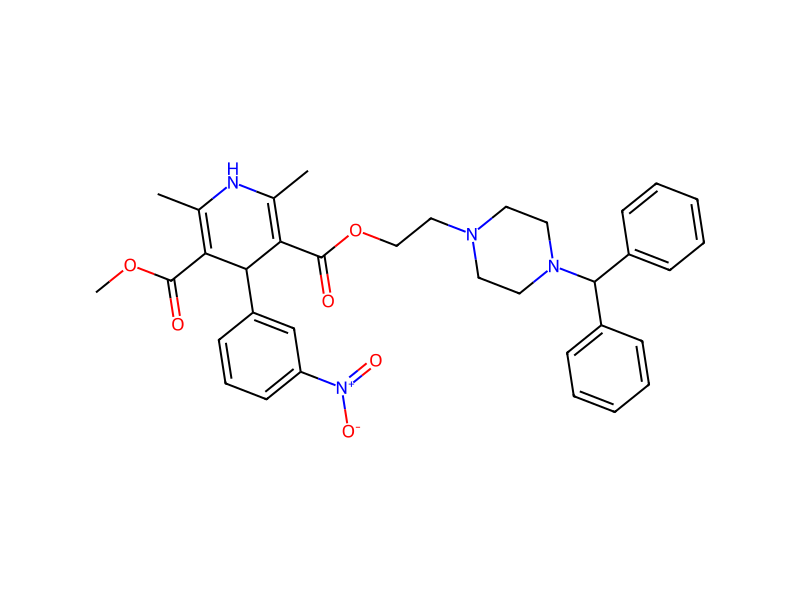
기본 정보
- 표준 SMILES
COC(=O)C1=C(C)NC(C)=C(C(=O)OCCN2CCN(C(c3ccccc3)c3ccccc3)CC2)C1c1cccc([N+](=O)[O-])c1- InChIKey
ANEBWFXPVPTEET-UHFFFAOYSA-N- 분자식
- C35H38N4O6
- 평균 분자량
- 610.7 g/mol
- 단동위원소 질량
- 610.27913494
이름 및 식별자
- 우선 이름
- Manidipine
- IUPAC
- 5-O-[2-(4-benzhydrylpiperazin-1-yl)ethyl] 3-O-methyl 2,6-dimethyl-4-(3-nitrophenyl)-1,4-dihydropyridine-3,5-dicarboxylate
- 현지명
- 마니디핀
- 영어명
- Manidipine
- 분자식
- C35H38N4O6
- 분자량
- 610.7
이름 및 동의어
manidipine89226-50-6FranidipineArtedilManidipine 6300Manidipino5-O-[2-(4-benzhydrylpiperazin-1-yl)ethyl] 3-O-methyl 2,6-dimethyl-4-(3-nitrophenyl)-1,4-dihydropyridine-3,5-dicarboxylate6O4754US88DTXSID20437452-(4-Diphenylmethyl-1-piperazinyl)ethyl methyl-1,4-dihydro-2,6-dimethyl-4-(3-nitrophenyl)-3,5-pyridinedicarboxylate3-{2-[4-(diphenylmethyl)piperazin-1-yl]ethyl} 5-methyl 2,6-dimethyl-4-(3-nitrophenyl)-1,4-dihydropyridine-3,5-dicarboxylatemanidipinum
이름 더 보기
마니디핀Manidipine (Manyper)IpertenManidipine(base)Manidipine(CV-4093)Manidipine Impurity1254Manidipine (10mM in DMSO)
3-(2-(4-(diphenylmethyl)piperazin-1-yl)ethyl) 5-methyl 2,6-dimethyl-4-(3-nitrophenyl)-1,4-dihydropyridine-3,5-dicarboxylate5-O-(2-(4-benzhydrylpiperazin-1-yl)ethyl) 3-O-methyl 2,6-dimethyl-4-(3-nitrophenyl)-1,4-dihydropyridine-3,5-dicarboxylatemanidipine, (+-)-RefChem:809939DTXCID0023745C08CA11120092-68-43-(2-(4-Benzhydrylpiperazin-1-yl)ethyl) 5-methyl 2,6-dimethyl-4-(3-nitrophenyl)-1,4-dihydropyridine-3,5-dicarboxylate
데이터베이스 식별자
- CAS
89226-50-6- PubChem CID
- 4008
- DTXSID
DTXSID2043745- ChEMBL
CHEMBL1085699、CHEMBL312176- ChEBI
CHEBI:135849- UNII
- 6O4754US88
- EC Number
- 855-394-4
- Nikkaji
- J313.870D
물성
구조 계산 물성
- XLogP
- 5.6
- 극성 표면적
- 117 Ų
- 수소 결합 공여자 수
- 1
- 수소 결합 수용자 수
- 9
- 회전 가능 결합 수
- 11
- 무거운 원자 수
- 45
- 형식 전하
- 0
- 복잡도
- 1,090
실험 및 물리화학적 성질
Solubility<1mg/mL
물리화학적 성질
- 녹는점
- 125 · 125-128°C
- 끓는 점
- 722 · 722.0±60.0 °C(Predicted)
- 밀도
- 1.232 · 1.232±0.06 g/cm3(Predicted)
- 저장 조건
- 2 · Sealed in dry,2-8°C
- 용해도
- 10 mM · Soluble in DMSO > 10 mM
- 물리적 상태
- 가루
- 산도 계수 (pKa)
- 6.12 · 6.12±0.10(Predicted)
- 색상
- Light yellow to yellow
- LogP
- 4.135 · 4.135
화학적 성질
Light Yellow Crystalline Solid
안전 및 규제
GHS 분류
GHS Classification
Danger
H301 (100%): Toxic if swallowed [Danger Acute toxicity, oral]
P264, P270, P301+P316, P321, P330, P405, and P501 (click each P-code to see the statement)
Aggregated GHS information provided per 3 reports by companies from 1 notifications to the ECHA C&L Inventory.;Information may vary between notifications depending on impurities, additives, and other factors. The percentage value in parenthesis indicates the notified classification ratio from companies that provide hazard codes. Only hazard codes with percentage values above 10% are shown. For more detailed information, please visit ECHA C&L website.
유해성 정보
Regulatory InformationStatus: Active Update: 11-04-2022 https://echa.europa.eu/registration-dossier/-/registered-dossier/33372
Hazard Classes and CategoriesAcute Tox. 3 (100%)
독성 정보
Drug Induced Liver Injury
Drug-Induced Liver Injury Severity and Toxicity (DILIst)
Manidipine
DILI Positive
DOI:10.1016/j.drudis.2019.09.022
규제 정보
Regulatory InformationStatus: Active Update: 11-04-2022 https://echa.europa.eu/registration-dossier/-/registered-dossier/33372
안전 데이터
- 신호 어
- Warning
- 유해·위험 문구
- 암호 유해·위험 문구 위험 등급 범주 신호 어 그림 문자 P- 코드 H302
화학 및 산업
약리 정보
ATC Code
C - Cardiovascular system;C08 - Calcium channel blockers;C08C - Selective calcium channel blockers with mainly vascular effects;C08CA - Dihydropyridine derivatives;C08CA11 - Manidipine
QC - Cardiovascular system;QC08 - Calcium channel blockers;QC08C - Selective calcium channel blockers with mainly vascular effects;QC08CA - Dihydropyridine derivatives;QC08CA11 - Manidipine
Protein BindingManidipine is 99% bound to human plasma proteins.
PharmacodynamicsManidipine produces vasodilation resulting in lower blood pressure.
Mechanism of Action
Contraction of vascular smooth muscle is stimulated by Gq coupled receptors which produce calcium release from the sarcoplasmic reticulum. This is followed by opening of voltage dependent calcium channels and an influx of calcium into the cell ultimately producing contraction. Manidipine binds to and dissociates slowly from L- and T-type voltage dependent calcium channels on smooth muscle cells, blocking the entrance of extracellular calcium into the cell and preventing this contraction. This produces vasodilation which decreases blood pressure. Manidipine produces renal vasodilation and an increase in natriuresis. This likely contributes to the antihypertensive effect by reducing blood volume. Manidipine is selective for the vasculature and does not produce significant effects on the heart or central nervous system at clinically relevant dosages.
Biological Half-LifeThe half life of elimination has been observed to be dose dependent. Doses of 5, 10, and 20 mg produced half lives of 3.94, 5.02, and 7.95 h respectively.
Metabolism/MetabolitesManidipine is extensively metabolized by CYP enzymes to pyridine derivatives and diphenylmethane derivatives which make up 4-7% and 22-24% of the dose excreted in the urine.
MeSH Pharmacological Classification
Drugs used in the treatment of acute or chronic vascular HYPERTENSION regardless of pharmacological mechanism. Among the antihypertensive agents are DIURETICS; (especially DIURETICS, THIAZIDE); ADRENERGIC BETA-ANTAGONISTS; ADRENERGIC ALPHA-ANTAGONISTS; ANGIOTENSIN-CONVERTING ENZYME INHIBITORS; CALCIUM CHANNEL BLOCKERS; GANGLIONIC BLOCKERS; and VASODILATOR AGENTS.
A class of drugs that act by selective inhibition of calcium influx through cellular membranes.
Absorption, Distribution and Excretion
The median Tmax is 1.5 h. Administration with food produces an 1.3-1.6-fold increase in Cmax but no change in Tmax. Manidipine does not accumulate significantly with multiple doses.
Manidipine is eliminated through extensive metabolism. 63% is eliminated in the feces and 31% in the urine as metabolites.
용도 및 제조
UsesUse (kg; approx.) in Germany (2009): >25;Consumption (g per capita; approx.) in Germany (2009): 0.000305;Calculated removal (%): 83.1
응용 분야
개요Manidipine is a dihydropyridine L- and T-type calcium channel blocker. It blocks recombinant rabbit L-type (α1Cα2/δβ1a) and human T-type (α1H) calcium channels expressed in Xenopus oocytes and native L-type channels in dissociated guinea pig cardiac ventricular cells (IC50 = 2.6 nM). Manidipine inhibits intracellular calcium increases induced by endothelin-1 (ET-1; ) in A7r5 rat vascular smooth muscle cells (ED50 = 1 nM) and potassium-induced contraction of isolated dog femoral and portal veins (IC50s = 24 and 2.1 nM, respectively). In vivo, it lowers blood pressure in spontaneously hypertensive rats (SHRs) when administered at a dose of 10 mg/kg and inhibits left ventricular hypertrophy in rats induced by isoproterenol when administered at a dose of 3 mg/kg. Formulations containing manidipine have been used in the treatment of hypertension.
용도Manidipine (Manyper) is a lipophilic, third-generation, highly vasoselective dihydropyridine calcium antagonist with an IC50 of 2.6 nM. It causes systemic vasodilation by inhibiting the voltage-dependent calcium inward currents in smooth muscle cells. It
상·하류 제품 정보
상류 원료
공급사50 곳
济南百隆化学有限公司[email protected] · [email protected]
成都超九八生物科技有限公司13348960310 13348960310 · [email protected]
上海麦克林生化科技股份有限公司021-50706066 15221275939 · [email protected]
杭州品高化工有限公司0571-87658025 · [email protected]
爱斯特(成都)生物制药股份有限公司+86-28-85122536 85324413 · [email protected]
LGM Pharma1-(800)-881-8210 · [email protected]
北京索莱宝科技有限公司010-50973130 17801761073 · [email protected]
安耐吉化学&3A(安徽泽升科技有限公司)021-58432009 400-005-6266 · [email protected]
欧利希(湖北)医药科技有限公司17316404525 17316404525 · [email protected]
InvivoChem中国13549236410 · [email protected]
MedBio脉铂医药021-69568360 18916172912 · [email protected]
上海泰坦科技股份有限公司400-6009262 15618770481 · [email protected]
上海隆盛化工有限公司58099637 13585536065 · [email protected]
MedChemexpress LLC021-58955995 · [email protected]
BOC Sciences1-631-485-4226; 16314854226 · [email protected]
ChemeGen 中国18818260767 · [email protected]
Moxin Chemicals+86-17320513646 +86-17320513646 · [email protected]
ALPENGLOW CHEMICAL INDUSTRIAL CO., LTD086-0531-86986713 · [email protected]
上海思域化工科技有限公司86-21-34053660 · [email protected]
AdooQ BioScience, LLC+1 (866) 930-6790 · [email protected]
深圳振强药物研发有限公司0755-66853366 13670046396 · [email protected]
南京生利德生物科技有限公司025-57798810 18652991625 · [email protected]
武汉鹏胤药业有限公司13163333255 · [email protected]
上海陶素生化科技有限公司021-33632979 · [email protected]
上海毕得医药科技股份有限公司400-164-7117 18317119277 · [email protected]
天津普西唐生物医药科技有限公司010-60605840 · [email protected]
常州翔龙医药科技有限公司18915873328 18915873328 · [email protected]
南京恰风和医药科技有限公司025-57018978 18251899859 · [email protected]
广州市慈铭生物科技有限公司020-38082199,29065168,38082986,29878298,29866629,4000192398
凯试(上海)科技有限公司021-50135380 · [email protected]
湖北巨胜科技有限公司027-59599241 18871490274 · [email protected]
上海陶术生物科技股份有限公司+1-781-999-5354; +1-00000000000 · [email protected]
厦门志信化学有限公司+86-5922680277 +86-13806087780 · [email protected]
上海阿拉丁生化科技股份有限公司6206333 13167063860 · [email protected]
武汉多普乐生物医药有限公司+86-02787215551 19945035818 · [email protected]
风咏生物(AbMole)021-10000000 13000000000 · [email protected]
上海珞珐生化科技有限公司021-51111890 15317326293 · [email protected]
陕西缔都医药化工有限公司+86-29-81139210 +86-17392587031 · [email protected]
上海源叶生物科技有限公司13636370518 · [email protected]
武汉沃格达生物科技有限公司15071299552 · [email protected]
南京博米尔生物科技有限公司025-83453382-8005 · [email protected]
Target molecule Corp.857-239-0968 · [email protected]
杭州摩库生物医药科技有限公司400-711-5280 86-571-81025280 · [email protected]
上海泰坦科技股份有限公司18616708014 · [email protected]
江苏艾康生物医药研发有限公司025-58851090 13913916777 · [email protected]
武汉峰耀同辉化学制品有限公司027-87466105 15377573527 · [email protected]
career henan chemical co+86-0371-86658258 · [email protected]
湖北康鑫源顺医药化工有限公司027-51831887 15337167856 · [email protected]
成都圣美凯生物科技有限公司028-85157043 15882256948 · [email protected]
上海吉至生化科技有限公司021-4009004166/18616739031 18616739031 · [email protected]
관련 반응
2건

연결된 노트
불러오는 중…