
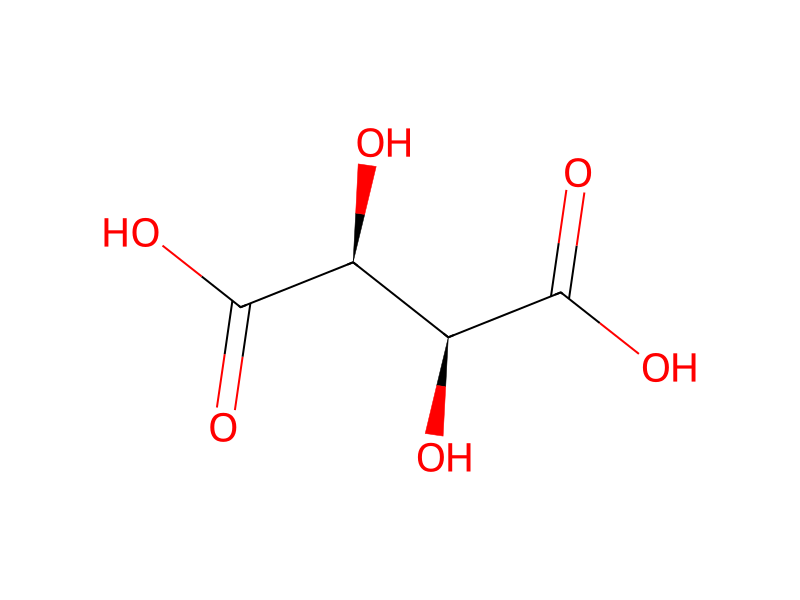
기본 정보
- 표준 SMILES
O=C(O)[C@@H](O)[C@H](O)C(=O)O- InChIKey
FEWJPZIEWOKRBE-LWMBPPNESA-N- 분자식
- C4H6O6
- 평균 분자량
- 150.09 g/mol
개요
D-tartaric acid is the D-enantiomer of tartaric acid. It has a role as an Escherichia coli metabolite. It is a conjugate acid of a D-tartrate(1-). It is an enantiomer of a L-tartaric acid.
이름 및 식별자
- 우선 이름
- D-Tartaric acid
- IUPAC
- (2S,3S)-2,3-dihydroxybutanedioic acid
- 영어명
- L-Tartaric acid
- 분자식
- C4H6O6
- 분자량
- 150.08684
이름 및 동의어
d-Tartaric acidD-(-)-Tartaric acid147-71-7(2S,3S)-2,3-dihydroxybutanedioic acid(-)-Tartaric acidD-threaric acid(-)-D-Tartaric acid(S,S)-Tartaric acid(2S,3S)-(-)-Tartaric acid(2S,3S)-Tartaric acid(-)-(S,S)-Tartaric acid(S,S)-(-)-Tartaric acid
이름 더 보기
unusual tartaric acidRRX6A4PL3CTARTARIC ACID, D-UNNATURAL TARTARIC ACIDDTXSID4043775CHEBI:15672RefChem:130683GlyTouCan:G95238FE
데이터베이스 식별자
- CAS
133-37-9、147-71-7- PubChem CID
- 439655
- DTXSID
DTXSID4043775- ChEMBL
CHEMBL1200861- ChEBI
CHEBI:15672- UNII
- RRX6A4PL3C
- EC Number
- 205-105-7、205-695-6
- Nikkaji
- J9.264I
물성
구조 계산 물성
- XLogP
- -1.9
- 극성 표면적
- 115 Ų
- 수소 결합 공여자 수
- 4
- 수소 결합 수용자 수
- 6
- 회전 가능 결합 수
- 3
- 무거운 원자 수
- 10
- 형식 전하
- 0
- 복잡도
- 134
실험 및 물리화학적 성질
Chemical Classes
Other Classes -> Organic Acids
Other Classes -> Organic Acids
SpringerMaterials PropertiesCrystal structure
FragrancesFragrance Ingredient (Tartaric acid (d-, l-, dl-, meso-)) -> IFRA transparency List
Solubility1.00E+06 mg/L @ 25 °C (exp)
Melting Point169 - 170 °C
Physical Description
Liquid; Other Solid
White solid; [ICSC] Colorless or white odorless solid; [JECFA] White odorless crystalline powder; [Acros Organics MSDS]
Solid; [Merck Index] White odorless crystalline powder; [Alfa Aesar MSDS]
Solid
Collision Cross Section
119.1 Ų [M-H]- [CCS Type: DT; Buffer gas: N2; Ionization: ESI-; Dataset: TOXCAST; Source Identifier: DTXSID5046986]
118.3 Ų [M-H]-
물리화학적 성질
- 녹는점
- 172.5 °C · 172.5 °C
- 끓는 점
- 399.3 · 399.3±42.0 °C(Predicted)
- 밀도
- 1.886 · 1.886±0.06 g/cm3(Predicted)
- 산도 계수 (pKa)
- 3.07 · 3.07±0.34(Predicted)
안전 및 규제
GHS 분류
GHS Classification
This chemical does not meet GHS hazard criteria for 5.1% (26 of 506) of reports.
Danger
H315 (22.1%): Causes skin irritation [Warning Skin corrosion/irritation]
P261, P264, P264+P265, P271, P280, P302+P352, P304+P340, P305+P351+P338, P305+P354+P338, P317, P319, P321, P332+P317, P337+P317, P362+P364, P403+P233, P405, and P501 (click each P-code to see the statement)
Aggregated GHS information provided per 506 reports by companies from 13 notifications to the ECHA C&L Inventory. Each notification may be associated with multiple companies.
This chemical does not meet GHS hazard criteria for 1% (3 of 310) of reports.
유해성 정보
Regulatory Information
Chemical: Butanedioic acid, 2,3-dihydroxy-, (R*,R*)-(.+-.)-
Chemical: Butanedioic acid, 2,3-dihydroxy-, [S-(R*,R*)]-
Butanedioic acid, 2,3-dihydroxy-, (2S,3S)- is listed on the EPA's Chemical Data Reporting (CDR) system. Manufacturers and importers of Butanedioic acid, 2,3-dihydroxy-, (2S,3S)- are required to report information about their production and use of this chemical to the EPA under the Toxic Substances Control Act (TSCA). (40 eCFR Part 711)
Status: Active Update: 23-07-2020 https://echa.europa.eu/registration-dossier/-/registered-dossier/17277
Status: Active Update: 03-10-2022 https://echa.europa.eu/registration-dossier/-/registered-dossier/34095
D-Tartaric acid: Does not have an individual approval but may be used under an appropriate group standard
Other Safety Information
IMAP assessments - Butanedioic acid, 2,3-dihydroxy-, (R*,R*)-(.+-.)-: Human health tier I assessment
Evaluation - Chemicals that are unlikely to require further regulation to manage risks to environment
Hazards Summary
Causes burns; Inhalation of aerosol may cause pulmonary edema; [ICSC] An irritant; [Acros Organics MSDS]
A skin, respiratory tract, and strong eye irritant; [Alfa Aesar MSDS]
Hazard Classes and Categories
Skin Irrit. 2 (22.1%)
Skin Irrit. 2 (23.5%)
독성 정보
Adverse EffectsDermatotoxin - Skin burns.
Carcinogen ClassificationNo indication of carcinogenicity to humans (not listed by IARC).
안전 데이터
- 신호 어
- Danger
- 유해·위험 문구
- 암호 유해·위험 문구 위험 등급 범주 신호 어 그림 문자 P- 코드 H318
화학 및 산업
약리 정보
Cellular LocationsCytoplasm
용도 및 제조
Uses
Used as a synergist for antioxidants, acid, emulsifier, sequestrant, and flavoring agent; [JECFA]
Dextro configuration of levorotatory tartaric acid; Called unnatural but has been found in nature; [Merck Index]
U.S. Production2023: 477,000 lb
Consumer UsesNot Known or Reasonably Ascertainable
Use Classification
Fragrance Ingredients
Flavouring Agent -> FLAVOURING_AGENTFood Additives -> ACID; ANTIOXIDANT_SYNERGIST; EMULSIFIER; SEQUESTRANT; SYNERGIST -> JECFA Functional Classes
General Manufacturing InformationButanedioic acid, 2,3-dihydroxy-, (2S,3S)-: ACTIVE
공급사50 곳
国药集团化学试剂有限公司86-21-63210123 · [email protected]
北京华美互利生物化工010-56205725 · [email protected]
梯希爱(上海)化成工业发展有限公司021-67121386 · [email protected]
衢州润东化工有限公司0570-8789886 18892685668 · [email protected]
上海阿拉丁生化科技股份有限公司400-6206333 13167063860 · [email protected]
爱斯特(成都)生物制药股份有限公司+86-28-85122536 85324413 · [email protected]
上海如吉生物科技发展有限公司+86-21-65211385-8001 36031160 · [email protected]
科瑞迪化学400-821-5857 021-64326257 · [email protected]
上海将来实业股份有限公司400-0066400 13621662912 · [email protected]
Syntechem Co.,Ltd[email protected]
上海迈瑞尔生化科技有限公司4006356688 18621169109 · [email protected]
阿法埃莎(中国)化学有限公司400-6106006 · [email protected]
太原市瑞和丰科贸有限公司+86 351 7031519 · [email protected]
安耐吉化学&3A(安徽泽升科技股份有限公司)400-0056266 · [email protected]
上海瀚鸿科技股份有限公司021-54306202 13764082696 · [email protected]
上海柯维化学技术有限公司021-64609169 18901607656 · [email protected]
上海景颜化工科技有限公司13817811078 · [email protected]
嘉兴市艾森化工有限公司0573-85285100 18627885956 · [email protected]
池州捷峰生物科技有限公司0566-8928158 · [email protected]
Pure Chemistry Scientific Inc.001-857-928-2050 or 1-888-588-9418 · [email protected]
孝感深远化工有限公司15527621225; 15527621225 · [email protected]
山东西亚化学有限公司13355009207 13355009207 · [email protected]
玛雅试剂+86 (573) 82222445 (0)18006601000 452520369 · [email protected]
四川库利南科技有限公司400-1166-196 18981987031 · [email protected]
天津希恩思生化科技有限公司400 638 7771 · [email protected]
湖南汇百侍生物科技有限公司0731-85526065 13308475853 · [email protected]
河南多贝化工有限公司0370-2785118 17550508557 · [email protected]
斯百全化学(上海)有限公司021-021-021-67601398-809-809-809 15221380277 · [email protected]
上海源叶生物科技有限公司13636370518 · [email protected]
艾科试剂4008-755-333 18080918076 · [email protected]
上海思域化工科技有限公司86-21-34053660 · [email protected]
赛默飞世尔科技(中国)有限公司800-810-5118 · [email protected]
北京伊诺凯科技有限公司400-810-7969 010-59572699 · [email protected]
江苏艾康生物医药研发有限公司025-66113011 13913916777 · [email protected]
TOKYO CHEMICAL INDUSTRY CO., LTD.03-36680489 · [email protected]
上海贤鼎生物科技有限公司4009209199 · [email protected]
深圳振强药物研发有限公司0755-66853366 13670046396 · [email protected]
深圳康特腾科技有限公司86-0755-86635001 · [email protected]
越林试剂021-62960152 · [email protected]
泰州天鸿生化科技有限公司0523-86132544 15366717810 · [email protected]
陕西帕尼尔生物科技有限公司13720616393;029-84385017-8003 13720616393 · [email protected]
深圳市石金谷科技有限公司(0086)755-61930359 (0086)18038192047 · [email protected]
泰州天鸿生化科技有限公司15366717998 · [email protected]
上海乐晨国际贸易有限公司021-67256163 · [email protected]
北京环宇世纪化学科技有限公司hysj_bj.com
上海湄水化工科技有限公司021-60549325 18616193163
上海将来实业股份有限公司021-61552785 · [email protected]
天津阿尔塔科技有限公司022-65378550-8551 · [email protected]
HBCChem, Inc.+1-510-219-6317 · [email protected]
日照力德士化工有限公司010-51268198 · [email protected]
관련 반응
139건


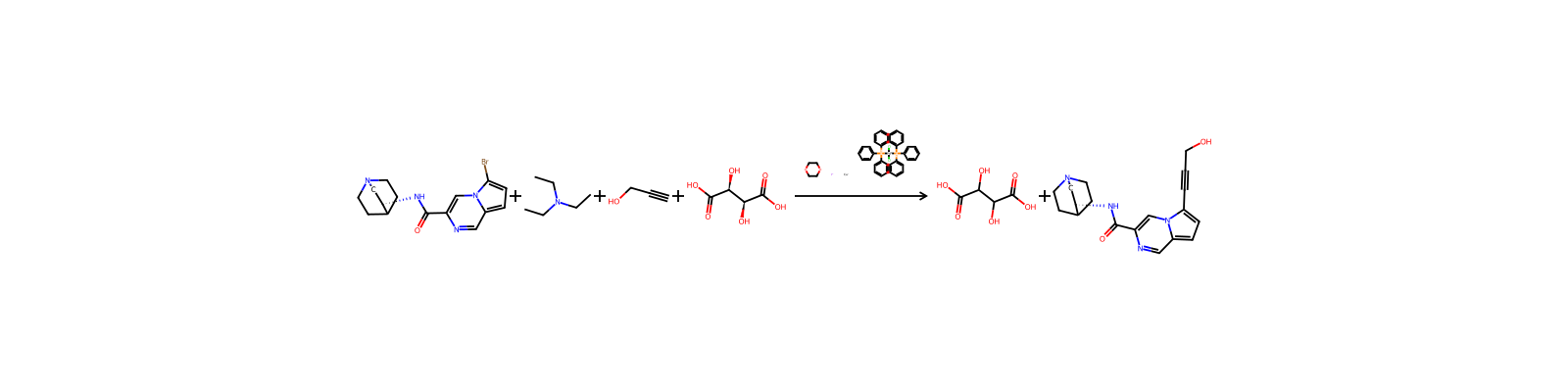


연결된 노트
불러오는 중…