
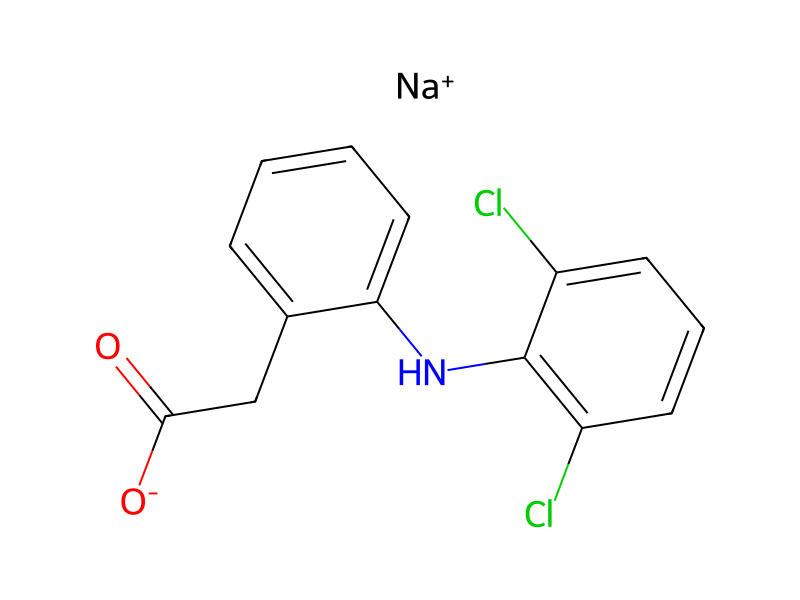
기본 정보
- CAS
15307-79-6- 표준 SMILES
O=C([O-])Cc1ccccc1Nc1c(Cl)cccc1Cl.[Na+]- InChIKey
KPHWPUGNDIVLNH-UHFFFAOYSA-M- 분자식
- C14H10Cl2NNaO2
- 평균 분자량
- 318.1 g/mol
- 단동위원소 질량
- 316.9986282
개요
Diclofenac sodium is the sodium salt of diclofenac. It contains a diclofenac(1-).
이름 및 식별자
- 우선 이름
- Diclofenac sodium
- IUPAC
- sodium 2-[2-(2,6-dichloroanilino)phenyl]acetate
- 현지명
- 디클로페낙 나트륨
- 영어명
- Diclofenac sodium
- 분자식
- C14H10Cl2NNaO2
- 분자량
- 318.13
이름 및 동의어
Diclofenac sodium15307-79-6Diclofenac sodium saltSodium diclofenacSolarazeNeriodinProphenatinVoltarenDiclophenac sodiumAbitrenBenfofenDyloject
이름 더 보기
디클로페낙나트륨디클로페낙나트륨(DICLOFENACSODIUM)tsudohminDiclofenac SodiuAceclofenac EP IMpurity ASODIUM 2-(2,6-DICHLOROANILINO)PHENYLACETATEsodium 2-[2-(2,6-dichloroanilino)phenyl]acetateN-(2,6-Dichlorophenyl)-o-aminophenylacetic acid sodium saltNaclof
EcofenacPennsaidVoltareneVoltaren-XRGP 45840DiclophlogontDealgicDeflamat
데이터베이스 식별자
- CAS
15307-79-6- PubChem CID
- 5018304
- DTXSID
DTXSID3037208- ChEMBL
CHEMBL1034- ChEBI
CHEBI:4509- UNII
- QTG126297Q
- EC Number
- 239-346-4
- Nikkaji
- J8.556A
물성
구조 계산 물성
- 극성 표면적
- 52.2 Ų
- 수소 결합 공여자 수
- 1
- 수소 결합 수용자 수
- 3
- 회전 가능 결합 수
- 4
- 무거운 원자 수
- 20
- 형식 전하
- 0
- 복잡도
- 310
실험 및 물리화학적 성질
Human Drugs
Breast Feeding; Lactation; Milk, Human; Analgesic Agents; Anti-inflammatory Agents, Nonsteroidal
FDA approved drugs -> Active ingredient
FDA approved drugs -> Active ingredient
Animal DrugsActive Ingredients (Diclofenac sodium) -> FDA Greenbook
Collision Cross Section157.2 Ų [M+H]+ [CCS Type: TW; Method: calibrated with polyalanine and drug standards]
물리화학적 성질
- 녹는점
- 288 · 288-290°C
- 밀도
- 0.781 g/cm3 · 0.781 g/cm3
- 저장 조건
- room temp
- 용해도
- 2 O: · H2O: 50 mg/mL
- 산도 계수 (pKa)
- 4 · 4(at 25℃)
- 물리적 상태
- 흰색 고체
- 색상
- 흰색에서 거의 흰색
- 생물학적 소스
- synthetic
- 수용성
- 50 mg/ml까지 · 50mg/ml까지 물에 용해됩니다.
- Merck
- 14 · 14,3081
- BCS Class
- 2 · 2
- 안정성
- 안정적인.
- 주요 응용
- 법의학 및 독성학의약품(소분자)
- InChI
- InChI=1S/C14H11Cl2NO2.Na/c15-10-5-3-6-11(16)14(10)17-12-7-2-1-4-9(12)8-13(18)19;/h1-7,17H,8H2,(H,18,19);/q;+1/p-1
- InChIKey
- KPHWPUGNDIVLNH-UHFFFAOYSA-M
- SMILES
- C1(=CC=CC=C1CC([O-])=O)NC1=C(Cl)C=CC=C1Cl.[Na+]
화학적 성질
Off-White Crystalline Solid
안전 및 규제
GHS 분류
GHS Classification
Danger
H301 (96.7%): Toxic if swallowed [Danger Acute toxicity, oral]
P203, P260, P261, P264, P264+P265, P270, P271, P273, P280, P301+P316, P302+P352, P304+P340, P305+P351+P338, P316, P318, P319, P321, P330, P332+P317, P337+P317, P362+P364, P391, P403+P233, P405, and P501 (click each P-code to see the statement)
Aggregated GHS information provided per 243 reports by companies from 43 notifications to the ECHA C&L Inventory. Each notification may be associated with multiple companies.
유해성 정보
Regulatory Information
Status: Active Update: 27-05-2019 https://echa.europa.eu/registration-dossier/-/registered-dossier/13423
Diclofenac sodium: Does not have an individual approval but may be used under an appropriate group standard
Other Safety InformationIMAP assessments - Benzeneacetic acid, 2-[(2,6-dichlorophenyl)amino]-, monosodium salt: Environment tier I assessment
Hazard Classes and CategoriesAcute Tox. 3 (96.7%)
독성 정보
Exposure RoutesCompletely absorbed from the gastrointestinal tract.
Toxicity Summary
The antiinflammatory effects of diclofenac are believed to be due to inhibition of both leukocyte migration and the enzyme cylooxygenase (COX-1 and COX-2), leading to the peripheral inhibition of prostaglandin synthesis. As prostaglandins sensitize pain receptors, inhibition of their synthesis is responsible for the analgesic effects of diclofenac. Antipyretic effects may be due to action on the hypothalamus, resulting in peripheral dilation, increased cutaneous blood flow, and subsequent heat dissipation.
Signs and SymptomsSymptoms of overdose include loss of consciousness, increased intracranial pressure, and aspiration pneumonitis.
Carcinogen ClassificationNo indication of carcinogenicity to humans (not listed by IARC).
Drug Induced Liver Injury
Drug Induced Liver Injury Rank (DILIrank 2.0)
Diclofenac sodium
vMost-DILI-concern
8
Warnings & precautions
DOI:10.1016/j.drudis.2016.02.015
Effects During Pregnancy and Lactation◉ Summary of Use during Lactation
Toxicity DataLD<sub>50</sub>=390mg/kg (orally in mice)
안전 데이터
- wgk
- 3
- rtecs
- AG6330000
- ridadr
- UN 2811 6.1/PG 3
- 독성
- LD50 in mice, rats (mg/kg): ~390, 150 orally (Krupp)
- HS 번호
- 29224999
- risk_code
- 25-36/37/38-63
- hazard_code
- T,Xi
- safety_code
- 22-36/37-45-36-26-60-20
- 포장분류
- III
- 위험 등급
- 6.1(b)
- 기존화학 물질
- KE-10179
- Hazard Classifications
- Acute Tox. 3 OralAquatic Chronic 2Repr. 2STOT RE 1
- 스토리지 클래스
- 6.1C - Combustible acute toxic Cat.3toxic compounds or compounds which causing chronic effects
화학 및 산업
약리 정보
Metabolism/Metabolites
Hepatic. Route of Elimination: Diclofenac is eliminated through metabolism and subsequent urinary and biliary excretion of the glucuronide and the sulfate conjugates of the metabolites. Little or no free unchanged diclofenac is excreted in the urine. Approximately 65% of the dose is excreted in the urine and approximately 35% in the bile as conjugates of unchanged diclofenac plus metabolites. Half Life: 2 hours
FDA Pharmacological Classification
DICLOFENAC SODIUM
Cyclooxygenase Inhibitors [MoA]; Nonsteroidal Anti-inflammatory Drug [EPC]; Anti-Inflammatory Agents, Non-Steroidal [CS]; Decreased Prostaglandin Production [PE]
DICLOFENAC SODIUM 1%
Cyclooxygenase Inhibitors [MoA]; Anti-Inflammatory Agents, Non-Steroidal [CS]; Decreased Prostaglandin Production [PE]; Nonsteroidal Anti-inflammatory Drug [EPC]
DICLOFENAC SODIUM D/R
Cyclooxygenase Inhibitors [MoA]; Nonsteroidal Anti-inflammatory Drug [EPC]; Decreased Prostaglandin Production [PE]; Anti-Inflammatory Agents, Non-Steroidal [CS]
MeSH Pharmacological Classification
Anti-inflammatory agents that are non-steroidal in nature. In addition to anti-inflammatory actions, they have analgesic, antipyretic, and platelet-inhibitory actions. They act by blocking the synthesis of prostaglandins by inhibiting cyclooxygenase, which converts arachidonic acid to cyclic endoperoxides, precursors of prostaglandins. Inhibition of prostaglandin synthesis accounts for their analgesic, antipyretic, and platelet-inhibitory actions; other mechanisms may contribute to their anti-inflammatory effects.
Compounds or agents that combine with cyclooxygenase (PROSTAGLANDIN-ENDOPEROXIDE SYNTHASES) and thereby prevent its substrate-enzyme combination with arachidonic acid and the formation of eicosanoids, prostaglandins, and thromboxanes.
용도 및 제조
UsesFor the acute and chronic treatment of signs and symptoms of osteoarthritis and rheumatoid arthritis.
Use ClassificationAnimal Drugs -> FDA Approved Animal Drug Products (Green Book) -> Active Ingredients
응용 분야
용도1. 백내장 수술시 다음 증상의 방지. ·수술 후 염증 ·수술 중 축동. ·수정체 축출과 인공수정체 삽입술과 관련된 낭포황반부종. 2. 전안부의 염증 치료. ·만성 결막염등 비감염성 염증 ·외상 후 염증.
개요Diclofenac is a non-steroidal anti-inflammatory drug (NSAID) and COX inhibitor (IC50s = 0.9-2.7 and 1.5-20 μM, for human COX-1 and COX-2, respectively). It is also an active metabolite of diclofenac methyl ester and diclofenac amide . Diclofenac inhibits release of arachidonic acid (Item Nos. 90010 | 90010.1 | 10006607) induced by A23187 in isolated rat peritoneal neutrophils and macrophages (IC50s = 60 and 10 μM, respectively). Transdermal administration of diclofenac inhibits carrageenan-induced paw edema in rats. Formulations containing diclofenac have been used in the treatment of pain associated with osteoarthritis, rheumatoid arthritis, and ankylosing spondylitis.
역사Diclofenac sodium is a classic nonsteroidal anti-inflammatory drug (NSAID), known for its potent antipyretic, analgesic, and anti-inflammatory effects, and is marketed under brand names such as Voltaren. Its discovery and widespread use have had a profound impact on the treatment of pain and inflammation.Discovery and Patent (1965): Diclofenac sodium was synthesized by a team of researchers Rudolf Pfister and Alfred Sallmann at the Swiss pharmaceutical company Ciba-Geigy AG (now part of Novartis) while searching for a highly active and well-tolerated NSAID. The compound was patented in 1965.First Market Launch (1973): After extensive preclinical and clinical trials, diclofenac sodium was first marketed globally in 1973 under the brand name Voltaren. Its design philosophy is based on clear principles and aims to be an effective cyclooxygenase (COX) inhibitor.
용도Diclofenac sodium is a nonsteroidal anti-inflammatory compound and cyclooxygenase (COX) inhibitor. Oxidation of diclofenac sodium produces the metabolite 4'-hydroxy diclofenac) which demonstrates specific inhibition of Cox-2. Inhibition of Cox by diclofenac and 4'-hydroxy diclofenac suppresses prostaglandin E2 synthesis, producing anti-inflammatory and analgesic effects. Diclofenac is also shown to stabilize the native tetrameric conformation of transthyretin (TTR) fibrils, preventing the formation of insoluble amyloidogenic TTR deposits. Diclofenac Sodium is a substrate of CYP2C9. It is also used as an inhibitor of Cox-1 and Cox-2.
일반 설명Pharmaceutical secondary standards for application in quality control, provide pharma laboratories and manufacturers with a convenient and cost-effective alternative to the preparation of in-house working standards.Diclofenac is a derivative of benzeneacetic acid. It is categorized under the class of non-steroidal anti-inflammatory drugs (NSAIDs). It shows inflammatory, analgesic and antipyretic activities.
상·하류 제품 정보
상류 원료
하류 제품
공급사100 곳
北京华美互利生物化工010-56205725 · [email protected]
梯希爱(上海)化成工业发展有限公司021-67121386 · [email protected]
上海阿拉丁生化科技股份有限公司400-6206333 13167063860 · [email protected]
T&W GROUP021-61551611 13296011611 · [email protected]
江苏荣硕药业有限公司0000-15105138935 15105138935 · [email protected]
LGM Pharma1-(800)-881-8210 · [email protected]
Syntechem Co.,Ltd[email protected]
上海迈瑞尔生化科技有限公司4006356688 18621169109 · [email protected]
大连美仑生物技术有限公司0411-62910999 13889544652 · [email protected]
山东穗泰生物科技有限公司15689727968 · [email protected]
太原市瑞和丰科贸有限公司+86 351 7031519 · [email protected]
安耐吉化学&3A(安徽泽升科技股份有限公司)400-0056266 · [email protected]
上海瀚鸿科技股份有限公司021-54306202 13764082696 · [email protected]
上海柯维化学技术有限公司021-64609169 18901607656 · [email protected]
上海相辉医药科技有限公司13761987713 · [email protected]
Pure Chemistry Scientific Inc.001-857-928-2050 or 1-888-588-9418 · [email protected]
MedChemexpress LLC021-58955995 · [email protected]
云南西力生物技术股份有限公司0871-65217109 · [email protected]
山东西亚化学有限公司13355009207 13355009207 · [email protected]
玛雅试剂+86 (573) 82222445 (0)18006601000 452520369 · [email protected]
天津希恩思生化科技有限公司400 638 7771 · [email protected]
武汉科美沃化工有限公司027-85736489 · [email protected]
斯百全化学(上海)有限公司021-021-021-67601398-809-809-809 15221380277 · [email protected]
上海源叶生物科技有限公司13636370518 · [email protected]
西安康培基生物科技有限公司86-029-85456576 · [email protected]
赛默飞世尔科技(中国)有限公司800-810-5118 · [email protected]
上海纳谦化学科技有限公司13598610367 0373-7129549 · [email protected]
AdooQ BioScience, LLC+1 (866) 930-6790 · [email protected]
上海遐瑞医药科技有限公司+86 21 61551611
TCI AMERICA800-4238616 · [email protected]
TOKYO CHEMICAL INDUSTRY CO., LTD.03-36680489 · [email protected]
TCI Europe320-37350700 · [email protected]
广州爱纯医药科技有限公司020-39119399 18927568969 · [email protected]
南京生利德生物科技有限公司025-57798810 18652991625 · [email protected]
深圳市石金谷科技有限公司(0086)755-61930359 (0086)18038192047 · [email protected]
Cato Research Chemicals Inc.020-81960175 · [email protected]
上海湄水化工科技有限公司021-60549325 18616193163
上海将来实业股份有限公司400-0066400 13621662912 · [email protected]
上海将来实业股份有限公司021-61552785 · [email protected]
上海笛柏生物科技有限公司400-008-9730,021-54359730 400-008-9730 · [email protected]
上海石洋化工有限公司021-56795766 · [email protected]
四川省维克奇生物科技有限公司028-81700200 18116577057 · [email protected]
雷丁试剂0510-85629785 18013409632 · [email protected]
上海创赛科技有限公司400-6087598 15021221957 · [email protected]
杭州宇昊化工科技有限公司0571-82693216 · [email protected]
上海麦克林生化科技股份有限公司15221275939 15221275939 · [email protected]
上海乾劲化工科技有限公司021-20900665 17321230821 · [email protected]
杭州杰恒化工有限公司0571-87396432 · [email protected]
上海纳谦化学科技有限公司13598610367 13598610367 · [email protected]
江苏艾康生物医药研发有限公司025-66028182 17714375163 · [email protected]
추가 설명
정의ChEBI: Diclofenac sodium is the sodium salt of diclofenac. It contains a diclofenac(1-).
관련 반응
24건


화합물 노트
불러오는 중…