
HRID 726524촉매로
Nickel sulfate hexahydrate
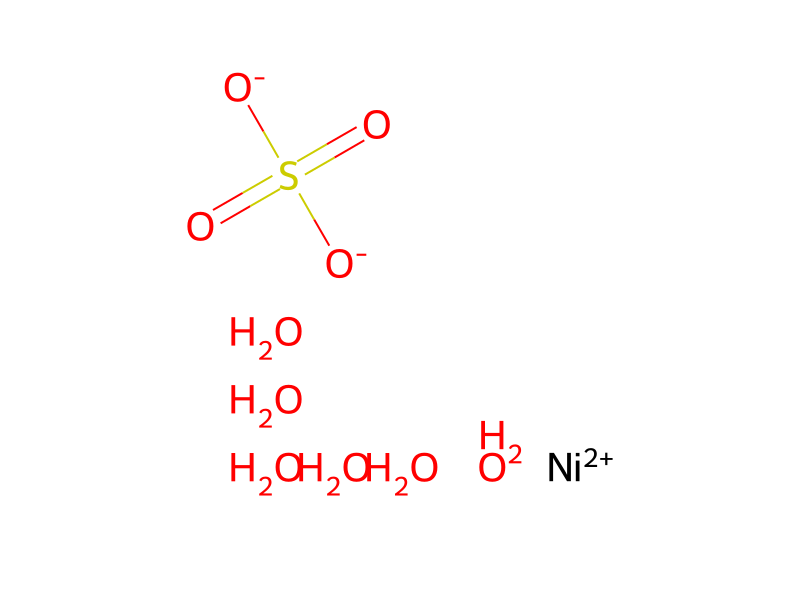
10101-97-0O.O.O.O.O.O.O=S(=O)([O-])[O-].[Ni+2]RRIWRJBSCGCBID-UHFFFAOYSA-LNickel sulfate hexahydrate appears as blue or emerald-green crystalline material. Toxic and carcinogenic. Two known phases. Alpha-form (blue tetragonal) converts to beta-form (green monoclinic) at 127.9 °F. Becomes blue and opaque at room temperature. Odorless. Sweet astringent taste. Somewhat efflorescent. Greenish-yellow anhydrous salt is formed at 536 °F. (NTP, 1992)
Metals -> Nickel Compounds, Inorganic
Carcinogens
2.07 (NTP, 1992) - Denser than water; will sink
2.031 @25 °C
Nickel sulfate hexahydrate appears as blue or emerald-green crystalline material. Toxic and carcinogenic. Two known phases. Alpha-form (blue tetragonal) converts to beta-form (green monoclinic) at 127.9 °F. Becomes blue and opaque at room temperature. Odorless. Sweet astringent taste. Somewhat efflorescent. Greenish-yellow anhydrous salt is formed at 536 °F. (NTP, 1992)
Liquid; Other Solid; Liquid
Blue to emerald-green crystals that are water soluble; [CAMEO]
안전 정보는 참고용이며, 공급업체의 물질안전보건자료(SDS), 관련 법규 및 전문가 평가를 대체하지 않습니다.
This chemical does not meet GHS hazard criteria for 0.6% (2 of 326) of reports.
Danger
H302+H332 (54.9%): Harmful if swallowed or if inhaled [Warning Acute toxicity, oral; acute toxicity, inhalation]
P203, P233, P260, P261, P264, P270, P271, P272, P273, P280, P284, P301+P317, P302+P352, P304+P340, P317, P318, P319, P321, P330, P332+P317, P333+P317, P342+P316, P362+P364, P391, P403, P405, and P501 (click each P-code to see the statement)
Aggregated GHS information provided per 326 reports by companies from 25 notifications to the ECHA C&L Inventory. Each notification may be associated with multiple companies.
Danger
Sulfuric acid, nickel(2+) salt (1:1), hexahydrate is listed on the EPA's Chemical Data Reporting (CDR) system. Manufacturers and importers of Sulfuric acid, nickel(2+) salt (1:1), hexahydrate are required to report information about their production and use of this chemical to the EPA under the Toxic Substances Control Act (TSCA). (40 eCFR Part 711)
Nickel (II) sulphate, hexahydrate: HSNO Approval: HSR005114 Approved with controls
The New Jersey Worker and Community Right to Know Act requires public and private employers to provide information about hazardous substances at their workplaces. (N.J.S.A. 34:5A-1 et. seq.)
SYMPTOMS: Symptoms of exposure to this class of compounds include irritation of the skin, eyes and respiratory tract; skin sensitization and a dermatitis known as "nickel itch". This begins with a sensation of burning and itching in the hand, followed by erythema and a nodular eruption on the web of the fingers, wrists and forearms. The nodules may become pustules or may ulcerate. In the chronic stage, pigmented or depigmented plaque may be formed. It may also be accompanied by lichenification resembling atopic or neurodermatitis. Other symptoms may include diarrhea, allergic skin rash, giddiness, coughing, sore throat, shortness of breath, irritation of the gastrointestinal tract, abdominal pain, eye damage, nasal or lung damage, and liver and kidney damage. It may cause nausea, vomiting, central nervous system depression and myocardial weakness. Other symptoms include local astringent action, emesis, hyperglycemia, weakness, headache, palpitations and capillary damage (especially in the brain and adrenals). It may also cause asthma, burning pain in the mouth and throat, tenesmus, retching, hemolysis, hematuria, anuria, jaundice, hypotension, collapse and convulsions. Chronic eczema and fever may occur. Pulmonary fibrosis and pulmonary edema have been reported. Pneumonitis has also been reported. Prolonged exposure to excessive concentrations of dust may cause chronic pulmonary disorders. Chronic repeated application of solutions of this class of compounds to the skin may cause erythematous, papular and granulomatous reactions in susceptible individuals.
Drugs that act locally on cutaneous or mucosal surfaces to produce inflammation; those that cause redness due to hyperemia are rubefacients; those that raise blisters are vesicants and those that penetrate sebaceous glands and cause abscesses are pustulants; tear gases and mustard gases are also irritants.
Used in nickel plating as a mordant in dyeing and to make catalysts and other nickel compounds; [Merck Index] Mainly used as an electrolyte in nickel plating baths; [Ullmann]
Electroplating [Category: Plate]
용도Nickel sulfate hexahydrate is a source of nickel metal, a common allergen present in various alloys, electroplated metal, earrings, lipstick holders, watches, buttons, zippers, rings, utensils, tools, instruments, batteries, machinery parts, working solutions of metal cutting fluids, nickel plating for alloys, coins, pigments, dentures, orthopedic plates, keys, scissors, razors, spectacle frames, kitchenware etc. May produce erythema multiforme like eruptions.
일반 설명Blue or emerald-green crystalline material. Toxic and carcinogenic. Two known phases. Alpha-form (blue tetragonal) converts to beta-form (green monoclinic) at 127.9°F. Becomes blue and opaque at room temperature. Odorless. Sweet astringent taste. Somewhat efflorescent. Greenish-yellow anhydrous salt is formed at 536°F.

10101-97-0DTXSID7020928CHEBI:53437Nickel sulphate hexahydrate is available as odourless, blue-green crystals. It is stable at room temperature in closed containers under normal storage and handling conditions and incompatible with strong acids and strong oxidising agents. On decomposition, nickel (II) sulphate hydroxylate releases oxides of sulphur, irritating and toxic fumes and gases, and nickel oxide.
Reported health effects include contact dermatitis, asthma, GI irritation, liver and kidney damage, and pneumonitis. [CAMEO] Chronic inhalation studies of rats and mice show pulmonary inflammation; [ACGIH] SeeNickel and linked occupational diseases.
NICKEL SULFATE HEXAHYDRATE is incompatible with strong acids, sulfur, Ni(NO3)2, wood and other combustibles. (NTP, 1992) At elevated temperature undergoes violent reaction with powdered aluminum or magnesium. When heated to decomposition it emits very toxic fumes of oxides of sulfur [Lewis, 3rd ed., 1993, p. 918].
Acute Tox. 4 (96%)
Acute toxicity (Oral) - Category 3
Carcinogens
EYES: First check the victim for contact lenses and remove if present. Flush victim's eyes with water or normal saline solution for 20 to 30 minutes while simultaneously calling a hospital or poison control center. Do not put any ointments, oils, or medication in the victim's eyes without specific instructions from a physician. IMMEDIATELY transport the victim after flushing eyes to a hospital even if no symptoms (such as redness or irritation) develop.
SMALL SPILLS AND LEAKAGE: If you spill this chemical, you should dampen the solid spill material with water, then transfer the dampened material to a suitable container. Use absorbent paper dampened with water to pick up any remaining material. Seal your contaminated clothing and the absorbent paper in a vapor-tight plastic bag for eventual disposal. Wash all contaminated surfaces with a soap and water solution. Do not reenter the contaminated area until the Safety Officer (or other responsible person) has verified that the area has been properly cleaned.
1.3 [mg/m3]
8.7 [mg/m3]
52 [mg/m3]
RECOMMENDED RESPIRATOR: Where the neat test chemical is weighed and diluted, wear a NIOSH-approved half face respirator equipped with an organic vapor/acid gas cartridge (specific for organic vapors, HCl, acid gas and SO2) with a dust/mist filter. (NTP, 1992)
10 mg Ni/m3 ; A potential occupational carcinogen. (NIOSH, 2024)
10.0 [mg/m3], as Ni
Nickel Sulfate Hexahydrate
TR-454: Toxicology and Carcinogenesis Studies of Nickel Sulfate Hexahydrate (CASRN 10101-97-0) in F344/N Rats and B6C3F1 Mice (Inhalation Studies) (1996 )
11/29/94
No Evidence
No Evidence
No Evidence
정의ChEBI: A hydrate that is the hexahydrate of nickel sulfate.