
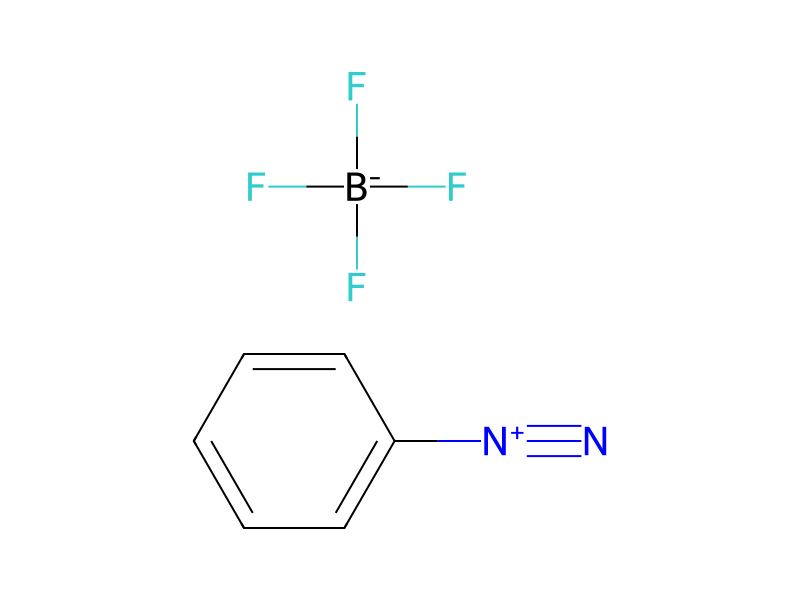
기본 정보
- 표준 SMILES
F[B-](F)(F)F.N#[N+]c1ccccc1- InChIKey
JNCLVGMBRSKDED-UHFFFAOYSA-N- 분자식
- C6H5BF4N2
- 평균 분자량
- 191.92 g/mol
- 단동위원소 질량
- 192.048191
이름 및 식별자
- 우선 이름
- Benzenediazonium tetrafluoroborate
- IUPAC
- benzenediazonium tetrafluoroborate
- 현지명
- 벤젠디아조늄,테트라플루오로보레이트
- 영어명
- Benzenediazonium,tetrafluoroborate
- 분자식
- BF4*C6H5N2
- 분자량
- 0
이름 및 동의어
Benzenediazonium tetrafluoroborate369-57-3Phenyldiazonium tetrafluoroborateDTXSID5021467Benzenediazonium fluoborateBenzenediazonium fluoroboratePhenyldiazonium fluoborate (salt)RefChem:117393DTXCID501467820-352-6BENZENEDIAZONIUM,TETRAFLUOROBORATEbenzenediazonium;tetrafluoroborate
이름 더 보기
벤젠디아조늄,테트라플루오로보레이트Ccris 5461Sildenafil Impurity 44Diazobenzene tetrafluoroborateBenzenediazonium·tetrafluoroboronanion
Benzenediazonium, tetrafluoroboranuideMFCD00968947C6H5BF4N2SCHEMBL237168SCHEMBL28241318SCHEMBL29095313JNCLVGMBRSKDED-UHFFFAOYSA-Nbenzenediazonium; tetrafluoroboranuide
데이터베이스 식별자
- CAS
369-57-3- PubChem CID
- 5284485
- DTXSID
DTXSID5021467- EC Number
- 820-352-6
물성
구조 계산 물성
- 극성 표면적
- 28.2 Ų
- 수소 결합 공여자 수
- 0
- 수소 결합 수용자 수
- 6
- 회전 가능 결합 수
- 0
- 무거운 원자 수
- 13
- 형식 전하
- 0
- 복잡도
- 124
물리화학적 성질
- 녹는점
- 121 · 121-122 °C (decomp)
- 밀도
- 1.53 g/cm3 · 1.53 g/cm3(Temp: 25 °C)
- 용해도
- 2 O; · fairly sol polar solvents such as acetonitrile, acetone, pyridine, DMF, DMSO, and HMPA with decomposition; slightly sol water; insol hydrocarbons and Et2O; solubilized in nonpolar media by crown ethers.
- 색상
- 80 °C · colorless solid after recrystallization; turns pink at 80 °C
안전 및 규제
GHS 분류
GHS Classification
Danger
H228 (66.7%): Flammable solid [Danger Flammable solids];H302 (100%): Harmful if swallowed [Warning Acute toxicity, oral];H315 (100%): Causes skin irritation [Warning Skin corrosion/irritation];H319 (100%): Causes serious eye irritation [Warning Serious eye damage/eye irritation];H335 (100%): May cause respiratory irritation [Warning Specific target organ toxicity, single exposure; Respiratory tract irritation];H373 (33.3%): May causes damage to organs through prolonged or repeated exposure [Warning Specific target organ toxicity, repeated exposure]
P210, P240, P241, P260, P261, P264, P264+P265, P270, P271, P280, P301+P317, P302+P352, P304+P340, P305+P351+P338, P319, P321, P330, P332+P317, P337+P317, P362+P364, P370+P378, P403+P233, P405, and P501 (click each P-code to see the statement)
Aggregated GHS information provided per 3 reports by companies from 3 notifications to the ECHA C&L Inventory. Each notification may be associated with multiple companies.;Information may vary between notifications depending on impurities, additives, and other factors. The percentage value in parenthesis indicates the notified classification ratio from companies that provide hazard codes. Only hazard codes with percentage values above 10% are shown. For more detailed information, please visit ECHA C&L website.
유해성 정보
Hazards SummaryCauses dermatitis in oral and subcutaneous lethal-dose studies of hamsters; [RTECS] See Diazobenzenesulfonic acid. See 4-Nitrobenzenediazonium tetrafluoroborate. See Potassium tetrafluoroborate.
Hazard Classes and CategoriesFlam. Sol. 1 (66.7%);Acute Tox. 4 (100%);Skin Irrit. 2 (100%);Eye Irrit. 2 (100%);STOT SE 3 (100%);STOT RE 2 (33.3%)
안전 데이터
- 독성
- mmo-sat 10 mmol/L CNREA8 42,1446,82
화학 및 산업
응용 분야
용도Benzenediazonium Tetrafluoroborate is much higher stability than the corresponding chlorides; shock-insensitive; often used when pure, isolated arenediazonium salts are needed; reagent for introducing aryl, arylazo, arylhydrazono, or amino groups; forms fluoroarenes upon heating; building block for heterocycles.
제조 방법
Preparative Methods of Benzenediazonium Tetrafluoroborate: The most commonly used procedures consist in diazotization of an aromatic amine (ArNH2) with NaNO2 in aqueous HCl or H2SO4 followed by precipitation of the salt with added NaBF4 or fluoroboric acid. Alternatively, the diazotization can be carried out directly in 40-50% aqueous HBF4. Aromatic amines that do not dissolve in aqueous mineral acids can be reacted with NO+BF4 - in an anhydrous organic solvent or in liquid SO2. This method can also be applied to N-(trimethylsilyl)anilines and for the preparation of those salts that are not easily isolated from water. An improved, high-yielding one-pot procedure employs ArNH2, t-BuONO, and BF3. Et2O in an anhydrous organic solvent, typically CH2Cl2.
상·하류 제품 정보
상류 원료
하류 제품
공급사33 곳
陕西缔都新材料有限公司81124267 17392282731 · [email protected]
武汉敬康恩生物医药科技有限公司13720134139 086-15871494362 13720134139 · [email protected]
广州隽沐生物科技股份有限公司020-36607679; 13502246435 · [email protected]
江苏艾康生物医药研发有限公司025-66061636 19370895928 · [email protected]
广州隽唐科技有限公司020-36607679 13502246435 · [email protected]
Allfluoro Pharmaceutical Company Limited+86-400-0216110 +86-15958047586 · [email protected]
欧利希(湖北)医药科技有限公司17316404525 17316404525 · [email protected]
希瓦生物科技(广州)有限公司13268215580 · [email protected]
韶远科技(上海)有限公司021-50795510 4000665055 · [email protected]
河南阿尔法化工有限公司0371-55013243 15324716602 · [email protected]
上海景颜化工科技有限公司13817811078 · [email protected]
NANJING YINGWEN BIOTECHNOLOGY CO LTD+86-13382787392 · [email protected]
常州宣叶科技有限公司15195022192 · [email protected]
成都创科诚生物科技有限公司028-028-0000000 13008177686 · [email protected]
Wuhan Jingkang en Biomedical Technology Co., Ltd+86-0086-13720134139 · [email protected]
Standardpharm Co. Ltd.86-714-3992388 · [email protected]
河南伊诺凯新材料有限公司15764055027 15764055027 · [email protected]
Shaanxi Dideu New Materials Co. Ltd18192503167 · [email protected]
武汉市恒瑞信泰生物医药科技有限公司027-027-65522215 18163303831 · [email protected]
ATK CHEMICAL COMPANY LIMITED+undefined-21-51877795 · [email protected]
career henan chemical co+86-0371-86658258 · [email protected]
上海固帮新材料科技有限公司021-51317962 · [email protected]
湖北摩科化学有限公司18627753421; 18627756402 · [email protected]
湖北达豪化工有限公司027-027-59106191 13986034860 · [email protected]
爆牛贸易重庆有限公司+86-023-6139-8061 +86-86-13650506873 · [email protected]
长沙福臻生物科技有限公司15111215862 18229892877 · [email protected]
湖北拓邦化工有限公司027-59106185 13986192185 · [email protected]
SHANGHAI KEAN TECHNOLOGY CO., LTD.+8613817748580 · [email protected]
天门恒昌化工有限公司027-59322316 15172518801 · [email protected]
Hefei TNJ Chemical Industry Co.,Ltd.+86-0551-65418671 +86-189 4982 3763 · [email protected]
湖北鑫红利化工有限公司027-027-59106151 15172325309 · [email protected]
淄博航宇生物科技发展有限公司+86-0533-2185556 +86-15965530500 · [email protected]
Henan Fengda Chemical Co., Ltd+86-371-86557731 +86-13613820652 · [email protected]
관련 반응
17건


연결된 노트
불러오는 중…