
기본 정보
- 표준 SMILES
COC(=O)c1ccccc1S(=O)(=O)NC(=O)Nc1nc(C)nc(OC)n1- InChIKey
RSMUVYRMZCOLBH-UHFFFAOYSA-N- 분자식
- C14H15N5O6S
- 평균 분자량
- 381.37 g/mol
- 단동위원소 질량
- 381.0743042
개요
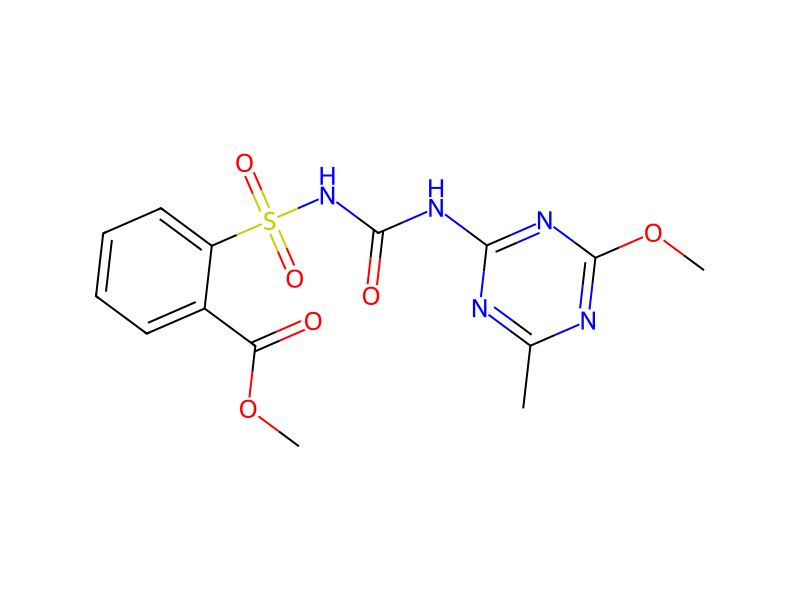
Metsulfuron methyl is a N-sulfonylurea in which the sulfonyl group is attached to a 2-(methoxycarbonyl)phenyl group while a (4-methoxy-6-methyl-1,3,5-triazin-2-yl group replaces one of the amino hydrogens of the remaining urea group. It has a role as a herbicide, a xenobiotic and an environmental contaminant. It is a benzoate ester, a methoxy-1,3,5-triazine and a N-sulfonylurea.
이름 및 식별자
- 우선 이름
- Metsulfuron-methyl
- IUPAC
- methyl 2-[(4-methoxy-6-methyl-1,3,5-triazin-2-yl)carbamoylsulfamoyl]benzoate
- 영어명
- Metsulfuron methyl
- 분자식
- C14H15N5O6S
- 분자량
- 381.36
이름 및 동의어
METSULFURON-METHYL74223-64-6Metsulfuron methylEscortGropperALLYGranstarAllieMetsulfuron methyl esterEscort (pesticide)ALLY 20DFHCHA 92HA
이름 더 보기
QUITMALBANdpx6376Ally[R]ally20df
methyl 2-[(4-methoxy-6-methyl-1,3,5-triazin-2-yl)carbamoylsulfamoyl]benzoateDTXSID6023864DPD 63760HDPX 6376T 6376N-((4-Methoxy-6-methyl-1,3,5-triazin-2-yl)aminocarbonyl)-2-methoxycarbonylbenzenesulfonamideDTXCID303864Benzoic acid, 2-(((((4-methoxy-6-methyl-1,3,5-triazin-2-yl)amino)carbonyl)amino)sulfonyl)-, methyl ester
데이터베이스 식별자
- CAS
2377723-88-9、74223-64-6- PubChem CID
- 52999
- DTXSID
DTXSID6023864- ChEMBL
CHEMBL1229749- ChEBI
CHEBI:39678- UNII
- 2589ET7417
- EC Number
- 616-063-8、879-784-9
- Nikkaji
- J327.334B
물성
구조 계산 물성
- XLogP
- 1.5
- 극성 표면적
- 158 Ų
- 수소 결합 공여자 수
- 2
- 수소 결합 수용자 수
- 9
- 회전 가능 결합 수
- 6
- 무거운 원자 수
- 26
- 형식 전하
- 0
- 복잡도
- 609
실험 및 물리화학적 성질
Pesticides
Pesticide -> EPA IRIS
Herbicides
Active substance -> EU Pesticides database: Approved
Pesticides -> Herbicides, Sulfonylurea
Pesticides -> Herbicides -> Urea herbicides -> Sulfonylurea herbicides
Herbicides
LogP
log Kow = 2.20
0.93
OdorFaint, sweet, ester-like
Color/Form
White crytals
White to pale yellow solid
Colorless crystals
Solubility
Solubility (mg/L at 25 °C): hexane 5.84X10⁻¹, ethyl acetate 1.11X10+4, methanol 7.63X10+3, acetone 3.7X10+4, dichloromethane 1.32X10+5, toluene 1.24X10+3.
In water, 9.50X10+3 mg/L at 25 °C
Melting Point163 °C
Vapor Pressure
0.000058 [mmHg]
2.5X10⁻¹² mm Hg at 25 °C
Physical DescriptionWhite solid; [Merck Index] Colorless or white to pale yellow solid with a mild sweet ester-like odor; [HSDB]
Stability/Shelf Life
Photolytically stable.
Stable in air to about 140 °C. It is hydrolysed in acid solution, 50% loss (25 °C) occurs in 15 hr at pH 2, 33 days at pH 5, > 41 days at pH 7 and pH 9, but is more rapid at 45 °C.
Dissociation ConstantspKa = 3.8 at 20 °C
물리화학적 성질
- 녹는점
- 158 °C · 158°C
- 끓는 점
- 181 °C · 181°C (rough estimate)
- 밀도
- 1.4561 · 1.4561 (rough estimate)
- 굴절률
- 1.646 · 1.6460 (estimate)
- 저장 조건
- 0 · 0-6°C
- 용해도
- DMSO(약간 용해됨), 메탄올(약간 용해됨, 가열)
- 물리적 상태
- Solid
- 산도 계수 (pKa)
- 2.55 · 2.55±0.10(Predicted)
- 색상
- 흰색에서 황백색까지
- 수용성
- 27 mg/L · 27mg/L(온도는 명시되지 않음)
- BRN
- 587472 · 587472
- Henry's Law Constant
- 7.5 · 7.5×1010 mol/(m3Pa) at 25℃, HSDB (2015)
- 주요 응용
- 농업환경
- InChI
- InChI=1S/C14H15N5O6S/c1-8-15-12(18-14(16-8)25-3)17-13(21)19-26(22,23)10-7-5-4-6-9(10)11(20)24-2/h4-7H,1-3H3,(H2,15,16,17,18,19,21)
- InChIKey
- RSMUVYRMZCOLBH-UHFFFAOYSA-N
- SMILES
- C(OC)(=O)C1=CC=CC=C1S(NC(NC1=NC(OC)=NC(C)=N1)=O)(=O)=O
- LogP
- 2.2 · 2.200
- EPA
- Metsulfuron-methyl (74223-64-6)
화학적 성질
Light yellow solid
안전 및 규제
GHS 분류
GHS Classification
Warning
H400: Very toxic to aquatic life [Warning Hazardous to the aquatic environment, acute hazard]
P273, P391, and P501 (click each P-code to see the statement)
Warning
H400 (100%): Very toxic to aquatic life [Warning Hazardous to the aquatic environment, acute hazard]
P273, P391, and P501 (click each P-code to see the statement)
유해성 정보
Regulatory Information
Commission Regulation No 844/2012
Metsulfuron methyl is listed in the dataset of EPA Human Health Benchmarks for Pesticides under the Safe Drinking Water Act (40 eCFR 141)
00/49/EC, 2010/77/EU, Reg (EU) 2018/155, Reg. (EU) 2015/1885, Reg. (EU) 2016/139, Reg. (EU) 2023/114, Reg. (EU) 2024/324, Reg. (EU) No 540/2011
Metsulfuron-methyl: Does not have an individual approval but may be used under an appropriate group standard
Hazards Summary
An eye and mild skin irritant; Urea-derived herbicides have low toxicity in animal feeding studies; [HSDB] Systemic toxicity unlikely unless large amounts ingested; [EPA Pesticides, p. 122] In a 90-day feeding study at 5000 mg/kg diet, dogs had no apparent systemic toxicity; [HSDB]
Special ReportsBlair AM, Martin TD; Pestic Sci 22 (3): 195-220 (1988). A review of the activity, fate and mode of action of sulfonylurea herbicides.
FIFRA Requirements
Tolerances are established for the combined residues of the herbicide metsulfuron methyl (methyl 2-[[[[(4-methoxy-6-methyl-1,3,5-triazin-2-yl)amino]carbonyl]amino]sulfonyl]benzoate) and its metabolite methyl 2-[[[[(4-methoxy-6-methyl-1-,3,5-triazin-2-yl)amino]carbonyl]amino] sulfonyl]-4-hydroxybenzoate in or on the following raw material agricultural commodities: barley, grain; barley, hay; barley, straw; grass, fodder; grass, forage; grass, hay; sorghum, grain, forage; sorghum, grain, grain; sorghum, grain, stover; sugarcane, cane; wheat, forage; wheat, grain; wheat, hay; and wheat, straw.
Tolerances are established for residues of metsulfuron methyl (methyl-2[[[[(4-methoxy-6-methyl-1,3,5-triazin-2-yl) amino]carbonyl] amino]sulfonyl]benzoate) in or on the following raw agricultural commodities: cattle, fat; cattle, kidney; cattle, meat; cattle, meat byproducts; goat, fat; goat, kidney; goat, meat; goat, meat byproducts; hog, fat; hog, kidney; hog, meat; hog, meat byproducts; horse, fat; horse, kidney; horse, meat; horse, meat byproducts; milk; sheep, fat; sheep, kidney; sheep, meat; and sheep, meat byproducts.
New Active Ingredients ... includes pesticide active ingredients initially registered after November 1, 1984, that currently have active product registrations. By law, these newer pesticides are not subject to the reregistration program. They must, however, meet the new safety standard of the FQPA, and will be reviewed on a 15-year cycle under the registration review program. ... Active Ingredient Number: 122010; Type of Pesticide: conventional - herbicide; Use Site: food use, pastures, rangeland, turf, etc; Year: 1986.
Hazard Classes and Categories
Aquatic Acute 1 (100%)
Hazardous to the aquatic environment (acute) - category 1
Aquatic Acute 1
Shipment Methods and Regulations
No person may /transport,/ offer or accept a hazardous material for transportation in commerce unless that person is registered in conformance ... and the hazardous material is properly classed, described, packaged, marked, labeled, and in condition for shipment as required or authorized by ... /the hazardous materials regulations (49 CFR 171-177)./
The International Air Transport Association (IATA) Dangerous Goods Regulations are published by the IATA Dangerous Goods Board pursuant to IATA Resolutions 618 and 619 and constitute a manual of industry carrier regulations to be followed by all IATA Member airlines when transporting hazardous materials.
The International Maritime Dangerous Goods Code lays down basic principles for transporting hazardous chemicals. Detailed recommendations for individual substances and a number of recommendations for good practice are included in the classes dealing with such substances. A general index of technical names has also been compiled. This index should always be consulted when attempting to locate the appropriate procedures to be used when shipping any substance or article.
Shipping Name/ Number DOT/UN/NA/IMO
UN 2763; Triazine pesticide, solid or liquid, not otherwise specified (cmpd & prepn)
UN 2998; Triazine pesticides, liquid, toxic, not otherwise specified
IMO 6.1; Triazine pesticides, liquid, toxic, flammable, not otherwise specified (flashpoint 23 °C or more)
UN 2764; Triazine pesticides, liquid, flammable, toxic, not otherwise specified (flashpoint 23 deg or more); (cmpds & prepn)
For more Shipping Name/ Number DOT/UN/NA/IMO (Complete) data for METSULFURON-METHYL (6 total), please visit the HSDB record page.
안전 및 보호
Storage Conditions
Store product in original container only. Do not contaminate water, other pesticides, fertilizers , food, or feed in storage, disposal, or cleaning equipment.
Safe Storage of Pesticides. Always store pesticides in their original containers, complete with labels that list ingredients, directions for use, and first aid steps in case of accidental poisoning. Never store pesticides in cabinets with or near food, animal feed, or medical supplies. Do not store pesticides in places where flooding is possible or in places where they might spill or leak into wells, drains, ground water, or surface water.
Cleanup Methods
If a spill occurs, clean it up promptly. Don't wash it away. Instead, sprinkle the spill with sawdust, vermiculite, or kitty litter. Sweep it into a plastic garbage bag, and dispose of it as directed on the pesticide product label.
After Applying a Pesticide, Indoors or Outdoors. To remove pesticide residues, use a bucket to rinse tools or equipment three times, including any containers or utensils that you used when mixing the pesticide. Then pour the rinsewater into the pesticide sprayer and reuse the solution by applying it according to the pesticide product label directions. After applying any pesticide wash your hands and any other parts of your body that may have come in contact with the pesticide..To prevent tracking pesticides inside, remove or rinse your boots or shoes before entering your home. Wash any clothes that have been exposed to a lot of pesticide separately from your regular wash.
Disposal Methods
Safe Disposal of Pesticides. The best way to dispose of small amounts of excess pesticides is to use them - apply them - according to the directions on the label. If you cannot use them, ask your neighbors whether they have a similar pest control problem and can use them. If all of the remaining pesticide cannot be properly used, check with your local solid waste management authority, environmental agency, or health department to find out whether your community has a household hazardous waste collection program or a similar program for getting rid of unwanted, leftover pesticides. These authorities can also inform you of any local requirements for pesticide waste disposal.
Safe Disposal of Pesticides. An empty pesticide container can be as hazardous as a full one because of residues left inside. Never reuse such a container. When empty, a pesticide container should be rinsed carefully three times and the rinsewater thoroughly drained back onto the sprayer or the container previously used to mix the pesticide. Use the rinsewater as a pesticide, following label directions. Replace the cap or closure securely. Dispose of the container according to label instructions. Do not puncture or burn a pressurized container like an aerosol - it could explode. Do cut or puncture other empty pesticide containers made of metal or plastic to prevent someone from reusing them. Wrap the empty container and put it in the trash after you have rinsed it.
SRP: The most favorable course of action is to use an alternative chemical product with less inherent propensity for occupational exposure or environmental contamination. Recycle any unused portion of the material for its approved use or return it to the manufacturer or supplier. Ultimate disposal of the chemical must consider: the material's impact on air quality; potential migration in soil or water; effects on animal, aquatic, and plant life; and conformance with environmental and public health regulations.
Preventive Measures
/For applying the product/ wear the items of protective clothing the label requires: for example, non-absorbent gloves (not leather or fabric), rubber footwear (not canvas or leather), a hat, goggles, or a dust-mist filter. If no specific clothing is listed, gloves, long-sleeved shirts and long pants, and closed shoes are recommended. You can buy protective clothing and equipment at hardware stores or building supply stores.
Indoor Applications. If the label directions permit, leave all windows open and fans operating after the application is completed. If the pesticide product is only effective in an unventilated (sealed) room or house, do not stay there. Put all pets outdoors, and take yourself any your family away from treated areas for at least the length of time prescribed on the label. Apply most surface sprays only to limited areas such as cracks; don't treat entire floors, walls, or ceilings. Don't let pesticides get on any surfaces that are used for food preparation. Wash any surfaces that may have pesticide residue before placing food on them.
Indoor Applications. When using total release foggers to control pests, use no more than the amount needed and to keep foggers away from ignition sources (ovens, stoves, air conditioners, space heaters, and water heaters, for example). Foggers should not be used in small, enclosed places such as closets and cabinets or under tables and counters.
Outdoor Applications. Never apply pesticides outdoors on a windy day (winds higher than 10 mph). Position yourself so that a light breeze does not blow pesticide spray or dust into your face.
SRP: Contaminated protective clothing should be segregated in such a manner so that there is no direct personal contact by personnel who handle, dispose, or clean the clothing. Quality assurance to ascertain the completeness of the cleaning procedures should be implemented before the decontaminated protective clothing is returned for reuse by the workers. Contaminated clothing should not be taken home at end of shift, but should remain at employee's place of work for cleaning.
Allowable Tolerances
Tolerances are established for the combined residues of the herbicide metsulfuron methyl (methyl 2-[[[[(4-methoxy-6-methyl-1,3,5-triazin-2-yl)amino]carbonyl]amino]sulfonyl]benzoate) and its metabolite methyl 2-[[[[(4-methoxy-6-methyl-1-,3,5-triazin-2-yl)amino]carbonyl]amino] sulfonyl]-4-hydroxybenzoate in or on the following raw material agricultural commodities: barley, grain, 0.1 ppm; barley, hay, 20.0 ppm; barley, straw, 0.3 ppm; grass, fodder, 15.0 ppm; grass, forage, 15.0 ppm; grass, hay, 15.0 ppm; sorghum, grain, forage, 0.2 ppm; sorghum, grain, grain, 0.1 ppm; sorghum, grain, stover, 0.2 ppm; sugarcane, cane, 0.05 ppm; wheat, forage, 5.0 ppm; wheat, grain, 0.1 ppm; wheat, hay, 20.0 ppm; and wheat, straw, 0.3 ppm.
Tolerances are established for residues of metsulfuron methyl (methyl-2[[[[(4-methoxy-6-methyl-1,3,5-triazin-2-yl) amino]carbonyl] amino]sulfonyl]benzoate) in or on the following raw agricultural commodities: cattle, fat, 0.1 ppm; cattle, kidney, 0.5 ppm; cattle, meat, 0.1 ppm; cattle, meat byproducts, 0.1 ppm; goat, fat, 0.1 ppm; goat, kidney, 0.5 ppm; goat, meat, 0.1 ppm; goat, meat byproducts, 0.1 ppm; hog, fat, 0.1 ppm; hog, kidney, 0.5 ppm; hog, meat, 0.1 ppm; hog, meat byproducts, 0.1 ppm; horse, fat, 0.1 ppm; horse, kidney, 0.5 ppm; horse, meat, 0.1 ppm; horse, meat byproducts, 0.1 ppm; milk, 0.05 ppm; sheep, fat, 0.1 ppm; sheep, kidney, 0.5 ppm; sheep, meat, 0.1 ppm; and sheep, meat byproducts, 0.1 ppm.
독성 정보
Ecotoxicity Values
LC50 American perch, rainbow trout 150 ppm/96 hr /Conditions of bioassay not specified in source examined/
LD50 /Anas platyrhynchos/ (Mallard duck) oral >2510 mg/kg
LC50 /Anas platyrhynchos/ (Mallard duck) dietary >5620 mg/kg/8 days
LC50 /Colinus virginianus/ (Bobwhite quail) dietary >5620 mg/kg/8 days
For more Ecotoxicity Values (Complete) data for METSULFURON-METHYL (14 total), please visit the HSDB record page.
Environmental Fate
TERRESTRIAL FATE: Based on a classification scheme(1), Koc values ranging from 4-345(2,3), indicate that metsulfuron methyl is expected to have moderate to very high mobility in soil(SRC). Volatilization of metsulfuron methyl from moist soil surfaces is not expected to be an important fate process(SRC) given an estimated Henry's Law constant of 1.32X10⁻¹⁶ atm-cu m/mole(SRC), calculated from its vapor pressure 2.50X10⁻¹² mm Hg(4) and water solubility of 9.50X10+3 mg/L(4). Metsulfuron methyl is not expected to volatilize from dry soil surfaces(SRC) based upon its vapor pressure(4). Metsulfuron methyl is expected to biodegrade in soil based on half-lives of 27, 60, and 17-69 days for this substance in different non-sterile soils compared with half-lives of 54, 108, and 99-139 days in different sterile soils(5,6).
TERRESTRIAL FATE: The half-life of metsulfuran methyl (200 g/kg in an herbicide formulation) applied to a field was 33 days at an application rate of 20.0 g/ha and 23 days at an application rate of 10.0 g/ha(1). The half-life determined for metsulfuron methyl applied to spring barley fields was 6.5 days at each application rate (4, 8, and 6 g/ha)(2). Half-lives measured for 4.3 ug metsulfuron methyl in different flasks containing 50 g of Horitiu sandy loam were 36 days at 10 °C; 22, 23, and 29 days at 22 °C; and 8 days at 30 °C(3). Half-lives of 10 and 11 days were measured for metsulfuron methyl applied to fields of Horitiu sandy loam at application rates of 30 and 60 g/ha, respectively(3). Metsulfuron methyl was dissipated by 50% after 16 days and by 90% after 54 days in a soil flow-through test system at both initial concentrations of 0.1 and 1.0 ppm(4). Half-lives corresponding to the degradation of 10 ug metsulfuron methyl applied to different samples containing 50 g of silt loam (pH 8, 22 g/kg organic carbon) that had been previously stored for 0, 3, and 6 months at 4 °C were 45, 60, and 62 days, respectively(5). The half-lives measured in soil stored for 0, 3, and 6 months at 20 °C were 45, 71, and 58 days, respectively(5).
AQUATIC FATE: Based on a classification scheme(1), Koc values ranging from 4-345(2,3) indicate that metsulfuron methyl is expected to have little to no adsorption to suspended solids and sediment(SRC). Volatilization from water surfaces is not expected(4) based upon an estimated Henry's Law constant of 1.32X10⁻¹⁶ atm-cu m/mole(SRC), calculated from its vapor pressure of 2.50X10⁻¹² mm Hg(5) and water solubility of 9.50X10+3 mg/L(5). The pKa of metsulfuron methyl is 3.8(6), indicating that the urea nitrogens in this compound will primarily exist in anion form in the environment and anions generally do not adsorb more strongly to organic carbon and clay than their neutral counterparts(7). According to a classification scheme(8), measured BCF values ranging from 1-17(9), suggest the potential for bioconcentration in aquatic organisms is low(SRC). Mesulfuron methyl is expected to undergo hydrolysis in the environment based on measured half-lives of 4-9.6, 116, 99-139, and 87 days at pH 5.2, 7.1, 8.2, and 10.2 and temperatures of 25-28 °C(10,11). Metsulfuron methyl is expected to biodegrade in water based on half-lives of 27, 60, and 17-69 days for this substance in non-sterile soil compared with half-lives of 54, 108, and 99-139 days in sterile soil(11,12).
AQUATIC FATE: Degradation of metsulfuron methyl was observed in an in-situ enclosure deployed in a mixed-wood/boreal forest lake(1). Half-lives were less than 84 days and approximately 30 days at initial concentrations of 1000 and 10,000 ug/L, respectively(1).
ATMOSPHERIC FATE: According to a model of gas/particle partitioning of semivolatile organic compounds in the atmosphere(1), metsulfuron methyl, which has a vapor pressure of 2.50X10⁻¹² mm Hg at 25 °C(2), is expected to exist solely in the particulate phase in the ambient atmosphere. Particulate-phase metsulfuron methyl may be removed from the air by wet or dry deposition(SRC). Metsulfuron methyl may undergo direct photolysis based on 50 and 76% degradation of this substance in an aqueous solution (10 ug/mL, pH 6.2) after 15 and 36 hours exposure to UV irradiation (greater than or equal to 290 nm), respectively(4). Only 5% of metsulfuron methyl was degraded in a control kept in complete darkness over the same time period(4).
Ecotoxicity Excerpts
/FIELD STUDIES/ The impact of two herbicides on the phytoplankton community of a typical forest lake was investigated using in situ enclosures. Chronic exposure to hexazinone resulted in concentration-dependent depression of /dissolved oxygen/ (DO), which mirrored reductions in biomass of all dominant phytoplankton groups (Cyanophyta, Chlorophyta, Chrysophyta, Cryptophyta, and Bacilliarophyceae). Although effects observed at the lowest treatment level of hexazinone (0.01 mg/L) were transient, no evidence of recovery in biomass was discernible at higher test concentrations within the 77 days of investigation. In contrast, metsulfuron methyl at concentrations as high as 1.0 mg/L (approximately 40x the worst-case expected environmental concentration [EEC]) induced only slight transient effects and only in the Cyanophyta. ...
/AQUATIC SPECIES/ Fingerlings of the silver catfish (Rhamdia quelen) were exposed to clomazone, quinclorac, and metsulfuron methyl. ... The LC50 value was 7.32 mg/L for clomazone and 395 mg/L for quinclorac, but was not obtained for metsulfuron-methyl since all fingerlings survived the highest concentration of 1200 mg/L. ... Clomazone significantly inhibited AChE activity, achieving maximal inhibition of about 83% in brain and 89% in muscle tissue. In contrast, quinclorac and metsulfuron methyl caused increases in enzyme activity in the brain (98 and 179%, respectively) and inhibitions in muscle tissue (88 and 56%, respectively).
... In the clay soil, bacterial populations decreased with increasing concentration of metsulfuron-methyl during the first 9 days of incubation but exceeded that of the control soil from day 27 onward. In the sandy loam soil, the herbicide reduced bacterial populations during the first 3 days after application, but these increased to the level of untreated controls after 9 days' incubation. Fungal populations in both soils increased with increasing metsulfuron-methyl concentrations, especially in the sandy loam soil. CO2 evolution was stimulated in both soils in the presence of the herbicide initially, but decreased during days 3 to 9 of the incubation period before increasing again afterward.
EPA IRIS Information
Ally
2.5 x 10 ^-1 mg/kg-day
Soil Adsorption/Mobility
Koc values ranging from 4-345 have been measured for metsulfuron methyl in various types of soil(1,2). According to a classification scheme(3), this range of Koc values suggests that metsulfuron methyl is expected to have moderate to very high mobility in soil. The pKa of metsulfuron methyl is 3.8(4), indicating that the urea nitrogens of this compound will primarily exist in anion form in the environment and anions generally do not adsorb more strongly to organic carbon and clay than their neutral counterparts(5).
Koc values measured for metsulfuran methyl in various types of soil were 14 in a clay loam (pH 7.5, 7.2% organic matter), 12 in a sandy loam (pH 7.7, 5.2% organic matter), 29 in a loam soil (pH 5.4, 3.9% organic matter), 7 in a loam soil (pH 7.6, 3.6% organic matter), 9 in a sandy clay loam (pH 7.5, 5.8% organic matter), 12 in a clay loam (pH 5.3, 4.4% organic matter), 4 in a sandy loam (pH 7.1, 2.3% organic matter), 44 in a sandy loam (pH 5.4, 19.0% organic matter), 60 in a silt loam (pH 6.5, 4.02% organic matter), 53 in a silt loam (pH 6.4, 2.75% organic matter), 50 in a sandy loam (pH 5.6, 1.40 % organic matter), and 206 in a sandy soil (pH 6.1, 0.3% organic matter)(1). Koc values measured for metsulfuron methyl in tropical soils (pH ranging from 3.63-4.23) were 194.79 (33.8% organic matter), 137.76 (21.89% organic matter), 169.90 (16.16% organic matter), 196.34 (6.15% organic matter), and 345.34 (2.77% organic matter)(2). Adsorption of metsulfuran methyl has been shown to increase with increasing soil organic matter and decreasing soil pH(2,3).
Artificial Pollution SourcesMetsulfuron methyl's production may result in its release to the environment through various waste streams; it's use as a herbicide(1) will result in its direct release to the environment(SRC).
Environmental Biodegradation
AEROBIC: Half-lives measured for metsulfuron methyl at an initial concentration of 20 mg/kg in sterile and non-sterile St Nazaire soil (pH 6.7, organic matter 2%, clay 22%, sand 24.3%) were 54 and 27 days, respectively(1). Half-lives measured for metsulfuron methyl at an initial concentration of 20 mg/kg in sterile and non-sterile Salanque soil (pH 7.8, organic matter 1.5%, clay 19.6%, sand 19%) were 108 and 60 days, respectively(1). Half-lives of 23 ug metsulfuron methyl added to 40 g of basic soil (pH 8.1) ranged from 17-69 days in non-sterile samples and from 99-139 in sterile samples(2). The half-lives of 23 ug metsulfuron methyl in 40 g acidic soil (pH 5.2) ranged from 5-17 days in non-sterile soil and from 4-5 days in sterile soil(2). Percent mineralization (%CO2 accumulation) of metsulfuron methyl applied to soil microcosms (20 ug/kg) was approximately 20 and 40% after 40 and 120 days, respectively in the 5-7 cm soil layer(3). Percent CO2 accumulation measured for the 30-35, 45-50, and 70-75 cm soil layers was approximately 37, 15, and 6%, respectively after 120 days(3). No mineralization was observed at soil depths between 165-780 cm(3). Metabolites of metsulfuron methyl found in non-sterile soil treated with this pesticide include metsulfuron, o-desmethyl metsulfuron-methyl, carbamoyl guanidine, saccharin, triazine amine, benzene sulfonamide(4).
ANAEROBIC: Pseudo-first-order rate constants for metsulfuron methyl in native and sterile anaerobic sediment from a eutrophic pond were 5.7X10⁻³ and 1.9X10⁻³ per day, respectively(1). These rate constants correspond to half-lives of 122 days in the native sediment and 365 days in the sterile sediment(1).
Carcinogen ClassificationNo indication of carcinogenicity to humans (not listed by IARC).
Environmental Bioconcentration
BCF values of 17, 14, and 1 were measured for metsulfuron methyl in freshwater microalga Chlorella fusca at pH 5, 5.3, and 6, respectively(1). According to a classification scheme(2), these BCF values suggests the potential for bioconcentration in aquatic organisms is low(SRC).
Volatilization from Water/Soil
The Henry's Law constant for metsulfuron methyl is estimated as 1.32X10⁻¹⁶ atm-cu m/mole(SRC) derived from its vapor pressure, 2.50X10⁻¹² mm Hg(1), and water solubility, 9.50X10+3 mg/L(1). This Henry's Law constant indicates that metsulfuron methyl is expected to be essentially nonvolatile from moist soil and water surfaces(2). Metsulfuron methyl is not expected to volatilize from dry soil surfaces(SRC) based upon its vapor pressure(1).
Non-Human Toxicity Excerpts
/LABORATORY ANIMALS: Subchronic or Prechronic Exposure/ No evidence of systemic toxicity was observed in 90 day feeding trials on dogs at 5000 mg/kg diet (the highest dose tested).
/LABORATORY ANIMALS: Subchronic or Prechronic Exposure/ /In a/ 21 day dermal toxicity /study using rabbits/: dermal NOAEL= 125 mg/kg/day. Dermal LOAEL= 500 mg/kg/day based on skin lesions characterized by diffuse/multifocal dermatitis. Systemic NOAEL= 125 mg/kg/day. Systemic LOAEL= 500 mg/kg/day based on increased incidence of diarrhea. /from table/
/LABORATORY ANIMALS: Chronic Exposure or Carcinogenicity/ Groups of 90 male and 90 female Sprague-Dawley rats were fed diets containing the test material at levels of 0, 5, 25, 500, or 5000 ppm for 2 years. Twenty animals/sex/group were removed from the chronic study at 11 weeks for the reproductive phase of the study and put back into the chronic phase at week 32. The LEL for systemic chronic toxicity is considered to be 5000 ppm based on body weights. The NOEL has been determined to be 500 ppm.
/LABORATORY ANIMALS: Developmental or Reproductive Toxicity/ Groups of 19 or 20 female rabbits were administered 2 mL portions of ally in 0.5% aqueous methocel by gavage during days 6 to 18 of gestation, at doses of either 25, 100, 300, or 700 mg/kg/day. Developmental toxicity was not demonstrated. Maternal toxicity was shown by a dose-related increase in mortality and decrease in body weight at doses of 100 mg/kg/day or higher. The 25 mg/kg/day dose was a NOEL. These results are consistent with those of the primary study.
For more Non-Human Toxicity Excerpts (Complete) data for METSULFURON-METHYL (9 total), please visit the HSDB record page.
Evidence for CarcinogenicityCancer Classification: Not Likely to be Carcinogenic to Humans
규제 정보
FIFRA Requirements
Tolerances are established for the combined residues of the herbicide metsulfuron methyl (methyl 2-[[[[(4-methoxy-6-methyl-1,3,5-triazin-2-yl)amino]carbonyl]amino]sulfonyl]benzoate) and its metabolite methyl 2-[[[[(4-methoxy-6-methyl-1-,3,5-triazin-2-yl)amino]carbonyl]amino] sulfonyl]-4-hydroxybenzoate in or on the following raw material agricultural commodities: barley, grain; barley, hay; barley, straw; grass, fodder; grass, forage; grass, hay; sorghum, grain, forage; sorghum, grain, grain; sorghum, grain, stover; sugarcane, cane; wheat, forage; wheat, grain; wheat, hay; and wheat, straw.
Tolerances are established for residues of metsulfuron methyl (methyl-2[[[[(4-methoxy-6-methyl-1,3,5-triazin-2-yl) amino]carbonyl] amino]sulfonyl]benzoate) in or on the following raw agricultural commodities: cattle, fat; cattle, kidney; cattle, meat; cattle, meat byproducts; goat, fat; goat, kidney; goat, meat; goat, meat byproducts; hog, fat; hog, kidney; hog, meat; hog, meat byproducts; horse, fat; horse, kidney; horse, meat; horse, meat byproducts; milk; sheep, fat; sheep, kidney; sheep, meat; and sheep, meat byproducts.
New Active Ingredients ... includes pesticide active ingredients initially registered after November 1, 1984, that currently have active product registrations. By law, these newer pesticides are not subject to the reregistration program. They must, however, meet the new safety standard of the FQPA, and will be reviewed on a 15-year cycle under the registration review program. ... Active Ingredient Number: 122010; Type of Pesticide: conventional - herbicide; Use Site: food use, pastures, rangeland, turf, etc; Year: 1986.
안전 데이터
- wgk
- 2
- rtecs
- DH3563000
- ridadr
- UN3077 9/PG 3
- 독성
- LD50 in male and female rats, in male and female rabbits (mg/kg): >5000, >2000 orally; LC50 (96 hour) in American perch, rainbow trout: 150 ppm; LD50 in wild ducks: 2510 mg/kg (Lefebvre)
- HS 번호
- 29339900
- risk_code
- 50/53
- hazard_code
- N
- safety_code
- 60-61
- Hazard Classifications
- Aquatic Acute 1Aquatic Chronic 1
- 스토리지 클래스
- 11 - Combustible Solids
- 유해 물질 데이터
- 74223-64-6(Hazardous Substances Data)
화학 및 산업
약리 정보
Biological Half-Life
Based on time course urinary and fecal excretion data /in rats/, elimination half-lives (males and females) were estimated to be 13-16 hours for Group I (single low dose), 9-12 hours for Group II (21 day dietary exposure), and 23-29 hours for Group III single high dose) ...
Metabolism/Metabolites
Four metabolites and parent were recovered in both urine and feces /of rats/ in all treatment groups. Parent compound accounted for most of the urinary and fecal radioactivity (77-90% and 1.8-6.2% of the administered dose, respectively). Metabolite I was consistent with (methyl 2-((amino)sulfonyl)benzoate); Metabolite II - (2-((amino)sulfonyl)benzoic acid); and Metabolite III was consistent with (methyl 2-((((amino)carbonyl)amino)sulfonyl)benzoate). Metab. I and II appeared to result from sequential hydrolysis reactions terminating in the formation of saccharin while metab. III was formed by cleavage of the two ring structures. Total metabolites (in urine + feces of each group) accounted for approximately 5.4-8.2% of the administered dose. The metabolite profiles were qualitatively similar for urine and feces in that parent compound and the four metabolites (saccharin, metabolites I, II, and III) were found in both matrices.
(Phenyl-(U)-(14)C)sulfometuron-methyl was metabolized in excised wheat seedlings (sensitive to sulfometuron-methyl) to (14)C methyl 2-(((((4-hydroxymethyl)-6-methylpyrimindin-2-yl)amino)carbonyl)amino sulfonyl)benzoate and its carbohydrate conjugate. This metabolic pathway is consistent with sulfometuron-methyl metabolism in tolerant species such as Bermuda grass. Sulfometuron-methyl was metabolized at a slower rate than metsulfuron-methyl in wheat. When plants were exposed to (14)C methyl-4-hydroxy-2(((((4-methoxy-6-methyl-1,3,5-triazin-2- yl-) amino)carbonyl)amino)-sulfonyl)benzoate and (14)C methyl 2-(((((4-hydroxymethyl)-6-methylpyrimindin-2-yl) amino)carbonyl)amino)sulfonyl)benzoate (the primary hydroxylated wheat metabolites of metsulfuron-methyl and sulfometuron-methyl, respectively), the rate of glucose conjugation of methyl-4-hydroxy-2(((((4-methoxy-6-methyl- 1,3,5-triazin-2-yl-)amino)carbonyl)amino)-sulfonyl)benzoate was much faster than the rate of glucose conjugation of methyl 2-(((((4-hydroxymethyl)-6- methylpyrimindin-2- yl)amino)carbonyl)amino)sulfonyl)benzoate. Along with their parent cmpd, both methyl 2-(((((4-hydroxymethyl)-6- methylpyrimindin-2- yl)amino)carbonyl)amino)sulfonyl)benzoate and methyl-4-hydroxy-2(((((4-methoxy-6-methyl-1,3,5-triazin-2- yl- )amino)carbonyl)amino)-sulfonyl)benzoate are potent inhibitors of wild mustard acetolactate synthase. These results indicate that wheat intolerance to sulfometuron-methyl (but tolerance to the structurally closed related metsulfon-methyl) reflects not only a reduced ability to hydroxylate the parent molecule but also a reduced ability to conjugate the primary toxic metabolite to a nontoxic moiety.
In mammals, following oral administration, metsulfuron-methyl is excreted predominantly unchanged. The methoxycarbonyl and sulfonylurea groups are only partly degraded, by O-demethylation and hydroxylation.
Absorption, Distribution and Excretion
Overall recovery of metsulfuron methyl among the treatment groups was acceptable (about 91.6-103.8%). The primary route of excretion /in rats/ was via the urine which accounted for approximately 71-95% (78-96% if cage wash radioactivity is considered) among the various treatment groups. Fecal elimination was 4.8-13.3%. Excretion was almost complete within 48 ours. Based on time course urinary and fecal excretion data, elimination half-lives (males and females) were estimated to be 13-16 hours for Group I (single low dose), 9-12 hours for Group II (21 day dietary exposure), and 23-29 hours for Group III single high dose) which affirmed notable alteration of absorption and/or excretion processes in the high-dose group. Tissue burdens were minimal (generally <0.1% to 1%) regardless of exposure protocol; the gastrointestinal tract, carcass, and skin had the highest concentrations of radioactivity. For the single or repeated low dose groups, the tissue content was generally >0.03 ppm. In the high-dose group, females had somewhat higher tissue burdens (ranging from 0.8 ppm in brain to 7.1 ppm in liver and 8.0 ppm in kidneys) than did males (0.1 ppm in blood to 1.6 ppm in liver and 2.6 ppm in kidneys). No evidence for sequestration of the test article or its biotransformation products.
In mammals, following oral administration, metsulfuron-methyl is excreted predominantly unchanged. The methoxycarbonyl and sulfonylurea groups are only partly degraded, by O-demethylation and hydroxylation.
용도 및 제조
Uses
Used as pre- and post-emergence herbicide for control of broad-leaved weeds and annual grasses in barley, wheat, pastures, rangeland, and non-cropland; [HSDB]
Farming (Pesticides) [Category: Industry]
For metsulfuron-methyl (USEPA/OPP Pesticide Code: 122010) ACTIVE products with label matches. /SRP: Registered for use in the U.S. but approved pesticide uses may change periodically and so federal, state and local authorities must be consulted for currently approved uses./
Herbicide
Postemergence for most broadleaf weeds, some annual grass weeds in barley, wheat, fallow, pastures, rangeland, and noncropland.
This is a man-made compound that is used as a pesticide.
Methods of ManufacturingPreparation ... G. Levitt, EP 7687 (1980 to DuPont); idem, US 4383113 (1983 to DuPont).
Formulations/Preparations
Dry flowable
Wettable powder (700 g sulfometuron-methyl/kg). Mixtures include: 'Finesse', water dispersible granules (metsulfuron-methyl + chlorsulfuron)
Technical is >96% /pure/.
Selected products: Allie; Ally; Escort; Gropper; Flumen; Metsulsun-M; Nicanor; Quit; Retador; Rosulfuron; Stretch; Timefron; ...Gaio; Gem 690; Jubilee; Lorate; Simba; Luger; Malban; Metgard; Pilarcort' Purestand; Fozar; Triticas; Valuron. Mixtures: Canvas (+thifensulfuron-methyl, +tribenuron-methyl); ...Allie Express (+carfentrazone-ethyl); Ally Express (+carfentrazone-ethyl); Almix (+chlorimuron-ethyl); Finesse (+chlorsulfuron); Harmony M (+thifensulfuron-methyl); Lexus XPE (+flupyrsulfuron-methyl-sodium); Scoop (+thifensulfuron-methyl); Sindax (+bensulfuron-methyl); Speleo (+flupyrsulfuron-methyl-sodium); Neptune (+mecoprop-P); Pasture MD (+2,4-D +dicamba); Sulfonil (+propanil).
For more Formulations/Preparations (Complete) data for METSULFURON-METHYL (7 total), please visit the HSDB record page.
Use Classification
Pesticides -> Herbicides -> Urea herbicides -> Sulfonylurea herbicides
Environmental transformation -> Pesticides (parent, predecessor)
Herbicides
General Manufacturing Information
Sulfonyl urea used as pre- and postemergence herbicide.
Affects sensitive weeds through inhibition of the enzyme acetolactate synthase (ALS). Inhibition of ALS leads to the rapid cessation of cell division and subsequent growth processes in plants. Mode of action: Selective systemic herbicide absorbed through the roots and foliage and translocated to the apex of the plants. Symptoms appear within days, with death within 2-4 weeks.
응용 분야
용도Herbicide.
상·하류 제품 정보
상류 원료
하류 제품
공급사50 곳
阿诺西(上海)生物技术有限公司400-1107768 15058188853 · [email protected]
上海阿拉丁生化科技股份有限公司400-6206333 13167063860 · [email protected]
Career Henan Chemica Co+86-0371-86658258 +86-13203830695 · [email protected]
上海炎泽化工有限公司15345144255 19975051755 · [email protected]
广州佳途科技股份有限公司81960175 18933936954 · [email protected]
上海毕得医药科技股份有限公司400-1647117 13681763483 · [email protected]
T&W GROUP021-61551611 13296011611 · [email protected]
Dayang Chem (Hangzhou) Co.,Ltd.+86-0571-88938639 17705817739 · [email protected]
湖北中科新辰科技有限公司欢迎详询+微信 18827688560
Syntechem Co.,Ltd[email protected]
安耐吉化学&3A(安徽泽升科技有限公司)021-58432009 400-005-6266 · [email protected]
北京欣恒研科技有限公司010-56034419 13426091577
梯希爱(上海)化工贸易有限公司021-61109150 · [email protected]
湖北魏氏化学试剂股份有限公司027-59102966 18717199209 · [email protected]
上海艾梯西生物科技有限公司18721763493
苏州莱克施德药业有限公司0512-63970158-603 18018108880 · [email protected]
合肥天健化工有限公司551-65418679 15856988503;15837135945 · [email protected]
佛山宝诺生物科技有限公司0757-85921206 18520245316 · [email protected]
武汉裕清嘉衡药业有限公司027-83850128 18207128853 · [email protected]
北京海岸鸿蒙标准物质技术有限责任公司13240431552 · [email protected]
上海毕楷科技有限公司18516304666
四川库利南科技有限公司400-1166-196 18981987031 · [email protected]
成都思天德生物科技有限公司028-83243028 19136088901 · [email protected]
深圳振强药物研发有限公司0755-66853366 13670046396 · [email protected]
潍坊沃腾进出口有限公司0536-2456718
广州爱纯医药科技有限公司020-39119399 18927568969 · [email protected]
南京生利德生物科技有限公司025-57798810 18652991625 · [email protected]
河南赢创生物科技有限公司15672878902 · [email protected]
上海将来实业股份有限公司400-0066400 13621662912 · [email protected]
天津阿尔塔科技有限公司022-65378550-8551 · [email protected]
HBCChem, Inc.+1-510-219-6317 · [email protected]
四川省维克奇生物科技有限公司028-81700200 18116577057 · [email protected]
雷丁试剂0510-85629785 18013409632 · [email protected]
天津普西唐生物医药科技有限公司010-60605840 · [email protected]
杭州杰恒化工有限公司0571-87396432 · [email protected]
南京恰风和医药科技有限公司025-57018978 18251899859 · [email protected]
武汉弘德悦欣医药科技有限公司027-83855396 15271852016
湖北宝凌化工科技有限公司13129969326 · [email protected]
常州百涛实业有限公司0519-82309982
池州凯隆进出口贸易有限公司[email protected]
桦特昇生物科技(武汉)有限公司027-59207879 1972026995 18140587686 · [email protected]
天津阿尔塔科技有限公司022-6537-8550 15522853686 · [email protected]
TargetMol中国(陶术生物)021-021-33632979 15002134094 · [email protected]
上海陶术生物科技股份有限公司+1-781-999-5354; +1-00000000000 · [email protected]
九鼎化学(上海)科技有限公司4009209199 · [email protected]
湖北玖丰隆化工有限公司13277936479 · [email protected]
武汉峰耀同辉化学制品有限公司027-87466205 15377579727 · [email protected]
西安美川生物科技有限公司029-89275612 +8618991951683 · [email protected]
武汉欣扬瑞和化学科技有限公司13720181483 13720181483 · [email protected]
广东翁江化学试剂有限公司0751-2886766 13927870850 · [email protected]
추가 설명
정의ChEBI: A N-sulfonylurea in which the sulfonyl group is attached to a 2-(methoxycarbonyl)phenyl group while a (4-methoxy-6-methyl-1,3,5-triazin-2-yl group replaces one of the amino hydrogens of the remaining urea group.
관련 반응
52건


연결된 노트
불러오는 중…