
트리플루오로메탄술폰산
Trifluoromethanesulfonic acid
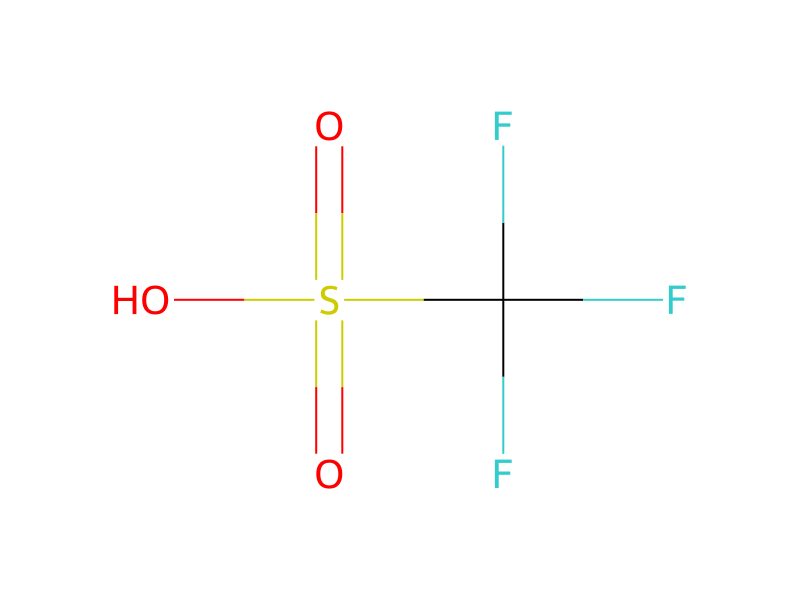
기본 정보
- CAS
1493-13-6- 표준 SMILES
O=S(=O)(O)C(F)(F)F- InChIKey
ITMCEJHCFYSIIV-UHFFFAOYSA-N- 분자식
- CHF3O3S
- 평균 분자량
- 150.08 g/mol
개요
Triflic acid is a one-carbon compound that is methanesulfonic acid in which the hydrogens attached to the methyl carbon have been replaced by fluorines. It is a perfluoroalkanesulfonic acid and a one-carbon compound. It is a conjugate acid of a triflate.
이름 및 식별자
- 우선 이름
- Trifluoromethanesulfonic acid
- IUPAC
- trifluoromethanesulfonic acid
- 현지명
- 트리플루오로메탄술폰산
- 영어명
- Trifluoromethanesulfonic acid
- 분자식
- CHF3O3S
- 분자량
- 150.08
이름 및 동의어
Trifluoromethanesulfonic acid1493-13-6Triflic acidPerfluoromethanesulfonic acidTrifluoromethanesulphonic acidtfmsaTrifluoromethane sulfonic acidTfOHDTXSID2044397HOTfJE2SY203E8Trifluormethansulfonsaeure
이름 더 보기
트라이플루오로메탄설폰산트리플루오로메탄술폰산트리플릭산퍼플루오로메탄술폰산Triflatetrifluorormethanesulfonic acidTFMStrifluoromethanesulfonictriflic
DTXCID0024397CHEBI:485111,1,1-trifluoromethanesulfonic acidAgOTf cpdCu(OTf)2Eu(OTf)3TFMSA cpdRefChem:191595
데이터베이스 식별자
- CAS
1493-13-6- PubChem CID
- 62406
- DTXSID
DTXSID2044397- ChEMBL
CHEMBL1236265- ChEBI
CHEBI:48511- UNII
- JE2SY203E8
- EC Number
- 216-087-5
- Nikkaji
- J12.301C
물성
구조 계산 물성
- XLogP
- 0.3
- 극성 표면적
- 62.8 Ų
- 수소 결합 공여자 수
- 1
- 수소 결합 수용자 수
- 6
- 회전 가능 결합 수
- 0
- 무거운 원자 수
- 8
- 형식 전하
- 0
- 복잡도
- 158
실험 및 물리화학적 성질
Chemical Classes
Other Classes -> Organic Acids
Ionic Liquids -> Fluorinated Ionic Liquids
Ionic Liquids
PFAS
PFAS -> Perfluorosulfonic acids
PFAS -> Ultra Short Chain PFsulfonic acids
PFAS -> PFAS identified in REACH Regulation EC No. 1272/2008
PFAS -> Suspected persistent, mobile, toxic (PMT) PFAS or PFAS-like compounds
PFAS -> PFAS with analytical method available
SpringerMaterials PropertiesSchoenflies notation
Food AdditivesUse unspecified -> FDA Substance added to food
Density1.696 @25 °C
Boiling Point162 °C @760 [mm Hg]
Melting Point-40 °C
Physical Description
Liquid
Colorless hygroscopic liquid; [Merck Index]
Collision Cross Section110.8 Ų [M-H]- [CCS Type: DT; Buffer gas: N2; Ionization: ESI-; Dataset: TOXCAST; Source Identifier: DTXSID2044397]
안전 및 규제
안전 정보는 참고용이며, 공급업체의 물질안전보건자료(SDS), 관련 법규 및 전문가 평가를 대체하지 않습니다.
GHS 분류
GHS Classification
Danger
H290 (92.8%): May be corrosive to metals [Warning Corrosive to Metals]
P234, P260, P261, P264, P270, P271, P280, P301+P317, P301+P330+P331, P302+P361+P354, P304+P340, P305+P354+P338, P316, P319, P321, P330, P363, P390, P403+P233, P405, P406, and P501 (click each P-code to see the statement)
Aggregated GHS information provided per 2365 reports by companies from 34 notifications to the ECHA C&L Inventory. Each notification may be associated with multiple companies.
Warning
H319: Causes serious eye irritation [Warning Serious eye damage/eye irritation]
유해성 정보
Regulatory Information
Chemical: Methanesulfonic acid, trifluoro-
Methanesulfonic acid, 1,1,1-trifluoro- is listed on the EPA's Chemical Data Reporting (CDR) system. Manufacturers and importers of Methanesulfonic acid, 1,1,1-trifluoro- are required to report information about their production and use of this chemical to the EPA under the Toxic Substances Control Act (TSCA). (40 eCFR Part 711)
Status: Active Update: 03-11-2021 https://echa.europa.eu/registration-dossier/-/registered-dossier/5311
Trifluoromethanesulphonic acid: Does not have an individual approval but may be used under an appropriate group standard
Hazards Summary
Highly corrosive to skin; [Quick CPC] One of the strongest acids known. May cause burns; [Merck Index] Oral LD50 (rat) is between 500 and 2,000 mg/kg; An acute dermal toxicity study of rats at 2,000 mg/kg produced extensive and severe local skin effects considered to be life threatening; 50 mg/kg doses were tolerated and showed no significant adverse effects at necropsy; No evidence of skin sensitization in guinea pigs; No evidence of mutagenicity; [EPA TSCA] Causes burns; Inhalation of high concentration can cause chemical pneumonitis; [Alfa Aesar MSDS]
Hazard Classes and Categories
Met. Corr. 1 (92.8%)
Serious eye damage/eye irritation - Category 2A-2B
화학 및 산업
약리 정보
Metabolism/Metabolites
Silver and its compounds can be absorbed via inhalation, while silver compounds can also be absorbed orally and dermally. It distributes throughout the body in the blood, particularily to the liver. Insoluble silver salts are transformed into soluble silver sulfide albuminates, bind to amino or carboxyl groups in RNA, DNA, and proteins, or are reduced to metallic silver by ascorbic acid or catecholamines. Metallic silver is oxidized and may deposit in the tissues, causing arygria. Silver is eliminated primarily in the faeces. (L808)
용도 및 제조
Uses
Used as a catalyst, solvent for ESR, acid titrant, and with trifluoroacetic acid in peptide synthesis; [Merck Index]
Silver trifluoromethanesulfonate is used in inorganic and organometallic chemistry to replace halide anions or ligands. (L833)
U.S. Production2023: 26,136 lb
Industry UsesNot Known or Reasonably Ascertainable
Use ClassificationPFAS -> Ultra Short Chain PFsulfonic acids
General Manufacturing Information
Not Known or Reasonably Ascertainable
Methanesulfonic acid, 1,1,1-trifluoro-: ACTIVE
응용 분야
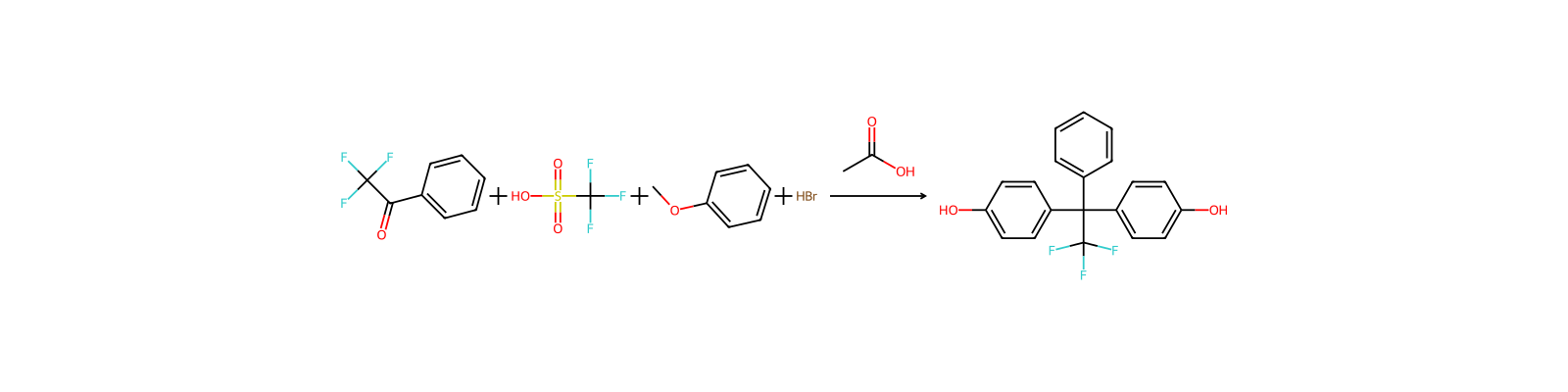
용도트리플루오로메탄술폰산은 펩티드 보호기를 제거하고 이성질체화와 중합을 촉매하기 위해 중합체에 대한 용매로 사용된다. 그 에스테르는 우수한 알킬화제이다. 무수물 (F3C-SO2)2O는 무색, 흡습성, 독성 액체이고(끓는점 84℃), 트리플루오로메탄술포닐기(triflate기)를 도입하기 위해 제조 화학에서 사용된다.
용도A cost-effective process for synthesizing daidzein was developed by Hai Cao and colleagues[1]. A two-step synthesis of daidzein (Friedel–Crafts acylation and [5+1] cyclization) was developed via the employment of trifluoromethanesulfonic acid (TfOH) as an effective promoting reagent. Due to the facilitating effect of TfOH, the Friedel–Crafts acylation was completed within 10 min at 90 °C and the [5+1] cyclization was completed within 180 min at 25 °C.
관련 반응
1,687건




화합물 노트
불러오는 중…