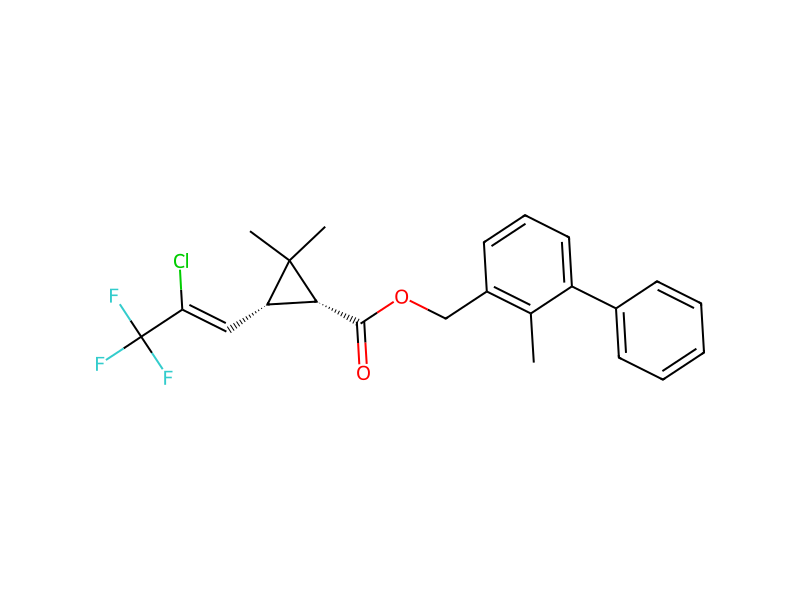
기본 정보
- 표준 SMILES
Cc1c(COC(=O)[C@@H]2[C@H](/C=C(\Cl)C(F)(F)F)C2(C)C)cccc1-c1ccccc1- InChIKey
OMFRMAHOUUJSGP-JHEGMOCKSA-N- 분자식
- C23H22ClF3O2
- 평균 분자량
- 422.9 g/mol
개요
Bifenthrin is an off-white to pale tan waxy solid with a very faint slightly sweet odor. Used as a broad spectrum insecticide.
이름 및 식별자
- 우선 이름
- Bifenthrin
- IUPAC
- trans-(2-methyl-3-phenylphenyl)methyl (1R,3R)-3-[(Z)-2-chloro-3,3,3-trifluoroprop-1-enyl]-2,2-dimethylcyclopropane-1-carboxylate
- 현지명
- 비펜스린
- 영어명
- Bifenthrin
- 분자식
- C23H22ClF3O2
- 분자량
- 422.87
이름 및 동의어
이름 더 보기
데이터베이스 식별자
- CAS
439680-76-9、82657-04-3- PubChem CID
- 6442842
- DTXSID
DTXSID20891316- ChEMBL
CHEMBL2227975- ChEBI
CHEBI:3093- UNII
- 6B66JED0KN、CNW4AM9VYX
- EC Number
- 617-373-6
- Nikkaji
- J384.276B、J389.191G
물성
구조 계산 물성
- XLogP
- 6
- 극성 표면적
- 26.3 Ų
- 수소 결합 공여자 수
- 0
- 수소 결합 수용자 수
- 5
- 회전 가능 결합 수
- 6
- 무거운 원자 수
- 29
- 형식 전하
- 0
- 복잡도
- 622
실험 및 물리화학적 성질
Pesticides
Pesticide -> EPA IRIS
Acaricides, Insecticides
Active substance -> EU Pesticides database: Not approved
Pesticides -> Pyrethrins/Pyrethroids
Acaricides, Insecticides
Pesticide (Bifenthrin) -> USDA PDB
LogP
log Kow = 6.00
6.0
Color/Form
Light brown viscous oil
Viscous liquid; crystalline or waxy solid
Off-white to pale tan waxy solid
Solubility
In water, <1.0 ug/L /<1.0X10-3 mg/L/ at 20 °C
Solubility in water: <0.1 ppb
Soluble in methylene chloride, chloroform, acetone, ether, toluene; slightly soluble in heptane, methanol
Flash Point
165 °C (329 °F) - closed cup
165 °C (Tag open cup); 151 °C (Pensky Martens closed cup)
329 °F (closed cup)
Decomposition
When heated to decomposition it emits toxic vapors of /fluoride/ and /chloride/.
In natural daylight /the half-life/ is 255 days.
Melting Point
69 °C
156.2 °F
Vapor Pressure
0.00000018 [mmHg]
1.78X10⁻³ mPa at 20 °C /1.335X10-8 mm Hg/
1.335x10⁻⁸ mmHg
물리화학적 성질
- 녹는점
- 68 · 68-71°C
- 끓는 점
- 453.2 · 453.2±45.0 °C(Predicted)
- 밀도
- 25 · d25 1.212 g/ml
- 증기압
- 2.4 · 2.4×10-5 Pa (25 °C)
- 인화점
- 165 °C · 165 °C
- 저장 조건
- 0 · 0-6°C
- 용해도
- 100 mg/mL · DMSO: 100 mg/mL (236.48 mM)
- 물리적 상태
- Solid
- 색상
- White to off-white
- 수용성
- 0.01 g/100mL · 0.01g/100mL
- Merck
- 13 · 13,1215
- Henry's Law Constant
- 9.9 · 9.9×100 mol/(m3Pa) at 25℃, Duchowicz et al. (2020)
- InChI
- 1S/C23H22ClF3O2/c1-14-16(10-7-11-17(14)15-8-5-4-6-9-15)13-29-21(28)20-18(22(20,2)3)12-19(24)23(25,26)27/h4-12,18,20H,13H2,1-3H3/b19-12-
- InChIKey
- OMFRMAHOUUJSGP-JHEGMOCKSA-N
- SMILES
- CC1(C(C1/C=C(C(F)(F)F)\Cl)C(OCC2=C(C(C3=CC=CC=C3)=CC=C2)C)=O)C
- LogP
- 7.3 · 7.300 (est)
- NIST
- Bifenthrin(82657-04-3)
- EPA
- Bifenthrin (82657-04-3)
화학적 성질
Bifenthrin is a member of the pyrethroid chemical class. It is an insecticide and acaricide. Bifenthrin is off-white to pale tan waxy solid granules with a faint, musty odor and slightly sweet smell. Bifenthrin is soluble in methylene chloride, acetone, chloroform, ether, and toluene, and is slightly soluble in heptane and methanol. It is slightly combustible and support combustion at elevated temperatures. Thermal decomposition and burning may form toxic by-products, such as carbon monoxide, carbon dioxide, hydrogen chloride, and hydrogen fl uoride. Bifentrin treatment affects the nervous system and causes paralysis in insects.
안전 및 규제
GHS 분류
GHS Classification
Danger
H300: Fatal if swallowed [Danger Acute toxicity, oral]
P203, P260, P261, P264, P270, P271, P272, P273, P280, P301+P316, P302+P352, P304+P340, P316, P318, P319, P321, P330, P333+P317, P362+P364, P391, P403+P233, P405, and P501 (click each P-code to see the statement)
Danger
H300 (93.4%): Fatal if swallowed [Danger Acute toxicity, oral]
P203, P260, P261, P264, P270, P271, P272, P273, P280, P301+P316, P302+P352, P304+P340, P316, P318, P319, P321, P330, P333+P317, P362+P364, P391, P403+P233, P405, and P501 (click each P-code to see the statement)
유해성 정보
Regulatory Information
Hazard Traits - Environmental tox
Commission Regulation (EC) No 33/2008
Bifenthrin is listed in the dataset of EPA Human Health Benchmarks for Pesticides under the Safe Drinking Water Act (40 eCFR 141)
2009/887/EC, Reg. (EU) 2017/195, Reg. (EU) 2018/291, Reg. (EU) 2019/324, Reg. (EU) 2022/801, Reg. (EU) No 582/2012
Bifenthrin: HSNO Approval: HSR003209 Approved with controls
The New Jersey Worker and Community Right to Know Act requires public and private employers to provide information about hazardous substances at their workplaces. (N.J.S.A. 34:5A-1 et. seq.)
Hazards Summary
May cause skin rash (especially on moist skin) and eye irritation; Caused no skin and nearly no eye irritation in rabbits; Not sensitizing to guinea pig skin; [HSDB] Effects in high-dose oral studies of rats include convulsions, tremors, and male reproductive toxicity; [RTECS] No developmental effects at doses maternally toxic; [REPROTOX] See Pyrethrum.
FIFRA Requirements
Tolerances are established for residues of the insecticide bifenthrin, including its metabolites and degradates, in or on the commodities in the table below. Compliance with the tolerance levels specified below is to be determined by measuring only bifenthrin, (2-methyl [1,1'-biphenyl]-3-yl) methyl-3-(2-chloro-3,3,3,-trifluoro-1-propenyl)-2,2-dimethylcyclopropanecarboxylate.[Table#6065]
A tolerance ... is established for residues of the insecticide bifenthrin, (2-methyl[1,1'-biphenyl]-3-yl)methyl-3-(2-chloro-3,3,3-trifluoro-1-propenyl)-2,2-dimethylcyclopropane-carboxylate, as follows: (i) In or on all food/feed items (other than those covered by a higher tolerance as a result of use on growing crops) in food/feed handling establishments. (ii) The insecticide may be present as a residue from application of bifenthrin in food handling establishments, including food service, manufacturing and processing establishments, such as restaurants, cafeterias, supermarkets, bakeries, breweries, dairies, meat slaughtering and packing plants, and canneries, feed handling establishments including feed manufacturing and processing establishments, in accordance with the following prescribed conditions: (A) Application shall be limited to general surface and spot and/or crack and crevice treatment in food/feed handling establishments where food/feed and food/feed products are held, processed, prepared and served. General surface application may be used only when the facility is not in operation provided exposed food/feed has been covered or removed from the area being treated. Spot and/or crack and crevice application may be used while the facility is in operation provided exposed food/feed is covered or removed from the area being treated prior to application. Spray concentration shall be limited to a maximum of 0.06 percent active ingredient. Contamination of food/feed or food/feed contact surfaces shall be avoided. (B) To assure safe use of the insecticide, its label and labeling shall conform to that registered with the U.S. Environmental Protection Agency and shall be used in accordance with such label and labeling.
Time-limited tolerances are established for residues of the insecticide bifenthrin, including its metabolites and degradates, in connection with use of the pesticide under a Section 18 emergency exemption granted by EPA. Compliance with the tolerance levels specified below is to be determined by measuring only bifenthrin, (2-methyl [1,1'-biphenyl]-3-yl) methyl-3-(2-chloro-3,3,3,-trifluoro-1-propenyl)-2,2-dimethylcyclopropanecarboxylate. These tolerances will expire and are revoked on the dates specified in the following table:[Table#6066]
Tolerances with regional registrations are established for residues of the insecticide bifenthrin, including its metabolites and degradates, in or on the commodities in the table below. Compliance with the tolerance levels specified below is to be determined by measuring only bifenthrin, (2-methyl [1,1'-biphenyl]-3-yl) methyl-3-(2-chloro-3,3,3,-trifluoro-1-propenyl)-2,2-dimethylcyclopropanecarboxylate.[Table#6067]
New Active Ingredients ... includes chemicals not previously registered as pesticides, as well as pesticide active ingredients initially registered after November 1, 1984 and that currently have active product registrations. By law, these pesticides must meet new safety standards, such as those described in the Food Quality Protection Act of 1996 and, if new safety standards are met, will be reviewed again on a 15-year cycle. Bifenthrin is designated by EPA as a New Pesticide Active Ingredient. Active Ingredient Number: 128825; Type of Pesticide: conventional - insecticide; Use Site: food use and non-food use; Year: 1985.
DOT Emergency Guidelines
/GUIDE 131 FLAMMABLE LIQUIDS - TOXIC/ Fire or Explosion: HIGHLY FLAMMABLE: Will be easily ignited by heat, sparks or flames. Vapors may form explosive mixtures with air. Vapors may travel to source of ignition and flash back. Most vapors are heavier than air. They will spread along ground and collect in low or confined areas (sewers, basements, tanks). Vapor explosion and poison hazard indoors, outdoors or in sewers. Those substances designated with a (P) may polymerize explosively when heated or involved in a fire. Runoff to sewer may create fire or explosion hazard. Containers may explode when heated. Many liquids are lighter than water. /Pyrethroid pesticide, liquid, flammable, poisonous; Pyrethroid pesticide, liquid, flammable, toxic; Pyrethroid pesticide, liquid, poisonous, flammable; Pyrethroid pesticide, liquid, toxic, flammable/
/GUIDE 131 FLAMMABLE LIQUIDS - TOXIC/ Health: TOXIC; may be fatal if inhaled, ingested or absorbed through skin. Inhalation or contact with some of these materials will irritate or burn skin and eyes. Fire will produce irritating, corrosive and/or toxic gases. Vapors may cause dizziness or suffocation. Runoff from fire control or dilution water may cause pollution. /Pyrethroid pesticide, liquid, flammable, poisonous; Pyrethroid pesticide, liquid, flammable, toxic; Pyrethroid pesticide, liquid, poisonous, flammable; Pyrethroid pesticide, liquid, toxic, flammable/
/GUIDE 131 FLAMMABLE LIQUIDS - TOXIC/ Public Safety: CALL Emergency Response Telephone Number on Shipping Paper first. If Shipping Paper not available or no answer, refer to appropriate telephone number listed on the inside back cover. As an immediate precautionary measure, isolate spill or leak area for at least 50 meters (150 feet) in all directions. Keep unauthorized personnel away. Stay upwind. Keep out of low areas. Ventilate closed spaces before entering. /Pyrethroid pesticide, liquid, flammable, poisonous; Pyrethroid pesticide, liquid, flammable, toxic; Pyrethroid pesticide, liquid, poisonous, flammable; Pyrethroid pesticide, liquid, toxic, flammable/
/GUIDE 131 FLAMMABLE LIQUIDS - TOXIC/ Protective Clothing: Wear positive pressure self-contained breathing apparatus (SCBA). Wear chemical protective clothing that is specifically recommended by the manufacturer. It may provide little or no thermal protection. Structural firefighters' protective clothing provides limited protection in fire situations ONLY; it is not effective in spill situations where direct contact with the substance is possible. /Pyrethroid pesticide, liquid, flammable, poisonous; Pyrethroid pesticide, liquid, flammable, toxic; Pyrethroid pesticide, liquid, poisonous, flammable; Pyrethroid pesticide, liquid, toxic, flammable/
For more DOT Emergency Guidelines (Complete) data for Bifenthrin (16 total), please visit the HSDB record page.
Hazard Classes and Categories
Acute Tox. 2 (93.4%)
Carcinogenicity - category 2
Acute toxicity (Oral) - Category 2
Skin sensitization - Category 1B
Flammable agents - 2nd degree
Carc. 2
Shipment Methods and Regulations
No person may /transport,/ offer or accept a hazardous material for transportation in commerce unless that person is registered in conformance ... and the hazardous material is properly classed, described, packaged, marked, labeled, and in condition for shipment as required or authorized by ... /the hazardous materials regulations (49 CFR 171-177)./
The International Air Transport Association (IATA) Dangerous Goods Regulations are published by the IATA Dangerous Goods Board pursuant to IATA Resolutions 618 and 619 and constitute a manual of industry carrier regulations to be followed by all IATA Member airlines when transporting hazardous materials. Pyrethroid pesticide, liquid, flammable, toxic, flash point less than 23 °C; Pyrethroid pesticide, liquid, toxic; Pyrethroid pesticide, liquid, toxic, flammable, flash point not less than 23 °C; and Pyrethroid pesticide, solid toxic are included on the dangerous goods list. /Pyrethroid pesticide, liquid, flammable, toxic, flash point less than 23 °C; Pyrethroid pesticide, liquid, toxic; Pyrethroid pesticide, liquid, toxic, flammable, flash point not less than 23 °C; Pyrethroid pesticide, solid toxic/
The International Maritime Dangerous Goods Code lays down basic principles for transporting hazardous chemicals. Detailed recommendations for individual substances and a number of recommendations for good practice are included in the classes dealing with such substances. A general index of technical names has also been compiled. This index should always be consulted when attempting to locate the appropriate procedures to be used when shipping any substance or article. Pyrethroid pesticide, liquid, flammable, toxic, flash point less than 23 °C; Pyrethroid pesticide, liquid, toxic; Pyrethroid pesticide, liquid, toxic, flammable, flash point not less than 23 °C; and Pyrethroid pesticide, solid toxic are included on the dangerous goods list. /Pyrethroid pesticide, liquid, flammable, toxic, flash point less than 23 °C; Pyrethroid pesticide, liquid, toxic; Pyrethroid pesticide, liquid, toxic, flammable, flash point not less than 23 °C; and Pyrethroid pesticide, solid toxic/
안전 및 보호
Fire Fighting Procedures
Suitable extinguishing media: Use water spray, alcohol-resistant foam, dry chemical or carbon dioxide.
Advice for firefighters: Wear self-contained breathing apparatus for firefighting if necessary.
Use carbon dioxide, foam, or dry chemical /on fires involving pyrethroids/. /Pyrethrum/
Fire-fighting: Self-contained breathing apparatus with a full facepiece operated in pressure-demand or other positive-pressure mode. /Pyrethrum/
Storage Conditions
Keep container tightly closed in a dry and well-ventilated place. Storage class (TRGS 510): Non-combustible, acute toxic Cat. 1 and 2 / very toxic hazardous materials.
Keep out of reach of children and animals. Store in original containers in cool, dry place and avoid excess heat. Carefully open containers. After partial use, replace lids and close tightly. Do not put concentrate or diluted materials into food or drink containers. Do not contaminate other pesticides, fertilizers, water, food or feed by storage or disposal.
Cleanup Methods
ACCIDENTAL RELEASE MEASURES: Personal precautions, protective equipment and emergency procedures: Wear respiratory protection. Avoid dust formation. Avoid breathing vapors, mist or gas. Ensure adequate ventilation. Evacuate personnel to safe areas. Avoid breathing dust. Environmental precautions: Prevent further leakage or spillage if safe to do so. Do not let product enter drains. Discharge into the environment must be avoided. Methods and materials for containment and cleaning up: Pick up and arrange disposal without creating dust. Sweep up and shovel. Keep in suitable, closed containers for disposal.
Disposal Methods
SRP: Recycle any unused portion of the material for its approved use or return it to the manufacturer or supplier. Ultimate disposal of the chemical must consider: the material's impact on air quality; potential migration in air, soil or water; effects on animal, aquatic and plant life; and conformance with environmental and public health regulations. If it is possible or reasonable use an alternative chemical product with less inherent propensity for occupational harm/injury/toxicity or environmental contamination.
SRP: Wastewater from contaminant suppression, cleaning of protective clothing/equipment, or contaminated sites should be contained and evaluated for subject chemical or decomposition product concentrations. Concentrations shall be lower than applicable environmental discharge or disposal criteria. Alternatively, pretreatment and/or discharge to a permitted wastewater treatment facility is acceptable only after review by the governing authority and assurance that "pass through" violations will not occur. Due consideration shall be given to remediation worker exposure (inhalation, dermal and ingestion) as well as fate during treatment, transfer and disposal. If it is not practicable to manage the chemical in this fashion, it must be evaluated in accordance with EPA 40 CFR Part 261, specifically Subpart B, in order to determine the appropriate local, state and federal requirements for disposal.
Product: Offer surplus and non-recyclable solutions to a licensed disposal company. Contact a licensed professional waste disposal service to dispose of this material. Dissolve or mix the material with a combustible solvent and burn in a chemical incinerator equipped with an afterburner and scrubber; Contaminated packaging: Dispose of as unused product.
Preventive Measures
ACCIDENTAL RELEASE MEASURES: Personal precautions, protective equipment and emergency procedures: Wear respiratory protection. Avoid dust formation. Avoid breathing vapors, mist or gas. Ensure adequate ventilation. Evacuate personnel to safe areas. Avoid breathing dust. Environmental precautions: Prevent further leakage or spillage if safe to do so. Do not let product enter drains. Discharge into the environment must be avoided.
Precautions for safe handling: Avoid contact with skin and eyes. Avoid formation of dust and aerosols. Further processing of solid materials may result in the formation of combustible dusts. The potential for combustible dust formation should be taken into consideration before additional processing occurs. Provide appropriate exhaust ventilation at places where dust is formed.
Appropriate engineering controls: Avoid contact with skin, eyes and clothing. Wash hands before breaks and immediately after handling the product.
Gloves must be inspected prior to use. Use proper glove removal technique (without touching glove's outer surface) to avoid skin contact with this product. Dispose of contaminated gloves after use in accordance with applicable laws and good laboratory practices. Wash and dry hands.
For more Preventive Measures (Complete) data for Bifenthrin (11 total), please visit the HSDB record page.
Allowable Tolerances
Tolerances are established for residues of the insecticide bifenthrin, including its metabolites and degradates, in or on the commodities in the table below. Compliance with the tolerance levels specified below is to be determined by measuring only bifenthrin, (2-methyl [1,1'-biphenyl]-3-yl) methyl-3-(2-chloro-3,3,3,-trifluoro-1-propenyl)-2,2-dimethylcyclopropanecarboxylate.[Table#6061]
A tolerance of 0.05 ppm is established for residues of the insecticide bifenthrin, (2-methyl[1,1'-biphenyl]-3-yl)methyl-3-(2-chloro-3,3,3-trifluoro-1-propenyl)-2,2-dimethylcyclopropane-carboxylate, as follows: (i) In or on all food/feed items (other than those covered by a higher tolerance as a result of use on growing crops) in food/feed handling establishments. (ii) The insecticide may be present as a residue from application of bifenthrin in food handling establishments, including food service, manufacturing and processing establishments, such as restaurants, cafeterias, supermarkets, bakeries, breweries, dairies, meat slaughtering and packing plants, and canneries, feed handling establishments including feed manufacturing and processing establishments, in accordance with the following prescribed conditions: (A) Application shall be limited to general surface and spot and/or crack and crevice treatment in food/feed handling establishments where food/feed and food/feed products are held, processed, prepared and served. General surface application may be used only when the facility is not in operation provided exposed food/feed has been covered or removed from the area being treated. Spot and/or crack and crevice application may be used while the facility is in operation provided exposed food/feed is covered or removed from the area being treated prior to application. Spray concentration shall be limited to a maximum of 0.06 percent active ingredient. Contamination of food/feed or food/feed contact surfaces shall be avoided. (B) To assure safe use of the insecticide, its label and labeling shall conform to that registered with the U.S. Environmental Protection Agency and shall be used in accordance with such label and labeling.
Time-limited tolerances are established for residues of the insecticide bifenthrin, including its metabolites and degradates, in connection with use of the pesticide under a Section 18 emergency exemption granted by EPA. Compliance with the tolerance levels specified below is to be determined by measuring only bifenthrin, (2-methyl [1,1'-biphenyl]-3-yl) methyl-3-(2-chloro-3,3,3,-trifluoro-1-propenyl)-2,2-dimethylcyclopropanecarboxylate. These tolerances will expire and are revoked on the dates specified in the following table:[Table#6062]
Tolerances with regional registrations are established for residues of the insecticide bifenthrin, including its metabolites and degradates, in or on the commodities in the table below. Compliance with the tolerance levels specified below is to be determined by measuring only bifenthrin, (2-methyl [1,1'-biphenyl]-3-yl) methyl-3-(2-chloro-3,3,3,-trifluoro-1-propenyl)-2,2-dimethylcyclopropanecarboxylate.[Table#6063]
Personal Protective Equipment (PPE)
Excerpt from ERG Guide 151 [Substances - Toxic (Non-Combustible)]:
Eye/face protection: Face shield and safety glasses. Use equipment for eye protection tested and approved under appropriate government standards such as NIOSH (US) or EN 166(EU).
Skin protection: Handle with gloves.
Body Protection: Complete suit protecting against chemicals. The type of protective equipment must be selected according to the concentration and amount of the dangerous substance at the specific workplace.
Respiratory protection: Where risk assessment shows air-purifying respirators are appropriate use a full-face particle respirator type N100 (US) or type P3 (EN 143) respirator cartridges as a backup to engineering controls. If the respirator is the sole means of protection, use a full-face supplied air respirator. Use respirators and components tested and approved under appropriate government standards such as NIOSH (US) or CEN (EU).
For more Personal Protective Equipment (PPE) (Complete) data for Bifenthrin (6 total), please visit the HSDB record page.
독성 정보
Treatment
Following oral exposure, the treatment is symptomatic and supportive and includes monitoring for the development of hypersensitivity reactions with respiratory distress. Provide adequate airway management when needed. Gastric decontamination is usually not required unless the pyrethrin product is combined with a hydrocarbon. Following inhalation exposure, move patient to fresh air. monitor for respiratory distress. If cough or difficulty breathing develops, evaluate for respiratory tract irritation, bronchitis, or pneumonitis. Administer oxygen and assist ventilation as required. Treat bronchospasm with inhaled beta2 agonist and oral or parenteral corticosteroids. In case of eye exposure, irrigate exposed eyes with copious amounts of room temperature water for at least 15 minutes. If irritation, pain, swelling, lacrimation, or photophobia persist, the patient should be seen in a health care facility. If the contamination occurs through dermal exposure, remove contaminated clothing and wash exposed area thoroughly with soap and water. A physician may need to examine the area if irritation or pain persists. Vitamin E topical application is highly effective in relieving parenthesis. (T36)
Interactions
A novel two-tiered analytical approach was used to characterize and quantify interactions between Type I and Type II pyrethroids on Hyalella azteca using standardized water column toxicity tests. Bifenthrin, permethrin, cyfluthrin and lambda-cyhalothrin were tested in all possible binary combinations across six experiments. All mixtures were analyzed for 4 d lethality, and two of the six mixtures (permethrin-bifenthrin and permethrin-cyfluthrin) were tested for subchronic 10 d lethality and sublethal effects on swimming motility and growth. Mixtures were initially analyzed for interactions using regression analyses, and subsequently compared to the additive models of Concentration Addition (CA) and Independent Action (IA) to further characterize mixture responses. Negative interactions (antagonistic) were significant in two of the six mixtures tested, including cyfluthrin-bifenthrin and cyfluthrin-permethrin, but only on the acute 4d lethality endpoint. In both cases mixture responses fell between the additive models of CA and IA. All other mixtures were additive across 4 d lethality, and bifenthrin-permethrin and cyfluthrin-permethrin were also additive on subchronic 10 d lethality and sublethal responses.
Piperonyl butoxide ... potentiates /insecticidal activity/ of pyrethrins by inhibiting the hydrolytic enzymes responsible for pyrethrins' metabolism in arthropods. When piperonyl butoxide is combined with pyrethrins, the insecticidal activity of the latter drug is increased 2-12 times /Pyrethrins/
At dietary level of 1000 ppm pyrethrins & 10000 ppm piperonyl butoxide ... /enlargement, margination, & cytoplasmic inclusions in liver cells of rats/ were well developed in only 8 days, but ... were not maximal. Changes were proportional to dosage & similar to those produced by DDT. Effects of the 2 ... were additive. /Pyrethrins/
Three carbamate (formetanate, methomyl, pyrimicarb) and one pyrethroid (bifenthrin) insecticides were investigated both as pure chemicals and as commercial formulations in order to unveil possible toxic effects of additives and solvents present in the commercial formulations and to evaluate the cellular stress response as a defense mechanism. Toxic effects were evaluated on A549 cells, derived from a human lung carcinoma, by measuring (1) threshold concentrations leading to a decrease of the growth rate (LOEC), (2) sublethal concentrations (SC) which arrested growth without killing the cells, and (3) expression levels of several stress proteins, i.e., HSP27, HSP72/73, HSP90, GRP78, and GRP94. As compared to the pure active molecule, LOEC appeared at lower concentrations when using the commercial formulations, i.e., Dicarzol (formetanate), Lannate20 (methomyl) and Talstar or Kiros EV (bifenthrin). Propylene glycol and propylene glycol monomethyl ether, respectively, present in Talstar and kiros, do not account for the high toxicity of these commercial formulations and do not potentiate the toxicity of bifenthrin. Additive but not synergistic adverse effects were observed when cells are exposed to a mixture of 4 different commercial formulations ... GRP78 was up-regulated by all the insecticides, commercial preparations being more efficient to trigger the stress reaction. This suggests that insecticides and additives present in commercial formulations disrupt ER functions. Conversely, HSP72/73 was found to be down-regulated by all the insecticides. This seems to be related with a decrease of protein synthesis in the cytosol, as a result of the ER unfolded protein response. Indeed, tunicamycin, known to inhibit N-linked glycosylation in the ER, was found to induce a similar inverse correlation between GRP78 overexpression and HSP72/73 under-expression. Expression of GRP94 was found to be increased and HSP27 lowered by the highest concentrations of bifenthrin commercial formulations. Methomyl and Lannate20 only induced an under-expression of HSP90.
Health Effects
As for every type I pyrethroid, bifenthrin effects typically include rapid onset of aggressive behavior and increased sensitivity to external stimuli, followed by fine tremor, prostration with coarse whole body tremor, elevated body temperature, coma, and death. (L857)
Ecotoxicity Values
LD50; Species: Colinus virginianus (Bobwhite quail) oral 1800 mg/kg
LC50; Species: Colinus virginianus (Bobwhite quail) dietary 4450 mg/kg diet for 8 days
LD50; Species: Anas platyrhychos (Mallard duck) oral 2150 mg/kg
LC50; Species: Anas platyrhychos (Mallard duck) dietary 1280 mg/kg diet for 8 days
For more Ecotoxicity Values (Complete) data for Bifenthrin (26 total), please visit the HSDB record page.
Environmental Fate
TERRESTRIAL FATE: Based on a classification scheme(1), Koc values for bifenthrin ranging from 8,387 to 14,332(2) indicate that bifenthrin is expected to be immobile in soil(SRC). Volatilization of bifenthrin from moist soil surfaces is expected to be an important fate process(SRC) given an estimated Henry's Law constant of 1.0X10⁻⁶ atm-cu m/mole(SRC), developed using a fragment estimation method(3). However, adsorption to soil is expected to attenuate volatilization(SRC). Bifenthrin is not expected to volatilize from dry soil surfaces(SRC) based upon its vapor pressure of 1.34X10⁻⁸ mm Hg(4). Bifenthrin is stable in soil over a wide range of pH; its degradation rate is influenced by soil characteristics(2). Using soils typical of Australia, bifenthrin, present at a concentration of 4.5 mg/kg and incubated for 24 months exhibited half-lives of 1332 to 1410 days(5) indicating that biodegradation is not an important environmental fate process in soil(SRC).
AQUATIC FATE: Based on a classification scheme(1), Koc values ranging from 8,387 to 14,332(2) indicate that bifenthrin is expected to adsorb to suspended solids and sediment(SRC). Volatilization from water surfaces is expected(3) based upon an estimated Henry's Law constant of 1.0X10⁻⁶ atm-cu m/mole(SRC), developed using a fragment constant estimation method(4). Using this Henry's Law constant and an estimation method(3), volatilization half-lives for a model river and model lake are 4.2 hours and 37 days, respectively(SRC). However, volatilization from water surfaces is expected to be attenuated by adsorption to suspended solids and sediment in the water column(SRC). The estimated volatilization half-life from a model pond is 62 years if adsorption is considered(5). According to a classification scheme(6), a log BCF of 3.8(7) corresponding to a BCF of 6,100(SRC) indicates that bioconcentration in aquatic organisms is very high(SRC). Bifenthrin was reported to be stable to hydrolysis at pH 5, 7, and 9 at 25 °C(8). The compound is very stable in aquatic environments(2) indicating that biodegradation is not an important environmental fate process in water(SRC).
ATMOSPHERIC FATE: According to a model of gas/particle partitioning of semivolatile organic compounds in the atmosphere(1), bifenthrin, which has a vapor pressure of 1.34X10⁻⁸ mm Hg at 20 °C(2), will exist in both the vapor and particulate phases in the ambient atmosphere. Vapor-phase bifenthrin is degraded in the atmosphere by reaction with photochemically-produced hydroxyl radicals(SRC); the half-life for this reaction in air is estimated to be 4 hours(SRC), calculated from its rate constant of 3.0X10⁻¹¹ cu cm/molecule-sec at 25 °C(SRC) that was derived using a structure estimation method(3). Particulate-phase bifenthrin may be removed from the air by wet and dry deposition(SRC). Pyrethroids, such as bifenthrin, are expected to undergo photodegradation in the environmental UV spectrum (>290 nm)(4); therefore, bifenthrin may be susceptible to direct photolysis by sunlight(SRC).
Food Survey Values
Bifenthrin was not detected in egg samples collected in Sao Paul City, Brazil from October 2003 through July 2005(1). The compound was detected not quantified in one of 72 strawberry samples analyzed as part of the Danish National Pesticide Monitoring Program conducted from 1995-1996(2). Bifenthrin was detected at a range of 0.1-7.45 ppm in 8 and 15 of 270 citrus and apple samples, respectively, in Karachi, Pakistan analyzed from 1999-2001. Seven and three samples exceeded maximum residue levels(3). The compound was detected in 11 of 206 vegetable samples (specifically garlic, ginger, chillies, cucumber, lady's finger, lufa, pumpkin, tomato, and cauliflower) from Karachi, Pakistan, sampled in 2001-2003; 5 samples exceeded maximum residue levels(4). Bifenthrin was detected in 7 of 45 domestic strawberry samples analyzed as part of a 5-year monitoring study conducted from April 1995 through March 2000 in Hyogo Prefecture, Japan(5). Vegetable samples from Belgrade, Serbia and analyzed from July to November 2006, tested positive for bifenthrin residues at the following concentrations: cabbage - 0.18 mg/kg detection limit 0.101 mg/kg); tomato - not detected (detection limit 0.005 mg/kg); potato - 0.49, 0.24 mg/kg (detection limit 0.11 mg/kg); cucumber - 0.08 mg/kg (detection limit 0.17 mg/kg)(6). Bifenthrin was tested for but not detected on cabbage (Brassica oleracea) (limit of detection = 111 ug/kg) and zucchini (Cucurbita pepo) (limit of detection - 10 ug/kg) collected during June to October 2009 from farms in Belgrade, Serbia. It was detected on cucumber (Cucumis sativus) at 2.46 ug/kg (1 of 6 samples positive, limit of detection - 1.9 ug/kg)(7).
The concentration of bifenthrin was measured in food commodities from Belgium between 1991-1993: lettuce (mean, 0.027 ppm; max, 0.99 ppm; 5.4% samples positive), spinach (mean, 0.016 ppm; max, 0.22 ppm; 2.4% samples positive), Lamb's lettuce (mean, 0.009 ppm; max, 0.72 ppm; 1.0% samples positive), apples (mean, 0.002 ppm; max, 0.1 ppm; 0.9% samples positive), strawberries (mean, 0.012 ppm; max, 0.2 ppm; 1.4% samples positive)(1).
Toxicity Summary
IDENTIFICATION AND USE: Bifenthrin is a light brown viscous oil. Bifenthrin is registered for use to control a variety of insects including aphids, worms, ants, gnats, moths, beetles, grasshoppers, mites, midges, spiders, ticks, yellow jackets, maggots, thrips, caterpillars, flies, fleas, and other pests in domestic, public health, agricultural, and industrial situations. HUMAN EXPOSURE AND TOXICITY: Neurological effects include symptoms such as dizziness, headache, tingling and numbness sensation, muscle spasms and tremors. Dermal effects include symptoms such as rash, hives, blisters, sores and itchiness. Respiratory effects include symptoms such as: shortness of breath, asthma, respiratory distress, respiratory irritation, coughing, difficulty in breathing, sinus problems, and chest pain. Most of the gastrointestinal symptoms were nausea, vomiting and few cases presented with abdominal pain and diarrhea. Ocular symptoms were redness, pain and swelling of eyes, itchy watery eyes and blurred vision. Few cases presented with cardiovascular symptoms such as high blood pressure, irregular heartbeat, and heart attack. Exposure to bifenthrin, even at "acceptable" limits, can increase the risk for and frequency of inflammatory responses and diseases such as asthma. ANIMAL STUDIES: Non-irritant to skin; virtually non-irritating to eyes (rabbits); no skin sensitization (guinea pigs). Bifenthrin Technical, 88.35% a.i., 98% cis, 2% trans; 200, 100, 50, 12 and 0 ppm /was given to rats in feed; 50/sex/dose for 2 years. No oncogenic effects reported. Effects included tremors, abrasions, alopecia, tail lacerations, reduced weight gain (females only), and reduced RBC 12% (males only). All effects were observed at 200 ppm. Technical (Bifenthrin), 89.7%, administered to 4 Beagles/sex/group at nominal concentrations of 0, 0.75, 1.50, 3.0, and 5.0 mg/kg/day in gelatin capsules for 52 weeks; Intermittent delayed onset of tremors occurring through week 29 at 3.0 and 5.0 mg/kg/day. Bifenthrin technical, 88.35% a.i., 98% cis, 2% trans; 100, 60, 30 and 0 ppm was given to rats in the feed for 8 weeks prior to F0 mating through F2b weaning; 25/sex/dose; no fertility or reproductive effects, other effects include tremors during lactation, ovary weight reduction in adults. Non-teratogenic in rats (> or = 2 mg/kg/day) & rabbits (8 mg/kg/day). Tremors were observed in 6 pups out of 40 examined (4 males on post-natal day (PND) 10 and 2 females on PND 28) at the highest dose (9 mg/kg/day). Bifenthrin was not mutagenic in the Ames assay, and did not produce chromosome aberrations in Chinese hamster ovary (CHO) cells. ECOTOXICITY STUDIES: Based on available data, bifenthrin has been classified as slightly toxic on an acute basis to birds. Bifenthrin showed no adverse effects to reproduction at the highest concentration tested for birds. Mammalian toxicity data suggest that this compound is moderately toxic to small mammals on an acute basis. Relative to steelhead, rainbow trout have different responses to bifenthrin acute toxicity as well as different rates of hepatic bifenthrin biotransformation. Bifenthrin is highly toxic on an acute and chronic basis to freshwater fish and aquatic-phase amphibians, and very highly toxic to freshwater aquatic invertebrates. Bifenthrin has also been classified as very highly toxic to estuarine/marine fish and invertebrates on an acute basis.
Pyrethroids exert their effect by prolonging the open phase of the sodium channel gates when a nerve cell is excited. They appear to bind to the membrane lipid phase in the immediate vicinity of the sodium channel, thus modifying the channel kinetics. This blocks the closing of the sodium gates in the nerves, and thus prolongs the return of the membrane potential to its resting state. The repetitive (sensory, motor) neuronal discharge and a prolonged negative afterpotential produces effects quite similar to those produced by DDT, leading to hyperactivity of the nervous system which can result in paralysis and/or death. Other mechanisms of action of pyrethroids include antagonism of gamma-aminobutyric acid (GABA)-mediated inhibition, modulation of nicotinic cholinergic transmission, enhancement of noradrenaline release, and actions on calcium ions. (T18, L857)
Ecotoxicity Excerpts
/BIRDS and MAMMALS/ Based on available data, bifenthrin has been classified as slightly toxic on an acute basis to birds. Bifenthrin showed no adverse effects to reproduction at the highest concentration tested for birds. Mammalian toxicity data suggest that this compound is moderately toxic to small mammals on an acute basis.
/AQUATIC SPECIES/ ... The authors evaluated the in vivo concentration-dependent ability of bifenthrin and permethrin to induce choriogenin (an estrogen-responsive protein) in Menidia beryllina /silverside/, a fish species known to reside in pyrethroid-contaminated aquatic habitats. The authors then compared the in vivo response with an in vitro assay--chemical activated luciferase gene expression (CALUX). Juvenile M. beryllina exposed to bifenthrin (1, 10, 100 ng/L), permethrin (0.1, 1, 10 ug/L), and ethinylestradiol (1, 10, 50 ng/L) had significantly higher ng/mL choriogenin (Chg) measured in whole body homogenate than controls. Though Chg expression in fish exposed to ethinylestradiol (EE2) exhibited a traditional sigmoidal concentration response, curves fit to Chg expressed in fish exposed to pyrethroids suggest a unimodal response, decreasing slightly as concentration increases. Whereas the in vivo response indicated that bifenthrin and permethrin or their metabolites act as estrogen agonists, the CALUX assay demonstrated estrogen antagonism by the pyrethroids. The results, supported by evidence from previous studies, suggest that bifenthrin and permethrin, or their metabolites, appear to act as estrogen receptor (ER) agonists in vivo, and that the unmetabolized pyrethroids, particularly bifenthrin, act as an ER antagonist in cultured mammalian cells.
/AQUATIC SPECIES/ ... In the present study, the zebrafish were exposed to environmental concentrations of cis-bifenthrin (BF), 1R-cis-BF and 1S-cis-BF during the embryos developmental stage. ...mRNA levels of the most genes related to oxidative stress, apoptosis and immunotoxicity including Cu/Zn-superoxide dismutase (Cu/Zn-Sod), catalase (Cat), P53, murine double minute 2 (Mdm2), B-cell lymphoma/leukemia-2 gene (Bcl2), Bcl2 associated X protein (Bax), apoptotic protease activating factor-1 (Apaf1), Caspase 9 (Cas9), Caspase 3 (Cas3), interleukin-1 beta (IL-1beta) and interleukin-8(Il-8) were much higher in 1S-cis-BF treated group than those in cis-BF or 1R-cis-BF treated ones, suggesting that 1S-cis-BF has higher risk to induced oxidative stress, apoptosis and immunotoxicity than 1R-cis-BF in zebrafish. The information presented in this study will help with elucidating the differences and environmental risk of the two enantiomers of cis-BF-induced toxicity in aquatic organisms.
/AQUATIC SPECIES/ ... Male steelhead (Oncorhynchus mykiss) exposed to bifenthrin (0.1 and 1.5 ug/L) for two weeks had a lower gonadosomatic index (GSI) in freshwater but were not affected by concurrent bifenthrin exposure and saltwater acclimation. Plasma estradiol-17beta (E2) levels and ovarian follicle diameter of fish exposed to bifenthrin (0.1 and 1.5 ug/L) in freshwater significantly increased. Under hypersaline conditions, fish exposed to bifenthrin had significantly reduced E2 levels and smaller follicles, and unhealthy ovarian follicles were observed. ...
For more Ecotoxicity Excerpts (Complete) data for Bifenthrin (33 total), please visit the HSDB record page.
규제 정보
FIFRA Requirements
Tolerances are established for residues of the insecticide bifenthrin, including its metabolites and degradates, in or on the commodities in the table below. Compliance with the tolerance levels specified below is to be determined by measuring only bifenthrin, (2-methyl [1,1'-biphenyl]-3-yl) methyl-3-(2-chloro-3,3,3,-trifluoro-1-propenyl)-2,2-dimethylcyclopropanecarboxylate.[Table#6065]
A tolerance ... is established for residues of the insecticide bifenthrin, (2-methyl[1,1'-biphenyl]-3-yl)methyl-3-(2-chloro-3,3,3-trifluoro-1-propenyl)-2,2-dimethylcyclopropane-carboxylate, as follows: (i) In or on all food/feed items (other than those covered by a higher tolerance as a result of use on growing crops) in food/feed handling establishments. (ii) The insecticide may be present as a residue from application of bifenthrin in food handling establishments, including food service, manufacturing and processing establishments, such as restaurants, cafeterias, supermarkets, bakeries, breweries, dairies, meat slaughtering and packing plants, and canneries, feed handling establishments including feed manufacturing and processing establishments, in accordance with the following prescribed conditions: (A) Application shall be limited to general surface and spot and/or crack and crevice treatment in food/feed handling establishments where food/feed and food/feed products are held, processed, prepared and served. General surface application may be used only when the facility is not in operation provided exposed food/feed has been covered or removed from the area being treated. Spot and/or crack and crevice application may be used while the facility is in operation provided exposed food/feed is covered or removed from the area being treated prior to application. Spray concentration shall be limited to a maximum of 0.06 percent active ingredient. Contamination of food/feed or food/feed contact surfaces shall be avoided. (B) To assure safe use of the insecticide, its label and labeling shall conform to that registered with the U.S. Environmental Protection Agency and shall be used in accordance with such label and labeling.
Time-limited tolerances are established for residues of the insecticide bifenthrin, including its metabolites and degradates, in connection with use of the pesticide under a Section 18 emergency exemption granted by EPA. Compliance with the tolerance levels specified below is to be determined by measuring only bifenthrin, (2-methyl [1,1'-biphenyl]-3-yl) methyl-3-(2-chloro-3,3,3,-trifluoro-1-propenyl)-2,2-dimethylcyclopropanecarboxylate. These tolerances will expire and are revoked on the dates specified in the following table:[Table#6066]
Tolerances with regional registrations are established for residues of the insecticide bifenthrin, including its metabolites and degradates, in or on the commodities in the table below. Compliance with the tolerance levels specified below is to be determined by measuring only bifenthrin, (2-methyl [1,1'-biphenyl]-3-yl) methyl-3-(2-chloro-3,3,3,-trifluoro-1-propenyl)-2,2-dimethylcyclopropanecarboxylate.[Table#6067]
New Active Ingredients ... includes chemicals not previously registered as pesticides, as well as pesticide active ingredients initially registered after November 1, 1984 and that currently have active product registrations. By law, these pesticides must meet new safety standards, such as those described in the Food Quality Protection Act of 1996 and, if new safety standards are met, will be reviewed again on a 15-year cycle. Bifenthrin is designated by EPA as a New Pesticide Active Ingredient. Active Ingredient Number: 128825; Type of Pesticide: conventional - insecticide; Use Site: food use and non-food use; Year: 1985.
안전 데이터
- wgk
- 3
- rtecs
- GZ1227800
- ridadr
- UN 2588
- 독성
- LD50 orally in rats: 54.5 mg/kg; LD50 dermally in rabbits: >2000 mg/kg (Doel)
- HS 번호
- 29162090
- risk_code
- 20/21/22-50/53-36-11-36/37/38-48/22-43-40-23/25
- hazard_code
- Xn;N,N,Xn,F,T
- safety_code
- 13-60-61-36/37-16-36-26-45-38-24-23
- 포장분류
- III
- 위험 등급
- 6.1(b)
- 기존화학 물질
- KE-05935
- Hazard Classifications
- Acute Tox. 2 OralAcute Tox. 3 InhalationAquatic Acute 1Aquatic Chronic 1Carc. 2Skin Sens. 1STOT RE 1
- 스토리지 클래스
- 6.1A - Combustible acute toxic Cat. 1 and 2very toxic hazardous materials
- 유해 물질 데이터
- 82657-04-3(Hazardous Substances Data)
화학 및 산업
약리 정보
Mechanism of Action
Bifenthrin, a relatively stable type I pyrethroid that causes tremors and impairs motor activity in rodents, is broadly used. We investigated whether nanomolar bifenthrin alters synchronous Ca2+ oscillations (SCOs) necessary for activity-dependent dendritic development. Primary mouse cortical neurons were cultured 8 or 9 days in vitro (DIV), loaded with the Ca2+ indicator Fluo-4, and imaged using a Fluorescence Imaging Plate Reader Tetra. Acute exposure to bifenthrin rapidly increased the frequency of SCOs by 2.7-fold (EC50 = 58 nM) and decreased SCO amplitude by 36%. Changes in SCO properties were independent of modifications in voltage-gated sodium channels since 100 nM bifenthrin had no effect on the whole-cell Na+ current, nor did it influence neuronal resting membrane potential. The L-type Ca2+ channel blocker nifedipine failed to ameliorate bifenthrin-triggered SCO activity. By contrast, the metabotropic glutamate receptor (mGluR)5 antagonist MPEP [2-methyl-6-(phenylethynyl)pyridine] normalized bifenthrin-triggered increase in SCO frequency without altering baseline SCO activity, indicating that bifenthrin amplifies mGluR5 signaling independent of Na+ channel modification. Competitive [AP-5; (-)-2-amino-5-phosphonopentanoic acid] and noncompetitive (dizocilpine, or MK-801 [(5S,10R)-(+)-5-methyl-10,11-dihydro-5H-dibenzo[a,d]cyclohepten-5,10-imine maleate]) N-methyl-d-aspartate antagonists partially decreased both basal and bifenthrin-triggered SCO frequency increase. Bifenthrin-modified SCO rapidly enhanced the phosphorylation of cAMP response element-binding protein (CREB). Subacute (48 hours) exposure to bifenthrin commencing 2 DIV-enhanced neurite outgrowth and persistently increased SCO frequency and reduced SCO amplitude. Bifenthrin-stimulated neurite outgrowth and CREB phosphorylation were dependent on mGluR5 activity since MPEP normalized both responses. Collectively these data identify a new mechanism by which bifenthrin potently alters Ca2+ dynamics and Ca2+-dependent signaling in cortical neurons that have long term impacts on activity driven neuronal plasticity.
Bifenthrin, a pyrethroid pesticide, is estrogenic in vivo in fishes. However, bifenthrin is documented to be anti-estrogenic in vitro, in the ER-CALUX (estrogen receptor) cell line. We investigated whether metabolite formation is the reason for this incongruity. We exposed Menidia beryllina (inland silversides) to 10 ng/L bifenthrin, 10 ng/L 4-hydroxy bifenthrin, and 10 ng/L bifenthrin with 25 ug/L piperonyl butoxide (PBO) - a P450 inhibitor. Metabolite-exposed juveniles had significantly higher estrogen-mediated protein levels (choriogenin) than bifenthrin/PBO-exposed, while bifenthrinalone was intermediate (not significantly different from either). This suggests that metabolites are the main contributors to bifenthrin's in vivo estrogenicity.
Voltage-gated sodium channels are important sites for the neurotoxic actions of pyrethroid insecticides in mammals. Here, we studied the mode of action of bifenthrin on the native sodium channels in cerebral cortical neurons prepared from newborn rat brain, where the toxic effects are largely generated. Bifenthrin caused a pronounced late current that persisted at the end of a depolarizing pulse, a slowly-decaying tail current following repolarization and significant resting modification (25.3% modification at 10 uM). No significant bifenthrin-induced effect was observed at the peak current. Bifenthrin also caused a concentration-dependent hyperpolarizing shift in steady-state activation and inactivation as well as slowed recovery from channel inactivation. Repetitive depolarization increased the potency of bifenthrin with high frequency. There was approximately 64% inhibition of modification upon repetitive activation by 10-Hz trains of depolarizing pulses. These results suggest that bifenthrin binds to and modifies sodium channels in both the closed and open states and exhibits the behavior between type I and type II.
... Since dopaminergic signaling significantly influences gonadotropin releasing hormone (GnRH2) release in fish, the goal of the study was to determine the effect of a 96 hr and 2 weeks exposure to bifenthrin on dopaminergic signaling in juvenile rainbow trout (Oncorhynchus mykiss) (RT). Our results indicated that a decrease in dopamine receptor 2A (DR2A) expression was associated with a trend toward an increase in plasma 17beta-estradiol (E2) following exposure at 96 hr and 2 weeks, and a significant increase in the relative expression of vitellogenin mRNA at 2 weeks. DR2A mRNA expression decreased 426-fold at 96 hr and 269-fold at 2 weeks in the brains of 1.5 ppb (3.55 pM) bifenthrin treated RT. There was an increase in tyrosine hydroxylase transcript levels at 96 hr, which is indicative of dopamine production in the brains of the 1.5 ppb (3.55 pM) bifenthrin treated RT. A significant increase in the relative expression of GnRH2 was observed at 96 hr but a significant decrease was noted after 2 weeks exposure indicating potential feedback loop activation. These results indicate that the estrogenic-effects of bifenthrin may result in part from changes in signaling within the dopaminergic pathway, but that other feedback pathways may also be involved.
For more Mechanism of Action (Complete) data for Bifenthrin (9 total), please visit the HSDB record page.
Biological Half-Life
The tissue residues /of rats/ were examined after oral administration of (14)C-bifenthrin at 0.5 mg/kg/day for 70 days. ... Analyses were extended for an additional 85 days following cessation of dosing (depuration phase). Half-lives of 51 days (fat), 50 days (skin), 19 days (liver), 28 days (kidney), and 40 days (ovaries and sciatic nerve) were estimated from (14)C-depuration.
... Intravenous dosing resulted in apparent terminal half-life (t1/2 ) values of 13.4 hr (plasma) and 11.1 hr (brain) ... .
... Following intravenous administration, the blood bifenthrin concentration decreased bi-exponentially, with a distribution half-life of 0.2 hr and an elimination half-life of 8 hr. ...
Metabolism/Metabolites
Male and female rats were treated with (14)C-bifenthrin labeled in the acid or alcohol moiety at single oral doses of 4 and 35 mg/kg. (14)C was rapidly excreted into feces and urine, and the excretion rates of the (14)C to feces and urine were 66-83% and 13-25%, respectively. ... The major fecal metabolites possessed intact ester linkage hydroxylated in the acid or alcohol moiety such as hydroxymethyl-bifenthrin, 4'-OH-bifenthrin, and 3'- or 4'-OH-hydroxymethyl bifenthrin. Ester-cleaved products derived from mono- and dihydroxylated parent compounds were also detected. On the other hand, the majority of urinary metabolites were ester-cleaved products such as 4'-OH-BPacid (4'-hydroxy-2-methyl-3-phenylbenzoic acid), BPacid (2-methyl-3-phenylbenzoic acid), 4'-OH-BPalcohol (4'-hydroxy-2-methyl-3-phenylbenzyl alcohol), dimethoxy-BPacid, 4'-methoxy BPacid, dimethoxy BPalcohol, BPalcohol, TFPacid [3-(2-chloro-3,3,3-trifluoro-1-propenyl-2,2-dimethyl-cyclopropanecarboxylic acid], cis- and trans-hydroxymethyl TFPacid. The major metabolic pathways are considered to be hydrolysis of ester linkage, oxidation at the methyl group of the acid moiety and at the 3'- and 4'-positions of the phenyl group, and O-methylation. The conjugation reactions are considered to take place; however, detailed information is not available.
Fastest breakdown is seen with primary alcohol esters of trans-substituted acids since they undergo rapid hydrolytic and oxidative attack. For all secondary alcohol esters and for primary alcohol cis-substituted cyclopropanecarboxylates, oxidative attack is predominant. /Pyrethroids/
Pyrethrins are reportedly inactivated in the GI tract following ingestion. In animals, pyrethrins are rapidly metabolized to water soluble, inactive compounds. /Pyrethrins/
Bifenthrin, a pyrethroid pesticide, is estrogenic in vivo in fishes. However, bifenthrin is documented to be anti-estrogenic in vitro, in the ER-CALUX (estrogen receptor) cell line. We investigated whether metabolite formation is the reason for this incongruity. We exposed Menidia beryllina (inland silversides) to 10 ng/L bifenthrin, 10 ng/L 4-hydroxy bifenthrin, and 10 ng/L bifenthrin with 25 ug/L piperonyl butoxide (PBO) - a P450 inhibitor. Metabolite-exposed juveniles had significantly higher estrogen-mediated protein levels (choriogenin) than bifenthrin/PBO-exposed, while bifenthrinalone was intermediate (not significantly different from either). This suggests that metabolites are the main contributors to bifenthrin's in vivo estrogenicity.
Synthetic pyrethroids are generally metabolized in mammals through ester hydrolysis, oxidation, and conjugation, and there is no tendency to accumulate in tissues. In the environment, synthetic pyrethroids are fairly rapidly degraded in soil and in plants. Ester hydrolysis and oxidation at various sites on the molecule are the major degradation processes. /Pyrethroids/
Upon absorption of bifenthrin , biotransformation takes place through hydrolysis of the central ester bond, oxidative attacks at several sites, and conjugation reactions to produce a complex array of primary and secondary water-soluble metabolites that undergo urinary and biliary excretion. It is widely accepted that metabolism results in the formation of compounds that have little or no demonstrable toxicity, although the formation of reactive or toxic intermediates cannot be ruled out, and it appears that cleavage of the ester bond results in substantial detoxification. Bifenthrin is also converted to chrysanthemum dicarboxylic acid and allethrolone. Bifenthrin leaves the body quickly, mainly in the urine, but also in feces and breath. (L857)
Absorption, Distribution and Excretion
Male and female rats were treated with (14)C-bifenthrin labeled in the acid or alcohol moiety at single oral doses of 4 and 35 mg/kg. (14)C was rapidly excreted into feces and urine, and the excretion rates of the (14)C to feces and urine were 66-83% and 13-25%, respectively. Highest residues were found in the fat, with values of slightly more than 1 ppm after low-dose administration and 8 and 16 ppm in males and females, respectively, after application of the high dose. Residue levels in other organs were in most cases <0.2 ppm after low-dose administration and <1 ppm after high-dose administration.
The tissue residues /of rats/ were examined after oral administration of (14)C-bifenthrin at 0.5 mg/kg/day for 70 days. The peak (14)C concentrations on an average were 9.6 ppm in fat, 1.7 ppm in skin, 0.4 ppm in liver, 0.3 ppm in kidney, 1.7 ppm in ovaries, 3.2 ppm in sciatic nerve, 0.06 ppm in whole blood, and 0.06 ppm in plasma. Analyses were extended for an additional 85 days following cessation of dosing (depuration phase). Half-lives of 51 days (fat), 50 days (skin), 19 days (liver), 28 days (kidney), and 40 days (ovaries and sciatic nerve) were estimated from (14)C-depuration. Analysis of the fat revealed that the parent chemical accounted for a majority (65-85%) of the (14)C-residues in fat.
Pyrethrins are absorbed through intact skin when applied topically. /Pyrethrins/
... The pharmacokinetics of bifenthrin in the rat after oral, inhalation and intravenous administration is described. Pyrethroid acute toxicity via oral and inhalation routes is also presented. Groups of male rats were dosed by oral gavage at 3.1 mg/kg in 1 mL/kg of corn oil (the critical, acute, oral benchmark dose lower limit, BMDL) and at an equivalent dose by inhalation (0.018 mg/L) for 4 hr. At 2, 4, 6, 8 and 12 hr after dosing initiation, blood plasma and brain bifenthrin concentrations were measured. The maximum concentrations of bifenthrin in plasma were 361 ng/mL or 0.853 uM (oral) and 232 ng/mL or 0.548 uM (inhalation), and in brain they were 83 and 73 ng/g. The area under the concentration versus time curve (AUC) values were 1969 h ng/mL (plasma) and 763 h ng/mL (brain) following oral gavage dosing, and 1584 h ng/mL (plasma) and 619 h ng/mL (brain) after inhalation. Intravenous dosing resulted in apparent terminal half-life (t1/2 ) values of 13.4 h (plasma) and 11.1 h (brain) and in AUC0-infinity values of 454 and 1566 h ng/mL for plasma and brain. Clearance from plasma was 37 mL/min/kg. Peak plasma and brain concentrations were generally a little higher after oral dosing (by ca 14%). Inhalation administration of bifenthrin did not cause increases in exposure in plasma or brain by avoiding first-pass effects in the liver. The elimination t1/2 was comparable with other pyrethroids and indicated little bioaccumulation potential. ...
... This study evaluated the oral disposition and bioavailability of bifenthrin in the adult male Long-Evans rat. In the disposition study, rats were administered bifenthrin (0.3 or 3 mg/kg) by oral gavage and serially sacrificed (0.25 hr to 21 days). Blood, liver, brain and adipose tissue were removed. In the bioavailability study, blood was collected serially from jugular vein cannulated rats (0.25 to 24 hr) following oral (0.3 or 3 mg/kg) or intravenous (0.3 mg/kg) administration of bifenthrin. Tissues were extracted and analyzed for bifenthrin by high-performance liquid chromatography-tandem mass spectrometry (HPLC-MS/MS). Bifenthrin concentration in blood and liver peaked 1-2-hr post-oral administration and were approximately 90 ng/mL (or g) and 1000 ng/mL (or g) for both tissues at 0.3 and 3 mg/kg, respectively. Bifenthrin was rapidly cleared from both blood and liver. Brain concentrations peaked at 4-6 hr and were lower than in blood at both doses (12 and 143 ng/g). Bifenthrin in adipose tissue peaked at the collected time points of 8 (157 ng/g) and 24 (1145 ng/g) hr for the 0.3 and 3 mg/kg doses, respectively and was retained 21 days post-oral administration. Following intravenous administration, the blood bifenthrin concentration decreased bi-exponentially, with a distribution half-life of 0.2 hr and an elimination half-life of 8 hr. Bifenthrin bioavailability was approximately 30%. These disposition and kinetic bifenthrin data may decrease uncertainties in the risk assessment for this pyrethroid insecticide.
용도 및 제조
Uses
Used as a broad spectrum insecticide (also used for termites) and acaricide (including mites); [HSDB]
Farming (Pesticides) [Category: Industry]
For bifenthrin (USEPA/OPP Pesticide Code: 128825) ACTIVE products with label matches. /SRP: Registered for use in the U.S. but approved pesticide uses may change periodically and so federal, state and local authorities must be consulted for currently approved uses./
Bifenthrin is registered for use to control a variety of insects including aphids, worms, ants, gnats, moths, beetles, grasshoppers, mites, midges, spiders, ticks, yellow jackets, maggots, thrips, caterpillars, flies, fleas, and other pests in domestic, public health, agricultural, and industrial situations.
Acaricide/Miticide, Insecticide
/Bifenthrin/ is effective against ... Coleoptera, Diptera, Heteroptera, Homoptera, Lepidoptera, and Othoptera; ... also controls some species of Acarina.
Methods of Manufacturing
Bifenthrin is produced by reaction of 3-(2-chloro-3,3,3-trifluoro-1-propenyl)-2,2-dimethylcyclopropanecarboxylic acid with 3-(bromomethylene-2-methyl)biphenyl in the presence of potassium hydroxide.
Preparation: J.F. Engel, European Patent Office patent 3336; idem, United States of America patent 4238505 (1979, 1980 both to FMC).
Formulations/Preparations
The National Pesticide Information Retrieval System (NPIRS) identifies 51 companies with active labels for products containing the chemical bifenthrin. To view the complete list of companies, product names and percent bifenthrin in formulated products click the following url and enter the CAS Registry number in the Active Ingredient field.
Bifenthrin 0.069% Plus Fertilizer (Nufarm Americas, Inc.): Active ingredient: Bifenthrin 0.069%.
Menace Fire Ant Killer (Nufarm Americas, Inc.): Active ingredient: Bifenthrin 0.2%.
Menace 13 MC Insecticide/miticide (Nufarm Americas, Inc.): Active ingredient: Bifenthrin 13.0%.
For more Formulations/Preparations (Complete) data for Bifenthrin (30 total), please visit the HSDB record page.
General Manufacturing Information
The WHO Recommended Classification of Pesticides by Hazard identifies Bifenthrin (technical grade) as Class II: moderately hazardous; Main Use: insecticide.
Third generation synthetic pyrethroid.
/Pyrethroids are/ ... modern synthetic insecticides ... similar chemically to natural pyrethrins, but pyrethroids are modified to increase stability in the natural environment. /Pyrethroids/
응용 분야
개요Bifenthrin is a synthetic pyrethroid insecticide/miticide/acaricide. Bifenthrin is off-white to pale tan waxy solid granules with a faint, musty odour and a slightly sweet smell. Bifenthrin is soluble in methylene chloride, acetone, chloroform, ether, and toluene and slightly soluble in heptane and methanol. It is slightly combustible and support combustion at elevated temperatures. Thermal decomposition and burning may form toxic byproducts such as carbon monoxide, carbon dioxide, hydrogen chloride, and hydrogen fluoride. Bifenthrin treatment affects the nervous system and causes paralysis in insects.
용도Bifenthrin controls foliar insect pests and some mites on a range of crops including cereals, citrus, cotton, fruit and vegetables.
상·하류 제품 정보
상류 원료
하류 제품
공급사50 곳
추가 설명
정의ChEBI: A carboxylic ester obtained by formal condensation of cis-3-(2-chloro-3,3,3-trifluoroprop-1-enyl)-2,2-dimethylcyclopropanecarboxylic acid and [(2-methyl-1,1'-biphenyl)-3-yl]methanol.
관련 반응
현재 필터 조건에 해당하는 반응 기록이 없습니다.
연결된 노트
불러오는 중…