
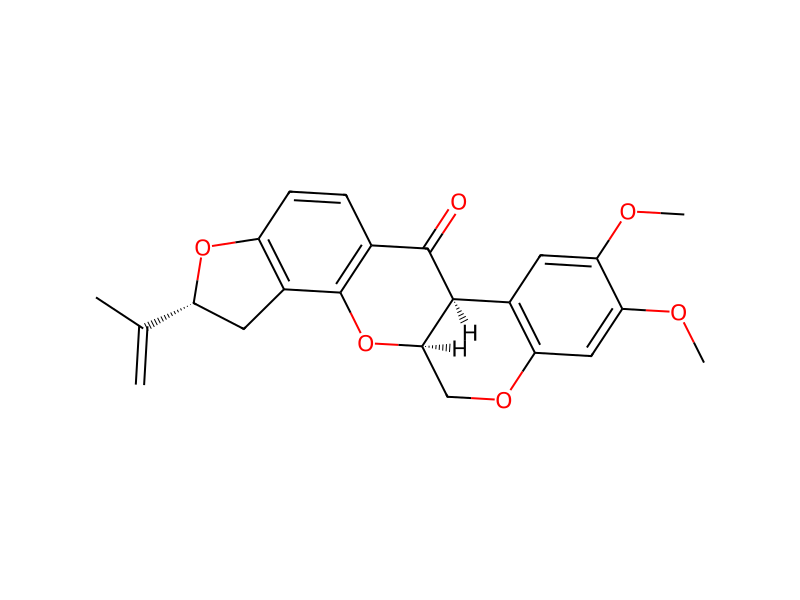
기본 정보
- 표준 SMILES
C=C(C)[C@H]1Cc2c(ccc3c2O[C@@H]2COc4cc(OC)c(OC)cc4[C@@H]2C3=O)O1- InChIKey
JUVIOZPCNVVQFO-HBGVWJBISA-N- 분자식
- C23H22O6
- 평균 분자량
- 394.4 g/mol
- 단동위원소 질량
- 394.14163842
개요
Rotenone appears as colorless to brownish crystals or a white to brownish-white crystalline powder. Has neither odor nor taste. (NTP, 1992)
이름 및 식별자
- 우선 이름
- Rotenone
- IUPAC
- (1S,6R,13S)-16,17-dimethoxy-6-prop-1-en-2-yl-2,7,20-trioxapentacyclo[11.8.0.03,11.04,8.014,19]henicosa-3(11),4(8),9,14,16,18-hexaen-12-one
- 현지명
- 로테논
- 영어명
- Rotenone
- 분자식
- C23H22O6
- 분자량
- 394.42
이름 및 동의어
rotenone83-79-4DactinolParaderilTubatoxin(-)-RotenoneDerrinDerrisNicouline(-)-cis-RotenoneDerilLiquid Derris
이름 더 보기
로테논(2R-(2알파,6(A)알파,12(A)알파))-1,2,12,12a-테트라하이드로-8,9-디메톡시-2-(1-메틸에텐일)(1)벤조피라노(3,4-b)푸로(2,3-H)(1)벤조피란-6(6aH)-온(2R,6aS,12aS)-1,2,12,12a-테트라하이드로-8,9-다이메톡시-2-(1-메틸바이닐)-[1]벤조피라노[3,4-b]퓨로[2,3-h][1]벤조피란-6(6aH)-온(2R,6aS,12aS)-1,2,6,6a,12,12a-헥사하이드로-2-아이소프로펜일-8,9-다이메톡시크로메노[3,4-b]퓨로[2,3-h]크로멘-6-온(2R,6aS,12aS)-1,2,6,6a,12,12a-헥사하이드로-2-아이소프로펜일-8,9-다이메톡시크로멘올[3,4b]퓨로[2,3-h]크로멘-6-온[2R-(2a,6aa,12aa)]-1,2,12,12a-테트라하이드로-8,9-다이메톡시-2-(1-메틸바이닐)-[1]벤조피라노[3,4-b]퓨로[2,3-h][1]벤조피란-6(6aH)-온1,2,12,12a-테트라하이드로-2a-아이소프로펜일-8,9-다이메톡시-[1]벤조피라노[3,4-b]퓨로[2,3-h][1]벤조피란-6(6aH)-온1,2,12,12a-테트라하이드로-2-알파-아이소프로펜일-8,9-다이메톡시(1)벤조피라노(3,4-b)퓨로(2,3-H)(1)벤조피란-6(6AH)-온(1)Benzopyrano(3,4-b)furo(2,3-h)(1)benzopyran-6(6aH)-one, 1,2,12,12a-tetrahydro-2-alpha-iospropenyl-8,9-dimethoxy-CUBEgeranechemfishDerris root5'beta-RotenonePyrethrum powder(2R,6aS,12aS)-8,9-Dimethoxy-2-(prop-1-en-2-yl)-1,2,12,12a-tetrahydrochromeno[3,4-b]furo[2,3-h]chromen-6(6aH)-onenekoe
Cube-PulverDri-KilRotocideNoxfireRononeRotenonCanexRotefive
데이터베이스 식별자
- CAS
83-79-4- PubChem CID
- 6758
- DTXSID
DTXSID6021248- ChEMBL
CHEMBL429023- ChEBI
CHEBI:28201- UNII
- 03L9OT429T
- EC Number
- 201-501-9
- Nikkaji
- J108.000H
물성
구조 계산 물성
- XLogP
- 4.1
- 극성 표면적
- 63.2 Ų
- 수소 결합 공여자 수
- 0
- 수소 결합 수용자 수
- 6
- 회전 가능 결합 수
- 3
- 무거운 원자 수
- 29
- 형식 전하
- 0
- 복잡도
- 664
실험 및 물리화학적 성질
DrugsPharmaceuticals -> Listed in ZINC15
LipidsPolyketides [PK] -> Flavonoids [PK12] -> Rotenoid flavonoids [PK1206]
Pesticides
Pesticide -> EPA IRIS
Insecticides
Active substance -> EU Pesticides database: Not approved
Pesticides -> Other Insecticides
Veterinary substances, Acaricides, Insecticides
Pesticide (Rotenone) -> USDA PDB
LogP
log Kow = 4.10
4.10
4.10
OdorOdorless
Density
1.27 at 68 °F (NTP, 1992) - Denser than water; will sink
1.27 at 20 °C
1.27 g/cm³
1.27
1.27 @ 20°C
1.27
Color/Form
Orthorhombic, six-sided plates from trichloroethylene
Needles or leaves (alcohol, aq acetone)
White crystals
Colorless to red, crystalline solid
Solubility
less than 1 mg/mL at 68 °F (NTP, 1992)
SOLUBILITY: 15 PPM IN WATER AT 100 °C. SHOWS RAPID RACEMIZATION ON ALKALI TREATMENT; CRYSTALLIZES WITH SOLVENT OF CRYSTALLIZATION; CIS CONFIGURATION IS GENERALLY ACCEPTED
In water, 15 mg/L at 100 °C
Soluble in ethanol, acetone, benzene; slightly soluble in ether; very soluble in chloroform
SLIGHTLY SOLUBLE IN PETROLEUM OILS
SOL IN LIPIDS
CorrosivityNon-corrosive
Endocrine DisruptorsPotential endocrine disrupting compound
Boiling Point
410 to 428 °F at 0.5 mmHg (NTP, 1992)
BP: 215 °C at 0.5 mm Hg
410-428 °F
Decomposes
DecompositionWhen heated to decomposition it emits acrid smoke and irritating fumes.
물리화학적 성질
- 녹는점
- 159 · 159-164 °C (lit.)
- 끓는 점
- 210 · 210-220 °C/0.5 mmHg (lit.)
- 밀도
- 1.1917 · 1.1917 (rough estimate)
- 굴절률
- 1.4593 · 1.4593 (estimate)
- 저장 조건
- Keep in dark place,Inert atmosphere,Room temperature
- 용해도
- 2 O; · insoluble in EtOH; insoluble in H2O; ≥77.6 mg/mL in DMSO
- 수용성
- 15 mg · 15mg l-1(100°C)
- 물리적 상태
- 흰색에서 회백색 고체
- 색상
- White to Light yellow to Light orange
- Merck
- 14 · 14,8271
- BRN
- 6773081 · 6773081
- Henry's Law Constant
- 8.8 · 8.8×107 mol/(m3Pa) at 25℃, HSDB (2015)
- 안정성
- 안정적이지만 빛과 공기에 민감함. 타기 쉬운. 특히 알칼리가 있는 경우 산화제와 호환되지 않습니다.
- InChI
- 1S/C23H22O6/c1-11(2)16-8-14-15(28-16)6-5-12-22(24)21-13-7-18(25-3)19(26-4)9-17(13)27-10-20(21)29-23(12)14/h5-7,9,16,20-21H,1,8,10H2,2-4H3/t16-,20-,21+/m1/s1
- InChIKey
- JUVIOZPCNVVQFO-HBGVWJBISA-N
- SMILES
- COc1cc2OCC3Oc4c5C[C@@H](Oc5ccc4C(=O)C3c2cc1OC)C(C)=C
- NIST
- Rotenone(83-79-4)
- EPA
- Rotenone (83-79-4)
화학적 성질
Rotenone is a colorless to red odorless crystalline solid; a white crystalline solid when pure; oxidation will cause yellowing to bright red coloring. Odorless. Rotenone is related to isoflavonoid compounds derived from the roots of Derris spp., Lonchocarpus spp., and Tephrosia spp., found primarily in Southeast Asia, South America, and East Africa. The isolated compound is an odorless, colorless to red crystalline solid. It is insoluble in water and has a very low vapor pressure (U.S. EPA, 2007; HSDB, 2012a).
안전 및 규제
GHS 분류
GHS Classification
Danger
H301: Toxic if swallowed [Danger Acute toxicity, oral]
P261, P264, P264+P265, P270, P271, P273, P280, P301+P316, P302+P352, P304+P340, P305+P351+P338, P319, P321, P330, P332+P317, P337+P317, P362+P364, P391, P403+P233, P405, and P501 (click each P-code to see the statement)
Danger
H301 (97.3%): Toxic if swallowed [Danger Acute toxicity, oral]
P261, P264, P264+P265, P270, P271, P273, P280, P301+P316, P302+P352, P304+P340, P305+P351+P338, P319, P321, P330, P332+P317, P337+P317, P362+P364, P391, P403+P233, P405, and P501 (click each P-code to see the statement)
유해성 정보
Regulatory Information
Rote is listed in the dataset of EPA Human Health Benchmarks for Pesticides under the Safe Drinking Water Act (40 eCFR 141)
2008/317
Rotenone: HSNO Approval: HSR003076 Approved with controls
Other Safety InformationIMAP assessments - [1]Benzopyrano[3,4-b]furo[2,3-h][1]benzopyran-6(6aH)-one, 1,2,12,12a-tetrahydro-8,9-dimethoxy-2-(1-methylethenyl)-, [2R-(2.alpha.,6a.alpha.,12a.alpha.)]-: Environment tier I assessment
DOT LabelPoison
Fire Hazards
Flash point data for this chemical are not available; however, it is probably combustible. (NTP, 1992)
Combustible.
Fire PotentialFlammable if preheated.
Health HazardsExcerpt from NIOSH Pocket Guide for Rotenone:
Hazards Summary
Formulations for home use are classified as slightly toxic. The emulsified concentrate is classified as highly toxic. Only certified applicators can use rotenone on cranberries and for fish control. [EXTOXNET] Skin and respiratory irritation has been reported after occupational exposure. [EPA Pesticides] Poisoning by ingestion in humans may result in convulsions and coma. [ACGIH] Liver and kidney injury may occur after ingestion. [ICSC] Rotenone is used in an experimental animal model of Parkinson's syndrome, but the large doses used are not likely to be relevant to occupational exposure levels. [Reference #2] Decomposes within days when exposed to light and air; No evidence to support a causal relationship between rotenone and Parkinson's disease; In a fatal poisoning case, the estimated oral dose was 50 mg/kg, and the symptoms were coma and respiratory arrest within 8.5 hours of ingestion; [Krieger, p. 135-41]
Reactive GroupKetones
EC ClassificationSymbol: T, N; R: 25-36/37/38-50/53; S: (1/2)-22-24/25-36-45-60-61
UN ClassificationUN Hazard Class: 6.1; UN Pack Group: III
Special Reports
DHHS/NTP; Toxicology & Carcinogenesis Studies of Rotenone in F344/N Rats and B6C3F1 Mice (Feed Studies) Technical Report Series No. 320 (1988) NIH Publication No. 88-2576
USEPA/Office of Pesticide Programs; Reregistration Eligibility Decision Document - Rotenone, EPA 738-R-07-005 (March 2007). The RED summarizes the risk assessment conclusions and outlines any risk reduction measures necessary for the pesticide to continue to be registered in the U.S.[Available from, as of November 20, 2011: http://www.epa.gov/pesticides/reregistration/status.htm]
FIFRA Requirements
(a) When applied to growing crops, in accordance with good agricultural practice, the following pesticide chemicals are exempt from the requirement of a tolerance: (1) Petroleum oils. (2) Piperonyl butoxide. (3) Pyrethrins. (4) Rotenone or derris or cube roots. (5) Sabadilla. (b) These pesticides are not exempted from the requirement of a tolerance when applied to a crop at the time of or after harvest.
Based on available data, EPA has completed its assessment of the risks associated with the use of pesticides containing the active ingredient rotenone and has concluded that it has sufficient information to make a decision as part of the reregistration process under FIFRA, as amended by the Food Quality Protection Act (FQPA). EPA has determined that currently registered uses of rotenone will not pose unreasonable risks or adverse effects to humans or the environment if the requirements for reregistration outlined in this document are implemented. Unless labeled and used as specified in this document, rotenone would present risks inconsistent with FIFRA. Accordingly, should a registrant fail to implement any of the requirements for reregistration identified in this document, the Agency may take regulatory action to address the risk concerns from the use of rotenone.
As the federal pesticide law FIFRA directs, EPA is conducting a comprehensive review of older pesticides to consider their health and environmental effects and make decisions about their future use. Under this pesticide reregistration program, EPA examines health and safety data for pesticide active ingredients initially registered before November 1, 1984, and determines whether they are eligible for reregistration. In addition, all pesticides must meet the new safety standard of the Food Quality Protection Act of 1996. Rotenone is found on List A, which contains most food use pesticides and consists of the 194 chemical cases (or 350 individual active ingredients) for which EPA issued registration standards prior to FIFRA, as amended in 1988. Case No: 0255; Pesticide type: Insecticide (acaricide,piscicide); Registration Standard Date: 10/88; Case Status: OPP is reviewing data from the pesticide's producers regarding its human health and/or environmental effects, or OPP is determining the pesticide's eligibility for reregistration and developing the Reregistration Eligibility Decision (RED) document.; Active ingredient (AI): Rotenone; Data Call-in (DCI) Date(s): 10/13/95; AI Status: The producers of the pesticide has made commitments to conduct the studies and pay the fees required for reregistration, and are meeting those commitments in a timely manner.
안전 및 보호
Fire Fighting
Fires involving this material can be controlled with a dry chemical, carbon dioxide or Halon extinguisher. A water spray may also be used. (NTP, 1992)
Use water spray, powder, alcohol-resistant foam, carbon dioxide.
First Aid Measures
Fresh air, rest. Artificial respiration may be needed.
First rinse with plenty of water for at least 15 minutes, then remove contaminated clothes and rinse again. Rinse and then wash skin with water and soap.
First rinse with plenty of water for several minutes (remove contact lenses if easily possible), then refer for medical attention.
Rinse mouth. Give a slurry of activated charcoal in water to drink. Rest. Refer for medical attention .
First Aid
EYES: First check the victim for contact lenses and remove if present. Flush victim's eyes with water or normal saline solution for 20 to 30 minutes while simultaneously calling a hospital or poison control center. Do not put any ointments, oils, or medication in the victim's eyes without specific instructions from a physician. IMMEDIATELY transport the victim after flushing eyes to a hospital even if no symptoms (such as redness or irritation) develop.
(General first aid procedures)
Safe StorageSeparated from food and feedstuffs. Well closed.
Storage Conditions
Store only in original containers, in a dry place inaccessible to children and pets. /7.4% Rotenone Wettable Powder/
Containers: Fiber drums; tins; multiwall paper sacks; keep in well-ventilated area.
Cleanup Methods
1. Ventilate area of spill. 2. For small quantities, sweep onto paper or other suitable material, place in an appropriate container and burn in a safe place (such as a fume hood). Large quantities can be reclaimed; however, if this is not practical, dissolve in a flammable solvent (such as alc) and atomize in a suitable combustion chamber.
Nonfire Spill Response
SMALL SPILLS AND LEAKAGE: If a spill of this chemical occurs, FIRST REMOVE ALL SOURCES OF IGNITION, then you should dampen the solid spill material with acetone and transfer the dampened material to a suitable container. Use absorbent paper dampened with acetone to pick up any remaining material. Seal your contaminated clothing and the absorbent paper in a vapor-tight plastic bag for eventual disposal. Solvent wash all contaminated surfaces with acetone followed by washing with a soap and water solution. Do not reenter the contaminated area until the Safety Officer (or other responsible person) has verified that the area has been properly cleaned.
Disposal Methods
SRP: The most favorable course of action is to use an alternative chemical product with less inherent propensity for occupational harm/injury/toxicity or environmental contamination. Recycle any unused portion of the material for its approved use or return it to the manufacturer or supplier. Ultimate disposal of the chemical must consider: the material's impact on air quality; potential migration in soil or water; effects on animal and plant life; and conformance with environmental and public health regulations.
PESTICIDE DISPOSAL: Wastes resulting from the use of this product may be disposed of on site or at an approved waste disposal facility. CONTAINER DISPOSAL: Completely empty bag into application equipment. Then dispose of empty bag in a sanitary landfill or by inCineration, or, if allowed by State and local authorities, by burning, If burned, stay out of smoke. /7.4% Rotenone Wettable Powder/
SRP: Wastewater from contaminant suppression, cleaning of protective clothing/equipment, or contaminated sites should be contained and evaluated for subject chemical or decomposition product concentrations. Concentrations shall be lower than applicable environmental discharge or disposal criteria. Alternatively, pretreatment and/or discharge to a permitted wastewater treatment facility is acceptable only after review by the governing authority and assurance that "pass through" violations will not occur. Due consideration shall be given to remediation worker exposure (inhalation, dermal and ingestion) as well as fate during treatment, transfer and disposal. If it is not practicable to manage the chemical in this fashion, it must be evaluated in accordance with EPA 40 CFR Part 261, specifically Subpart B, in order to determine the appropriate local, state and federal requirements for disposal.
1. By making packages of rotenone in paper or other flammable material and burning in a suitable combustion chamber. 2. By dissolving rotenone in a flammable solvent (such as alcohol) and atomizing in a suitable combustion chamber.
Spillage Disposal
Personal protection: particulate filter respirator adapted to the airborne concentration of the substance. Do NOT let this chemical enter the environment. Sweep spilled substance into covered air-tight containers. If appropriate, moisten first to prevent dusting. Carefully collect remainder. Then store and dispose of according to local regulations.
Preventive Measures
SRP: The scientific literature for the use of contact lenses by industrial workers is inconsistent. The benefits or detrimental effects of wearing contact lenses depend not only upon the substance, but also on factors including the form of the substance, characteristics and duration of the exposure, the uses of other eye protection equipment, and the hygiene of the lenses. However, there may be individual substances whose irritating or corrosive properties are such that the wearing of contact lenses would be harmful to the eye. In those specific cases, contact lenses should not be worn. In any event, the usual eye protection equipment should be worn even when contact lenses are in place.
Wear protective gloves adn clothing to prevent any reasonable probability of skin contact. ... Wear dust proof chemical goggles and face shield unless full facepiece respiratory protection is worn. Employees should wash immediately with soap when skin is wet or contaminated. ...
The worker should immediately wash the skin when it becomes contaminated.
Work clothing that becomes wet or significantly contaminated should be removed and replaced.
For more Preventive Measures (Complete) data for ROTENONE (6 total), please visit the HSDB record page.
Isolation and EvacuationExcerpt from ERG Guide 151 [Substances - Toxic (Non-Combustible)]:
Eye PreventionWear safety goggles or eye protection in combination with breathing protection if powder.
독성 정보
TreatmentSince rotenone is unstable in light and heat, its toxicity can be lost after 2 or 3 days. (T10)
Target Organs
Developmental
Eyes, skin, respiratory system, central nervous system
Health Effects
Studies with primary cultures of rat neurons and microglia have shown low doses of rotenone (below 10 nM) to induce oxidative damage and death of dopaminergic neurons and it is these neurons in the substantia nigra that die in Parkinson's disease. Injecting rotenone into rats causes symptoms of Parkinson's disease to develop. The study does not directly suggest that rotenone exposure is responsible for Parkinson's disease in humans. (L1274) Rotenone dust is highly irritating to the eyes (causing conjunctivitis), skin (causing contact dermatitis), upper respiratory tract (causing rhinitis), and throat (linked with pharyngitis) (T10)
Ecotoxicity Values
LD50; Species: Anas platyrhynchos (Mallard duck) female, 3 months old; oral > or =2200 mg/kg
LC50; Species: Anas platyrhynchos (Mallard) 10 days old; oral approx 2600 ppm
LC50; Species: Coturnix japonica (Japanese quail) juvenile 14 days posthatch; oral diet 5,608 ppm (95% confidence interval 4459-7053 ppm) for 5 day, slope: 5.78, standard error: 1.57
LD50; Species: Phasianus colchicus (Pheasant) female, 3 months old; oral 1680 mg/kg (95% confidence limit: 1410-2000 mg/kg)
For more Ecotoxicity Values (Complete) data for ROTENONE (133 total), please visit the HSDB record page.
Environmental Fate
TERRESTRIAL FATE: Based on a classification scheme(1), an estimated Koc value of 3,200(SRC), determined from a log Kow of 4.10(2), and a regression-derived equation(3), indicates that rotenone is expected to have slight mobility in soil(SRC). Volatilization of rotenone from moist soil surfaces is not expected to be an important fate process(SRC) given an estimated Henry's Law constant of 1.12X10⁻¹³ atm-cu m/mole(SRC), using a fragment constant estimation method(3). Rotenone is not expected to volatilize from dry soil surfaces(SRC) based upon an estimated vapor pressure of 6.9X10⁻¹⁰ mm Hg at 25 °C(SRC), determined from a fragment constant method(4). The field half-life for rotenone in anaerobic and aerobic soils is 3 days(5). Half-life values reported from experiments of rotenone degradation in Italian soils ranged from 21-25 days at 10 °C and 5-8 days at 20 °C(6), suggesting that biodegradation may be in important environmental fate process in soil(SRC).
AQUATIC FATE: Based on a classification scheme(1), an estimated Koc value of 3,200(SRC), determined from a log Kow of 4.10(2), indicates that rotenone is expected to adsorb to suspended solids and sediment(SRC). Volatilization from water surfaces is not expected(3) based upon an estimated Henry's Law constant of 1.12X10⁻¹³ atm-cu m/mole(SRC), developed using a fragment constant estimation method(4). According to a classification scheme(5), a BCF range of 125 to 3500(6) suggests that bioconcentration in aquatic organisms is high to very high(SRC). In freshwater mussels and crayfish, rotenone residues gradually increased for 1 week in cold water and 1 day in warm water and then slowly decreased. Rotenone residues in fish varied with species and water temperatures(7). Decomposition of rotenone in water followed a first-order decay curve; the half-life was 10.3 days in cold water and 0.94 days in warm water(7). A photolysis study showed that rotenone degraded by first order kinetics in near UV light and indicated estimated summer time photolysis half-life was as 191 days for a well-mixed pond with a depth of 2 m, and 21 hours for a stratified pond in which rotenone remains in the top 1 cm surface layer(8). Rotenone may be degraded during aerobic and anaerobic sewage treatment if adequate acclimatization can be achieved(9), suggesting that biodegradation in water is conditional(SRC).
AQUATIC FATE: A cold water pond (0 to 5 °C, November 1983) at the Geona National Fish Hatchery, Wisconsin and a warm water pond (23 to 27 °C, July 1984) at the La Crosse National Fisheries Research Center was treated with Noxfish (0.25 mg/L rotenone) and analyzed. In the cold water pond, the mean concentration of rotenone in samples taken 3 hours after treatment was 0.229 mg/L; concentration of rotenone declined gradually but steadily to 0.002 mg/L (limit of detection) after 57 days. In the warm water pond the mean concentration of rotenone in samples taken after 3 hours was 0.180 mg/L; concentration of rotenone declined by more than 50 percent in the first 12 hours and then fell to 0.002 mg/L within four days(1). Residues of rotenone in bottom sediments in the cold water pond peaked at 0.10 ug/g after 14 days and then declined to <0.025 ug/g (limit of detection) after 64 days. Accumulation and elimination were much faster in the warm water pond: concentration in bottom sediments peaked at 0.075 ug/g after 6 hours and dropped to <0.025 ug/g after 24 hours(1).
ATMOSPHERIC FATE: According to a model of gas/particle partitioning of semivolatile organic compounds in the atmosphere(1), rotenone, which has an estimated vapor pressure of 6.9X10⁻¹⁰ mm Hg at 25 °C(SRC), determined from a fragment constant method(2), is expected to exist solely in the particulate phase in the ambient atmosphere. Particulate-phase rotenone may be removed from the air by wet or dry deposition(SRC). Rotenone contains chromophores that absorb at wavelengths >290 nm(4), and therefore is expected to be susceptible to direct photolysis by sunlight(SRC). When exposed to light and air, rotenone undergoes hydroxylation at C-7, followed by dehydration to form dehydrorotenone. These reactions inactivate rotenone after 5 to 10 days of exposure to sunlight(5).
Food Survey ValuesPesticide residues were reported in foods for the 4-year period 1982 to 1986. Rotenone was found as a residue in FY83-86 regulatory monitoring of approximately 11,500 samples(1).
Adverse EffectsNeurotoxin - Parkinsonism
Exposure Routes
The substance can be absorbed into the body by inhalation and by ingestion.
inhalation, ingestion, skin and/or eye contact
Toxicity Summary
Rotenone works by interfering with the electron transport chain in mitochondria. Specifically, it inhibits the transfer of electrons from iron-sulfur centers in complex I to ubiquinone. This prevents NADH from being converted into usable cellular energy (ATP). (L1274)
Ecotoxicity Excerpts
/BIRDS and MAMMALS/ Signs of intoxication: ataxia, nutation/act of nodding especially involuntary nodding/, dyspnea, polyuria, feathers fluffed or held tightly to body, wing drop, neck pulled in, immobility. Regurgitation occurred at levels above 1500 mg/kg. Signs were observed less than an hour after single oral administration, and mortalities occurred up to 5 days after treatment. Remission took up to 1 week. /Mallards and/or Pheasants/
/AQUATIC SPECIES/ Rotenone, a natural insecticide and piscicide, was shown to have an extremely small margin between no lethality (5.0 ug/L) and 100% mortality (6.6 ug/L) for static-renewal 96-hour toxicity tests with juvenile rainbow trout (Oncorhynchus mykiss). Dissolved organic carbon (DOC) at concentrations of 3.0 and 4.0 mg/L significantly increased the rotenone 96-hour LC(50) (median lethal concentration) from 5.80 ug/L (confidence interval (CI) 5.51 to 6.10) to 6.55 ug/L (CI 6.28 to 6.83) and 7.75 ug/L (CI 7.29 to 8.24), respectively, probably as a result of rotenone adsorption onto DOC, which decreased its bioavailability. Using concentrations of 0, 3.0, 4.0, and 5.0 ug/L rotenone and exposure periods of 2, 4, 6, 12, 16, 24, and 48 hours, the threshold concentration of rotenone for impairment of critical swimming performance (Ucrit) was 3.0 ug/L (P = 0.029), with no further impairment at higher concentrations and no time-dependent effect on Ucrit. Using continuous measures of oxygen uptake for 48 hours before and 48 hours during rotenone exposure (0, 1.5, 2.5, 3.0, and 3.5 ug/L), rotenone significantly decreased peak active oxygen uptake at all rotenone concentrations tested without affecting routine oxygen uptake. Fish were individually chased and then placed in rotenone concentrations of 0, 1.0, 3.0, 4.0, 5.0, and 6.0 ug/L to monitor initial postexercise oxygen uptake (Mo2Max) and excess postexercise oxygen consumption (EPOC) during a 40-minute recovery period. Rotenone significantly decreased Mo2Max (P = 0.002) after exposures to 4.0 and 5.0 ug/L, but not 6.0 ug/L, without affecting EPOC.
/AQUATIC SPECIES/ (Artemia) nauplii was used to asses the toxicity of rotenone, MPTP (1-methyl-4-phenyl-1,2,3,6-tetrahydropyridine), MP+ (1-methyl-4-phenylpyridinium) and the effect of L-DOPA co-treatment with rotenone. Rotenone had a dose dependent effect on mortality (LC50: 0.37 +/- 0.04 uM mean +/- S E, n = 24), while MPTP and MP+ proved to be toxic in millimolar range (LC50: 0.21 +/- 0.09 mM and 0.20 +/- 0.08 mM, respectively, n = 4). L-DOPA (50-200 uM) co-treatment increased the survival of the rotenone-treated animals (LC50: 0.51 +/- 0.23 uM, 1.03 +/- 0.66 ?M, and 0.76 +/- 0.52 ?M, respectively). In the whole body tissue homogenates of Artemia, sublethal (up to 0.3 uM) concentrations of rotenone increased the glutathione S-transferase (GST) activity by up to 50 about percent (LC50: 53.3 +/- 6.8 nM/min/mg protein, against 34.7 +/- 3.6 nM/min/mg protein, n = 4). Nauplii treated in 100 mM L-DOPA and rotenone together showed further increase of GST activity all across the range of rotenone concentrations. These results on Artemia nauplii show similarities with other animal models, when complex I inhibitors were tested. Biochemical measurements suggest a protective role of L-DOPA by increasing the GST activity as part of the intracellular defences during toxin-evoked oxidative stress.
/OTHER TERRESTRIAL SPECIES/ A 90% mortality of the 4th instar larvae of Aedes aegypti occurred after exposure for 24 hr to 1 day-aged rotenone (4 ppm) extracted from Derris elliptica roots. The mortality percentage was dose-dependent and decreased by aging rotenone extracts. The toxicity of rotenone to mosquitoes was completely lost within 14-15 days after extraction. The content of rotenone in roots was higher (2.27%) in winter than in summer (1.6%).
/FIELD STUDIES/ Applications of 2 or 5 uL/L concentration of synergized rotenone (2.5%) in the Pro-Noxfish formulation to 2 shallow, 0.05 hectare ponds caused a temporary reduction in both total number and diversity of benthic invertebrates, a total mortality of caged Asiatic clams (Corbicula manilensis) in both ponds, and a partial mortality of a resident population of larval leopard frogs (Rana pipiens) in the 5 uL/L treatment. At day 7 after treatment, benthic organisms were reduced 67% by the 2 uL/L concentration and 96% by the 5 uL/L application. The diversity index declined sharply in both ponds between days 3 and 7 after treatment, the lowest values being recorded on day 7 and day 37 in the 2 and 5 uL/L treatments, respectively. The equitability index declined from day 3 to day 37 in both ponds. By day 69, however, total numbers of benthic organisms had more than doubled over those originally present in the 2 uL/L treatment, had more than tripled in the 5 uL/L treatment, and were virtually unchanged in the control pond. Pretreatment zooplankton populations were low; no significant deleterious effects from the treatments were observed.
Signs and Symptoms
Confusion. Cough. Headache. Tremor. Laboured breathing. Nausea. Sore throat. Unconsciousness.
Redness.
Redness.
Abdominal cramps. Convulsions. Diarrhoea. Vomiting. Further see Inhalation.
irritation eyes, skin, respiratory system; numb mucous membrane; nausea, vomiting, abdominal pain; muscle tremor, incoordination, clonic convulsions, stupor
Acute poisoning in animals is characterized by an initial respiratory stimulation followed by respiratory depression, ataxia, convulsions, and death from respiratory arrest. (T10)
Acute Toxicity LinkChemical: ROTENONE
규제 정보
FIFRA Requirements
(a) When applied to growing crops, in accordance with good agricultural practice, the following pesticide chemicals are exempt from the requirement of a tolerance: (1) Petroleum oils. (2) Piperonyl butoxide. (3) Pyrethrins. (4) Rotenone or derris or cube roots. (5) Sabadilla. (b) These pesticides are not exempted from the requirement of a tolerance when applied to a crop at the time of or after harvest.
Based on available data, EPA has completed its assessment of the risks associated with the use of pesticides containing the active ingredient rotenone and has concluded that it has sufficient information to make a decision as part of the reregistration process under FIFRA, as amended by the Food Quality Protection Act (FQPA). EPA has determined that currently registered uses of rotenone will not pose unreasonable risks or adverse effects to humans or the environment if the requirements for reregistration outlined in this document are implemented. Unless labeled and used as specified in this document, rotenone would present risks inconsistent with FIFRA. Accordingly, should a registrant fail to implement any of the requirements for reregistration identified in this document, the Agency may take regulatory action to address the risk concerns from the use of rotenone.
As the federal pesticide law FIFRA directs, EPA is conducting a comprehensive review of older pesticides to consider their health and environmental effects and make decisions about their future use. Under this pesticide reregistration program, EPA examines health and safety data for pesticide active ingredients initially registered before November 1, 1984, and determines whether they are eligible for reregistration. In addition, all pesticides must meet the new safety standard of the Food Quality Protection Act of 1996. Rotenone is found on List A, which contains most food use pesticides and consists of the 194 chemical cases (or 350 individual active ingredients) for which EPA issued registration standards prior to FIFRA, as amended in 1988. Case No: 0255; Pesticide type: Insecticide (acaricide,piscicide); Registration Standard Date: 10/88; Case Status: OPP is reviewing data from the pesticide's producers regarding its human health and/or environmental effects, or OPP is determining the pesticide's eligibility for reregistration and developing the Reregistration Eligibility Decision (RED) document.; Active ingredient (AI): Rotenone; Data Call-in (DCI) Date(s): 10/13/95; AI Status: The producers of the pesticide has made commitments to conduct the studies and pay the fees required for reregistration, and are meeting those commitments in a timely manner.
State Drinking Water Guidelines
(ME) MAINE 28 ug/l
(FL) FLORIDA 28 ug/l
안전 데이터
- OEB
- B
- OEL
- TWA: 5 mg/m3
- wgk
- 3
- IDLA
- 2,500 mg/m3
- rtecs
- DJ2800000
- ridadr
- UN 2811 6.1/PG 3
- 독성
- LD50 i.p. in mice: 2.8 mg/kg (Fukami); in rats (mg/kg): 132 orally; 6 i.v. (Soloway)
- HS 번호
- 29329990
- risk_code
- 25-36/37/38-50/53
- hazard_code
- T,N
- safety_code
- 22-24/25-36-45-60-61
- 포장분류
- III
- 위험 등급
- 6.1(b)
- 기존화학 물질
- KE-05-0696
- Hazard Classifications
- Acute Tox. 1 InhalationAcute Tox. 2 OralAquatic Acute 1Aquatic Chronic 1Eye Irrit. 2Skin Irrit. 2STOT SE 3
- 스토리지 클래스
- 6.1A - Combustible acute toxic Cat. 1 and 2very toxic hazardous materials
- 유해 물질 데이터
- 83-79-4(Hazardous Substances Data)
- 함량 및 규제정보
- 물질구분: 유독물질; 혼합물(제품)함량정보: 로테논 및 이를 2% 이상 함유한 혼합물
- 유해화학물질 필터링
- 97-1-60
화학 및 산업
약리 정보
Mechanism of Action
Rotenone inhibits the oxidation of NADH to NAD, blocking the oxidation by NAD of substrates such as glutamate, alpha-ketoglutarate, and pyruvate. Rotenone inhibits the mitochondrial respiratory chain between diphosphopyridine nucleotide and flavine. This blockade is overcome by Vitamin K3 (menadione sodium bisulphite), which apparently activates a bypass of the rotenone sensitive site. Rotenone is a powerful inhibitor of mitochondrial electron transport. The regulation of fatty acid synthesis in mitochondria by rotenone may be altered after chronic administration, resulting in fatty changes in the liver.
The ability of rotenone to inhibit respiration and glutamate oxidation was first described ... using insect tissues. The extension of this work to show potent inhibition of rat liver mitochondrial respiration and the localization of rotenone's site of action in or near complex I was described ... /Subsequent investigations/ have confirmed the view that the primary site of action for rotenone is the inhibition of respiration by interaction with complex I. Two binding sites have been identified for rotenone within complex I, a high affinity site and a lower affinity one, both of which must be occupied for full inhibition of electron flow through the complex. The recent studies with a photoaffinity label for the putative rotenone binding site already described also reveal a high affinity and a lower affinity binding site. These authors concluded that the 23 kDa PSST subunit of complex I plays a key role in high affinity binding.
Rotenone inhibits cellular growth and division in many biological systems with inhibitory effects on cell division observed at 10-100 nM concentrations in a number of types of isolated cells. At least two possible mechanisms for this antimitotic action have been described: a slowing of progression through the cell cycle due to rotenone's effects on respiration and ATP availability, and a direct effect on microtubule assembly and spindle formation which arrests cell division in mitosis and resembles the effects of colchicine in disrupting spindle formation.
/The/ general antiproliferative action /of rotenone is/ related to the ability of rotenoids to inhibit the expression of phorbol ester-induced omithine decarboxylase (ODC) in mouse cells. ODC is involved in the regulation of cell proliferation and tumor promotion and is utilized as a biomarker for cancer chemopreventive agents. In turn, the rotenoid effect on ODC induction was attributed to an observed rapid decrease in cellular ATP levels due to complex I inhibition. The alternative hypothesis that rotenoids could have their anticancer activity by inhibiting tubulin polymerization was rejected since deguelin is inactive in this regard, and activity correlated with complex I inhibitory activity rather than antimitotic capability among several other compounds.
For more Mechanism of Action (Complete) data for ROTENONE (20 total), please visit the HSDB record page.
Biological Half-Life... The half-life of rotenone in the head, viscera, and carcass of bluegills was about 22, 11, and 28 days, respectively, and the major metabolites identified were rotenolone and 6',7'-dihydro-6',7'-dihydroxyrotenone.
Metabolism/Metabolites
Male and female Sprague Dawley rats were dosed with purified rotenone (99.23% pure). ... Nine metabolites were detected in urine and feces. Four of these cochromatographed with (14)C-labeled impurities in the standard. No parent compound could be detected in feces or urine. The major metabolite (S0) was very polar and in feces accounted for 40.82 to 72.99% of the excreted (14)C by males and 33.48% to 65.76% by females. A similar polar metabolite in male urine accounted for 69.67% to 93.37% of the excreted (14)C and in females 43.51 to 94.88%. Only one metabolite (S8) from one rat comigrated with a known standard (rotenolone). It represented about 0.23% of the dose (8.2% of the urinary (14)C X 2.79% of the dose that was excreted in the urine).
The principal metabolites formed both in vivo and in vitro from rotenone for these species are basically the same and are, in decreasing order of mammalian toxicity, as follows: 8'-hydroxyrotenone, 6a beta,12a beta-rotenolone, 6a beta,12a alpha-rotenolone, and 6',7'-dihydro-6',7'-dihydroxyrotenone. The hydroxylated metabolites also have reduced inhibitory activity to insect and rat liver mitochondria. The formation of water-soluble conjugates, which were more abundant in mammalian than in insect tissues, was also noted in these studies. A phenolic metabolite resulting from 3-O-demethylation was also identified.
In vitro, rotenone is subject to a variety of cytochrome P-450-catalyzed oxidations in vertebrate and insect tissues. Oxidation occurs (e.g., at both the methyl group and the double bond of the isopropenyl group, and at the carbon atom adjacent to the keto group between the B and C rings to yield a pair of enantiomers, rotenolones I and II).
Rotenone can also be oxidized completely to carbon dioxide (CO2) such that up to 13% and 27% of the compound administered to mice and rats appeared as exhaled. Some 20% of the ingested rotenone can be accounted for as urinary metabolites in rats and mice.
For more Metabolism/Metabolites (Complete) data for ROTENONE (9 total), please visit the HSDB record page.
MeSH Pharmacological Classification
Pesticides designed to control insects that are harmful to man. The insects may be directly harmful, as those acting as disease vectors, or indirectly harmful, as destroyers of crops, food products, or textile fabrics.
Chemical agents that uncouple oxidation from phosphorylation in the metabolic cycle so that ATP synthesis does not occur. Included here are those IONOPHORES that disrupt electron transfer by short-circuiting the proton gradient across mitochondrial membranes.
Absorption, Distribution and Excretion
Gastrointestinal absorption is low and incomplete. In animals, rotenone is hundreds of times more toxic intravenously than orally. Fats and oils increase absorption.
Male and female Sprague Dawley rats were dosed with purified rotenone (99.23% pure). ... Preliminary excretion balance, excretion balance, pharmacokinetic, and enterohepatic circulation studies were conducted in both sexes using oral and intravenous (iv) doses of (14C)-rotenone at 0.01 to 5.0 mg/kg. Urinary and fecal metabolites were analyzed by thin layer chromatography. ... Feces were the major route of excretion for iv and oral exposures with small amounts of (14C) being recovered in the urine. Excretion was nearly complete in 48 hours in both sexes after iv doses and in males after oral doses. Female excretion was nearly complete 72 hours after oral dosing. Tissue retention of (14C) was low. The pharmacokinetics data were described by a two-compartment model. Data were consistent with enterohepatic recycling. ...
Early experiments with rabbits and dogs fed with rotenone indicated retention and/or metabolism of the toxicant. No intact material was obtained from the urine, but the feces contained rotenone for at least 8 days after administration. A somewhat different picture emerged for mice 48 hr after treatment with (14)C-labeled rotenone, 20% of the (14)C was in the urine, 0.3% was expired, 5% remained in the body, and the rest was in the feces.
When the fate and distribution of (14)C-labeled rotenone in different organs were followed in mice, 21.6% of the radioactivity was found in the small intestine, 19.5% in the urine, and 4.4% in the liver.
Exhalation of (14)CO2 within 50 hr after oral or ip dosing of 5'beta-[3-methoxy-(14)C]rotenone to mice and rats respectively was 27 and 12.5%. /5'beta-[3-methoxy-(14)C]Rotenone/
Cellular LocationsMembrane
용도 및 제조
Uses
Used to kill insects in gardens and on pets; the emulsion form is used to kill fish in lakes and ponds; [EXTOXNET] Derived from the East Asian Derris (tuba) plant; Used in agricultural fields and orchards; Also used to control fire ants, household insects, scabies and head lice in humans, and other ectoparasites in domestic animals; [Krieger, p. 135]
Farming (Pesticides) [Category: Industry]
For rotenone (USEPA/OPP Pesticide Code: 071003) ACTIVE products with label matches. /SRP: Registered for use in the U.S. but approved pesticide uses may change periodically and so federal, state and local authorities must be consulted for currently approved uses./
EPA issued a notice of intent to suspend True Stop insecticide (EPA Registration Number 74343-1) on December 10, 2010
Rotenone products are classified as Restricted Use Pesticides due to acute inhalation, acute oral, and aquatic toxicity.
All non-RUP /Restricted Use Pesticide/ agricultural and residential uses, and all food uses were voluntarily cancelled in 2006.
U.S. Production
(1971) 1.4X10+7 GRAMS (CONSUMPTION)
(1974) 2.27X10+7 GRAMS (CONSUMPTION)
Production volumes for non-confidential chemicals reported under the Inventory Update Rule. [Table#3552]
Consumption Patterns21% USED ON CROPS; 78% USED ON LIVESTOCK; 1% FOR OTHER APPLICATIONS (1975)
Methods of Manufacturing
... Agitation of 100 g dichloromethane at 45 °For 0.5 hr, followed by removal of dichloromethane by distillation gave an extraction containing 14% rotenone plus 64% octyl stearate. The extraction was diluted to 7% rotenone and emulsified by a surfactant for spraying plants.
Produced in Malaysia from Derris elipitica roots and in South America from Lonchocarpus roots; white crystalline solid separated from the root by solvent extraction followed by crystallization.
Formulations/Preparations
Cube, dusts.
Premix Partners: pyrethrins.
Liquid, wettable powder.
Formulations incl dusts of 0.75 to 1.5% concn, emulsifiable concentrates of 2 to 3% concn, wettable powder of 5% concn, soln of up to 5% concn, and resins of 30% concn intended for manufacture.
For more Formulations/Preparations (Complete) data for ROTENONE (24 total), please visit the HSDB record page.
Household ProductsInformation on 9 consumer products that contain Rotenone in the following categories is provided:
Use Classification
Veterinary substances, Acaricides, Insecticides
INSECTICIDES
General Manufacturing Information
The WHO Recommended Classification of Pesticides by Hazard identifies rotenone (technical grade) as Class II: moderately hazardous; Main Use: insecticide.
Its use for louse control on humans is not recommended, since irritation often is produced, especially in the groin region.
Cube is now the only commercial source in the United States of rotenone for insecticide production, although derris, timbo, and other related rotenone-containing plants have been utilized. Peru is the major source of the root of the plant which may be ground as a dust, or extracted to provide concentrates, etc. Other rotenone related compounds such as deguelin, tephrosin, and toxicarol have been isolated from various parts of rotenone-containing plants, mostly legume shrubs. Roots are prepared for use in insecticides by grinding and applying as a dust (using non-alkaline carrier) or by extracting the insecticidal principles with acetone, carbon tetrachloride, benzene, or other solvents and incorporating the extracts in spray preparations.
/Rotenone/ ... is related to isoflavonoid compounds derived from the roots of Derris spp., Lonchocarpus spp., and Tephrosia spp., found primarily in Southeast Asia, South America, and East Africa, respectively. Rotenone has three chiral centers, and thus has a complex stereochemistry. Other plant flavonoids (rotenoloids) that are similarly structured to rotenone are also contained in the plants from which rotenone is extracted. Formulated end-use products of rotenone may have varying amounts of "cube root extractables" containing rotenoloids.
For more General Manufacturing Information (Complete) data for ROTENONE (7 total), please visit the HSDB record page.
응용 분야
개요The principal source of rotenone is the tuber root of Derris elliptica; however, it is also extracted from the roots of Derris mallaccensis, Lonchocarpus utilis, and Lonchocarpus uruca. Rotenone is both a stomach and contact poison for arthropods. Its fast knockdown action is attributed to decreasing the availability of nicotinamide adenine dinucleotide to serve as a cofactor in various biochemical pathways including the Krebs cycle, thereby inhibiting the mitochondrial respiratory enzymes.
용도Rotenone is an broad spectrum insecticide that occurs naturally in seeds and stems of several plants. Rotenone was first registered in 1947 and is currently used exclusively to kill fish (U.S. EPA, 2007). In 2006, registrants voluntarily canceled all livestock, residential and home owner uses, domestic pet uses, and all other uses except for piscicide uses. Currently the main uses include fish management strategies to remove nonnative fish species from lakes, ponds, or streams and in catfish aquaculture prior to stocking ponds with with fry to remove undesirable fish species (U.S. EPA, 2006d). Rotenone has been historically used by native people to paralyze fish for capture and consumption. Outside the United States, the compound is still used to control insects in fruit and vegetable cultivation and for control of fire ants and mosquito larvae in pond water (HSDB, 2012a).
일반 설명Colorless to brownish crystals or a white to brownish-white crystalline powder. Has neither odor nor taste.
상·하류 제품 정보
상류 원료
추가 설명
정의ChEBI: A member of the class of rotenones that consists of 1,2,12,12a-tetrahydrochromeno[3,4-b]furo[2,3-h]chromen-6(6aH)-one substituted at position 2 by a prop-1-en-2-yl group and at positions 8 and 9 by methoxy group (the 2R,6aS,12aS-isomer). A non-systemic insecticide, it is the principal insecticidal constituent of derris (the dried rhizome and root of Derris elliptica).
관련 반응
5건




연결된 노트
불러오는 중…