
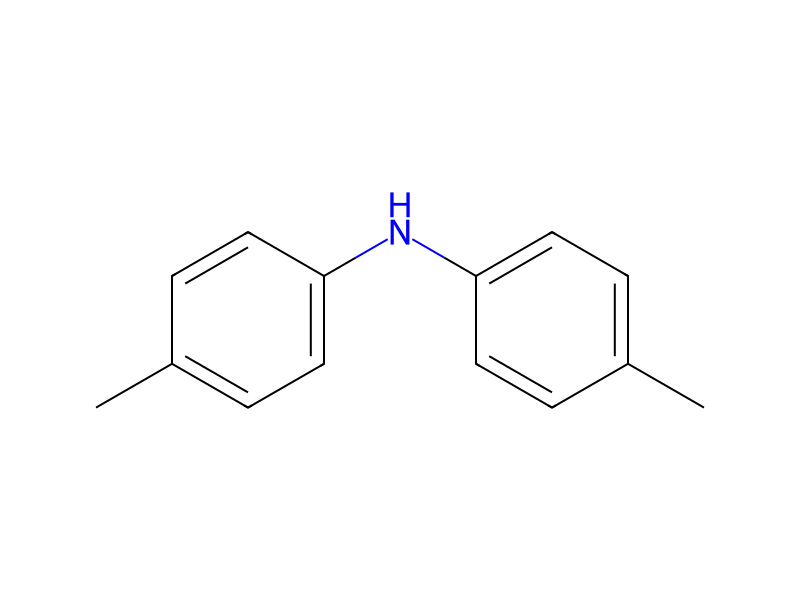
기본 정보
- CAS
620-93-9- 표준 SMILES
Cc1ccc(Nc2ccc(C)cc2)cc1- InChIKey
RHPVVNRNAHRJOQ-UHFFFAOYSA-N- 분자식
- C14H15N
- 평균 분자량
- 197.27 g/mol
- 단동위원소 질량
- 197.12044948
이름 및 식별자
- 우선 이름
- Benzenamine, 4-methyl-N-(4-methylphenyl)-
- IUPAC
- 4-methyl-N-(4-methylphenyl)aniline
- 영어명
- Di-p-tolylamine
- 분자식
- C14H15N
- 분자량
- 197.28
이름 및 동의어
Di-p-tolylaminebis(4-methylphenyl)amineBenzenamine, 4-methyl-N-(4-methylphenyl)-EINECS 210-659-84-Methyl-N-(4-methylphenyl)benzenamineRefChem:561900210-659-84,4'-Dimethyldiphenylamine620-93-94-Methyl-N-(4-methylphenyl)anilinep,p'-Ditolylamine4,4-Dimethyldiphenylamine
이름 더 보기
DMDPADI-P-TolyamineDi-p-toLDitlylaminep,p'-DitolyamineP,P'-DITLYLAMINE4,4'-DitolylamineBis(p-tolyl)amine
MFCD00059317di-p-tolylaminbis(4-tolyl) amineN,N-di(p-toluyl)amineDi-p-tolylamine, 97%4,4`-DimethyldiphenylamineIFLab1_001787HMS1417B05
데이터베이스 식별자
- CAS
620-93-9- PubChem CID
- 69293
- DTXSID
DTXSID5060726- EC Number
- 210-659-8
- Nikkaji
- J29.936G
물성
구조 계산 물성
- XLogP
- 4.2
- 극성 표면적
- 12 Ų
- 수소 결합 공여자 수
- 1
- 수소 결합 수용자 수
- 1
- 회전 가능 결합 수
- 2
- 무거운 원자 수
- 15
- 형식 전하
- 0
- 복잡도
- 154
실험 및 물리화학적 성질
SpringerMaterials PropertiesDensity
물리화학적 성질
- 녹는점
- 78 · 78-82°C
- 끓는 점
- 330 °C · 330 °C
- 밀도
- 1.0514 · 1.0514 (rough estimate)
- 굴절률
- 1.6095 · 1.6095 (estimate)
- 저장 조건
- Keep in dark place,Inert atmosphere,Room temperature
- 용해도
- 클로로폼(약간 용해됨), 메탄올(약간 용해됨)
- 물리적 상태
- 고체
- 산도 계수 (pKa)
- 1.68 · 1.68±0.40(Predicted)
- 색상
- 회백색
- InChI
- InChI=1S/C14H15N/c1-11-3-7-13(8-4-11)15-14-9-5-12(2)6-10-14/h3-10,15H,1-2H3
- InChIKey
- RHPVVNRNAHRJOQ-UHFFFAOYSA-N
- SMILES
- C1(NC2=CC=C(C)C=C2)=CC=C(C)C=C1
- EPA
- 4 · 4,4'-Dimethyldiphenylamine (620-93-9)
화학적 성질
White crystalline powder
안전 및 규제
안전 정보는 참고용이며, 공급업체의 물질안전보건자료(SDS), 관련 법규 및 전문가 평가를 대체하지 않습니다.
GHS 분류
GHS Classification
Warning
H302 (33.3%): Harmful if swallowed [Warning Acute toxicity, oral]
P261, P264, P264+P265, P270, P271, P280, P301+P317, P302+P352, P304+P340, P305+P351+P338, P317, P319, P321, P330, P332+P317, P337+P317, P362+P364, P403+P233, P405, and P501 (click each P-code to see the statement)
Aggregated GHS information provided per 3 reports by companies from 2 notifications to the ECHA C&L Inventory. Each notification may be associated with multiple companies.
유해성 정보
Hazard Classes and CategoriesAcute Tox. 4 (33.3%)
안전 데이터
- wgk
- 3
- tsca
- TSCA listed
- HS 번호
- 29214990
- 스토리지 클래스
- 11 - Combustible Solids
화학 및 산업
용도 및 제조
General Manufacturing InformationBenzenamine, 4-methyl-N-(4-methylphenyl)-: ACTIVE
응용 분야
개요Di-p-tolylamine (also known as 4,4′-dimethyldiphenylamine) is an intermediate for OLED materials. Acting as a strong electron-donating unit, Di-p-tolylamine is chemically incorporated into the molecular framework of the host material POPCPA, and is used to fabricate highly efficient blue phosphorescent OLED devices with low driving voltages (maximum power efficiency of 45.3 lm/W; driving voltage of 2.6 V at 1 cd/m2). This compound shares a similar diphenylamine structure to that found in commonly used hole-transporting materials (such as TAPC); the methyl-substituted diphenylamine unit possesses good electron-donating ability and steric hindrance, which helps to increase the material's glass transition temperature (90°C) and thermal decomposition temperature (406°C), thereby enhancing the thermal stability of the device[1].
용도4,4''-Dimethyldiphenylamine is a reagent used in the comparative studies of the analgesic and anti-inflammatory properties of N-phenylanthranilic acids and mefenamic acid, and the anti parasitic activities of some substituted diphenylamines.
상·하류 제품 정보
상류 원료
관련 반응
26건


화합물 노트
불러오는 중…