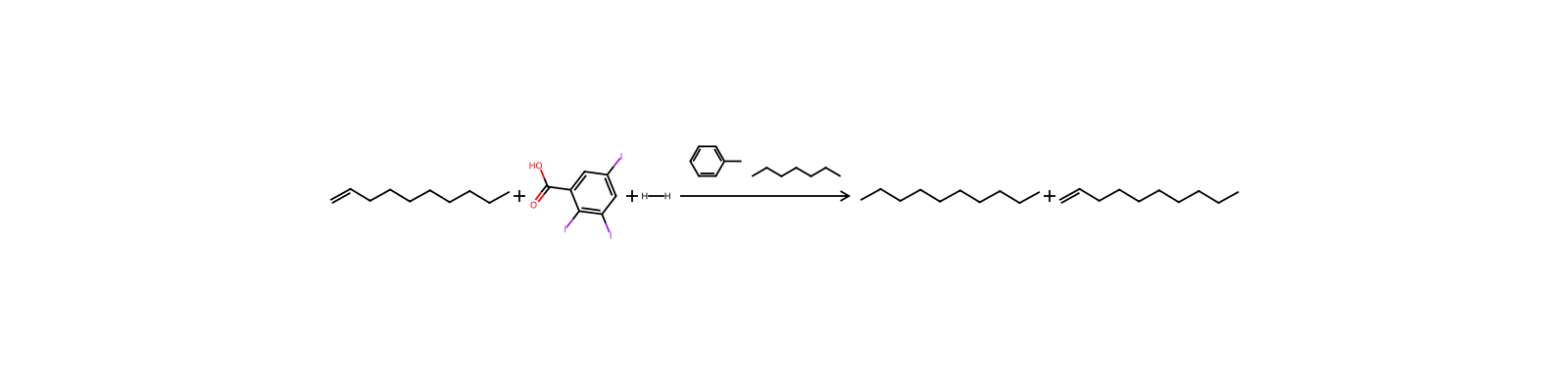

기본 정보
- 표준 SMILES
O=C(O)c1cc(I)cc(I)c1I- InChIKey
ZMZGFLUUZLELNE-UHFFFAOYSA-N- 분자식
- C7H3I3O2
- 평균 분자량
- 499.81 g/mol
- 단동위원소 질량
- 499.72672334
개요
2,3,5-triiodobenzoic acid is a member of the class of benzoic acids that is benzoic acid in which the hydrogens at positions 2, 3 and 5 are replaced by iodine atoms. It is an auxin polar transport inhibitor. It has a role as a member of antiauxins. It is a member of benzoic acids and an organoiodine compound.
이름 및 식별자
- 우선 이름
- 2,3,5-Triiodobenzoic acid
- IUPAC
- 2,3,5-triiodobenzoic acid
- 영어명
- 2,3,5-Triiodobenzoic acid
- 분자식
- C7H3I3O2
- 분자량
- 499.81
이름 및 동의어
2,3,5-TRIIODOBENZOIC ACID88-82-4FloraltoneTIBAJohnkolorBenzoic acid, 2,3,5-triiodo-2,3,5-TIBANSC 2582DTXSID4041317A 20812NSC-2582H575A4059Q
이름 더 보기
Tibtriiodobenzoicacid2,3,5-triiodobenzoicB3Ia20812Regim 8TIBA(R)
DTXCID2021317CHEBI:73175A-20812RefChem:81403201-859-6MFCD00002420Regin 8C7H3I3O2
데이터베이스 식별자
- CAS
88-82-4- PubChem CID
- 6948
- DTXSID
DTXSID4041317- ChEMBL
CHEMBL115079- ChEBI
CHEBI:73175- UNII
- H575A4059Q
- EC Number
- 201-859-6
- Nikkaji
- J3.907A
물성
구조 계산 물성
- XLogP
- 3.4
- 극성 표면적
- 37.3 Ų
- 수소 결합 공여자 수
- 1
- 수소 결합 수용자 수
- 2
- 회전 가능 결합 수
- 1
- 무거운 원자 수
- 12
- 형식 전하
- 0
- 복잡도
- 185
실험 및 물리화학적 성질
SpringerMaterials PropertiesFusion temperature
LogP3.45
Color/Form
White to off-white amorphous powder
Prisms from alcohol
Solubility
Insoluble in water; slightly soluble in benzene; very soluble in ethanol, ether
Very slightly soluble in water
DecompositionHazardous Decomposition Products: Carbon monoxide, Carbon dioxide, Hydrogen iodide.
Melting Point225 °C
PolymerizationHazardous Polymerization: Will not occur
Dissociation ConstantspKa = approximately 1.5
Collision Cross Section498.7 Ų [M-H]- [CCS Type: DT; Buffer gas: N2; Ionization: ESI-; Dataset: TOXCAST; Source Identifier: DTXSID4041317]
물리화학적 성질
- 녹는점
- 220 · 220-222 °C (lit.)
- 끓는 점
- 456.7 · 456.7±45.0 °C(Predicted)
- 밀도
- 2.7985 · 2.7985 (estimate)
- 저장 조건
- -20 °C · -20°C
- 용해도
- 5 %, · 메탄올: 용해성 5%, 흐릿함, 주황색에서 매우 진한 주황색(연한)
- 산도 계수 (pKa)
- 2.16 · 2.16±0.10(Predicted)
- 물리적 상태
- 고체
- 색상
- 연한 갈색
- 수용성
- 물에 불용성.
- BRN
- 1955088 · 1955088
- InChI
- InChI=1S/C7H3I3O2/c8-3-1-4(7(11)12)6(10)5(9)2-3/h1-2H,(H,11,12)
- InChIKey
- ZMZGFLUUZLELNE-UHFFFAOYSA-N
- SMILES
- C(O)(=O)C1=CC(I)=CC(I)=C1I
- NIST
- 2 · 2,3,5-Triiodobenzoic acid(88-82-4)
- EPA
- 2 · 2,3,5-Triiodobenzoic acid (88-82-4)
화학적 성질
beige powder
안전 및 규제
GHS 분류
GHS Classification
Warning
H302 (100%): Harmful if swallowed [Warning Acute toxicity, oral]
P261, P264, P264+P265, P270, P271, P280, P301+P317, P302+P352, P304+P340, P305+P351+P338, P319, P321, P330, P332+P317, P337+P317, P362+P364, P403+P233, P405, and P501 (click each P-code to see the statement)
Aggregated GHS information provided per 46 reports by companies from 4 notifications to the ECHA C&L Inventory. Each notification may be associated with multiple companies.
유해성 정보
Hazard Classes and CategoriesAcute Tox. 4 (100%)
Skin, Eye, and Respiratory IrritationsMay cause skin irritation.
안전 및 보호
Fire Fighting ProceduresProtective Equipment: Wear self-contained breathing apparatus and protective clothing to prevent contact with skin and eyes. Specific Hazard(s): Emits toxic fumes under fire conditions.
Storage ConditionsKeep tightly closed. Store at -20 °C
Cleanup Methods
Accidental Release Measures: Procedures to be followed in case of leak or spill - Evacuate area. Procedures of personal precautions: Wear self-contained breathing apparatus, rubber boots, and heavy rubber gloves. Methods for cleaning up: Sweep up, place in a bag and hold for waste disposal. Avoid raising dust. Ventilate area and wash spill site after material pickup is complete.
Disposal Methods
SRP: The most favorable course of action is to use an alternative chemical product with less inherent propensity for occupational exposure or environmental contamination. Recycle any unused portion of the material for its approved use or return it to the manufacturer or supplier. Ultimate disposal of the chemical must consider: the material's impact on air quality; potential migration in soil or water; effects on animal, aquatic, and plant life; and conformance with environmental and public health regulations.
Preventive Measures
Do not breathe dust. Avoid contact with eyes, skin, and clothing. Avoid prolonged or repeated exposure.
For several good reasons, .... herbicides ... should be handled and applied only with full attention to safety measures that minimize personal contact. Many formulations contain adjuvants (stabilizers, penetrants, surfactants) that may have significant irritating and toxic effects. A number of premixed formulations contain two or more active ingredients; the companion pesticides may be more toxic than the principal herbicide. Good hygienic practice should not be disregarded just because a pesticide is reported to have a high LD50 in laboratory rodents.
Personal Protective Equipment (PPE)
Engineering controls: Safety shower and eye bath. Mechanical exhaust required.
Personal protective equipment: Respiratory: Use respirators and components tested and approved under appropriate government standards such as NIOSH (US) or CEN (EU). Where risk assessment shows air-purifying respirators are appropriate use a dust mask type N95 (US) or type P1 (EN 143) respirator.
독성 정보
Environmental Fate
TERRESTRIAL FATE: Based on a classification scheme(1), an estimated Koc value of 64(SRC), determined from a structure estimation method(2), indicates that 2,3,5-triiodobenzoic acid is expected to have high mobility in soil(SRC). The pKa of 2,3,5-triiodobenzoic acid is approximately 1.5(3), indicating that this compound will primarily exist in the anion form in the environment and anions generally do not adsorb more strongly to soils containing organic carbon and clay than their neutral counterparts(4). Volatilization of 2,3,5-triiodobenzoic acid from moist soil surfaces is not expected to be an important fate process given that ions do not volatilize(SRC). 2,3,5-Triiodobenzoic acid is not expected to volatilize from dry soil surfaces(SRC) based upon an estimated vapor pressure of 1.3X10⁻⁷ mm Hg(SRC), determined from a fragment constant method(5). After 8 weeks incubation, soil microflora degraded this compound to 2,5- (15-20% peak concn) and 3,5-diiodobenzoic acid (14-15% peak concn) and one unknown metabolite(6), indicating that biodegradation may be an important environmental fate process in soil(SRC).
AQUATIC FATE: Based on a classification scheme(1), an estimated Koc value of 64(SRC), determined from a structure estimation method(2), indicates that 2,3,5-triiodobenzoic acid is not expected to adsorb to suspended solids and sediment(SRC). An approximate pKa of 1.5(3) indicates 2,3,5-triiodobenzoic acid will exist almost entirely in the anion form at pH values of 5 to 9 and therefore volatilization from water surfaces is not expected to be an important fate process(4). According to a classification scheme(5), an estimated BCF of 6(SRC), from an estimated log Kow of 5.03(6) and a regression-derived equation(7), suggests the potential for bioconcentration in aquatic organisms is low(SRC). Biodegradation data for the compound in water were not available(SRC, 2008).
ATMOSPHERIC FATE: According to a model of gas/particle partitioning of semivolatile organic compounds in the atmosphere(1), 2,3,5-triiodobenzoic acid, which has an estimated vapor pressure of 1.3X10⁻⁷ mm Hg at 25 °C(SRC), determined from a fragment constant method(2), will exist in both the vapor and particulate phases in the ambient atmosphere. Vapor-phase 2,3,5-triiodobenzoic acid is degraded in the atmosphere by reaction with photochemically-produced hydroxyl radicals(SRC); the half-life for this reaction in air is estimated to be 27 days(SRC), calculated from its rate constant of 6.0X10⁻¹³ cu cm/molecule-sec at 25 °C(SRC) that was derived using a structure estimation method(3). Particulate-phase 2,3,5-triiodobenzoic acid may be removed from the air by wet or dry deposition(SRC). UV radiation of 2,3,5-triiodobenzoic acid was shown to result in the formation of 2,5- and 3,5-diiodobenzoic acids(4); therefore, 2,3,5-triiodobenzoic acid may be susceptible to direct photolysis by sunlight(SRC).
Milk Concentrations
The metabolites of 2,3,5-triiodobenzoic acid in cow's milk resulting from acute administration of the compound (1.197 g) were determined using electron capture gas-chromatograph procedures. The parent compound plus seven suspected metabolites were detected; of these, four were identified, and one quantitated. The primary metabolite was 2-OHI-3,5-diiodobenzoic acid. Occurring in trace amounts were mono-iodobenzoic acids, 2-0H-5 iodobenzoic acid, and 3,5-diiodobenzoic acid. The maximum concentration of 2,3,5-triiodobenzoic acid in raw milk was found in the 30-hr milk sample at the 0.79 mg/kilogram level and of 2-OH-3,5-diiodobenzoic acid in the 42-hr milk at the 0.27 mg/kilogram level.
Soil Adsorption/Mobility
Using a structure estimation method based on molecular connectivity indices(1), the Koc of 2,3,5-triiodobenzoic acid can be estimated to be 64(SRC). According to a classification scheme(2), this estimated Koc value suggests that 2,3,5-triiodobenzoic acid is expected to have high mobility in soil. The pKa of 2,3,5-triiodobenzoic acid is approximately 1.5(3), indicating that this compound will primarily exist in the anion form in the environment and anions generally do not adsorb more strongly to soils containing organic carbon and clay than their neutral counterparts(4).
Human Toxicity Excerpts
/SIGNS AND SYMPTOMS/ Harmful if swallowed
/SIGNS AND SYMPTOMS/ May cause skin irritation.
Artificial Pollution Sources2,3,5-Triiodobenzoic acid's production may result in its release to the environment through various waste streams; its use as a plant growth regulator(1) will result in its direct release to the environment(SRC).
Environmental Biodegradation
AEROBIC: Very little is known about biodegradation of 2,3,5-triiodobenzoic acid in soil(1). Soil microflora degraded this compound to 2,5- and 3,5-diiodobenzoic acid and one unknown metabolite; peak concns of 2,5- and 3,5-diiodobenzoic acid were 15-20% and 14-15%, respectively, after 8 weeks incubation(2).
ANAEROBIC: Using ruminal fluid as an inoculum, 2,3,5-triiodobenzoic acid was persistent, showing no evidence of dehalogenation(1).
Environmental Bioconcentration
An estimated BCF of 6 was calculated in fish for 2,3,5-triiodobenzoic acid(SRC), using an estimated log Kow of 5.03(1) and a regression-derived equation(2). According to a classification scheme(3), this BCF suggests the potential for bioconcentration in aquatic organisms is low(SRC).
Volatilization from Water/Soil
The pKa of 2,3,5-triiodobenzoic acid is approximately 1.5(1), indicating that this compound will primarily exist in the anion form in the environment and therefore volatilization from water surfaces is not expected to be an important fate process(2). 2,3,5-Triiodobenzoic acid is not expected to volatilize from dry soil surfaces(SRC) based upon an estimated vapor pressure of 1.3X10⁻⁷ mm Hg(SRC), determined from a fragment constant method(3).
Non-Human Toxicity Excerpts
/LABORATORY ANIMALS: Acute Exposure/ Intraperitoneal, Mouse LD50 = 562 mg/kg. Remarks: Behavioral:Rigidity (includes catalepsy). Behavioral:Muscle contraction or spasticity.
/LABORATORY ANIMALS: Subchronic or Prechronic Exposure/ The effects of some plant growth regulators (PGRs), 2,3,5-triiodobenzoic acid (TIBA), Naphthaleneacetic acid (NAA) and 2,4-Dichlorofenoxyacetic acid (2,4-D), at sublethal concentrations on antioxidant defense system [glutathione peroxidases (GPx), reduced glutathione (GSH), glutathione reductase (GR), glutathione-S-transferase (GST) and catalase (CAT)], immune potential enzymes [adenosine deaminase (ADA) and myeloperoxidase (MPO)], and lipid peroxidation content [Malondialdehyde, (MDA)] were investigated in lung and speen tissues of rats. Sprague-Dawley albino rats were exposed to 0, 50, or 100 ppm (parts per million) TIBA, NAA, or 2,4-D in drinking water ad libitum for 25 days continuously. According to the results, MDA concentration significantly increased in the tissues treated with 100 ppm dosage of NAA or 2,4-D without any change in the tissues of rats treated with either dosage of TIBA. The GSH depletion in the spleen tissue of rats treated with either the dosage of NAA and 2,4-D were found to be significant. Also, GSH level in the spleen was significantly reduced with 100 ppm of 2,4-D and NAA. The activity of antioxidant enzymes were also seriously affected by PGRs; GPx significantly decreased in the lung of rats treated with either dosages of the PGRs, whereas GPx activity in the spleen were significantly increased with 100 ppm dosage of 2,4-D and NAA. On the other hand, CAT activity significantly decreased in the lung of rats treated with both dosages of NAA, 100 ppm of 2,4-D and 50 ppm of TIBA, and also in the spleen treated with 50 ppm NAA and 2,4-D. The ancillary enzyme GR activity significantly decreased in the spleen with both doses of the PGRs, also in the lung treated with both dosages of 2,4-D, 50 ppm of NAA and 100 ppm of TIBA. The drug metabolizing enzyme GST activity significantly reduced in the lung of rats treated with either dosages of the PGRs and also in the spleen treated with 100 ppm dosage of 2,4-D and TIBA and 50 ppm of NAA. Meanwhile, immune potential enzyme MPO activity significantly increased in the spleen of rats treated with both doses of NAA and TIBA whereas ADA activity significantly decreased in the spleen of rats treated with 100 ppm dose of NAA and TIBA. The observations presented led us to conclude that the administrations of subacute NAA, 2,4-D, and TIBA promote MDA content, inhibit the antioxidative defense system and activate or inhibit immune potential enzymes in the rat's spleen and lung tissues. These data suggest that PGRs produced substantial organ toxicity in the lung and spleen during the period of a 25-day subacute exposure.
/OTHER TOXICITY INFORMATION/ This study aims to investigate the effects of the plant growth regulators (PGRs) (2,3,5-triiodobenzoic acid (TIBA), Naphthaleneacetic acid (NAA), and 2,4-dichlorofenoxyacetic acid (2,4-D)) on serum marker enzymes (aspartate aminotransferase (AST), alanine aminotransferase (ALT), creatine phosphokinase (CPK), and lactate dehydrogenase (LDH)), antioxidant defense systems (reduced glutathione (GSH), glutathione reductase (GR), superoxide dismutase (SOD), glutathione-S-transferase (GST), and catalase (CAT)), and lipid peroxidation content (malondialdehyde = MDA) in various tissues of rats. 50 and 100 ppm of PGRs as drinking water were administered orally to rats (Sprague-Dawley albino) ad libitum for 25 days continuously. The PGRs treatment caused different effects on the serum marker enzymes, antioxidant defense systems, and the MDA content in experimented rats compared to controls. Results showed that TIBA caused a significant decrease in serum AST activity with both the dosage whereas serum CPK was significantly increased with 100 ppm dosage of TIBA. Meanwhile, serum AST, CPK, and LDH activities were significantly increased with both dosage of NAA and 2,4-D. The lipid peroxidation end-product MDA significantly increased in the all tissues treated with both dosages of PGRs without any change in the brain and erythrocyte of rats treated with both the dosages of 2,4-D. The GSH depletion in the kidney and brain tissues of rats treated with both dosages of PGRs was found to be significant. Furthermore, the GSH depletion in the erythrocyte of rats treated with both dosages of PGRs except 50 ppm dosage of 2,4-D was significant too. Also, the GSH level in the liver was significantly depleted with 50 ppm of 2,4-D and NAA, whereas the GSH depletion in the same tissue did not significantly change with the treatment. The activity of antioxidant enzymes was also seriously affected by PGRs; SOD significantly decreased in the liver, heart, kidney, and brain of rats treated with both dosages of NAA, whereas the SOD activity in the erythrocytes, liver, and heart was either significantly decreased or not changed with two doses of 2,4-D and TIBA. Although the CAT activity significantly increased in the erythrocyte and brain of rats treated with both doses of PGRs, it was not changed in the liver, heart, and kidney. Meanwhile, the ancillary enzyme GR activity significantly increased in the brain, heart, and liver but decreased in the erythrocyte and kidney of rats treated with both doses of PGRs. The drug-metabolizing enzyme GST activity significantly increased in the heart and kidney but decreased in the brain and erythrocytes of rats treated with both dosages of PGRs. As a conclusion, the results indicate that PGRs might affect antioxidant potential enzymes, the activity of hepatic damage enzymes, and lipid peroxidation dose independently. Also, the rats resisted to oxidative stress via antioxidant mechanism but the antioxidant mechanism could not prevent the increases in lipid peroxidation in rat's tissues. These data, along with the determined changes, suggest that PGRs produced substantial systemic organ toxicity in the erythrocyte, liver, brain, heart, and kidney during the period of a 25-day subacute exposure.
Environmental Abiotic Degradation
The rate constant for the vapor-phase reaction of 2,3,5-triiodobenzoic acid with photochemically-produced hydroxyl radicals has been estimated as 6.0X10⁻¹³ cu cm/molecule-sec at 25 °C(SRC) using a structure estimation method(1). This corresponds to an atmospheric half-life of about 27 days at an atmospheric concentration of 5X10+5 hydroxyl radicals per cu cm(1). 2,3,5-Triiodobenzoic acid is not expected to undergo hydrolysis in the environment due to the lack of functional groups that hydrolyze under environmental conditions(3). UV radiation of foliar-applied 2,3,5-triiodobenzoic acid to soybean plants was shown to result in the formation of 2,5- and 3,5-diiodobenzoic acids(4); therefore, 2,3,5-triiodobenzoic acid may be susceptible to direct photolysis by sunlight(SRC).
Probable Routes of Human ExposureOccupational exposure to 2,3,5-triiodobenzoic acid may occur through inhalation and dermal contact with this compound at workplaces where 2,3,5-triiodobenzoic acid is produced or used. (SRC)
Environmental Fate/Exposure Summary
2,3,5-Triiodobenzoic acid's production may result in its release to the environment through various waste streams; its use as a plant growth regulator will result in its direct release to the environment. If released to air, an estimated vapor pressure of 1.3X10⁻⁷ mm Hg at 25 °C indicates 2,3,5-triiodobenzoic acid will exist in both the vapor and particulate phases in the atmosphere. Vapor-phase 2,3,5-triiodobenzoic acid will be degraded in the atmosphere by reaction with photochemically-produced hydroxyl radicals; the half-life for this reaction in air is estimated to be 27 days. Particulate-phase 2,3,5-triiodobenzoic acid will be removed from the atmosphere by wet or dry deposition. UV radiation of 2,3,5-triiodobenzoic acid was shown to result in the formation of 2,5- and 3,5-diiodobenzoic acids and therefore, 2,3,5-triiodobenzoic acid may be susceptible to direct photolysis by sunlight. If released to soil, 2,3,5-triiodobenzoic acid is expected to have high mobility based upon an estimated Koc of 64. The pKa of 2,3,5-triiodobenzoic acid is approximately 1.5, indicating that this compound will exist almost entirely in the anion form in the environment and anions generally do not adsorb more strongly to soils containing organic carbon and clay than their neutral counterparts. Volatilization from moist soil surfaces is not expected to be an important fate process based upon its ionic form. After 8 weeks incubation, soil microflora degraded this compound to 2,5- (15-20% peak concn) and 3,5-diiodobenzoic acid (14-15% peak concn) and one unknown metabolite, indicating that biodegradation may be an important environmental fate process in soil. If released into water, 2,3,5-triiodobenzoic acid is not expected to adsorb to suspended solids and sediment based upon the estimated Koc. Biodegradation data in water were not available. The estimated pKa indicates 2,3,5-triiodobenzoic acid will exist almost entirely in the anion form at pH values of 5 to 9 and therefore volatilization from water surfaces is not expected to be an important fate process. An estimated BCF of 6 suggests the potential for bioconcentration in aquatic organisms is low. Hydrolysis is not expected to be an important environmental fate process since this compound lacks functional groups that hydrolyze under environmental conditions. Occupational exposure to 2,3,5-triiodobenzoic acid may occur through inhalation and dermal contact with this compound at workplaces where 2,3,5-triiodobenzoic acid is produced or used. (SRC)
안전 데이터
- wgk
- 3
- tsca
- TSCA listed
- rtecs
- DH9275000
- HS 번호
- 29163900
- risk_code
- 22
- hazard_code
- Xn
- safety_code
- 22-26-36-24/25
- 기존화학 물질
- KE-34307
- Hazard Classifications
- Acute Tox. 4 Oral
- 스토리지 클래스
- 11 - Combustible Solids
- 유해 물질 데이터
- 88-82-4(Hazardous Substances Data)
화학 및 산업
약리 정보
Metabolism/Metabolites
Rats receiving oral doses of C14-carboxyl or 2,3( 125-I),5(126-I)-triiodobenzoic acid excreted 72-75 % of the radioactivity in urine and 24-28% in feces during the 4 days following drug administration... . Thin-layer chromatograms of ether extracts of urine (50-80% of the radioactivity was extracted) revealed the presence of: 2,5-diiodobenzoic acid, as the free acid and a conjugate, accounting for 66% of the extractable radioactivity (39.6% of dose); unchanged TIBA, 9.5% (5.7% of dose); 2-hydroxy-3,5-diiodobenzoic acid, 2.3% (1.4% of dose); and 3,5-diiodobenzoic acid, 0.7% (0.4% of dose). Thin-layer chromatograms of feces extracts revealed a metabolic pattern similar io urine.
The whole body retention, excretion, distribution, thyroid uptake, and metabolism of 2(131I),3,5-triiodobenzoic acid (TIBA) were studied in goats and a cow. A single oral dose of TIBA exhibited a two-component whole body radioactivity retention curve and was excreted primarily in the urine. TIBA plus nine metabolites, four of which were identified, were found in the urine. The major metabolite was 2,5-diiodobenzoic acid (2,5-DIBA). Trace amounts of 2,3-diiodobenzoic acid (2,3-DIBA), orthoiodobenzoic acid (OIBA), and iodide ion were found. TIBA was metabolized by deiodination. Iodide ion was concentrated in the thyroid and excreted by way of milk and urine.
The metabolites of 2,3,5-triiodobenzoic acid in cow's milk resulting from acute administration of the compound (1.197 g) were determined using electron capture gas-chromatograph procedures. The parent compound plus seven suspected metabolites were detected; of these, four were identified, and one quantitated. The primary metabolite was 2-OHI-3,5-diiodobenzoic acid. Occurring in trace amounts were mono-iodobenzoic acids, 2-0H-5 iodobenzoic acid, and 3,5-diiodobenzoic acid. The maximum concentration of 2,3,5-triiodobenzoic acid in raw milk was found in the 30-hr milk sample at the 0.79 mg/kilogram level and of 2-OH-3,5-diiodobenzoic acid in the 42-hr milk at the 0.27 mg/kilogram level.
Absorption, Distribution and Excretion
The placental transfer of 2, 3, 5-triiodobenzoic acid and/or metabolites was studied using 14C-labeled 2, 3, 5-triiodobenzoic acid. Placental transfer of 2, 3, 5-triiodobenzoic acid and/or metabolites occurred in both cold-stressed and control rats. The maternal blood of cold-stressed and control rats contained significantly higher concentrations of 2, 3, 5-triiodobenzoic acid and/or metabolites than the blood of respective fetal rats. However, cold stress did not significantly alter either placental transfer or the level of 2, 3, 5-triiodobenzoic acid and/or metabolites in the maternal and fetal tissue. Cold stress had no apparent effect upon the plasma level of either 2, 3, 5-triiodobenzoic acid, 2, 5-diiodobenzoic acid, or 3, 5-diiodobenzoic acid in maternal or fetal animals. While nonpregnant rats acclimated to cold stress, pregnant rats did not, indicating cold stress and pregnancy may act synergistically.
Rats receiving oral doses of C14-carboxyl or 2,3( 125-I),5(125-I)-triiodobenzoic acid excreted 72-75% of the radioactivity in urine and 24-28% in feces during the 4 days following drug administration. Peak levels of carbon-14 were observed in brain, thyroid, liver, lungs, heart, spleen, kidneys, and carcass 4 or 8 hr after dosing and rapidly decreased thereafter. Levels of iodine-125 were significantly higher than carbon-14 levels in the brain and thyroid. Iodine-125 in thyroid increased with time. ...
용도 및 제조
Uses
A plant growth regulator used as a growth retardant
Plant growth regulator synthesis and function inhibitor
Plant growth regulator and defoliant with the properties of an antiauxin
Methods of Manufacturing... 2-aminobenzoic acid with iodine monochloride to form 2-amino-3,5-diiodobenzoic acid ... diazotized and reacted with potassium to yield 2,3,5-triiodobenzoic acid
General Manufacturing InformationBenzoic acid, 2,3,5-triiodo-: ACTIVE
응용 분야
용도2,3,5-Triiodobenzoic Acid is a polar auxin transport inhibitor that inhibits and promotes endoreduplication in hypocotyls and cotyledons.
상·하류 제품 정보
상류 원료
하류 제품
공급사50 곳
国药集团化学试剂有限公司86-21-63210123 · [email protected]
梯希爱(上海)化成工业发展有限公司021-67121386 · [email protected]
上海阿拉丁生化科技股份有限公司400-6206333 13167063860 · [email protected]
合肥胜航医药科技有限公司19156016681 18326946292 · [email protected]
INTATRADE GmbH+49 3493/605464 · [email protected]
爱斯特(成都)生物制药股份有限公司+86-28-85122536 85324413 · [email protected]
韶远科技(上海)有限公司021-50795510 4000665055 · [email protected]
科瑞迪化学400-821-5857 021-64326257 · [email protected]
Syntechem Co.,Ltd[email protected]
南通萧畅医药贸易有限公司0513-82104991 18862997351 · [email protected]
上海迈瑞尔生化科技有限公司4006356688 18621169109 · [email protected]
阿法埃莎(中国)化学有限公司400-6106006 · [email protected]
安耐吉化学&3A(安徽泽升科技股份有限公司)400-0056266 · [email protected]
石家庄斯迪亚诺精细化工有限公司0311-89250318 13582355795 · [email protected]
上海瀚鸿科技股份有限公司021-54306202 13764082696 · [email protected]
嘉兴市艾森化工有限公司0573-85285100 18627885956 · [email protected]
上海隆盛化工有限公司58099637 13585536065 · [email protected]
武汉丰泰威远科技有限公司027-87465837 19945049750 · [email protected]
山东西亚化学有限公司13355009207 13355009207 · [email protected]
玛雅试剂+86 (573) 82222445 (0)18006601000 452520369 · [email protected]
四川库利南科技有限公司400-1166-196 18981987031 · [email protected]
天津希恩思生化科技有限公司400 638 7771 · [email protected]
武汉科美沃化工有限公司027-85736489 · [email protected]
湖南汇百侍生物科技有限公司0731-85526065 13308475853 · [email protected]
河南多贝化工有限公司0370-2785118 17550508557 · [email protected]
斯百全化学(上海)有限公司021-021-021-67601398-809-809-809 15221380277 · [email protected]
上海源叶生物科技有限公司13636370518 · [email protected]
天津科创医药中间体技术生产力促进有限公司022-60116533 13207668525 · [email protected]
上海思域化工科技有限公司86-21-34053660 · [email protected]
TOKYO CHEMICAL INDUSTRY CO., LTD.03-36680489 · [email protected]
上海贤鼎生物科技有限公司4009209199 · [email protected]
上海灏云化工科技有限公司021-68367562 · [email protected]
上海将来实业股份有限公司021-61552785 · [email protected]
HBCChem, Inc.+1-510-219-6317 · [email protected]
美岚实业(上海)有限公司021-58958189 · [email protected]
上海爱蝶实业有限公司021-58957966 18930537195 · [email protected]
广拓化学(上海)有限公司021-60899189-8001 18918189673 · [email protected]
上海麦克林生化科技股份有限公司15221275939 15221275939 · [email protected]
杭州杰恒化工有限公司0571-87396432 · [email protected]
上海有朋化工有限公司021-69005955 13701776567 · [email protected]
北京海力扬化学科技有限公司13718199399 · [email protected]
北京欣赛维化学科技有限公司010-56218822 13717722232 · [email protected]
四川海诺威科技有限公司13708085536 13708085536 · [email protected]
江苏艾康生物医药研发有限公司025-66028182 17714375163 · [email protected]
上海凯赛化工有限公司021-33516722 13701817765 · [email protected]
上海彤源化工有限公司021-021-69182866 13701855675 · [email protected]
苏州氟洛科医药技术有限公司0512-62706796 · [email protected]
上海孚一生物科技有限公司+86 (21) 61124340
北京华扬致成科技有限公司13716033033 · [email protected]
上海蓝润化学有限公司021-69515658 ; 69515628 13701998368 · [email protected]
추가 설명
정의ChEBI: 2,3,5-triiodobenzoic acid is a member of the class of benzoic acids that is benzoic acid in which the hydrogens at positions 2, 3 and 5 are replaced by iodine atoms. It is an auxin polar transport inhibitor. It has a role as a member of antiauxins. It is an organoiodine compound and a member of benzoic acids.
관련 반응
34건


연결된 노트
불러오는 중…