N,N-Diethyl-p-phenylenediamine
데이터를 보충하는 중입니다. 잠시 후 페이지를 새로 고치면 최신 내용을 볼 수 있습니다
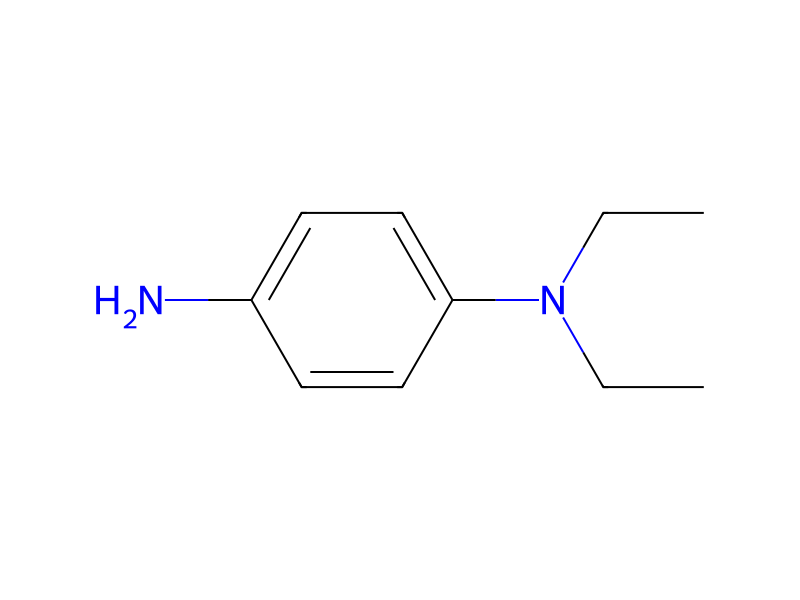
93-05-0CCN(CC)c1ccc(N)cc1QNGVNLMMEQUVQK-UHFFFAOYSA-NReddish brown or black liquid. (NTP, 1992)
93-05-0DTXSID2025058CHEMBL14521580.988 (NTP, 1992) - Less dense than water; will float
0.988
Liquid
Pale yellow liquid
less than 1 mg/mL at 66 °F (NTP, 1992)
Insol in water; sol in alcohol and ether
Very soluble in benzene
500 to 504 °F at 760 mmHg (NTP, 1992)
260-262 °C
Reddish brown or black liquid. (NTP, 1992)
Pale yellow liquid; [HSDB] Reddish-brown or black liquid; [CAMEO] Pale yellow liquid; Turns dark brown on exposure to light and air; [CHEMINFO] Clear very deep brown liquid; [MSDSonline]
안전 정보는 참고용이며, 공급업체의 물질안전보건자료(SDS), 관련 법규 및 전문가 평가를 대체하지 않습니다.
Danger
H301: Toxic if swallowed [Danger Acute toxicity, oral]
P260, P264, P270, P280, P301+P316, P301+P330+P331, P302+P361+P354, P304+P340, P305+P354+P338, P316, P321, P330, P363, P405, and P501 (click each P-code to see the statement)
Danger
H301 (100%): Toxic if swallowed [Danger Acute toxicity, oral]
P260, P264, P270, P280, P301+P316, P301+P330+P331, P302+P361+P354, P304+P340, P305+P354+P338, P316, P321, P330, P363, P405, and P501 (click each P-code to see the statement)
Chemical: 1,4-Benzenediamine, N,N-diethyl-
Status: Active Update: 02-06-2015 https://echa.europa.eu/registration-dossier/-/registered-dossier/7727
4-Amino-N,N-diethylaniline: Does not have an individual approval but may be used under an appropriate group standard
May cause allergic dermatitis, irritation, and hemorrhage on skin contact; May induce methemoglobinemia; [HSDB] A severe eye irritant, based on animal studies; May cause skin sensitization after prolonged contact, based on a related compound; [CHEMINFO] Can cause burns; [eChemPortal: ESIS] A severe eye irritant; Causes general anesthesia, convulsions, and cyanosis in dermal lethal-dose study of rabbits; Causes convulsions in oral lethal-dose study of cats; [RTECS] Causes burns; Toxic if ingested; May be harmful if absorbed through skin; [Aldrich MSDS]
Used as a dye intermediate and in diazo copying processes; [Hawley] Used as an antioxidant/antiozonant, as a developing agent in color photography, and in organic synthesis; [CHEMINFO]
Photographic Processing [Category: Other]
Dye intermediate; source of diazonium compd in diazo copying process
Color photography /Hydrochloride/
Treatment of diethylaniline with nitrous acid and subsequent reduction.
Reduction of p-nitro-N,N-dimethylaniline
용도Dye intermediate, source of diazonium compounds in diazo copying process.
일반 설명Reddish brown or black liquid.
불러오는 중…
dark brown to black solid or liquid, depending upon room temperature
N,N-DIETHYL-P-PHENYLENEDIAMINE neutralizes acids in exothermic reactions to form salts plus water. May be incompatible with isocyanates, halogenated organics, peroxides, phenols (acidic), epoxides, anhydrides, and acid halides. Flammable gaseous hydrogen may be generated in combination with strong reducing agents, such as hydrides.
Acute Tox. 3 (100%)
Acute toxicity - category 3
Acute toxicity (Oral) - Category 3
Acute Tox. 3 *
EYES: First check the victim for contact lenses and remove if present. Flush victim's eyes with water or normal saline solution for 20 to 30 minutes while simultaneously calling a hospital or poison control center. Do not put any ointments, oils, or medication in the victim's eyes without specific instructions from a physician. IMMEDIATELY transport the victim after flushing eyes to a hospital even if no symptoms (such as redness or irritation) develop.
SMALL SPILLS AND LEAKAGE: If you spill this chemical, FIRST REMOVE ALL SOURCES OF IGNITION. Then, use absorbent paper to pick up all liquid spill material. Your contaminated clothing and absorbent paper should be sealed in a vapor-tight plastic bag for eventual disposal. Solvent wash all contaminated surfaces with 60-70% ethanol followed by washing with a soap and water solution. Do not reenter the contaminated area until the Safety Officer (or other responsible person) has verified that the area has been properly cleaned.
SRP: At the time of review, criteria for land treatment or burial (sanitary landfill) disposal practices are subject to significant revision. Prior to implementing land disposal of waste residue (including waste sludge), consult with environmental regulatory agencies for guidance on acceptable disposal practices.
RECOMMENDED RESPIRATOR: Where the neat test chemical is weighed and diluted, wear a NIOSH-approved half face respirator equipped with an organic vapor/acid gas cartridge (specific for organic vapors, HCl, acid gas and SO2) with a dust/mist filter. (NTP, 1992)
TERRESTRIAL FATE: Based on a classification scheme(1), an estimated Koc value of 470(SRC), determined from a structure estimation method(2), indicates that the non-protonated form of N,N-diethyl-p-phenylenediamine is expected to have moderate mobility in soil(SRC). Volatilization of N,N-diethyl-p-phenylenediamine from moist soil surfaces is not expected to be an important fate process(SRC) given an estimated Henry's Law constant of 5.3X10⁻⁸ atm-cu m/mole(3), using a fragment constant estimation method(3). A pKa of 7.96(5) indicates N,N-diethyl-p-phenylenediamine will exist primarily in the protonated form at pH values of 5 to 9.Cations generally adsorb to organic carbon and clay more strongly than their neutral counterparts. N,N-Diethyl-p-phenylenediamine is not expected to volatilize from dry soil surfaces(SRC) based upon an estimated vapor pressure of 3.0X10⁻³ mm Hg(SRC), determined from a fragment constant method(4).
AQUATIC FATE: Based on a classification scheme(1), an estimated Koc value of 470(SRC), determined from an estimation method(2), indicates that the non-protonated form of N,N-diethyl-p-phenylenediamine is expected to adsorb to suspended solids and sediment(SRC). Volatilization from water surfaces is not expected(3) based upon an estimated Henry's Law constant of 5.3X10⁻⁸ atm-cu m/mole(4), developed using a fragment constant estimation method(4). A pKa of 7.96(5) indicates N,N-diethyl-p-phenylenediamine will exist primarily in the ionized form at pH values of 5 to 9. According to a classification scheme(6), an estimated BCF of 11(SRC), from an estimated log Kow of 2.2(7),and a regression-derived equation(8), suggests the potential for bioconcentration in aquatic organisms is low.
ATMOSPHERIC FATE: According to a model of gas/particle partitioning of semivolatile organic compounds in the atmosphere(1), N,N-diethyl-p-phenylenediamine, which has an estimated vapor pressure of 3.0X10⁻³ mm Hg at 25 °C(SRC), determined from a fragment constant method(2), is expected to exist solely in the vapor-phase in the ambient atmosphere. Vapor-phase N,N-diethyl-p-phenylenediamine is degraded in the atmosphere by reaction with photochemically-produced hydroxyl radicals(SRC); the half-life for this reaction in air is estimated to be 2 hours(SRC), calculated from its rate constant of 2.2X10⁻¹⁰ cu cm/molecule-sec at 25 °C(SRC) determined using a structure estimation method(3). N,N-Diethyl-p-phenylenediamine absorbs light in the environmental spectrum and has the potential for direct photolysis(4).
Using a structure estimation method based on molecular connectivity indices(1), the Koc for N,N-diethyl-p-phenylenediamine can be estimated to be 470(SRC). According to a classification scheme(2), this estimated Koc value suggests that the non-protonated form of N,N-diethyl-p-phenylenediamine is expected to have moderate mobility in soil. The pKa of N,N-diethyl-p-phenylenediamine is 7.96(3), indicating that this compound will exist in the cation form. Cations generally adsorb to organic carbon and clay more strongly than their neutral counterparts. Volatilization from moist soil surfaces is not expected to be an important fate process because the cation is not expected to volatilize(SRC).
An estimated BCF of 11 was calculated for N,N-diethyl-p-phenylenediamine(SRC), using an estimated log Kow of 2.2(1) and a regression-derived equation(2). According to a classification scheme(3), this BCF suggests the potential for bioconcentration in aquatic organisms is low(SRC).
The Henry's Law constant for N,N-diethyl-p-phenylenediamine is estimated as 5.3X10⁻⁸ atm-cu m/mole(SRC) using a fragment constant estimation method(1). This Henry's Law constant indicates that N,N-diethyl-p-phenylenediamine is expected to be essentially nonvolatile from water surfaces(2). N,N-Diethyl-p-phenylenediamine is not expected to volatilize from dry soil surfaces(SRC) based upon an estimated vapor pressure of 3.0X10⁻³ mm Hg(SRC) determined from a fragment constant method(3).
The rate constant for the vapor-phase reaction of N,N-diethyl-p-phenylenediamine with photochemically-produced hydroxyl radicals has been estimated as 2.2X10⁻¹⁰ cu cm/molecule-sec at 25 °C(SRC) using a structure estimation method(1). This corresponds to an atmospheric half-life of approximately 2 hours at an atmospheric concentration of 5X10+5 hydroxyl radicals per cu cm(1).
N,N-Diethyl-p-phenylenediamine's production and use as a dye may result in its release to the environment through various waste streams. If released to air, an estimated vapor pressure of 3.0X10⁻³ mm Hg at 25 °C indicates N,N-diethyl-p-phenylenediamine will exist solely in the vapor-phase. Vapor-phase N,N-diethyl-p-phenylenediamine will be degraded in the atmosphere by reaction with photochemically-produced hydroxyl radicals; the half-life for this reaction in air is estimated to be 2 hours. N,N-Diethyl-p-phenylenediamine absorbs light in the environmental UV spectrum and has the potential for direct photolysis. If released to soil, N,N-diethyl-p-phenylenediamine is expected to have moderate mobility based upon an estimated Koc of 470. Volatilization from moist soil surfaces is not expected to be an important fate process based upon an estimated Henry's Law constant of 5.3X10⁻⁸ atm-cu m/mole. The pKa of N,N-diethyl-p-phenylenediamine is 7.96, indicating that this compound will exist in the cation form. Cations generally adsorb to organic carbon and clay more strongly than their neutral counterparts. Volatilization from moist soil surfaces is not expected to be an important fate process because the cation is not expected to volatilize. If released into water, N,N-diethyl-p-phenylenediamine is expected to adsorb to suspended solids and sediment based upon the estimated Koc. Volatilization from water surfaces is not expected to be an important fate process based upon this compound's estimated Henry's Law constant. An estimated BCF of 11 suggests the potential for bioconcentration in aquatic organisms is low. The general population may be exposed to N,N-diethyl-p-phenylenediamine via dermal contact with this compound and consumer products containing N,N-diethyl-p-phenylenediamine. (SRC)