
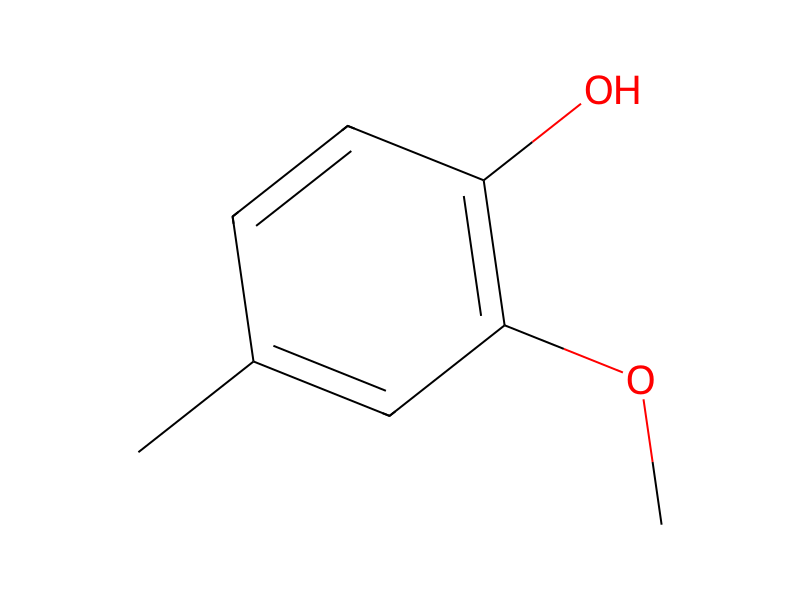
기본 정보
- 표준 SMILES
COc1cc(C)ccc1O- InChIKey
PETRWTHZSKVLRE-UHFFFAOYSA-N- 분자식
- C8H10O2
- 평균 분자량
- 138.16 g/mol
- 단동위원소 질량
- 138.06807956
개요
2-Methoxy-4-methylphenol is a member of phenols and a member of methoxybenzenes.
이름 및 식별자
- 우선 이름
- 2-Methoxy-4-Methylphenol
- IUPAC
- 2-methoxy-4-methylphenol
- 현지명
- 2-메톡시파라크레졸
- 영어명
- 2-Methoxy-4-methylphenol
- 분자식
- C8H10O2
- 분자량
- 138.16
이름 및 동의어
2-METHOXY-4-METHYLPHENOL93-51-6CreosolPhenol, 2-methoxy-4-methyl-4-Methyl guaiacolp-Methylguaiacolp-Creosol2-Methoxy-4-cresol4-Methyl-2-methoxyphenolp-Cresol, 2-methoxy-3-Methoxy-4-hydroxytoluene4-Hydroxy-3-methoxytoluene
이름 더 보기
2-메톡시-p-크레졸2-메톡시파라크레졸크레오솔2-메톡시-4-메틸페놀4-METHYLGUAIACOLFEMA 26712-METHOXY-P-CRESOLVALSPICEMETHYL GUAIACOL
4-Hydroxy-3-methoxy-1-methylbenzeneFEMA No. 2671DTXSID6047105W9GW1KZG6NNSC-4969DTXCID4027105NSC4969RefChem:128445
데이터베이스 식별자
- CAS
93-51-6- PubChem CID
- 7144
- DTXSID
DTXSID6047105- ChEMBL
CHEMBL3182715- ChEBI
CHEBI:89886- UNII
- W9GW1KZG6N
- EC Number
- 202-252-9
- Nikkaji
- J1.175D
물성
구조 계산 물성
- XLogP
- 1.3
- 극성 표면적
- 29.5 Ų
- 수소 결합 공여자 수
- 1
- 수소 결합 수용자 수
- 2
- 회전 가능 결합 수
- 1
- 무거운 원자 수
- 10
- 형식 전하
- 0
- 복잡도
- 103
실험 및 물리화학적 성질
SpringerMaterials PropertiesBoiling point
FragrancesFragrance Ingredient (2-Methoxy-4-methylphenol) -> IFRA transparency List
Food AdditivesFLAVORING AGENT OR ADJUVANT -> FDA Substance added to food
Density1.089-1.096
Flavoring AgentsEU Flavoring substances
Solubility
slightly soluble in water
miscible (in ethanol)
Boiling Point
221.00 to 222.00 °C. @ 760.00 mm Hg
220-222 °C
Melting Point5.5 °C
Refractive Index1.534-1.538
Physical Description
Liquid
Colourless to yellowish liquid, sweet, spicy, slightly vanilla-like odour
물리화학적 성질
- 녹는점
- 5 °C · 5 °C (lit.)
- 끓는 점
- 221 · 221-222 °C (lit.)
- 밀도
- 1.092 g/mL · 1.092 g/mL at 25 °C (lit.)
- 굴절률
- 20 · n20/D 1.537(lit.)
- FEMA
- 2671 · 2671 | 2-METHOXY-4-METHYLPHENOL
- 인화점
- 211 °F · 211 °F
- 저장 조건
- Inert atmosphere,Room Temperature
- 용해도
- 클로로포름(소량으로 용해), 메탄올(약간 용해됨)
- 물리적 상태
- 액체
- 산도 계수 (pKa)
- 10.27 · 10.27±0.18(Predicted)
- Specific Gravity
- 1.091 · 1.091.092
- 색상
- 무색~연황색
- 냄새
- 10 % · 디프로필렌 글리콜 중 10.00%. 매콤한 정향 바닐라 페놀릭 약용 가죽 같은 우디 스모키 탄
- 냄새 유형
- 매운
- 생물학적 소스
- synthetic
- 수용성
- 물에 약간 용해됩니다.
- Merck
- 14 · 14,2571
- JECFA Number
- 715 · 715
- BRN
- 1862340 · 1862340
- Henry's Law Constant
- 7.7 · 7.7×100 mol/(m3Pa) at 25℃, Sagebiel et al. (1992)
- Dielectric constant
- 11 · 11.0
- 화장품 원료 기능
- 향수
- InChI
- 1S/C8H10O2/c1-6-3-4-7(9)8(5-6)10-2/h3-5,9H,1-2H3
- InChIKey
- PETRWTHZSKVLRE-UHFFFAOYSA-N
- SMILES
- COc1cc(C)ccc1O
- LogP
- 1.65 · 1.65
- NIST
- 2 · Phenol, 2-methoxy-4-methyl-(93-51-6)
- EPA
- 2 · Phenol, 2-methoxy-4-methyl- (93-51-6)
안전 및 규제
GHS 분류
GHS Classification
This chemical does not meet GHS hazard criteria for 0.2% (3 of 1728) of reports.
Warning
H302 (99.8%): Harmful if swallowed [Warning Acute toxicity, oral]
P261, P264, P264+P265, P270, P272, P280, P301+P317, P302+P352, P305+P351+P338, P321, P330, P332+P317, P333+P317, P337+P317, P362+P364, and P501 (click each P-code to see the statement)
Aggregated GHS information provided per 1728 reports by companies from 9 notifications to the ECHA C&L Inventory. Each notification may be associated with multiple companies.
유해성 정보
Regulatory Information
Chemical: Phenol, 2-methoxy-4-methyl-
Commission Regulation (EC) No 1565/2000 (Repealed by Com. Implementing Reg. (EU) No 872/2012)
Status: Active Update: 22-05-2018 https://echa.europa.eu/registration-dossier/-/registered-dossier/25111
2-Methoxy-4-methylphenol: Does not have an individual approval but may be used under an appropriate group standard
Hazard Classes and CategoriesAcute Tox. 4 (99.8%)
안전 데이터
- wgk
- 3
- tsca
- TSCA listed
- rtecs
- GP1755000
- ridadr
- 2810
- HS 번호
- 29095090
- risk_code
- 22-36/37/38
- hazard_code
- Xn,Xi
- safety_code
- 26-36-24/25
- 포장분류
- II
- 위험 등급
- 6.1(a)
- F 고인화성물질
- 10
- Hazard Classifications
- Acute Tox. 4 OralEye Irrit. 2Skin Irrit. 2
- 스토리지 클래스
- 10 - Combustible liquids
화학 및 산업
약리 정보
Cellular LocationsCytoplasm
용도 및 제조
IFRA Fragrance Standards
2-Methoxy-4-methylphenol
Creosol; p-Creosol; p-Cresol, 2-methoxy-; Homoguaiacol; 1-Hydroxy-2-methoxy-4-methylbenzene; 4-Hydroxy-3-methoxytoluene; 2-Methoxy-p-cresol; 3-Methoxy-4-hydroxytoluene; 4-Methylguaiacol; p-Methylguaiacol; 4-Methyl-2-methoxyphenol; Phenol, 2-methoxy-4-methyl-; Valspice (commercial name)
IFRA_STD_058.pdf
49
IFRA 51st Amendment - Guidance for the use of IFRA Standards
Restriction: This material should be used only in the limited quantity as stated in the Standard
Household ProductsInformation on 1 consumer products that contain 2-Methoxy-P-Cresol in the following categories is provided:
Use Classification
Fragrance Ingredients
Flavouring Agent -> FLAVOURING_AGENT -> JECFA Functional Classes
Flavoring Agents -> JECFA Flavorings Index
Flavouring Agent -> FLAVOURING_AGENT -> JECFA Functional Classes
Flavouring Agent -> FLAVOURING_AGENT -> JECFA Functional Classes
Flavouring Agent -> FLAVOURING_AGENT -> JECFA Functional Classes
General Manufacturing InformationPhenol, 2-methoxy-4-methyl-: ACTIVE
Restriction Limits in the Finished Product (%)
0.0085 [Products applied to the lips]
0.0025 [Products applied to the axillae]
0.051 [Products applied to the face/body using fingertips]
0.047 [Products related to fine fragrances]
0.012 [Products applied to the body using the hands (palms), primarily leave-on (Body lotion)]
0.012 [Products applied to the face using the hands (palms), primarily leave-on (Face moisturizer)]
응용 분야
개요2-Methoxy-4-methylphenol has a characteristic aromatic odor (sweet, spicy, slightly vanilla-like) and a somewhat bitter taste (vanilla-like). May be prepared by methylation of homopyrocatechin using dimethyl sulfate and alkali; also by hydrogenation of vanillin.
출처Occurs in beechwood tar; also identified in the essential oils of ylang-ylang, jasmine and anise seeds; it is one of the active constituents of creosote. Reported found in Gruyere cheese, smoked fish, cured pork, beer, rum, bourbon whiskey, malt and Scotch whiskey, sherry, white and red wine, cocoa, coffee, tea, mushrooms, mango, pear brandy, malt, wort, dried bonito, Bourbon vanilla, cuttlefish and green maté.
용도2-Methoxy-4-methylphenol is used for blending baking and smoked food flavors. Excellent additive and modifier in artificial Ylang-Ylang, Cassie-bases, Jasmin bases, Lily, Gardenia, etc. Finds use in flavor compositions for imitation Vanilla, Clove, various fruit compositions, Rum flavors, etc. and in Nut-Nougat flavor bases. Concentration will be about 0.02 to 1 ppm in the finished consumer product. In beverages, however, it may be as high as 10 to 20 ppm.
일반 설명2-Methoxy-4-methylphenol is the major component of black-ripe table olive aroma. It is the major anti-inflammatory compound in bamboo vinegar. Kinetics of reaction of 2-methoxy-4-methylphenol with chlorine atoms was studied.
제조 방법
생산 방법With three distinct oxygenated functional groups (aldehyde, ether, and hydroxyl), VAN can undergo selective hydrodeoxygenation to produce 2- methoxy-4-methylphenol (MMP), a promising candidate for future biofuel applications and its use in fragrances and intermediate in pharmaceutical synthesis. Kumar et al. developed stable, cost-effective Ni nanoparticles supported on montmorillonite (MMT) clay, which was synthesized for eco-friendly, alcohol-mediated catalytic transfer hydrodeoxygenation of VAN to MMP. The Ni(10%)/MMT catalyst achieved >99% VAN conversion and 95.2% MMP selectivity using isopropanol (IPA) as a solvent and hydrogen donor[1].
By methylation of homopyrocatechin using dimethyl sulfate and alkali; also by hydrogenation of vanillin.
상·하류 제품 정보
상류 원료
하류 제품
공급사50 곳
国药集团化学试剂有限公司86-21-63210123 · [email protected]
梯希爱(上海)化成工业发展有限公司021-67121386 · [email protected]
INTATRADE GmbH+49 3493/605464 · [email protected]
T&W GROUP021-61551611 13296011611 · [email protected]
北京安司莫森技术有限公司010-82954736 13391601435 · [email protected]
韶远科技(上海)有限公司021-50795510 4000665055 · [email protected]
科瑞迪化学400-821-5857 021-64326257 · [email protected]
Syntechem Co.,Ltd[email protected]
上海迈瑞尔生化科技有限公司4006356688 18621169109 · [email protected]
阿法埃莎(中国)化学有限公司400-6106006 · [email protected]
安耐吉化学&3A(安徽泽升科技股份有限公司)400-0056266 · [email protected]
吉良化学21-62165282 · [email protected]
上海尚饮思生化医药有限公司021-021-57872719 13761402923 · [email protected]
武汉丰泰威远科技有限公司+86-27-8746-5837 +86-18627785180 · [email protected]
合肥天健化工有限公司551-65418679 15856988503;15837135945 · [email protected]
武汉丰泰威远科技有限公司027-87465837 19945049750 · [email protected]
玛雅试剂+86 (573) 82222445 (0)18006601000 452520369 · [email protected]
四川库利南科技有限公司400-1166-196 18981987031 · [email protected]
上海耐士化工科技有限公司400-188-0725 +86 21 34310725 13611771617
天津希恩思生化科技有限公司400 638 7771 · [email protected]
青岛保税区鲁联国际贸易有限公司0532-83893697 18561902820 · [email protected]
赛默飞世尔科技(中国)有限公司800-810-5118 · [email protected]
北京伊诺凯科技有限公司400-810-7969 010-59572699 · [email protected]
上海遐瑞医药科技有限公司+86 21 61551611
TCI AMERICA800-4238616 · [email protected]
TOKYO CHEMICAL INDUSTRY CO., LTD.03-36680489 · [email protected]
TCI Europe320-37350700 · [email protected]
上海贤鼎生物科技有限公司4009209199 · [email protected]
北京环宇世纪化学科技有限公司hysj_bj.com
四川省维克奇生物科技有限公司028-81700200 18116577057 · [email protected]
成都零六生物科技有限公司400-1166-196 13458535857 · [email protected]
雷丁试剂0510-85629785 18013409632 · [email protected]
上海麦克林生化科技股份有限公司15221275939 15221275939 · [email protected]
杭州杰恒化工有限公司0571-87396432 · [email protected]
上海永叶生物科技有限公司86-021-61559134 15921386130 · [email protected]
上海有朋化工有限公司021-69005955 13701776567 · [email protected]
北京海力扬化学科技有限公司13718199399 · [email protected]
北京欣赛维化学科技有限公司010-56218822 13717722232 · [email protected]
四川海诺威科技有限公司13708085536 13708085536 · [email protected]
江苏艾康生物医药研发有限公司025-66028182 17714375163 · [email protected]
上海凯赛化工有限公司021-33516722 13701817765 · [email protected]
上海彤源化工有限公司021-021-69182866 13701855675 · [email protected]
上海孚一生物科技有限公司+86 (21) 61124340
上海兴鲁化工科技有限公司02120970332 · [email protected]
北京华扬致成科技有限公司13716033033 · [email protected]
上海蓝润化学有限公司021-69515658 ; 69515628 13701998368 · [email protected]
上海容立化学科技有限公司021-69992220 13701886816 · [email protected]
上海康拓化工有限公司021-69185552 13701777608 · [email protected]
湖北巨胜科技有限公司027-59599241 18871490274 · [email protected]
Sigma-Aldrich西格玛奥德里奇(上海)贸易有限公司021-61415566 800-8193336 · [email protected]
관련 반응
22건


연결된 노트
불러오는 중…