
HRID 351159반응물로
데이터를 보충하는 중입니다. 잠시 후 페이지를 새로 고치면 최신 내용을 볼 수 있습니다
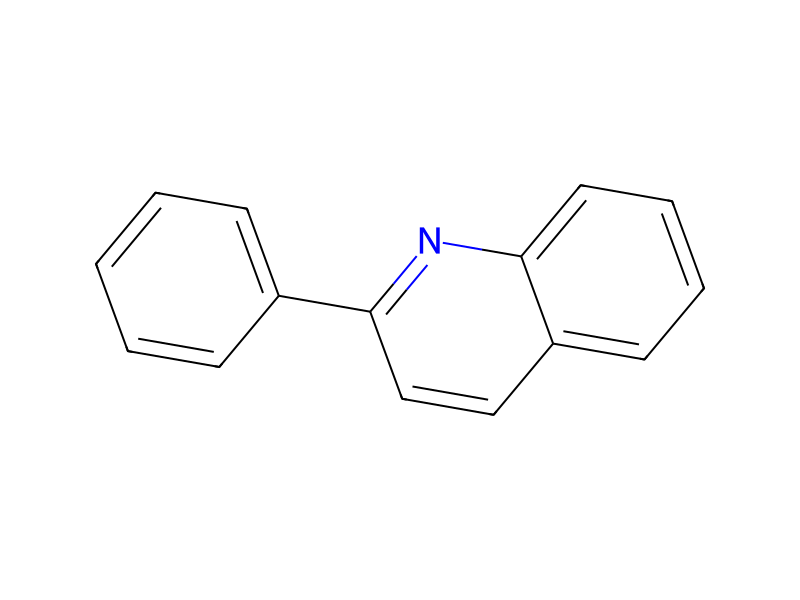
612-96-4c1ccc(-c2ccc3ccccc3n2)cc1FSEXLNMNADBYJU-UHFFFAOYSA-Nstructure in first source
612-96-4DTXSID30210115CHEMBL89786안전 정보는 참고용이며, 공급업체의 물질안전보건자료(SDS), 관련 법규 및 전문가 평가를 대체하지 않습니다.
Warning
H315 (100%): Causes skin irritation [Warning Skin corrosion/irritation]
P261, P264, P264+P265, P271, P280, P302+P352, P304+P340, P305+P351+P338, P319, P321, P332+P317, P337+P317, P362+P364, P403+P233, P405, and P501 (click each P-code to see the statement)
Aggregated GHS information provided per 41 reports by companies from 4 notifications to the ECHA C&L Inventory. Each notification may be associated with multiple companies.
개요2-Phenylquinoline is the major quinoline alkaloid of Galipea iongiflora, a Bolivian plant used as treatment for cutaneous leishmaniasis. Antinociceptive properties of 2-phenylquinoline isolated from the bark of Galipea iongiflora against different models of pain in mice were evaluated.
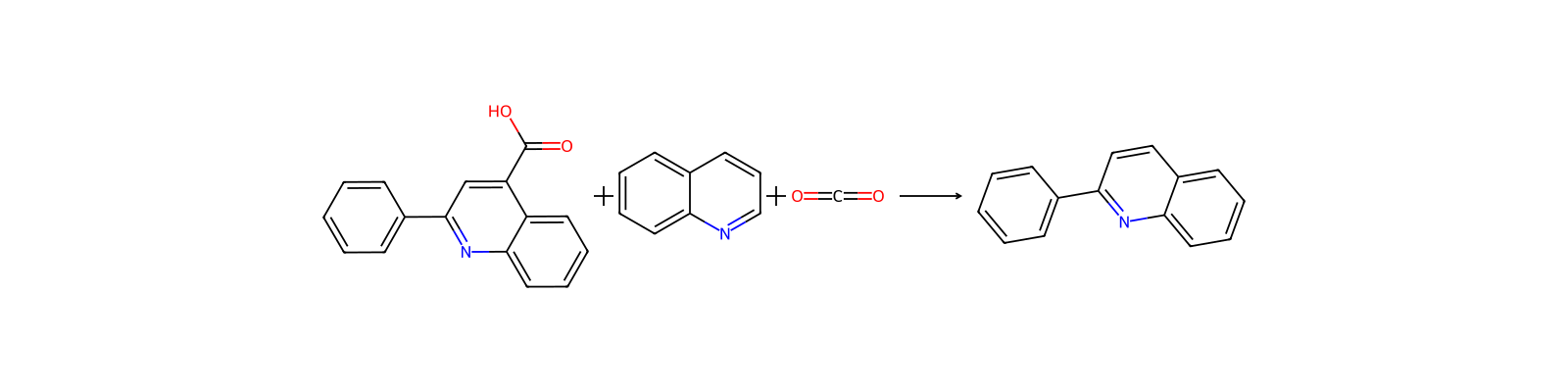
Synthesis of 2-phenylquinoline: Quinoline (1.0 g, 7.742 mmol) and phenyl lithium (2.30 mL, 2 M, 23.22 mmol) were reacted according to general procedure. Purification of the residue by silica gel column chromatography (EtOAc:MeOH:Et3N; 10-30:1:1 or PhMe:MeOH:Et3N; 10:1:1) gave 2-phenylquinoline (0.66 g, 42%) as an orange solid.Aniline (0.140 g, 1.50 mmol) and cinnamaldehyde (0.132 g, 1.00 mmol) were dissolved in toluene in a reaction vial equipped with a magnetic stirrer bar, followed by the addition of K10 (0.50 g). The reaction mixture was heated at a temperature of 110 C for 3 hours. After completion of the reaction, the crude product was purified by column chromatography over silica gel eluting with a mixture of Hexane : Ethyl acetate (20:1) to produce 2-Phenylquinoline as a yellow solid (0.044 g, 21%); (m.p. 82-84 C) (lit. 84-85 °C); Rf 0.67 (20:1 hexane:ethyl acetate);1H NMR (400 MHz, CDCl3) δH 7.46-7.51 (1H, m, H-4’), 7.53-7.56 (3H, m, H-6, 3’, 5’), 7.73- 7.77 (1H, m, H-7), 7.85 (1H, d, J = 8.31 Hz, H-5), 7.88-7.91 (1H, d, J = 8.31 Hz, H-3), 8.18- 8.27 (4H, m, H-4, 8, 2’, 6’)13C NMR(400 MHz, CDCl3) δC 119.2 (C-3), 126.7 (C-6), 127.2 (C-4a), 127.5 (C-2’, 6’), 127.9 (C-5), 128.4 (C-3’, 5’), 128.7 (C-4’), 128.9 (C-7, 8), 129.8 (C-4), 130.3 (C-1’), 137.9 (C-8a), 157.2 (C-2)



white to light yellow crystalline powder