반응식
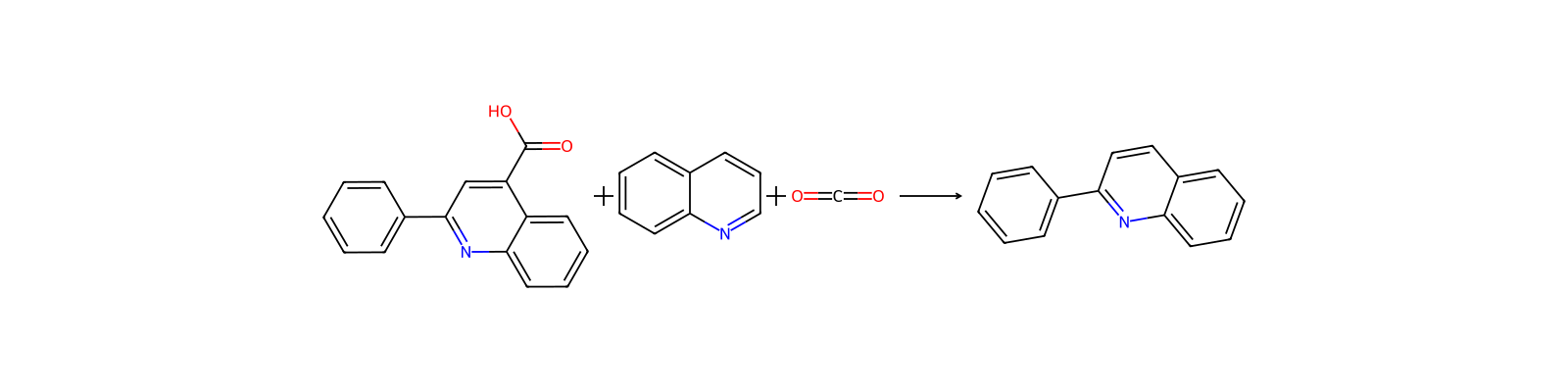
[C:1]1([C:7]2[CH:16]=[C:15](C(O)=O)[C:14]3[C:9](=[CH:10][CH:11]=[CH:12][CH:13]=3)[N:8]=2)[CH:6]=[CH:5][CH:4]=[CH:3][CH:2]=1.N1C2C(=CC=CC=2)C=CC=1.C(=O)=O>>[C:1]1([C:7]2[CH:16]=[CH:15][C:14]3[C:9](=[CH:10][CH:11]=[CH:12][CH:13]=3)[N:8]=2)[CH:6]=[CH:5][CH:4]=[CH:3][CH:2]=1참가 물질
4



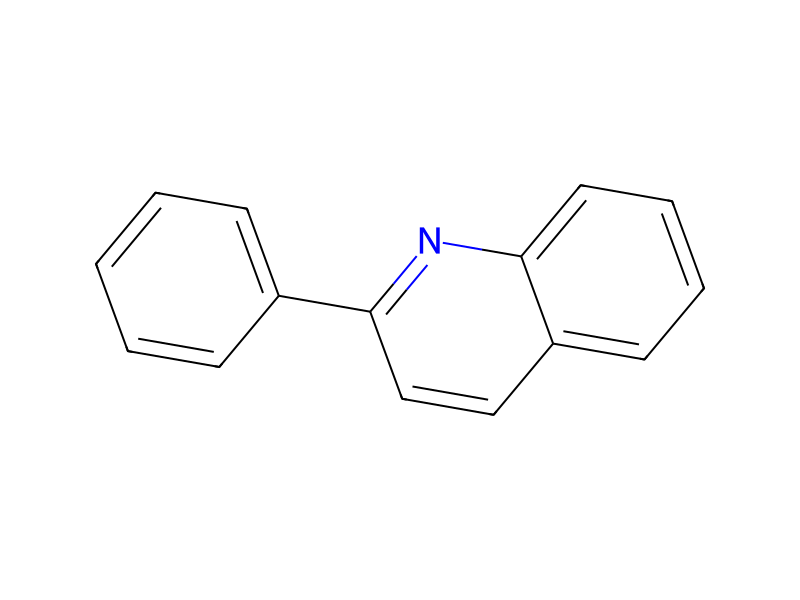
반응 조건
- 온도
- 200 °C
실험 절차
A 1-liter capacity flask equipped with N2 -bleeding tube, thermometer, paddle stirrer, and condenser was charged with 2-phenyl-4-quinolinecarboxylic acid, 227.7 g (0.90 mol), quinoline 200.0 g, and cupurons oxide 20.0 g (0.14 mol). The flask was heated with stirring to 200° C., and maintained at 200° C. for 1 hour. CO2 started to evolve at about 120° C. The mixture was cooled to room temperature, and filtered by suction using filter aid and ether. Ether was evaporated from the filtrate in a vacuum evaporator, and the residue was subjected to fractional distillation under vacuum. A fraction was collected at 140° C./0.2 mmHG-155° C./0.5 mmHg which was 99+% pure 2-phenylquinoline by GC, NMR. M.p. 80°-84° C. The yield was 82.0 g (44%).
후처리
- customA 1-liter capacity flask equipped with N2 -bleeding tube
- temperatureThe flask was heated
- temperaturemaintained at 200° C. for 1 hour
- customto evolve at about 120° C
- temperatureThe mixture was cooled to room temperature
- filtrationfiltered by suction
- filtrationusing filter aid and ether
- customEther was evaporated from the filtrate in a vacuum evaporator
- distillationthe residue was subjected to fractional distillation under vacuum
- customA fraction was collected at 140° C./0.2 mmHG-155° C./0.5 mmHg which
출처 및 근거
- ORD 기록
- ord-50a8f8a5224340599a3a24d606138a0c
- 출처 데이터셋
- uspto-grants-1985_05
- 특허 번호
- US04519938
연결된 노트
불러오는 중…