7,7,8,8-테트라시아노퀴노 디메탄
Tetracyanoquinodimethane
데이터를 보충하는 중입니다. 잠시 후 페이지를 새로 고치면 최신 내용을 볼 수 있습니다

기본 정보
- CAS
1518-16-7- 표준 SMILES
N#CC(C#N)=c1ccc(=C(C#N)C#N)cc1- InChIKey
PCCVSPMFGIFTHU-UHFFFAOYSA-N- 분자식
- C12H4N4
- 평균 분자량
- 204.19 g/mol
- 단동위원소 질량
- 204.04359613
개요
Tetracyanoquinodimethane is a quinodimethane that is p-quinodimethane in which the methylidene hydrogens are replaced by cyano groups. It is a nitrile, an alicyclic compound and a quinodimethane. It is functionally related to a p-quinodimethane.
이름 및 식별자
- 우선 이름
- Tetracyanoquinodimethane
- IUPAC
- 2-[4-(dicyanomethylidene)cyclohexa-2,5-dien-1-ylidene]propanedinitrile
- 현지명
- 7,7,8,8-테트라시아노퀴노 디메탄
- 영어명
- 7,7,8,8-Tetracyanoquinodimethane
- 분자식
- C12H4N4
- 분자량
- 204.19
이름 및 동의어
1518-16-77,7,8,8-TetracyanoquinodimethaneTCNQTetracyanoquinodimethaneTetracyanoquinodimethanTetracyano-p-quinodimethanePropanedinitrile, 2,2'-(2,5-cyclohexadiene-1,4-diylidene)bis-Tetracyanoquinodimethan(e)7,7,8,8-Tetracyano-p-quinodimethane7,7,8,8-Tetracyano-1,4-quinodimethan7,7',8,8'-Tetracyanoquinodimethane2-[4-(dicyanomethylidene)cyclohexa-2,5-dien-1-ylidene]propanedinitrile
이름 더 보기
7,7,8,8-테트라사이아노퀴노이메탄7,7,8,8-테트라시아노퀴노디메탄Tetracyano p-Quinone Dimethane2,2'-(Cyclohexa-2,5-diene-1,4-diylidene)dimalononitrileTIMTEC-BB SBB0004357,7,8,8-Tetracyanoqutetracyano-quinodimethaetracyanoquinodimethane7,7,8,8-Tetracyanodimethan
2,5-Cyclohexadiene-1,4-diylidenedimalononitrileHC6FB4H2KW2,5-Cyclohexadiene-delta(sup1alpha:4alpha)dimalononitrileNSC-1052372,5-Cyclohexadiene-delta1,alpha:4,alpha'-dimalononitrileDTXSID5061748CHEBI:524452,5-Cyclohexadiene-1,4-diylidene-alpha,alpha'-dimalononitrile
데이터베이스 식별자
- CAS
1518-16-7- PubChem CID
- 73697
- DTXSID
DTXSID5061748- ChEBI
CHEBI:52445- UNII
- HC6FB4H2KW
- EC Number
- 216-174-8
- Nikkaji
- J38.157H
물성
구조 계산 물성보충 중
- XLogP
- 1
- 극성 표면적
- 95.2 Ų
- 수소 결합 공여자 수
- 0
- 수소 결합 수용자 수
- 4
- 회전 가능 결합 수
- 0
- 무거운 원자 수
- 16
- 형식 전하
- 0
- 복잡도
- 535
실험 및 물리화학적 성질
Chemical ClassesNitrogen Compounds -> Nitriles
SpringerMaterials PropertiesBand gap energy
Physical DescriptionGreen crystalline solid; [Alfa Aesar MSDS]
물리화학적 성질
- 녹는점
- 287 · 287-289 °C (dec.) (lit.)
- 끓는 점
- 332.67 °C · 332.67°C (rough estimate)
- 밀도
- 1.3596 · 1.3596 (rough estimate)
- 굴절률
- 1.5 · 1.5000 (estimate)
- 저장 조건
- Sealed in dry,Room Temperature
- 물리적 상태
- 결정성 분말
- 색상
- 주황색-갈색에서 녹색
- 수용성
- 불용성
- BRN
- 611604 · 611604
- 안정성
- 안정적인. 강산, 강염기, 강환원제, 강산화제와 호환되지 않습니다.
- InChI
- InChI=1S/C12H4N4/c13-5-11(6-14)9-1-2-10(4-3-9)12(7-15)8-16/h1-4H
- InChIKey
- PCCVSPMFGIFTHU-UHFFFAOYSA-N
- SMILES
- C1(=C(C#N)C#N)C=CC(=C(C#N)C#N)C=C1 |c:8,t:0|
- NIST
- 2 · Propanedinitrile, 2,2'-(2,5-cyclohexadiene-1,4-diylidene)bis-(1518-16-7)
- EPA
- 2 · Propanedinitrile, 2,2'-(2,5-cyclohexadiene-1,4-diylidene)bis- (1518-16-7)
화학적 성질
orange to green crystalline powder
안전 및 규제
안전 정보는 참고용이며, 공급업체의 물질안전보건자료(SDS), 관련 법규 및 전문가 평가를 대체하지 않습니다.
GHS 분류
GHS Classification
Danger
H301+H311+H331 (87%): Toxic if swallowed, in contact with skin or if inhaled [Danger Acute toxicity, oral; acute toxicity, dermal; acute toxicity, inhalation]
P261, P262, P264, P270, P271, P280, P301+P316, P301+P317, P302+P352, P304+P340, P316, P317, P321, P330, P361+P364, P403+P233, P405, and P501 (click each P-code to see the statement)
Aggregated GHS information provided per 46 reports by companies from 4 notifications to the ECHA C&L Inventory. Each notification may be associated with multiple companies.
유해성 정보
Regulatory Information7,7,8,8-Tetracyanoquinonedimethane: Does not have an individual approval but may be used under an appropriate group standard
Hazards SummaryIntravenous LD50 (mouse) = 56 mg/kg; [RTECS] May cause irritation; Harmful by ingestion and skin absorption; Toxic by inhalation; [Alfa Aesar MSDS] See NITRILES.
Hazard Classes and CategoriesAcute Tox. 3 (89.1%)
안전 및 보호
Protective Action Criteria (PAC)
0.18 [mg/m3]
2.0 [mg/m3]
12 [mg/m3]
독성 정보
Treatment
Antidotes to cyanide poisoning include hydroxocobalamin and sodium nitrite, which release the cyanide from the cytochrome system, and rhodanase, which is an enzyme occurring naturally in mammals that combines serum cyanide with thiosulfate, producing comparatively harmless thiocyanate. Oxygen therapy can also be administered. (L97)
Health Effects
Exposure to high levels of cyanide for a short time harms the brain and heart and can even cause coma, seizures, apnea, cardiac arrest and death. Chronic inhalation of cyanide causes breathing difficulties, chest pain, vomiting, blood changes, headaches, and enlargement of the thyroid gland. Skin contact with cyanide salts can irritate and produce sores. (L96, L97)
Exposure RoutesOral (L96) ; inhalation (L96) ; dermal (L96)
Toxicity Summary
Organic nitriles decompose into cyanide ions both in vivo and in vitro. Consequently the primary mechanism of toxicity for organic nitriles is their production of toxic cyanide ions or hydrogen cyanide. Cyanide is an inhibitor of cytochrome c oxidase in the fourth complex of the electron transport chain (found in the membrane of the mitochondria of eukaryotic cells). It complexes with the ferric iron atom in this enzyme. The binding of cyanide to this cytochrome prevents transport of electrons from cytochrome c oxidase to oxygen. As a result, the electron transport chain is disrupted and the cell can no longer aerobically produce ATP for energy. Tissues that mainly depend on aerobic respiration, such as the central nervous system and the heart, are particularly affected. Cyanide is also known produce some of its toxic effects by binding to catalase, glutathione peroxidase, methemoglobin, hydroxocobalamin, phosphatase, tyrosinase, ascorbic acid oxidase, xanthine oxidase, succinic dehydrogenase, and Cu/Zn superoxide dismutase. Cyanide binds to the ferric ion of methemoglobin to form inactive cyanmethemoglobin. (L97)
Signs and SymptomsCyanide poisoning is identified by rapid, deep breathing and shortness of breath, general weakness, giddiness, headaches, vertigo, confusion, convulsions/seizures and eventually loss of consciousness. (L96, L97)
Carcinogen ClassificationNo indication of carcinogenicity to humans (not listed by IARC).
안전 데이터
- wgk
- 3
- tsca
- TSCA listed
- rtecs
- GU4850000
- ridadr
- 3276
- HS 번호
- 29269095
- risk_code
- 22-20/21/22-23/24/25
- hazard_code
- Xn,Xi,T
- safety_code
- 22-24/25-36/37-26-36-45
- 포장분류
- II
- 위험 등급
- 6.1
- 위험 참고 사항
- Irritant
- Hazard Classifications
- Acute Tox. 3 DermalAcute Tox. 3 InhalationAcute Tox. 3 Oral
- 스토리지 클래스
- 6.1A - Combustible acute toxic Cat. 1 and 2very toxic hazardous materials
화학 및 산업
약리 정보
Metabolism/Metabolites
Organic nitriles are converted into cyanide ions through the action of cytochrome P450 enzymes in the liver. Cyanide is rapidly absorbed and distributed throughout the body. Cyanide is mainly metabolized into thiocyanate by either rhodanese or 3-mercaptopyruvate sulfur transferase. Cyanide metabolites are excreted in the urine. (L96)
용도 및 제조
Uses
Synthetic Polymer MALDI Matrix Compounds
Tetracyanoquinodimethane is an electron-acceptor that is used to prepare charge transfer salts, which are of interest in the area of molecular electronics. (L614)
General Manufacturing InformationPropanedinitrile, 2,2'-(2,5-cyclohexadiene-1,4-diylidene)bis-: ACTIVE
응용 분야
개요7,7,8,8-tetracyanoquinodimethane (TCNQ), with a LUMO at 4.5 eV, is known for the charge-transfer salts formed by its radical anion TCNQ inphotovoltaic, light-emitting diodes, and organic field-effect transistordevices. TCNQ and its derivativeshave been used as dopants, leading to an increase in hole mobility or to the lowering of injectionbarriers. One classic example of such is the treatment of tetrathiafulvene (TTF), an electron donor with TCNQ. TFF and TCNQ form an ion pair, the TTF-TCNQ complex. This process of doping leads to the crystallisation of the ion pair into a one-dimensionally stacked polymer. This polymer consists of segregated stacks of cations and anions of the donors and the acceptors, respectively. The complex crystal is an organic semiconductor that exhibits metallic electric conductivity [1, 2].
역사The first report on the electrical conductivity in an organic solid appeared in 1954, namely, a perylene—bromine complex with a room-temperature conductivity of 0.1 S cm1. In 1960, the organic acceptor Tetracyanoquinodimethane (TCNQ; 7,7,8,8-Tetracyanoquinodimethane) was synthesized, as well as a great number of its conducting charge-transfer complexes and radical ion salts. In the 1970s, the organic donor TTF led to the first organic metal TTF-TCNQ. Its room-temperature conductivity (500 S cm1) increases with a decrease in the temperature to the value of 6000 S cm1 at 60 K, where a metal-insulator transition occurs[1].
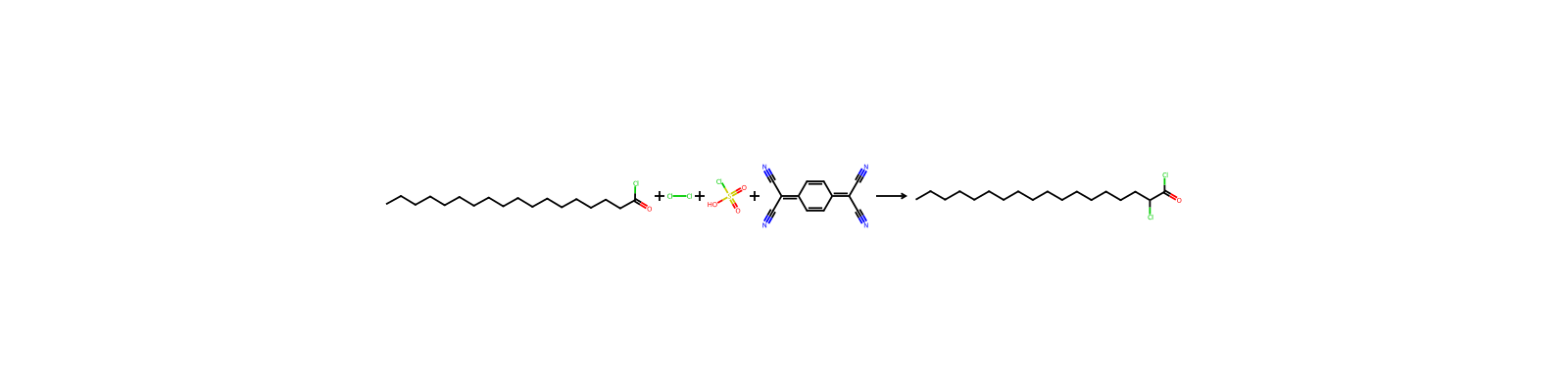
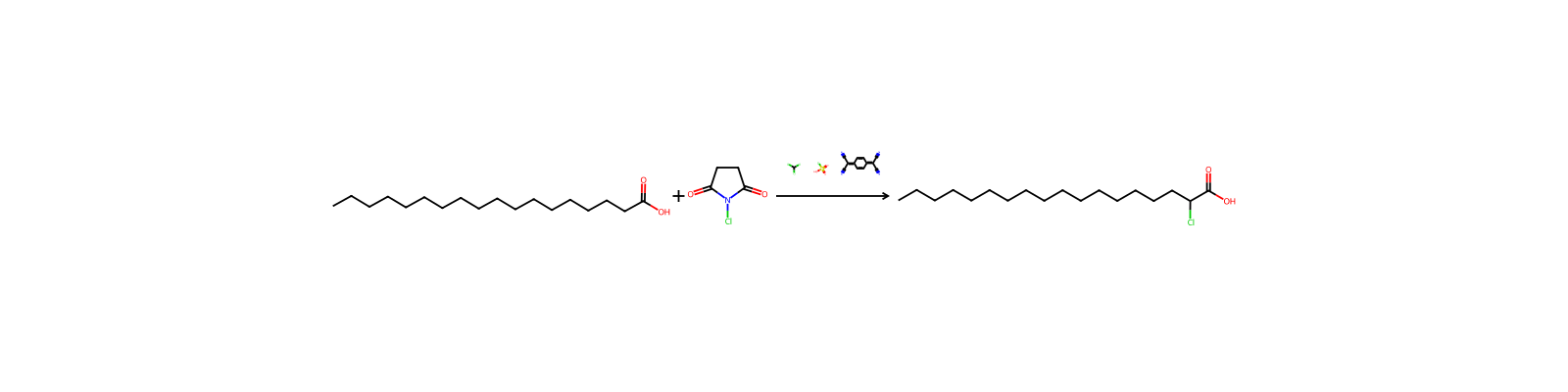
용도7,7,8,8-Tetracyanoquinodimethane is an electron-acceptor molecule used to form charge-transfer superconductors. It is an effective catalyst used for the -chlorination of carboxylic acids using chlorosulfonic acid; the presence of TCNQ suppresses competing free-radical chlorination.
일반 설명7,7,8,8-Tetracyanoquinodimethane (TNCQ) is a strong electron acceptor as it has four cyano groups and π-conjugation bonds that form charge transferring chains and ion radical salts which are mainly used as p-dopants for the fabrication of a variety of semiconductor applications.
상·하류 제품 정보
하류 제품
추가 설명
정의ChEBI: A quinodimethane that is p-quinodimethane in which the methylidene hydrogens are replaced by cyano groups.
관련 반응
13건


화합물 노트
불러오는 중…