홈MCP워크벤치Skills
홈워크벤치알림마이페이지
llms.txt · MCP 가이드개인정보처리방침 · 이용약관 · 지원v1.8.0
  1. 홈
  2. /화합물

페닐이소티오시아네이트

Phenyl Isothiocyanate

HCID 7673
새 노트새 반응견적 요청하기
인쇄 미리보기

데이터를 보충하는 중입니다. 잠시 후 페이지를 새로 고치면 최신 내용을 볼 수 있습니다
기본 정보이름 및 식별자물성안전 및 규제화학 및 산업관련 반응화합물 노트
부분 구조 검색유사 구조 찾기

기본 정보

CAS
103-72-0
표준 SMILES
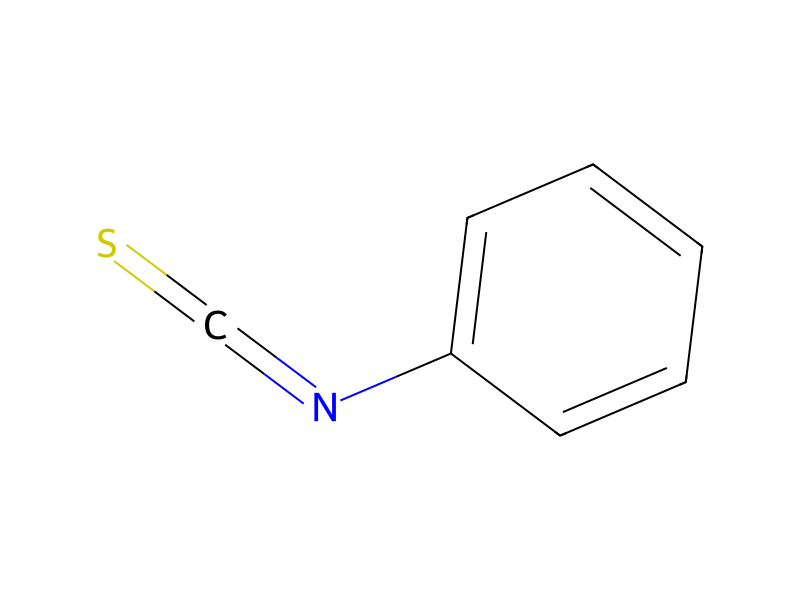
S=C=Nc1ccccc1
InChIKey
QKFJKGMPGYROCL-UHFFFAOYSA-N
분자식
C7H5NS
평균 분자량
135.19 g/mol
단동위원소 질량
135.01427034

이름 및 식별자

우선 이름
Phenyl Isothiocyanate
IUPAC
isothiocyanatobenzene
현지명
페닐이소티오시아네이트
영어명
Phenyl isothiocyanate
분자식
C7H5NS
분자량
135.19

이름 및 동의어

IsothiocyanatobenzenePHENYL ISOTHIOCYANATE103-72-0PhenylisothiocyanatePITCThiocarbanilBenzene, isothiocyanato-PhenylsenfoelIsothiocyanic acid phenyl esterBenzene-1-isothiocyanatePhenyl thioisocyanateIsothiocyanic acid, phenyl ester
이름 더 보기
페닐이소티오시안산페닐이소티오시아네이트페닐이소티오시안산페닐 아이소티오사이아네이트PTCR1PITPhenyl thiocyanatePhenyl isothiocyanate,PITCPHENYL ISOTHIOCYANATE SOLUTION, FOR PROT.SEQ. ANAL.RR1H174
FenylisothiokyanatDTXSID0021129CHEBI:851030D58F84LSUNSC-5583DTXCID501129RefChem:57537Phenylisothiocyanate 1533

데이터베이스 식별자

CAS
103-72-0
PubChem CID
7673
DTXSID
DTXSID0021129
ChEMBL
CHEMBL309036
ChEBI
CHEBI:85103
UNII
0D58F84LSU
EC Number
203-138-1
Nikkaji
J5.019I

물성

구조 계산 물성보충 중

XLogP
3.3
극성 표면적
44.5 Ų
수소 결합 공여자 수
0
수소 결합 수용자 수
2
회전 가능 결합 수
1
무거운 원자 수
9
형식 전하
0
복잡도
121

실험 및 물리화학적 성질

Vapor Pressure1.5 [mmHg]
Physical DescriptionLiquid; [Merck Index] Colorless liquid; [Sigma-Aldrich MSDS]
Kovats Retention Index · 2건

1163

1138

물리화학적 성질

녹는점
21 °C · −21 °C (−6 °F; 252 K)
끓는 점
221 °C · 221 °C (430 °F; 494 K)
밀도
1.1288 g/cm3 · 1.1288 g/cm3
증기압
10 hPa · 10 hPa (20 °C)
굴절률
1.65 · 1.65
인화점
88 °C · 88 °C
저장 조건
2 · 2-8°C
용해도
물: 불용성
물리적 상태
liquid
색상
Colorless
Specific Gravity
1.137 · 1.137 (20/4℃)
수용성
알코올과 에테르에 용해됩니다. 물에 불용성.
Merck
14 · 14,7297

안전 및 규제

안전 정보는 참고용이며, 공급업체의 물질안전보건자료(SDS), 관련 법규 및 전문가 평가를 대체하지 않습니다.

GHS 분류

GHS Classification · 6건

This chemical does not meet GHS hazard criteria for 0.5% (1 of 214) of reports.

Danger

H301 (82.2%): Toxic if swallowed [Danger Acute toxicity, oral];H314 (79.4%): Causes severe skin burns and eye damage [Danger Skin corrosion/irritation];H317 (79%): May cause an allergic skin reaction [Warning Sensitization, Skin];H318 (54.7%): Causes serious eye damage [Danger Serious eye damage/eye irritation];H334 (76.2%): May cause allergy or asthma symptoms or breathing difficulties if inhaled [Danger Sensitization, respiratory];H341 (54.2%): Suspected of causing genetic defects [Warning Germ cell mutagenicity];H361 (54.2%): Suspected of damaging fertility or the unborn child [Warning Reproductive toxicity];H400 (21.5%): Very toxic to aquatic life [Warning Hazardous to the aquatic environment, acute hazard];H410 (24.3%): Very toxic to aquatic life with long lasting effects [Warning Hazardous to the aquatic environment, long-term hazard]

P203, P233, P260, P261, P264, P264+P265, P270, P271, P272, P273, P280, P284, P301+P316, P301+P330+P331, P302+P352, P302+P361+P354, P304+P340, P305+P354+P338, P316, P317, P318, P321, P330, P333+P317, P342+P316, P362+P364, P363, P391, P403, P405, and P501 (click each P-code to see the statement)

Aggregated GHS information provided per 214 reports by companies from 11 notifications to the ECHA C&L Inventory. Each notification may be associated with multiple companies.;Reported as not meeting GHS hazard criteria per 1 of 214 reports by companies.;There are 10 notifications provided by 213 of 214 reports by companies with hazard statement code(s).;Information may vary between notifications depending on impurities, additives, and other factors. The percentage value in parenthesis indicates the notified classification ratio from companies that provide hazard codes. Only hazard codes with percentage values above 10% are shown. For more detailed information, please visit ECHA C&L website.

유해성 정보

Regulatory Information · 3건

Chemical: Benzene, isothiocyanato-

Status: Active Update: 10-12-2018 https://echa.europa.eu/registration-dossier/-/registered-dossier/26134

Phenyl isothiocyanate: Does not have an individual approval but may be used under an appropriate group standard

화학 및 산업

약리 정보

Metabolism/Metabolites · 1건

Cyanide is rapidly alsorbed through oral, inhalation, and dermal routes and distributed throughout the body. Cyanide is mainly metabolized into thiocyanate by either rhodanese or 3-mercaptopyruvate sulfur transferase. Cyanide metabolites are excreted in the urine. (L96)

용도 및 제조

Uses · 2건

Used to derive primary and secondary amines, in sequencing of peptides by Edman degradation, and in amino acid analysis by HPLC; [Merck Index]

Phenyl isothiocyanate is a reagent used in reversed phase high-performance liquid chromatography (HPLC). (L197)

General Manufacturing InformationBenzene, isothiocyanato-: ACTIVE
응용 분야 · 2건

용도Phenyl isothiocyanate is the reagent of choice in automated Edman degradation systems. However, this reagent is highly toxic and for manual modification other reagents are preferred such as dimethy laminoazobenzene isothiocyanate (Chang, 1983; Wang et al, 2000) or trifluoroethyl isothiocyanate (Bartlet-Jones et al, 1994). This last reagent has the advantage of being volatile, so that the excess of reagent is easily removed by vacuum before MS analysis (Spengler, 1997). This compound was used successfully during seven successive cycles of manual cleavage coupled with MS analysis. Nevertheless, the high reactivity of such compounds seems to shows artefactual modification such as“acetylation' of the hydroxyl groups of the Ser and Thr. Allyl isothiocyanate shows better selectivity, but again this reagent is toxic and difficult to use in manual approaches (Gu & Preswich, 1997) .

일반 설명Phenyl isothiocyanate is an aromatic isothiocyanate. It participates in dehydration reactions of alcohols. It is widely used for synthesis of various biologically important heterocyclic compounds.

제조 방법 · 1건

관련 반응

334건
반응 기록 만들기
HRID 754 반응식
HRID 754반응물로uspto-grants-1998_03
HRID 36065 반응식
HRID 36065반응물로uspto-grants-1995_05
HRID 38706 반응식
HRID 38706반응물로uspto-grants-2013_09
HRID 49699 반응식
HRID 49699반응물로uspto-grants-2004_03
HRID 49957 반응식
HRID 49957반응물로uspto-grants-2004_03
HRID 66562 반응식
HRID 66562반응물로uspto-grants-1982_08
HRID 72690 반응식
HRID 72690반응물로uspto-grants-2014_09
HRID 80000 반응식
HRID 80000반응물로uspto-grants-2014_09
1 / 42 페이지

화합물 노트

불러오는 중…

이 페이지에서기본 정보이름 및 식별자물성안전 및 규제화학 및 산업관련 반응화합물 노트
더보기
새 노트새 반응견적 요청하기
BRN
471392 · 471392
Henry's Law Constant
3.3 · 3.3×10-3 mol/(m3Pa) at 25℃, Duchowicz et al. (2020)
Dielectric constant
10.7 · 10.7(20℃)
안정성
안정적인. 타기 쉬운. 강한 산화제, 강산과 호환되지 않습니다.
InChI
1S/C7H5NS/c9-6-8-7-4-2-1-3-5-7/h1-5H
InChIKey
QKFJKGMPGYROCL-UHFFFAOYSA-N
SMILES
S=C=Nc1ccccc1
LogP
3.28 · 3.280
표면장력
41.5 mN/m · 41.5mN/m at 20°C
NIST
Benzene, isothiocyanato-(103-72-0)
EPA
Benzene, isothiocyanato- (103-72-0)

화학적 성질

colourless to pale yellow liquid with a penetrating odour

Hazards Summary · 1건

Dermal studies of guinea pigs demonstrate severe irritation, good absorption, and sensitization; Effects on thyroid function (decreased serum T4 levels) observed in 4-week oral study of rats; [EPA - PPRTV] Causes burns and lachrymation; May cause skin and respiratory sensitization; Inhalation may cause corrosive injuries to upper respiratory tract and lungs; Harmful by ingestion; Targets the kidney and bladder; [Sigma-Aldrich MSDS]

Hazard Classes and CategoriesAcute Tox. 3 (82.2%);Skin Corr. 1B (79.4%);Skin Sens. 1 (79%);Eye Dam. 1 (54.7%);Resp. Sens. 1 (76.2%);Muta. 2 (54.2%);Repr. 2 (54.2%);Aquatic Acute 1 (21.5%);Aquatic Chronic 1 (24.3%)

독성 정보

Treatment · 1건

EYES: irrigate opened eyes for several minutes under running water. INGESTION: do not induce vomiting. Rinse mouth with water (never give anything by mouth to an unconscious person). Seek immediate medical advice. SKIN: should be treated immediately by rinsing the affected parts in cold running water for at least 15 minutes, followed by thorough washing with soap and water. If necessary, the person should shower and change contaminated clothing and shoes, and then must seek medical attention. INHALATION: supply fresh air. If required provide artificial respiration.

Health Effects · 1건

Exposure to high levels of cyanide for a short time harms the brain and heart and can even cause coma, seizures, apnea, cardiac arrest and death. Chronic inhalation of cyanide causes breathing difficulties, chest pain, vomiting, blood changes, headaches, and enlargement of the thyroid gland. Skin contact with cyanide salts can irritate and produce sores. (L96, L97)

Adverse Effects · 1건

Dermatotoxin - Skin burns.;Lacrimator (Lachrymator) - A substance that irritates the eyes and induces the flow of tears.;Skin Sensitizer - An agent that can induce an allergic reaction in the skin.;Toxic Pneumonitis - Inflammation of the lungs induced by inhalation of metal fumes or toxic gases and vapors.

Exposure RoutesInhalation (L96) ; oral (L96) ; dermal (L96)
Toxicity Summary · 1건

Cyanide is an inhibitor of cytochrome c oxidase in the fourth complex of the electron transport chain (found in the membrane of the mitochondria of eukaryotic cells). It complexes with the ferric iron atom in this enzyme. The binding of cyanide to this cytochrome prevents transport of electrons from cytochrome c oxidase to oxygen. As a result, the electron transport chain is disrupted and the cell can no longer aerobically produce ATP for energy. Tissues that mainly depend on aerobic respiration, such as the central nervous system and the heart, are particularly affected. Cyanide is also known produce some of its toxic effects by binding to catalase, glutathione peroxidase, methemoglobin, hydroxocobalamin, phosphatase, tyrosinase, ascorbic acid oxidase, xanthine oxidase, succinic dehydrogenase, and Cu/Zn superoxide dismutase. Cyanide binds to the ferric ion of methemoglobin to form inactive cyanmethemoglobin. (L97)

Signs and SymptomsCyanide poisoning is identified by rapid, deep breathing and shortness of breath, general weakness, giddiness, headaches, vertigo, confusion, convulsions/seizures and eventually loss of consciousness. (L96, L97)
Carcinogen ClassificationNo indication of carcinogenicity to humans (not listed by IARC).
Toxicity DataLD50: 87 mg/kg (Oral, Mouse) (L565) LD50: 250 mg/kg (Subcutaneous, Mouse) (L565) LD50: 100 mg/kg (Intraperitoneal, Mouse) (L565)
RAIS Toxicity Values · 4건

0.0002

SCREEN Current

0.002

PPRTV Current

EPA Provisional Peer-Reviewed Toxicity Values · 5건

Phenyl Isothiocyanate

2 x 10^-3 mg/kg-day

PDF Document

Inadequate information to assess carcinogenic potential

2009

Hazard Quotient Level 0.1 or Cancer Risk Level 1E-06 · 6건

1.60e+01

2.30e+02

2.60e+00

1.5E+01(G)

1.70e-03

2.00e-04

Hazard Quotient Level 3 or Cancer Risk Level 1E-04 · 6건

4.70e+01

7.00e+02

7.90e+00

1.5E+01 (G)

2.00e-04

Volatile

규제 정보

Regulatory Information · 3건

Chemical: Benzene, isothiocyanato-

Status: Active Update: 10-12-2018 https://echa.europa.eu/registration-dossier/-/registered-dossier/26134

Phenyl isothiocyanate: Does not have an individual approval but may be used under an appropriate group standard

안전 데이터

wgk
3
tsca
TSCA listed
rtecs
NX9275000
ridadr
UN 1993 3/PG 2
독성
LD50 orally in Rabbit: 157 mg/kg
HS 번호
2930909099
risk_code
25-34-42/43-51/53-67-65-50/53-36/37/38-22-11-38-63-23/24/25-36/38
hazard_code
T,N,Xn,F
safety_code
9-16-29-33-60-61-62-36-26-23-45-36/37/39-38-28A-36/37
포장분류
II
위험 등급
6.1
기존화학 물질
KE-21760
F 고인화성물질
19
Hazard Classifications
Acute Tox. 3 OralResp. Sens. 1Skin Corr. 1BSkin Sens. 1
스토리지 클래스
6.1A - Combustible acute toxic Cat. 1 and 2very toxic hazardous materials

Synthetic procedure for phenyl isothiocyanate in 1-mol scaleInto a 2-L jacketed flask, 91.2 g of CS2 (1.2 mol) was dropwise added to a mixture of aniline (93.0 g, 1.0 mol) and K2CO3 (276.0 g, 2.0 mol) in 700 mL of water at room temperature within a period of 2.5 h. After the addition was complete, the mixture was stirred another 2 h. Then, the mixture was cooled to 0 °C, and a solution of 92.3 g of TCT (0.5 mol) in 450 mL of CH2Cl2 was dropwise added within 4 h. After the addition was complete, the mixture was stirred another 1 h to complete the conversion. The resulting mixture was basified to pH >11 with 250 mL of 6 N NaOH and yielded a clear solution. The organic layer was separated and the aqueous layer was extracted with 150 mL of CH2Cl2. The combined organic layers were dried over anhydrous Na2SO4, filtered, and the solvent of filtrate was removed via distillation under atmospheric pressure with a 25-cm Vigreux column. The residue was vacuum distilled and the desired product fraction was collected at 72–74 °C/1 mmHg. Finally, 127.0 g of colorless liquid (94%) was obtained.

상·하류 제품 정보

상류 원료

염화칼슘N,N'-디페닐티오요소

하류 제품

1-페닐-1H-테트라졸-5-티올N-(2-hydroxy-5-methylphenyl)-N'-phenylthiourea1,1-디클로로-N-페닐메탄이민4-(디메틸아미노)페닐이소티오시아네이트Phenylthiohydantoin-DL-alanine2-머캅토-4(3H)-퀴나졸린온1-Adamantyl isothiocyanate티오아세트닐리드이소티오시안산부틸에스테르4-Phenyl-3-thiosemicarbazide

추가 설명

정의ChEBI: Phenyl isothiocyanate is an isothiocyanate having a phenyl group attached to the nitrogen; used for amino acid sequencing in the Edman degradation. It has a role as an allergen and a reagent.