
이소부틸아크릴레이트
Isobutyl acrylate

기본 정보
- CAS
106-63-8- 표준 SMILES
C=CC(=O)OCC(C)C- InChIKey
CFVWNXQPGQOHRJ-UHFFFAOYSA-N- 분자식
- C7H12O2
- 평균 분자량
- 128.17 g/mol
- 단동위원소 질량
- 128.08372962
개요
Isobutyl acrylate appears as a clear colorless liquid with an acrid odor. Flash point 86 °F. Less dense than water. Vapors irritate eyes and respiratory system. May polymerize exothermically if heated or contaminated. If polymerization takes place inside a container, the container may rupture violently.
이름 및 식별자
- 우선 이름
- Isobutyl acrylate
- IUPAC
- 2-methylpropyl prop-2-enoate
- 현지명
- 이소부틸아크릴레이트
- 영어명
- Isobutyl acrylate
- 분자식
- C7H12O2
- 분자량
- 128.17
이름 및 동의어
ISOBUTYL ACRYLATEIsobutyl 2-propenoateIsobutyl propenoate2-Propenoic acid, 2-methylpropyl esterAcrylic acid, isobutyl ester2-Methylpropyl acrylateNSC 20949Isobutylester kyseliny akrylovePropenoic acid, isobutyl esterCCRIS 4828HSDB 6102-Propenoic acid isobutyl ester
이름 더 보기
아이소뷰틸아크릴레이트아크릴산,이소부틸에스테르이소부틸아크릴레이트이소뷰틸아크릴레이트아이소뷰틸아크릴레이트이소뷰틸아크릴레이트아이소뷰틸 아크릴레이트2-페틸프로필 아크리에이트2-프로펜오익 산, 2-메틸프로필 에스테르2-프로펜오익 산-2-메틸 프로필 에스테르아크릴 산, 이소뷰틸 에스테르이소-뷰틸 아크릴레이트이소뷰틸 프로펜오에이트이소뷰틸-2-프로펜오에이트IBA2-methylpropylacrylate2-methylpropyl prop-2-enoateisobutylpropenoateIsobutylacrylatacrylated’isobutyleisobutyl2-propenoateAcrylic acid isobutyl
DTXSID1021873iso-butyl acrylateEINECS 203-417-8Isobutyl acrylate, inhibitedUN2527Isobutylester kyseliny akrylove [Czech]BRN 1749388UNII-U02509V73F
데이터베이스 식별자
- CAS
106-63-8- PubChem CID
- 7819
- DTXSID
DTXSID1021873- ChEMBL
CHEMBL1606107- UNII
- U02509V73F
- EC Number
- 203-417-8
- Nikkaji
- J33.774I
물성
구조 계산 물성
- XLogP
- 2.2
- 극성 표면적
- 26.3 Ų
- 수소 결합 공여자 수
- 0
- 수소 결합 수용자 수
- 2
- 회전 가능 결합 수
- 4
- 무거운 원자 수
- 9
- 형식 전하
- 0
- 복잡도
- 105
실험 및 물리화학적 성질
Chemical ClassesFlammable agents - 3rd degree
PolymersPlastics & Rubber -> (Meth)acrylates
SpringerMaterials PropertiesBoiling point
LogP
log Kow = 2.22
2.22
OdorSharply odorous
Density
0.889 at 68 °F (USCG, 1999) - Less dense than water; will float
0.8896 at 20 deg
Liquid heat capacity= 0.431 BTU/lb-F @ 70 °F; Liquid thermal conductivity= 1.048 BTU-in/hr-sq ft-F at 70 °F; Saturated vapor density= 0.00494 lb/cu ft @ 70 °F; Ideal gas heat capacity= 0.371 BTU/lb-F @ 75 °F
Viscosity0.822 CP at 70 °F
Color/FormClear liquid
Solubility
Slightly soluble (NTP, 1992)
Soluble in ethanol, ether and methanol
In water, 2,000 mg/L at 25 °C
Flash Point
86 °F (NTP, 1992)
86 °F (30 °C) (open cup)
Boiling Point
270 °F at 760 mmHg (NTP, 1992)
132 °C
Boiling point: 61-63 °C (51 mm Hg)
DecompositionWhen heated to decomposition it emits acrid smoke and toxic fumes.
물리화학적 성질
- 녹는점
- -60 °C · -60°C
- 끓는 점
- 132 °C · 132 °C
- 밀도
- 0.89 · 0.89
- 증기압
- 8.13 hPa · 8.13hPa at 22.9℃
- 굴절률
- 1.41 · 1.41
- 인화점
- 31 °C · 31 °C
- 용해도
- soluble in Ether,Alcohol
- 물리적 상태
- clear liquid
- 색상
- Colorless to Almost colorless
- 냄새
- 자극적인 향기로운 냄새
- Odor Threshold
- 0.0009 ppm · 0.0009ppm
- 수용성
- 7.903 g/L · 7.903g/L(온도 미표시)
- BRN
- 1749388 · 1749388
- Henry's Law Constant
- 1.3 · 1.3×10-2 mol/(m3Pa) at 25℃, Duchowicz et al. (2020)
- 안정성
- 안정성 열과 빛에 민감합니다. 중합에 취약함. 가연성. 강한 산화제, 알데히드와 호환되지 않습니다.
- InChI
- 1S/C7H12O2/c1-4-7(8)9-5-6(2)3/h4,6H,1,5H2,2-3H3
- InChIKey
- CFVWNXQPGQOHRJ-UHFFFAOYSA-N
- SMILES
- CC(C)COC(=O)C=C
- LogP
- 2.22 · 2.220
- NIST
- 2 · 2-Propenoic acid, 2-methylpropyl ester(106-63-8)
- EPA
- Isobutyl acrylate (106-63-8)
화학적 성질
Liquid.Contains 100 ppm monomethyl ether hydroquinone as inhibitor.
안전 및 규제
안전 정보는 참고용이며, 공급업체의 물질안전보건자료(SDS), 관련 법규 및 전문가 평가를 대체하지 않습니다.
GHS 분류
GHS Classification
Warning
H226: Flammable liquid and vapor [Warning Flammable liquids]
P210, P233, P240, P241, P242, P243, P261, P264, P271, P272, P280, P302+P352, P303+P361+P353, P304+P340, P317, P321, P332+P317, P333+P317, P362+P364, P370+P378, P403+P235, and P501 (click each P-code to see the statement)
This chemical does not meet GHS hazard criteria for 6.3% (37 of 583) of reports.
Warning
H226 (93.7%): Flammable liquid and vapor [Warning Flammable liquids]
유해성 정보
Regulatory Information
Chemical: 2-Propenoic acid, 2-methylpropyl ester
2-Propenoic acid, 2-methylpropyl ester is listed on the EPA's Chemical Data Reporting (CDR) system. Manufacturers and importers of 2-Propenoic acid, 2-methylpropyl ester are required to report information about their production and use of this chemical to the EPA under the Toxic Substances Control Act (TSCA). (40 eCFR Part 711)
REACH registered substance: Isobutyl acrylate (EC: 203-417-8)
2-Propenoic acid, 2-methylpropyl ester: HSNO Approval: HSR001095 Approved with controls
The New Jersey Worker and Community Right to Know Act requires public and private employers to provide information about hazardous substances at their workplaces. (N.J.S.A. 34:5A-1 et. seq.)
Other Safety InformationIMAP assessments - 2-Propenoic acid, 2-methylpropyl ester: Environment tier I assessment
DOT LabelFlammable Liquid
Fire Hazards
Excerpt from ERG Guide 129 [Flammable Liquids (Water-Miscible / Noxious); polymerization hazard]:
· HIGHLY FLAMMABLE: Will be easily ignited by heat, sparks or flames.
Fire PotentialFlammable when exposed to heat or flame ...
Health Hazards
Moderate toxicity when swallowed. Contact with the eyes causes minor irritation no worse than that caused by hand soap. (USCG, 1999)
· May cause toxic effects if inhaled or absorbed through skin.
Hazards Summary
A skin sensitizer; [Quick CPC] May polymerize exothermically on exposure to heat or if contaminated; [CAMEO] High vapor concentrations can cause mild and temporary smarting of the eyes and respiratory tract; A mild eye irritant (no worse than hand soap); Prolonged skin contact may cause reddening; [CHRIS] An irritant; Inhalation may cause asthma symptoms or difficulty breathing; Toxic by skin absorption; Harmful by inhalation; [Aldrich MSDS] Isobutyl acrylate, stabilized (UN2527) has warning of explosive polymerization; [ERG 2016]
DOT ID and Guide2527 129P
FDA RequirementsHomopolymers and copolymers of isobutyl acrylate are an indirect food additive for use only as a component of adhesives.
Reactive GroupAcrylates and Acrylic Acids
TSCA Requirements
Pursuant to section 8(d) of TSCA, EPA promulgated a model Health and Safety Data Reporting Rule. The section 8(d) model rule requires manufacturers, importers, and processors of listed chemical substances and mixtures to submit to EPA copies and lists of unpublished health and safety studies. Isobutyl acrylate is included on this list. Effective date 9/30/91; Sunset date 12/19/95.
Section 8(a) of TSCA requires manufacturers of this chemical substance to report preliminary assessment information concerned with production, exposure, and use to EPA as cited in the preamble in 51 FR 41329. Effective date 9/30/91; Reporting date 11/27/91.
Reactivity AlertsHighly Flammable
안전 및 보호
Fire FightingExcerpt from ERG Guide 129 [Flammable Liquids (Water-Miscible / Noxious); polymerization hazard]:
Accidental Release Measures
· CALL 911. Then call emergency response telephone number on shipping paper. If shipping paper not available or no answer, refer to appropriate telephone number listed on the inside back cover.
· ELIMINATE all ignition sources (no smoking, flares, sparks or flames) from immediate area.
First Aid
EYES: First check the victim for contact lenses and remove if present. Flush victim's eyes with water or normal saline solution for 20 to 30 minutes while simultaneously calling a hospital or poison control center. Do not put any ointments, oils, or medication in the victim's eyes without specific instructions from a physician. IMMEDIATELY transport the victim after flushing eyes to a hospital even if no symptoms (such as redness or irritation) develop.
General First Aid:
Exposure Control and Personal Protection· Wear positive pressure self-contained breathing apparatus (SCBA).
Fire Fighting Procedures
This chemical is a combustible liquid. Poisonous gases are produced in fire. Use dry chemical, carbon dioxide, or foam extinguishers. Water may be ineffective. Vapors are heavier than air and will collect in low areas. Vapors may travel long distances to ignition sources and flashback. Vapors in confined area may explode in fire. Containers may explode in fire. Storage containers and parts of containers may rocket great distances, in many directions. If materials or contaminated runoff enters waterways, notify downstream users of potentially contaminated waters. Notify local health and fire officials and pollution control agencies. From a secure, explosion-proof location, use water spray to cool exposed containers. If cooling streams are ineffective (venting sound increases in volume and pitch, tank discolors, or shows any signs of deforming), withdraw immediately to a secure position. If employees are expected to fight fires, they must be trained and equipped.
Alcohol foam. Water may be ineffective.
If material on fire or involved in fire: Do not extinguish fire unless flow can be stopped. Use water in flooding quantities as fog. Solid streams of water may spread fire. Cool all affected containers with flooding quantities of water. Apply water from as far a distance as possible. Use foam, dry chemical, or carbon dioxide. /Isobutyl acrylate, stabilized/
Evacuation: If fire becomes uncontrollable or container is exposed to direct flame-consider evacuation of one-third (1/3) mile radius.
Storage Conditions
Prior to working with this chemical you should be trained on its proper handling and storage. Before entering a confined space where hexanol may be present, check to make sure that an explosive concentration does not exist. Store in an explosion-proof cool area. Protect for air and light for long-term storage. Where possible, automatically pump liquid from drums or other storage containers to process containers.
The effectiveness of phenolic inhibitors is dependent on the presence of oxygen and the monomers must be stored under air rather than an inert atmosphere. Temp must be kept low to minimize formation of peroxides and other products. ... The acrylic esters may be stored in mild or stainless steel, or aluminum. /Acrylic acid & derivatives/
Cleanup Methods
Evacuate and restrict persons not wearing protective equipment from area of spill or leak until cleanup is complete. Remove all ignition sources. Establish forced ventilation to keep levels below explosive limit. Absorbent may be used to concolidate spills on land (such as sorbent polyurethane foams). Oil skimming equipment may be used for spills on water. Absorb liquids in vermiculite, dry sand, earth, or a similar non-organic materials and deposit in sealed containers. Kepp this chemical out of a confined space, such as a sewer, because of the possibility of an explosion, unless the sewer is designed to prevent the build-up of explosive concentrations. It may be necessary to contain and dispose of this chemical as a hazardous waste. If material or contaminated runoff enters waterways, notify downstream users of potentially contaminated waters. Contact your Department of Environmental Protection or your regional office of the federal EPA for specific recommendations. If employees are required to clean-up spills, they must be properly trained and equipped.
Nonfire Spill ResponseExcerpt from ERG Guide 129 [Flammable Liquids (Water-Miscible / Noxious); polymerization hazard]:
Disposal Methods
SRP: The most favorable course of action is to use an alternative chemical product with less inherent propensity for occupational exposure or environmental contamination. Recycle any unused portion of the material for its approved use or return it to the manufacturer or supplier. Ultimate disposal of the chemical must consider: the material's impact on air quality; potential migration in soil or water; effects on animal, aquatic, and plant life; and conformance with environmental and public health regulations.
Preventive Measures
Wear protective gloves and clothing to prevent any reasonable probability of skin contact. Safety equipment suppliers/manufacturers can provide recommendations on the most protective glove/clothing material for your operation. Polyvinyl Alcohol is among the recommended protective materials. All protective clothing (suits, gloves, footwear, headgear) should be clean, available each day, and put on before work. Contact lenses should not be worn when working with this chemical. Wear splash-proof chemical goggles and face shield unless full facepiece respiratory protection is worn. Employees should wash immediately with soap when skin is wet or contaminated. Provide emergency showers and eyewash.
Awareness of the dangers and of good engineering design are essential to safety. Employees should be instructed about the necessity of cleansing the skin if it is contaminated by materials which are irritants or skin-absorbed. With careful design, however, and complete enclosure of those processes where toxic chemicals or intermediates occur, dangerous exposures can be avoided. /Acrylic acid & derivatives/
If material not on fire and not involved in fire: Keep sparks, flames, and other sources of ignition away. Keep material out of water sources and sewers. Build dikes to contain flow as necessary. Attempt to stop leak if without undue personnel hazard. Use water spray to knock-down vapors. /Isobutyl acrylate, stabilized/
Personnel protection: Avoid breathing vapors. Keep upwind. ... Do not handle broken packages unless wearing appropriate personal protective equipment. Wash away any material which may have contacted the body with copious amounts of water or soap and water. /Isobutyl acrylate, stabilized/
For more Preventive Measures (Complete) data for ISOBUTYL ACRYLATE (6 total), please visit the HSDB record page.
Isolation and Evacuation
Excerpt from ERG Guide 129 [Flammable Liquids (Water-Miscible / Noxious); polymerization hazard]:
Immediate precautionary measure
Personal Protective Equipment (PPE)
Self-contained breathing apparatus, rubber gloves, chemical goggles. (USCG, 1999)
Where the potential for exposure to this chemical, use a MSHA/NIOSH approved supplied-air-respirator with a full facepiece operated in the positive pressure mode or with a full facepiece, hood, or helmet in the continuous flow mode, or use a MSHA/NIOSH approved self-contained breathing apparatus operated in a pressure-demand or other positive-pressure mode.
Self-contained breathing apparatus, rubber gloves, chemical goggles.
SUITABLE PROTECTIVE CLOTHING & SELF-CONTAINED RESP PROTECTIVE APPARATUS SHOULD BE AVAILABLE FOR USE OF THOSE WHO MAY HAVE TO RESCUE PERSONS OVERCOME BY FUMES. /ACRYLIC ACID & DERIVATIVES/
Protection required for safe handling of acrylic acid and esters commonly includes use of impervious gloves, shoe soles, and clothing; splash-proof goggles ... . /Acrylic acid & derivatives/
Personnel protection: Wear appropriate chemical protective gloves, boots and goggles. /Isobutyl acrylate, stabilized/
독성 정보
Ecotoxicity Values
LC50 Pimephales promelas (Fathead minnows, 29 days old, mean length 18.5 mm, mean weight 0.1 g) 2.09 mg/L/96 hr (95% confidence limit 1.92-2.28 mg/L); flow through, 24.0 °C, hardness 45.3 mg/L (CaCO3), pH 7.61, dissolved oxygen 7.1 mg/L, alkalinity 49.8 mg/L (CaCO3) />97% purity/
EC50 Pimephales promelas (Fathead minnows, 29 days old, mean length 18.5 mm, mean weight 0.1 g) 1.90 mg/L/96 hr; flow through, 24.0 °C, hardness 45.3 mg/L (CaCO3), pH 7.61, dissolved oxygen 7.1 mg/L, alkalinity 49.8 mg/L (CaCO3); Effect:.Affected fish lost schooling behavior and swam near the tank surface in a corkscrew/spiral pattern. They were hyperactive and overreactive to external stimuli, had increased respiration and edema, and lost equilibrium prior to death. />97% purity/
LC50 Pimephales promelas (Fathead minnow, 29 days old, mean length 21.4 mm, mean weight 0.149 g) 2.11 mg/L/96 hr; flow through, 25.1 °C, hardness 44.0 mg/L (CaCO3), pH 7.7, dissolved oxygen 6.7 mg/L, alkalinity 43.8 mg/L (CaCO3) />97% purity/
EC50 Pimephales promelas (Fathead minnow, 29 days old, mean length 21.4 mm, mean weight 0.149 g) 2.11 mg/L/96 hr; flow through, 25.1 °C, hardness 44.0 mg/L (CaCO3), pH 7.7, dissolved oxygen 6.7 mg/L, alkalinity 43.8 mg/L (CaCO3); Effect: Affected fish lost schooling behavior, were hyperactive and swam near the tank surface, frequently in a corkscrew/spiral pattern. They were overreactive to external stimuli, had increased respiration, were edematous and lost equilibrium prior to death. />97% purity/
For more Ecotoxicity Values (Complete) data for ISOBUTYL ACRYLATE (9 total), please visit the HSDB record page.
Environmental Fate
TERRESTRIAL FATE: Based on a classification scheme(1), an estimated Koc value of 66(SRC), determined from a water solubility of 2,000 mg/L(2) and a regression-derived equation(3), indicates that isobutyl acrylate is expected to have high mobility in soil(SRC). Volatilization of isobutyl acrylate from moist soil surfaces is expected to be an important fate process(SRC) given an estimated Henry's Law constant of 6.0X10⁻⁴ atm-cu m/mole(SRC), derived from its vapor pressure, 7.07 mm Hg(4), and water solubility(2). Isobutyl acrylate is expected to volatilize from dry soil surfaces(SRC) based upon its vapor pressure(4). By analogy to butyl acrylate, which reached 61% of its theoretical BOD in 2 weeks using an activated sludge inoculum in the Japanese MITI test(5), biodegradation of isobutyl acrylate may by an important environmental fate process in soil(SRC).
AQUATIC FATE: Based on a classification scheme(1), an estimated Koc value of 66(SRC), determined from a water solubility of 2,000 mg/L(2) and a regression-derived equation(3), indicates that isobutyl acrylate is not expected to adsorb to suspended solids and sediment(SRC). Volatilization from water surfaces is expected(3) based upon an estimated Henry's Law constant of 6.0X10⁻⁴ atm-cu m/mole(SRC), derived from its vapor pressure, 7.07 mm Hg(4), and water solubility(2). Using this Henry's Law constant and an estimation method(3), volatilization half-lives for a model river and model lake are 4.6 hours and 117 hours, respectively(SRC). According to a classification scheme(5), an estimated BCF of 10(SRC), from a log Kow of 2.22(6) and a regression-derived equation(7), suggests the potential for bioconcentration in aquatic organisms is low(SRC). No hydrolysis data were available for isobutyl acrylate. A base-catalyzed second-order hydrolysis rate constant of 1.33X10⁻² L/mole-sec(SRC) was estimated using a structure estimation method(8); this corresponds to half-lives of 1.6 years and 16.5 years at pH values of 8 and 7, respectively(8). By analogy to butyl acrylate, which reached 61% of its theoretical BOD in 2 weeks using an activated sludge inoculum in the Japanese MITI test(9), biodegradation of isobutyl acrylate may by an important environmental fate process in water(SRC).
ATMOSPHERIC FATE: According to a model of gas/particle partitioning of semivolatile organic compounds in the atmosphere(1), isobutyl acrylate, which has a vapor pressure of 7.07 mm Hg at 25 °C(2), is expected to exist solely as a vapor in the ambient atmosphere. Vapor-phase isobutyl acrylate is degraded in the atmosphere by reaction with photochemically-produced hydroxyl radicals(SRC); the half-life for this reaction in air is estimated to be 1.2 days(SRC), calculated from its rate constant of 1.4X10⁻¹¹ cu cm/molecule-sec at 25 °C(SRC) that was derived using a structure estimation method(3). The rate constant for the vapor-phase reaction of isobutyl acrylate with ozone has been estimated as 0.18X10⁻¹⁷ cu cm/molecule-sec at 25 °C(SRC) that was derived using a structure estimation method(4). This corresponds to an atmospheric half-life of about 6.5 days at an atmospheric concentration of 7X10+11 ozone molecules per cu cm(5).
Adverse EffectsSkin Sensitizer - An agent that can induce an allergic reaction in the skin.
Ongoing Test Status
The following link will take the user to the National Toxicology Program (NTP) Test Agent Search Results page, which tabulates all of the "Standard Toxicology & Carcinogenesis Studies", "Developmental Studies", and "Genetic Toxicity Studies" performed with this chemical. Clicking on the "Testing Status" link will take the user to the status (i.e., in review, in progress, in preparation, on test, completed, etc.) and results of all the studies that the NTP has done on this chemical.[Available from: http://ntp-apps.niehs.nih.gov/ntp_tox/index.cfm?fuseaction=ntpsearch.searchresults&searchterm=106-63-8]
Medical SurveillanceLung function tests. Consider chest x-ray following acute overexposure.
Soil Adsorption/Mobility
The Koc of isobutyl acrylate is estimated as 66(SRC), using a water solubility of 2,000 mg/L(1) and a regression-derived equation(2). According to a classification scheme(3), this estimated Koc value suggests that isobutyl acrylate is expected to have high mobility in soil.
Human Toxicity Excerpts
/SIGNS AND SYMPTOMS/ THE ACUTE TOXICITY OF THE ACRYLATES DECREASES WITH INCREASING MOLECULAR WEIGHT. ... HUMAN SIGNS & SYMPTOMS FOLLOWING INGESTION OF ACRYLIC MONOMERS INCL COLLAPSE, SEVERE RESPIRATORY DIFFICULTIES, & CNS STIMULATION. ACUTE INHALATION OF HIGHER CONCN MAY CAUSE MARKED IRRITATION, SALIVATION, CONJUNCTIVAL IRRITATION, & PRONOUNCED PULMONARY IRRITATION OR EDEMA. PROLONGED SKIN OR EYE CONTACT MAY RESULT IN SEVERE TISSUE DAMAGE. THE PATHOLOGY FROM SINGLE EXPOSURE IS NONSPECIFIC , CONTRARY TO REPEATED EXPOSURE EFFECTS, WHICH INCL PULMONARY CONGESTION OR HEMORRHAGE & CLOUDY SWELLING OF LIVER & KIDNEY. /ACRYLATES/
/OTHER TOXICITY INFORMATION/ ISOMERIZATION APPEARS TO DECR ORAL, BUT INCR DERMAL, TOXICITY.
Artificial Pollution Sources
Isobutyl acrylate's production and use as a comonomer in acrylic surface coatings, an intermediate for the production of polymers and as the monomer in synthetic resin manufacture(1) may result in its release to the environment through various waste streams(SRC).
Environmental Biodegradation
AEROBIC: By analogy to butyl acrylate, which biodegrades readily in the MITI test(1), biodegradation of isobutyl acrylate may by an important environmental fate process(SRC). Butyl acrylate, present at 100 mg/L, reached 61% of its theoretical BOD in 2 weeks using an activated sludge inoculum at 30 mg/L in the Japanese MITI test(1)..
Environmental Bioconcentration
An estimated BCF of 10 was calculated in fish for isobutyl acrylate(SRC), using a log Kow of 2.22(1) and a regression-derived equation(2). According to a classification scheme(3), this BCF suggests the potential for bioconcentration in aquatic organisms is low(SRC).
Volatilization from Water/Soil
The Henry's Law constant for isobutyl acrylate is estimated as 6.0X10⁻⁴ atm-cu m/mole(SRC) derived from its vapor pressure, 7.07 mm Hg(1), and water solubility, 2,000 mg/L(2). This Henry's Law constant indicates that isobutyl acrylate is expected to volatilize from water surfaces(3). Based on this Henry's Law constant, the volatilization half-life from a model river (1 m deep, flowing 1 m/sec, wind velocity of 3 m/sec)(3) is estimated as 4.6 hours(SRC). The volatilization half-life from a model lake (1 m deep, flowing 0.05 m/sec, wind velocity of 0.5 m/sec)(3) is estimated as 5 days(SRC). Isobutyl acrylate's estimated Henry's Law constant indicates that volatilization from moist soil surfaces may occur(SRC). The potential for volatilization of isobutyl acrylate from dry soil surfaces may exist(SRC) based upon its vapor pressure(1).
Non-Human Toxicity Excerpts
/LABORATORY ANIMALS: Acute Exposure/ Acrylic acid isobutyl ester has been tested externally on the eyes of rabbits & ... rated 2 on scale of 1 to 10 according to the degree of injury observed after 24 hr. The most severely injurious substances have been rated 10.
/LABORATORY ANIMALS: Acute Exposure/ Contact sensitivity was produced in Guinea pigs with mono-, di-, and tri- acrylate compounds. /Mono-, di-, and tri- acrylate compounds/
/GENOTOXICITY/ Isobutyl acrylate was tested for mutagenicity in the Salmonella/microsome preincubation assay using a protocol approved by the National Toxicology Program. Isobutyl acrylate was tested over a wide range of doses (0, 100, 333, 1000, 3333, and 10,000 ug/plate) in four Salmonella typhimurium strains (TA98, TA100, TA1535, and TA1537) in the presence and absence of Aroclor-induced rat or hamster liver S9. Isobutyl acrylate was negative in these tests and the highest ineffective dose level tested in any Salmonella tester strain was 10,000 ug/plate.
/OTHER TOXICITY INFORMATION/ TOXICITY OF 6 ACRYLATES & 6 METHACRYLATES WAS DETERMINED IN FISH & RATS. ALL ESTERS WERE LESS TOXIC THAN ACRYLAMINE & ACRYLONITRILE. METHACRYLATES WERE APPROX 5-FOLD LESS TOXIC THAN ACRYLATES. TOXICITY FOR A GIVEN SERIES DECR WITH INCR LENGTH OF CARBON CHAIN.
/OTHER TOXICITY INFORMATION/ STRUCTURE-TOXICITY RELATIONSHIPS OF ACRYLATES, INCL ISOBUTYL ACRYLATE, & METHACRYLATES WERE ANALYZED IN MICE. ACUTE ORAL LD50, PARTITION COEFFICIENT (P), & 2ND ORDER RATE CONSTANT (K) MEASURED EXPTL. TOXICITIES FOUND TO BE DEPENDENT UPON LOG P OR LOG K, ESPECIALLY UPON LOG P.
규제 정보
FDA RequirementsHomopolymers and copolymers of isobutyl acrylate are an indirect food additive for use only as a component of adhesives.
TSCA Requirements
Pursuant to section 8(d) of TSCA, EPA promulgated a model Health and Safety Data Reporting Rule. The section 8(d) model rule requires manufacturers, importers, and processors of listed chemical substances and mixtures to submit to EPA copies and lists of unpublished health and safety studies. Isobutyl acrylate is included on this list. Effective date 9/30/91; Sunset date 12/19/95.
Section 8(a) of TSCA requires manufacturers of this chemical substance to report preliminary assessment information concerned with production, exposure, and use to EPA as cited in the preamble in 51 FR 41329. Effective date 9/30/91; Reporting date 11/27/91.
안전 데이터
- wgk
- 2
- tsca
- TSCA listed
- rtecs
- AT2100000
- ridadr
- UN 2527 (ISOBUTYL ACRYLATE, STABILIZED)
- HS 번호
- 29161230
- risk_code
- 10-20/21-38-43-37/38
- hazard_code
- Xn
- safety_code
- 9-24-37
- 포장분류
- III
- 위험 등급
- 3
- 기존화학 물질
- KE-29610
- Hazard Classifications
- Acute Tox. 4 DermalAcute Tox. 4 InhalationAquatic Chronic 3Flam. Liq. 3Skin Irrit. 2Skin Sens. 1STOT SE 3
- 스토리지 클래스
- 3 - Flammable liquids
- 유해 물질 데이터
- 106-63-8(Hazardous Substances Data)
화학 및 산업
용도 및 제조
Uses
Used as a monomer in the production of acrylic resins; [HSDB] Used in organic synthesis, as latent solvent in paints and lacquers, as substitute for n-butyl alcohol, in paint removers, for fluorometric determinations, liquid chromatography, and in fruit flavor concentrates; [NTP] Used as comonomer for polymers used in surface coatings, films and pressure sensitive adhesives, dispersions, and construction materials; [OECD SIDS]
Painting (Pigments, Binders, and Biocides) [Category: Paint]
CHEMICAL INTERMEDIATE FOR POLYMERS; COMONOMER IN ACRYLIC SURFACE COATINGS
Used as a monomer in synthetic resin manufacture
Monomer for acrylate resins
... comonomer in acrylic surface coatings, an intermediate for the production of polymers and as the monomer in synthetic resin manufacture
U.S. Imports(1983) 1.36X10+9 g /Acrylates & Acrylic Acid/
U.S. Production
2023: 5,000,000 - <10,000,000 lb
(1974) 7.3X10+9 G (EST - INCL OTHER ACRYLATES)
(1975) 9.08X10+9 G (EST-INCL OTHER ACRYLATES)
Production volumes for non-confidential chemicals reported under the Inventory Update Rule. [Table#1714]
2-Propenoic acid, 2-methylpropyl ester is listed as a High Production Volume (HPV) chemical (65FR81686). Chemicals listed as HPV were produced in or imported into the U.S. in >1 million pounds in 1990 and/or 1994. The HPV list is based on the 1990 Inventory Update Rule. (IUR) (40 CFR part 710 subpart B; 51FR21438).
Consumption PatternsESSENTIALLY 100% AS A COMONOMER IN ACRYLIC SURFACE COATINGS (1976)
Industry UsesIntermediate
Methods of Manufacturing
Reaction of acrylic acid with isobutyl alcohol (esterification)
ACRYLATES CAN BE PREPARED BY ... DEHYDRATION OF THE CORRESPONDING HYDROXYALKANOIC ACID, SAPONIFICATION OF THE ALKENE NITRILE, CATALYTIC HYDRATION OF ACETYLENE AND CARBON MONOXIDE, OR THE REACTION OF ACETONE WITH HYDROCYANIC ACID. /ACRYLATES/
In ... propylene oxidation process acrolein is first formed by the catalytic oxidation of propylene vapor at high temp in the presence of steam. The acrolein is then oxidized to acrylic acid. ... The acrylic acid is esterified with alcohol to the ... acrylic ester in a separate process. /Acrylic ester monomers/
Formulations/Preparations
Grades of purity: 99.0%
Inhibitor of polymerization: Methyl ether of hydroquinone: 10-60 ppm; hydroquinone: 5 ppm
... Contains 100 ppm monomethyl ether hydroquinone as inhibitor.
General Manufacturing Information
Paint and Coating Manufacturing
2-Propenoic acid, 2-methylpropyl ester: ACTIVE
POLYISOBUTYL ACRYLATE IS HIGHLY USEFUL COMPONENT IN COPOLYMERIZATION REACTIONS & SERVES AS MOST PREFERRED VISCOSITY INDEX IMPROVER IN PETROLEUM INDUSTRY. /POLYISOBUTYL ACRYLATE/
... POLYMERIZED ESTERS ... ESP METHYL, ETHYL & BUTYL ESTERS, ARE KNOWN UNDER TRADE NAMES OF "LUCITE", "PLEXIGLAS", & "PERSPEX", & ARE OF CONSIDERABLE COMMERCIAL IMPORTANCE. THEY ARE WIDELY USED AS SUBSTITUTES FOR GLASS & IN CERTAIN SITUATIONS ARE PREFERRED TO IT SINCE THEY ARE ALMOST AS TRANSPARENT AS GLASS BUT WEIGH ONLY HALF AS MUCH. ... WHERE HIGH OPTICAL ACCURACY IS NOT REQUIRED THEY CAN ALSO BE MADE INTO LENSES. THIS ORGANIC GLASS HAS PROPERTY OF TOTAL INTERNAL REFLECTION & CAN "PIPE" LIGHT ... USEFUL FOR SURGICAL RETRACTORS & THROAT LIGHTS. ... WIDELY USED FOR DENTURES, ARTIFICIAL EYES & SURGICAL PROSTHESES. THE POLYMERS MAY BE CAST INTO SHEETS OR MOULDED ... . /ACRYLIC ACID DERIVATIVES/
응용 분야
용도Isobutyl Acrylate is used in of acrylic acid metal salt resin with good antifouling performance.
일반 설명A clear colorless liquid with an acrid odor. Flash point 86°F. Less dense than water. Vapors irritate eyes and respiratory system. May polymerize exothermically if heated or contaminated. If polymerization takes place inside a container, the container may rupture violently.
제조 방법
아이소뷰틸 알콜과 아크릴산의 반응 (에스터화) 아크릴염은 하이드록시알카노산의 건조, 알켄 나이트릴의 비누화, 아세틸렌과 일산화탄소의 촉매 수화, 또는 시안화수소산과 아세톤의 반응으로 얻음(아크릴염)
상·하류 제품 정보
하류 제품
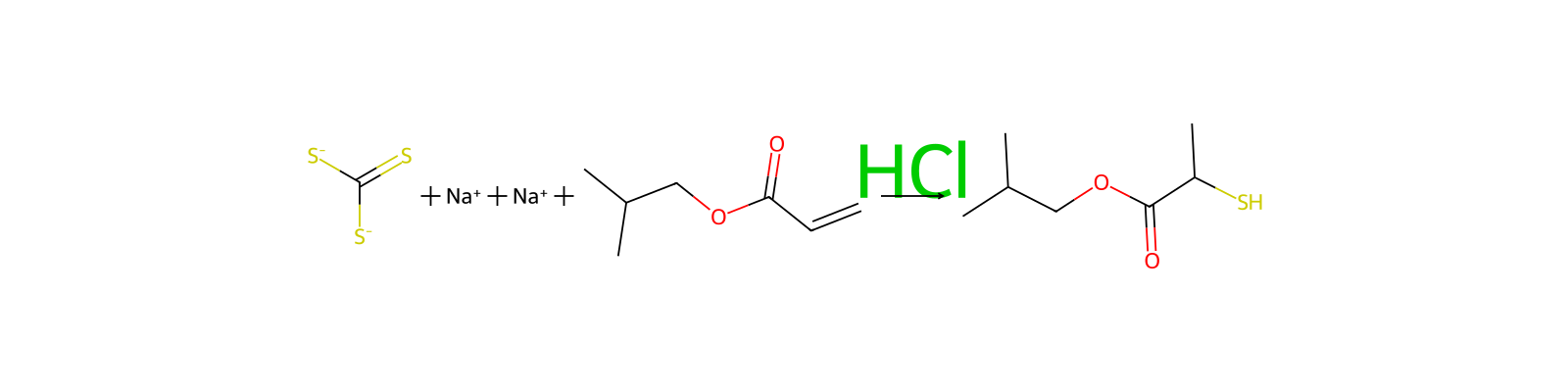
관련 반응
15건


화합물 노트
불러오는 중…