홈MCP워크벤치Skills
홈워크벤치알림마이페이지
llms.txt · MCP 가이드개인정보처리방침 · 이용약관 · 지원v1.8.0
  1. 홈
  2. /화합물

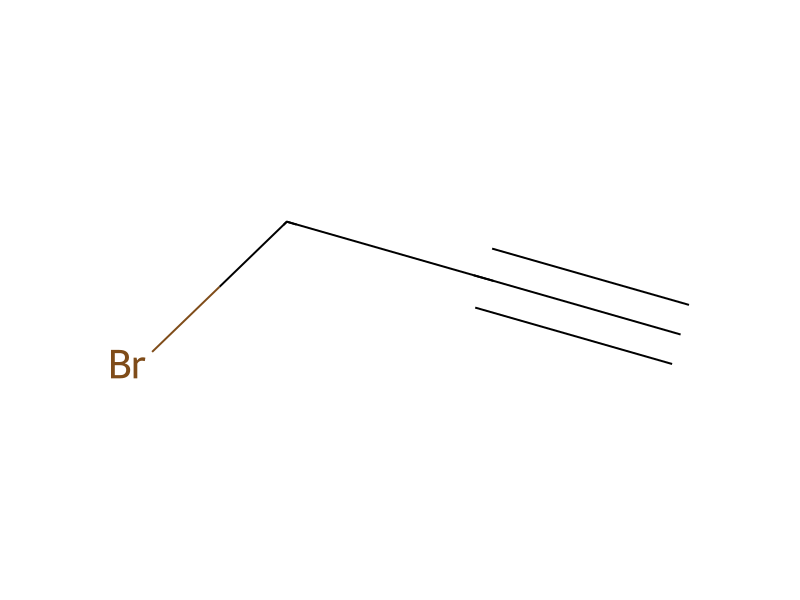
프로파길브로마이드

Propargyl bromide

HCID 7842
새 노트새 반응견적 요청하기
인쇄 미리보기

데이터를 보충하는 중입니다. 잠시 후 페이지를 새로 고치면 최신 내용을 볼 수 있습니다
기본 정보개요이름 및 식별자물성안전 및 규제화학 및 산업관련 반응화합물 노트
부분 구조 검색유사 구조 찾기

기본 정보

CAS
106-96-7
표준 SMILES
C#CCBr
InChIKey
YORCIIVHUBAYBQ-UHFFFAOYSA-N
분자식
C3H3Br
평균 분자량
118.96 g/mol
단동위원소 질량
117.9418122

개요

3-bromopropyne appears as a colorless to light yellow liquid substance with a sharp odor. Flash point 65 °F. Denser than water and insoluble in water. Vapors are heavier than air. May be irritating to skin and eyes. Used to make other chemicals. It may decompose explosively with mild shock.

이름 및 식별자

우선 이름
Propargyl bromide
IUPAC
3-bromoprop-1-yne
현지명
프로파길브로마이드
영어명
Propargyl bromide
분자식
C3H3Br
분자량
118.96

이름 및 동의어

PROPARGYL BROMIDE3-Bromopropyne106-96-73-Bromo-1-propyne1-Propyne, 3-bromo-2-Propynyl bromide1-Bromo-2-propynePropynyl bromidePropyne, 3-bromo-Gamma-bromoallyleneF3H7ZXK9ZUNSC-8801
이름 더 보기
3-브로모-1-프로핀3-브로모프로핀프로파길브로마이드PBRpropargylG-BROMOALLYLENEPropargylbromid3-bromo-1-propyn
DTXSID3042340RefChem:869612DTXCID1022340203-447-13-bromoprop-1-ynepropargylbromide3-bromo-propyne1-Brom-2-propin

데이터베이스 식별자

CAS
106-96-7
PubChem CID
7842
DTXSID
DTXSID3042340
UNII
F3H7ZXK9ZU
EC Number
203-447-1
Nikkaji
J5.054G

물성

구조 계산 물성보충 중

XLogP
1.1
극성 표면적
0 Ų
수소 결합 공여자 수
0
수소 결합 수용자 수
0
회전 가능 결합 수
0
무거운 원자 수
4
형식 전하
0
복잡도
38.5

실험 및 물리화학적 성질

Chemical ClassesFlammable agents - 3rd degree
SpringerMaterials PropertiesCoriolis coupling
PesticidesPesticides -> Fumigants
OdorSharp odor
Density · 3건

1.564 to 1.57 (EPA, 1998)

1.579 g/cu cm at 19 °C

1.579 @ 19°C

Color/Form · 2건

Liquid

Colorless, crystalline

Solubility · 2건

Soluble in ethanol, ether, benzene, carbon tetrachloride, and chloroform

In water, 1.49X10+4 mg/L at 25 °C

Flash Point · 3건

50 °F (EPA, 1998)

50 °F

10.0 °C (closed cup); 18.0 °C (open cup)

Boiling Point · 2건

190 to 194 °F at 760 mmHg (EPA, 1998)

89 °C

Decomposition · 2건

May be decomposed by mild shock. Decomposes when heated under confinement. Dilution with toluene reduces the explosive tendency of the material.

안전 및 규제

안전 정보는 참고용이며, 공급업체의 물질안전보건자료(SDS), 관련 법규 및 전문가 평가를 대체하지 않습니다.

GHS 분류

GHS Classification · 6건

Danger

H225 (92.5%): Highly Flammable liquid and vapor [Danger Flammable liquids]

P210, P233, P240, P241, P242, P243, P260, P261, P264, P264+P265, P270, P271, P280, P301+P316, P301+P330+P331, P302+P352, P302+P361+P354, P303+P361+P353, P304+P340, P305+P351+P338, P305+P354+P338, P316, P319, P321, P330, P332+P317, P337+P317, P362+P364, P363, P370+P378, P403+P233, P403+P235, P405, and P501 (click each P-code to see the statement)

Aggregated GHS information provided per 53 reports by companies from 12 notifications to the ECHA C&L Inventory. Each notification may be associated with multiple companies.

Danger

H225: Highly Flammable liquid and vapor [Danger Flammable liquids]

유해성 정보

Regulatory Information · 4건

Chemical: 1-Propyne, 3-bromo-

Status: Active Update: 14-12-2021 https://echa.europa.eu/registration-dossier/-/registered-dossier/28261

1-Propyne, 3-bromo-: Does not have an individual approval but may be used as a component in a product covered by a group standard. It is not approved for use as a chemical in its own right.

The New Jersey Worker and Community Right to Know Act requires public and private employers to provide information about hazardous substances at their workplaces. (N.J.S.A. 34:5A-1 et. seq.)

DOT LabelFlammable Liquid
Fire Hazards · 2건

This material detonates at 428F or more; ignites by impact. Emits highly toxic fumes of bromides when heated to decomposition. Reacts vigorously with oxidizing materials. Becomes shock-sensitive when mixed with chloropicrin. Unstable, avoid heat, flame, shock, and other chemicals (EPA, 1998)

· HIGHLY FLAMMABLE: Will be easily ignited by heat, sparks or flames.

Fire Potential · 1건

Fire and Explosion Hazards: Flammable liquid. Combustion may produce irritants and toxic gases. Closed containers may rupture violently when heated. May be decomposed by mild shock. Decomposes when heated; if diluted with toluene, its explosive properties are practically eliminated.

화학 및 산업

약리 정보

MeSH Pharmacological Classification · 2건

Chemicals that kill or inhibit the growth of fungi in agricultural applications, on wood, plastics, or other materials, in swimming pools, etc.

Substances that inhibit the growth or reproduction of BACTERIA.

용도 및 제조

Uses · 6건

Used as a fumigant, an alkylating agent, and a chemical intermediate; [HSDB]

Farming (Pesticides) [Category: Industry]

Ingredient of fumigants /SRP65, Former use in USA/

Soil fumigant /Former, US/

Chemical intermediate

Alkylating agent

U.S. Exports(1987) No Data
U.S. Imports(1987) No Data
U.S. Production(1987) No Data
Methods of ManufacturingFrom acetylene by high-pressure synthesis
General Manufacturing Information · 3건

1-Propyne, 3-bromo-: ACTIVE

... A process for preparing propargyl phenols /was presented/. ... A polyhydric phenolic material is reacted with propargyl bromide in aqueous sodium hydroxide solution. The reaction occurs at the interface between the aqueous basic solution of the phenolic material and the propargyl bromide which is insoluble in water.

In search of new tuberculostatic agents, imidazoline-2-thiol and some of its derivatives were reacted with propargyl bromide, and the compounds obtained were reacted with some arylsulfonyl chlorides, aromatic aldehydes, isocyanates and isothiocyanates. Fourteen resultant compounds were characterized and shown to display varied tuberculostatic activity when tested against Mycobacterium tbc 607 and H37Rv strains.

응용 분야 · 2건

관련 반응

1,700건
반응 기록 만들기
HRID 1618 반응식
HRID 1618반응물로uspto-grants-1998_03
HRID 3402 반응식
HRID 3402반응물로uspto-grants-1998_03
HRID 3404 반응식
HRID 3404반응물로uspto-grants-1998_03
HRID 3405 반응식
HRID 3405반응물로uspto-grants-1998_03
HRID 3620 반응식
HRID 3620반응물로uspto-grants-1998_03
HRID 4171 반응식
HRID 4171반응물로uspto-grants-1988_02
HRID 5317 반응식
HRID 5317반응물로uspto-grants-1993_09
HRID 5319 반응식
HRID 5319반응물로uspto-grants-1993_09
1 / 213 페이지

화합물 노트

불러오는 중…

이 페이지에서기본 정보개요이름 및 식별자물성안전 및 규제화학 및 산업관련 반응화합물 노트
더보기
새 노트새 반응견적 요청하기

When heated to decomposition it emits highly toxic fumes of /hydrogen bromide/.

Melting Point · 2건

-77.9 °F (EPA, 1998)

-61.07 °C

Vapor Density · 2건

4.1 (EPA, 1998) - Heavier than air; will sink (Relative to Air)

6.87 (Air = 1)

물리화학적 성질

녹는점
-61 °C · -61°C
끓는 점
97 °C · 97 °C
밀도
1.38 g/mL · 1.38 g/mL at 20 °C
굴절률
20 · n20/D 1.494
인화점
65 °F · 65 °F
저장 조건
2 · 2-8°C
용해도
에 용해됨클로로포름, 메탄올 (약간 용해됨)
물리적 상태
액체
색상
무색~황색
수용성
에탄올, 에테르, 벤젠, 사염화탄소 및 클로로포름과 혼합 가능합니다. 물과 섞이지 않습니다.
BRN
605309 · 605309
Henry's Law Constant
8.8 · 8.8×10-3 mol/(m3Pa) at 25℃, Yates and Gan (1998)
InChI
1S/C3H3Br/c1-2-3-4/h1H,3H2
InChIKey
YORCIIVHUBAYBQ-UHFFFAOYSA-N
SMILES
BrCC#C
NIST
1 · 1-Propyne, 3-bromo-(106-96-7)
EPA
Propargyl bromide (106-96-7)

화학적 성질

Light yellow, highly toxic liquid. Soluble in ethanol, ether, benzene, and chloroform.

Health Hazards · 2건

This material is very toxic via the oral route. If inhaled, may be harmful; contact may cause burns to skin and eyes. (EPA, 1998)

· May cause toxic effects if inhaled or absorbed through skin.

Hazards Summary · 1건

In inhalation studies, all rats die when exposed to 1000 ppm for 1 hour or 120 ppm for 7 hours. Minor liver and kidney damage occurs at lethal doses. [HSDB] Can burn the skin; A strong lacrimating agent; Inhalation of high concentrations can cause acute pneumonitis; [CAMEO] Undiluted liquid can produce irreversible corneal damage; At concentrations >1500 ppm, can cause coughing, extreme respiratory distress, and delayed pulmonary edema; [AIHA]

DOT ID and Guide2345 130
Reactive GroupHalogenated Organic Compounds
FIFRA Requirements · 2건

Tolerances are established for residues of inorganic bromides (calculated as Br) in or on the following raw agricultural commodities grown in soil fumigated with combinations of chloropicrin, methyl bromide, and propargyl bromide. No tolerances are established for chloropicrin since it has been established that no residue of this substance remains in the raw agricultural commodity: broccoli; cauliflower; eggplant; muskmelon; pepper; pineapple; strawberry; and tomato.

Tolerances with regional registration, as defined in §180.1(n), are established for residues of inorganic bromides (calculated as Br) in or on the following raw agricultural commodities grown in soil fumigated with combinations of chloropicrin, methyl bromide, and propargyl bromide: asparagus; lettuce; and onion, dry bulb.

Reactivity AlertsHighly Flammable
Reactivity Profile · 1건

3-BROMOPROPYNE is soluble in alcohol, ether, chloroform, carbon tetrachloride and carbon disulfide. It is highly flammable and a dangerous fire risk, sensitive to shock. It is used in organic syntheses, preparation of resins and perfume intermediates [Hawley]. There is a high danger of formation of explosive metal acetylides, when this compound comes in contact with copper, high-copper alloys, mercury, or silver.

Flammable LimitsLower flammable limit: 3.0%

안전 및 보호

Fire Fighting · 1건

Wear self-contained breathing apparatus and full protective clothing. Move container from fire area if you can do it without risk. Do not get water inside container. Cool containers that are exposed to flames with water from the side until well after fire is out. Withdraw immediately in case of rising sound from venting safety device or any discoloration of tank due to fire. Isolate for 1/2 mile in all directions if tank car or truck is involved in fire.

Accidental Release Measures · 2건

· CALL 911. Then call emergency response telephone number on shipping paper. If shipping paper not available or no answer, refer to appropriate telephone number listed on the inside back cover.

· ELIMINATE all ignition sources (no smoking, flares, sparks or flames) from immediate area.

First Aid · 2건

Warning: Propargyl bromide is very toxic via the oral route, has corrosive effects, causes burns to skin and eyes, and is a strong lacrimating agent.

General First Aid:

Exposure Control and Personal Protection· Wear positive pressure self-contained breathing apparatus (SCBA).
Fire Fighting Procedures · 2건

Fire Fighting Procedure: Use water spray, dry chemical, foam, or carbon dioxide. Use fine spray or fog to control fire by preventing its spread and absorbing some of its heat. Application of a water blanket may be effective for extinguishment. Use water spray to keep fire-exposed containers cool. Fight fire from protected location or maximum possible distance. Approach fire from upwind to avoid hazardous vapors and toxic decomposition.

If material on fire or involved in fire: Do not extinguish fire unless flow can be stopped. Use water in flooding quantities as fog. Solid streams of water may be ineffective. Cool all affected containers with flooding quantities of water. Use alcohol foam, dry chemical or carbon dioxide. Keep run-off water out of sewers and water sources.

Storage Conditions · 1건

Unstabilized material should be stored like an explosive. If diluted, material should be stored like a flammable material. Store in a cool, dry, well-ventilated location. Outside or detached storage is preferred. Separate from oxidizing materials. Inside storage should be in a standard flammable liquids storage warehouse, room, or cabinet.

Cleanup Methods · 2건

Absorb the spill with paper towels. ... Place in hood to evaporate material.

Spill or leak procedures: Eliminate all ignition sources. Stop or control the leak, if this can be done without undue risk. Use water spray to cool and disperse vapors, and protect personnel. Control runoff and isolate discharged material for proper disposal. Fire situations may require evacuation.

Nonfire Spill ResponseExcerpt from ERG Guide 130 [Flammable Liquids (Water-Immiscible / Noxious)]:
Disposal Methods · 2건

Dissolve in a combustible solvent. Scatter spray of solution into a furnace with afterburner and alkali scrubber.

SRP: At the time of review, criteria for land treatment or burial (sanitary landfill) disposal practices are subject to significant revision. Prior to implementing land disposal of waste residue (including waste sludge), consult with environmental regulatory agencies for guidance on acceptable disposal practices.

Preventive Measures · 3건

If material on fire or involved in fire: Do not extinguish fire unless flow can be stopped. Use water in flooding quantities as fog. Solid streams of water may be ineffective. Cool all affected containers with flooding quantities of water. Use alcohol foam, dry chemical or carbon dioxide. Keep run-off water out of sewers and water sources.

Personnel protection: Avoid breathing vapors. Keep upwind. Do not handle broken packages unless wearing appropriate personal protective equipment. If contact with the material anticipated, wear appropriate chemical protective clothing.

SRP: The scientific literature for the use of contact lenses in industry is conflicting. The benefit or detrimental effects of wearing contact lenses depend not only upon the substance, but also on factors including the form of the substance, characteristics and duration of the exposure, the uses of other eye protection equipment, and the hygiene of the lenses. However, there may be individual substances whose irritating or corrosive properties are such that the wearing of contact lenses would be harmful to the eye. In those specific cases, contact lenses should not be worn. In any event, the usual eye protection equipment should be worn even when contact lenses are in place.

Isolation and Evacuation · 2건

Excerpt from ERG Guide 130 [Flammable Liquids (Water-Immiscible / Noxious)]:

Immediate precautionary measure

Allowable Tolerances · 2건

Tolerances are established for residues of inorganic bromides (calculated as Br) in or on the following raw agricultural commodities grown in soil fumigated with combinations of chloropicrin, methyl bromide, and propargyl bromide. No tolerances are established for chloropicrin since it has been established that no residue of this substance remains in the raw agricultural commodity: broccoli, 25 ppm; cauliflower, 25 ppm; eggplant, 60 ppm; muskmelon, 40 ppm; pepper, 25 ppm; pineapple, 25 ppm; strawberry, 25 ppm; and tomato 40 ppm.

Tolerances with regional registration, as defined in §180.1(n), are established for residues of inorganic bromides (calculated as Br) in or on the following raw agricultural commodities grown in soil fumigated with combinations of chloropicrin, methyl bromide, and propargyl bromide: asparagus, 300 ppm; lettuce, 300 ppm; and onion, dry bulb, 300 ppm.

독성 정보

Environmental Fate · 4건

TERRESTRIAL FATE: Based on a classification scheme(1), Koc values of 1.1 and 5.3(2) indicate that 3-bromo-1-propyne is expected to have very high mobility in soil(SRC). Volatilization of 3-bromo-1-propyne from moist soil surfaces is expected to be an important fate process(SRC) given a Henry's Law constant of 1.13X10⁻³ atm-cu m/mole(2). 3-Bromo-1-propyne is expected to volatilize from dry soil surfaces(SRC) based upon an estimated vapor pressure of 108 mm Hg(SRC), calculated using a water solubility of 1.49X10+4 mg/L(2) and the Henry's Law constant(2). Biodegradation in soil is not expected to compete with chemical degradation processes based on similar half-lives in sterile soil (0.37-11 days) and nonsterile soil (0.046-12 days)(2,3,4). It has been proposed that the alkylation of soil organic matter is the primary degradation process for 3-bromo-1-propyne in soil(2-4).

TERRESTRIAL FATE: The measured first-order degradation rate constants for 310 mg/kg 3-bromo-1-propyne in autoclaved Arlington sand loam, nonautoclaved Arlington sand loam, autoclaved Linne clay loam, and nonautoclaved Linne clay loam were 0.065, 0.056, 0.20, and 0.20 per day, respectively, which correspond to half-lives of 11, 12, 3.5, and 3.5 days, respectively(1). The measured first-order degradation rate constants for 20 mg/kg 3-bromo-1-propyne in sterile Arlington sandy loam, Carsitas loamy sand, and Linne clay loam were 0.18, 0.57, and 0.39 per day, respectively, which correspond to half-lives of 3.9, 1.2, and 1.8 days, respectively(2). Measured rate constants for this substance (20 mg/kg) in nonsterile Arlington sandy loam, Carsitas loamy sand, and Linne clay loam were 0.14, 0.46, and 0.48 per day, respectively, which correspond to half-lives of 5.0, 1.5, and 1.4 days, respectively(2). Half-lives determined from first-order degradation rate constants for 0.7 mg/kg 3-bromo-1-propyne in sterile Coachella fine sand, Arlington sandy loam, Chualar loam, and Florida muck were 2.4, 2.4, 1.0, and 0.37 days, respectively at an inital concentration of 0.7 mg/kg; 3.2, 4.6, 3.0, and 0.71 days, respectively at an initial concentration of 7 mg/kg; and 6.3, 6.9, 3.5, and 1.2 days, respectively at an initial concentration of 70 mg/kg(3). Half-lives determined from first-order degradation rate constants for 0.7 mg/kg propargyl bromide in non-sterile Coachella fine sand, Arlington sandy loam, Chualar loam, and Florida muck were 3.5, 0.39, 0.36, and 0.046 days, respectively at an inital concentration of 0.7 mg/kg; 4.1, 3.6, 2.8, and 0.43 days, respectively at an initial concentration of 7 mg/kg; and 8.7, 7.7, 4.6, and 1.1 days, respectively at an initial concentration of 70 mg/kg(3).

AQUATIC FATE: Based on a classification scheme(1), Koc values of 1.1 and 5.3(2), indicate that 3-bromo-1-propyne is not expected to adsorb to suspended solids and sediment(SRC). Volatilization from water surfaces is expected(3) based upon a Henry's Law constant of 1.13X10⁻³ atm-cu m/mole(2). Using this Henry's Law constant and an estimation method(3), volatilization half-lives for a model river and model lake are 2 hours and 5 days, respectively(SRC). According to a classification scheme(4), an estimated BCF of 3(SRC), from a water solubility of 1.49X10+4 mg/L(2) and a regression-derived equation(5), suggests the potential for bioconcentration in aquatic organisms is low(SRC). 3-Bromo-1-propyne is expected to undergo hydrolysis based on measured half-lives of 64 and 47 days at 22 and 25 °C, respectively(2,6). Biodegradation in water is not expected to compete with chemical degradation processes based on similar half-lives in sterile soil (0.37-11 days) and nonsterile soil (0.046-12 days)(2,6,7).

ATMOSPHERIC FATE: According to a model of gas/particle partitioning of semivolatile organic compounds in the atmosphere(1), 3-bromo-1-propyne, which has an estimated vapor pressure of 108 mm Hg at 25 °C(SRC), calculated from a water solubility of 1.49X10+4 mg/L(2) and a Henry's Law constant of 1.13X10⁻³ atm-cu m/mol(2), is expected to exist solely as a vapor in the ambient atmosphere. Vapor-phase 3-bromo-1-propyne is degraded in the atmosphere by reaction with photochemically-produced hydroxyl radicals(SRC); the half-life for this reaction in air is estimated to be 3 days(SRC), calculated from its rate constant of 5.6X10⁻¹² cu cm/molecule-sec at 25 °C(SRC) that was derived using a structure estimation method(3). Propargyl bromide does not contain chromophores that absorb at wavelengths >290 nm and therefore is not expected to be susceptible to direct photolysis by sunlight(SRC).

Adverse EffectsOccupational hepatotoxin - Secondary hepatotoxins: the potential for toxic effect in the occupational setting is based on cases of poisoning by human ingestion or animal experimentation.
Soil Adsorption/Mobility · 1건

Koc values of 1.1 and 5.3 were determined for 3-bromo-1-propyne in Linne clay loam (Kd = 0.033, 2.99% organic matter) and Arlington sandy loam (Kd = 0.049, 0.93% organic matter), respectively(1). According to a classification scheme(2), these Koc values suggest that 3-bromo-1-propyne is expected to have very high mobility in soil.

TSCA Test Submissions · 3건

3-Bromopropyne (CAS # 106-96-7) was evaluated for acute oral toxicity. The test substance was administer by oral gavage to rats (dosage, sex, number of rats, and strain was not reported). The LD50 was determined to be 0.067 g/kg. No further information was submitted.

3-Bromopropyne (CAS # 106-96-7) was evaluated for acute oral toxicity. The test substance was administer by oral gavage to guinea pigs (dosage, sex, number of guinea pigs, and strain was not reported). The LD50 was determined to be 0.029 g/kg. No further information was submitted.

3-Bromopropyne (CAS # 106-96-7) was evaluated for acute inhalation toxicity. Number of rats and strain were not reported. All of the rats exposed to 1000 ppm for 1 hour, 200 ppm for 4 hours, and 120 ppm for 7 hours died. All rats exposed to 1000 ppm for 0.2 hours, 200 ppm for 0.5 hours, and 120 ppm for 2 hours survived. Vapor inhalation of test substance is considered irritating and under the above conditions caused slight liver and kidney injury. No further information was submitted.

Human Toxicity Excerpts · 4건

/SIGNS AND SYMPTOMS/ Symptomatology: 1. A. Inhalation, high vapor concn: gasping, refusal to breathe, coughing, substernal pain, and extreme respiratory distress at vapor concn over 1500 ppm. Irritation of eyes and upper respiratory mucosa appears promptly after exposure to concentrated vapors. Lacrimation and headache are prominent. Coma may occur rapidly. B. Inhalation, low vapor concentrations: Central nervous depression and moderate irritation of respiratory system. Headache is frequent. /Dichloropropenes/

/SIGNS AND SYMPTOMS/ Symptomatology: 2. Dermal: Severe skin irritation with marked inflammatory response of epidermis and underlying tissues. 3. Oral: Acute gastrointestinal distress with pulmonary congestion and edema. Central nervous depression, perhaps even in the absence of impaired oxygen uptake. 4. By any route, possible late injuries to liver, kidneys and heart. 5. After inhalation exposures, malaise, headache, chest and abdominal discomfort and irritability have been reported to persist for several years. /Dichloropropenes/

/SIGNS AND SYMPTOMS/ Vapors and liquid are corrosive toward skin, eyes, and mucous membranes.

/Propargyl bromide/ vapors are very toxic.

Artificial Pollution Sources · 1건

3-Bromo-1-propyne's production and use as a chemical intermediate(1) may result in its release to the environment through various waste streams; its former production and use as a soil fumigant(1) may have resulted in its direct release to the environment(SRC).

Environmental BiodegradationAEROBIC: Biodegradation of 3-bromo-1-propyne is not expected to compete with chemical degradation processes based on similar half-lives measured for this substance in sterile soil (0.37-11 days) and nonsterile soil (0.046-12 days)(1-3).
Environmental Bioconcentration · 1건

An estimated BCF of 3 was calculated for 3-bromo-1-propyne(SRC), using a water solubility of 1.49X10+4 mg/L(1) and a regression-derived equation(2). According to a classification scheme(3), this BCF suggests the potential for bioconcentration in aquatic organisms is low(SRC).

Volatilization from Water/Soil · 1건

The Henry's Law constant for 3-bromo-1-propyne is 1.13X10⁻³ atm-cu m/mole(1). This Henry's Law constant indicates that 3-bromo-1-propyne is expected to volatilize rapidly from water surfaces(2). Based on this Henry's Law constant, the volatilization half-life from a model river (1 m deep, flowing 1 m/sec, wind velocity of 3 m/sec)(2) is estimated as 2 hours(SRC). The volatilization half-life from a model lake (1 m deep, flowing 0.05 m/sec, wind velocity of 0.5 m/sec)(2) is estimated as 5 days(SRC). 3-Bromo-1-propyne's Henry's Law constant indicates that volatilization from moist soil surfaces may occur(SRC). 3-Bromo-1-propyne is expected to volatilize from dry soil surfaces(SRC) based upon an estimated vapor pressure of 108 mm Hg(SRC), calculated using a water solubility of 1.49X10+4 mg/L(2) and its Henry's Law constant(2).

Environmental Abiotic Degradation · 2건

The rate constant for the vapor-phase reaction of 3-bromo-1-propyne with photochemically-produced hydroxyl radicals has been estimated as 5.6X10⁻¹² cu cm/molecule-sec at 25 °C(SRC) using a structure estimation method(1). This corresponds to an atmospheric half-life of about 3 days at an atmospheric concentration of 5X10+5 hydroxyl radicals per cu cm(1). A hydrolysis half-life of 47 days at 25 °C was calculated for 3-bromo-1-propyne using a rate constant (not reported) determined from measurements at temperatures between 2 and 40 °C(2). A hydrolysis half-life of 64 days at 22 °C has also been measured for this substance(3). The hydrolysis products observed during this reaction were propargyl hydroxide and bromide ion(3). 3-Bromo-1-propyne does not contain chromophores that absorb at wavelengths >290 nm and therefore is not expected to be susceptible to direct photolysis by sunlight(SRC).

The measured first-order degradation rate constants for 310 mg/kg propargyl bromide in autoclaved Arlington sand loam and Linne clay loam were 0.065 and 0.20 per day, respectively, which correspond to half-lives of 11 and 3.5 days, respectively(1). The measured first-order degradation rate constants for 20 mg/kg 3-bromo-1-propyne in sterile Arlington sandy loam, Carsitas loamy sand, and Linne clay loam were 0.18, 0.57, and 0.39 per day, respectively, which correspond to half-lives of 3.9, 1.2, and 1.8 days, respectively(2). Half-lives determined from first-order degradation rate constants for 0.7 mg/kg 3-bromo-1-propyne in sterile Coachella fine sand, Arlington sandy loam, Chualar loam, and Florida muck were 2.4, 2.4, 1.0, and 0.37 days, respectively at an inital concentration of 0.7 mg/kg; 3.2, 4.6, 3.0, and 0.71 days, respectively at an initial concentration of 7 mg/kg; and 6.3, 6.9, 3.5, and 1.2 days, respectively at an initial concentration of 70 mg/kg(3). It has been proposed that the primary degradation process for 3-bromo-1-propyne in soil is the alkylation of soil organic matter(1-3).

Probable Routes of Human ExposureOccupational exposure to 3-bromo-1-propyne may occur through inhalation and dermal contact with this compound at workplaces where 3-bromo-1-propyne is produced or used. (SRC)
Environmental Water ConcentrationsDRINKING WATER: 3-Bromo-1-propyne was listed among chemicals that have been detected in drinking water collected from Europe and the United States(1). However, neither concentration data nor frequency of detection were reported(1).

규제 정보

FIFRA Requirements · 2건

Tolerances are established for residues of inorganic bromides (calculated as Br) in or on the following raw agricultural commodities grown in soil fumigated with combinations of chloropicrin, methyl bromide, and propargyl bromide. No tolerances are established for chloropicrin since it has been established that no residue of this substance remains in the raw agricultural commodity: broccoli; cauliflower; eggplant; muskmelon; pepper; pineapple; strawberry; and tomato.

Tolerances with regional registration, as defined in §180.1(n), are established for residues of inorganic bromides (calculated as Br) in or on the following raw agricultural commodities grown in soil fumigated with combinations of chloropicrin, methyl bromide, and propargyl bromide: asparagus; lettuce; and onion, dry bulb.

CERCLA Reportable Quantities · 1건

Releases of CERCLA hazardous substances are subject to the release reporting requirement of CERCLA section 103, codified at 40 CFR part 302, in addition to the requirements of 40 CFR part 355. Propargyl bromide is an extremely hazardous substance (EHS) subject to reporting requirements when stored in amounts in excess of its threshold planning quantity (TPQ) of 10 lbs.

안전 데이터

wgk
3
tsca
TSCA listed
rtecs
UK4375000
ridadr
UN 2345
HS 번호
29033990
risk_code
60-61-20/21-25-63-36/37/38-11-67-65-48/20
hazard_code
F,T,C
safety_code
53-16-36/37/39-45-37/39-28A-26-62-36/37
포장분류
II
위험 등급
3
F 고인화성물질
8
위험 참고 사항
Highly Flammable/Toxic/Corrosive
Hazard Classifications
Acute Tox. 3 OralAsp. Tox. 1Eye Dam. 1Flam. Liq. 2Skin Corr. 1BSTOT RE 2 InhalationSTOT SE 3
스토리지 클래스
3 - Flammable liquids
유해 물질 데이터
106-96-7(Hazardous Substances Data)

개요Propargyl bromide is a Shock sensitive liquid, lachrymator. Supplied as an 80% solution in toluene stabilized with magnesium oxide. Alternative formulations are currently under development.

일반 설명3-bromopropyne appears as a colorless to light yellow liquid substance with a sharp odor. Flash point 65 °F. Denser than water and insoluble in water. Vapors are heavier than air. May be irritating to skin and eyes. Used to make other chemicals. It may decompose explosively with mild shock.

상·하류 제품 정보

상류 원료

프로파질 알코올디브로모프로펜(2.3-)1,3-DIBROMO-1-PROPENE

하류 제품

2-Allyl-4-hydroxy-3-methyl-2-cyclopenten-1-oneHALOPROGIN2,4,5-트리클로로페닐-프로피닐에테르테르비나핀2-AMINOPENT-4-YNENITRILE(+/-)-1,2-디페닐에틸렌디아민NISTC10024187디브로모프로펜(2.3-)1,3,5-Tris(bromomethyl)benzenepinazepamMandipropamid1,2-Hexadien-5-yne알파-시클로프로필스티렌1,3-헥사디엔-5-인.벤조니트릴,3-(2-프로피닐옥시)-(9CI)