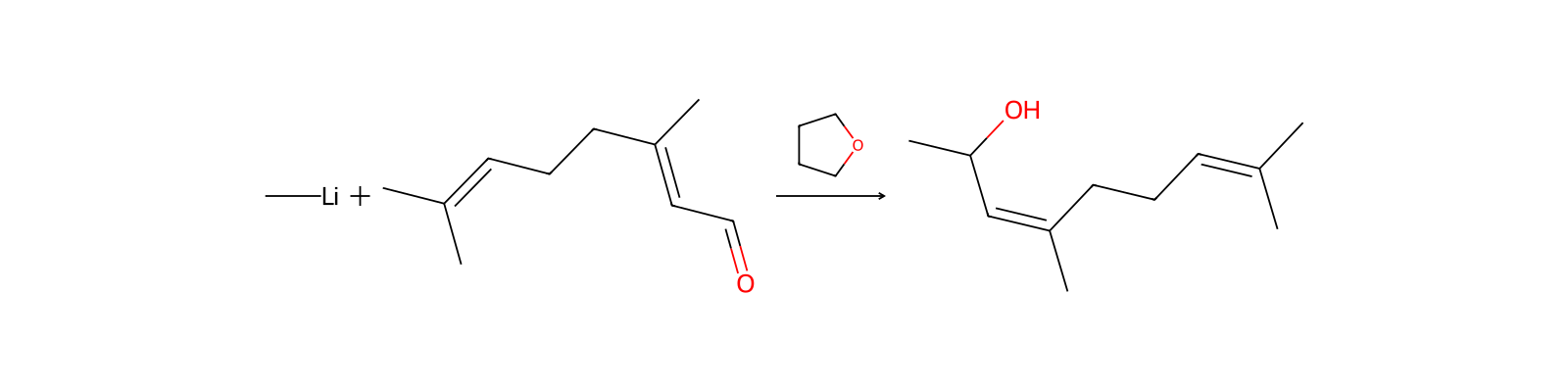
시트랄
3,7-Dimethylocta-2,6-Dienal
데이터를 보충하는 중입니다. 잠시 후 페이지를 새로 고치면 최신 내용을 볼 수 있습니다

기본 정보
- CAS
5392-40-5- 표준 SMILES
CC(C)=CCCC(C)=CC=O- InChIKey
WTEVQBCEXWBHNA-UHFFFAOYSA-N- 분자식
- C10H16O
- 평균 분자량
- 152.23 g/mol
- 단동위원소 질량
- 152.12011513
개요
Citral is an enal that consists of octa-2,6-dienal bearing methyl substituents at positions 3 and 7. A mixture of the two geometric isomers geranial and neral, it is the major constituent (75-85%) of oil of lemon grass, the volatile oil of Cymbopogon citratus, or of C. flexuosus. It also occurs in oils of verbena, lemon, and orange. It has a role as an insecticide, a metabolite, a flavouring agent, a fragrance and an EC 1.2.3.1 (aldehyde oxidase) inhibitor. It contains a geranial and a neral.
이름 및 식별자
- 우선 이름
- 3,7-Dimethylocta-2,6-Dienal
- IUPAC
- 3,7-dimethylocta-2,6-dienal
- 현지명
- 시트랄
- 영어명
- Citral
- 분자식
- C10H16O
- 분자량
- 152.23
이름 및 동의어
RefChem:10661553,7-Dimethylocta-2,6-DienalLemarome nlime octadienalNSC 6170cis,trans-CitralSCHEMBL23074SCHEMBL954112orb1304483orb30257643,7-dimethyl-2,6-octandienalCHEMBL2297541
이름 더 보기
시트랄게라니알(트랜스시트랄)2,6-옥타다이엔알, 3,7-다이메틸-NERALGERANIALcis-Citral2,6-Octadienal, 3,7-dimethyl-3,7-DIMETHYL-2,6-OCTADIENALCITRATHALFEMA 2303geranialdehydeCITRAL NATURALCITRAL EX LITSEA
3,7-dimethyl-octa-2,6-dienalCitral (cis- and trans- mixture)3,7-dimethyl-2,6-octadien-1-al3,7-dimethyl-2,6-octadiene-1-alAKOS024306977Citral 1000 microg/mL in AcetonitrileDB-052426D0762
데이터베이스 식별자
- CAS
5392-40-5- PubChem CID
- 8843
- DTXSID
DTXSID6024836- ChEMBL
CHEMBL2297541- ChEBI
CHEBI:23316
물성
구조 계산 물성보충 중
- XLogP
- 3
- 극성 표면적
- 17.1 Ų
- 수소 결합 공여자 수
- 0
- 수소 결합 수용자 수
- 1
- 회전 가능 결합 수
- 4
- 무거운 원자 수
- 11
- 형식 전하
- 0
- 복잡도
- 171
실험 및 물리화학적 성질
SpringerMaterials PropertiesBoiling point
Endocrine DisruptorsPotential endocrine disrupting compound
물리화학적 성질
- 녹는점
- -10 °C · <-10°C
- 끓는 점
- 229 °C · 229 °C (lit.)
- 밀도
- 0.888 g/mL · 0.888 g/mL at 25 °C (lit.)
- 증기 밀도
- 5 · 5 (vs air)
- 증기압
- 0.2 mm · 0.2 mm Hg ( 200 °C)
- 굴절률
- 20 · n20/D 1.488(lit.)
- FEMA
- 2303 · 2303 | CITRAL
- 인화점
- 215 °F · 215 °F
- 저장 조건
- 2 · 2-8°C
- 용해도
- 0.42 g/L · 0.42g/L
- 물리적 상태
- 액체
- 색상
- 무색~연황색
- 냄새
- 100 %에서 · 100.00%에서. 달콤한 레몬 시트랄
- 냄새 유형
- 감귤류
- 생물학적 소스
- synthetic
- 폭발한계
- 4.3 · 4.3-9.9%(V)
- 수용성
- 실질적으로 불용성
- Merck
- 14 · 14,2322
- JECFA Number
- 1225 · 1225
- BRN
- 1721871 · 1721871
- Henry's Law Constant
- 2.9 · 2.9×10-1 mol/(m3Pa) at 25℃, Wu et al. (2022)
- 안정성
- 안정적인. 그러나 쉽게 이성질체화됩니다. 알칼리, 강산화제, 강산과 호환되지 않습니다. 타기 쉬운. 공기와 빛에 민감합니다.
- 주요 응용
- 향료 및 향
- 화장품 원료 기능
- 향료향기향수
- InChI
- 1S/C10H16O/c1-9(2)5-4-6-10(3)7-8-11/h5,7-8H,4,6H2,1-3H3
- InChIKey
- WTEVQBCEXWBHNA-UHFFFAOYSA-N
- SMILES
- [H]C(=O)C=C(C)CC\C=C(\C)C
- LogP
- 2.76 at · 2.76 at 25℃
- NIST
- Citral(5392-40-5)
- EPA
- Citral (5392-40-5)
화학적 성질
Citral occurs as (2Z)- and (2E)-isomers (citral a and b, respectively) analogous to the corresponding alcohols, geraniol and nerol: geranial (citral a), bp2.7 kPa 118–119 °C, d20 0.8888, n20 D 1.4898; neral (citral b), bp2.7 kPa 120 °C, d20 0.8869, n20 D 1.4869. Natural citral is nearly always a mixture of the two isomers. It occurs in lemongrass oil (up to 85%), in Litsea cubeba oil (up to 75%), and in small amounts inmany other essential oils. The citrals are colorless to slightly yellowish liquids, with an odor reminiscent of lemon. Since citral is an α,β-unsaturated aldehyde with an additional double bond, it is highly reactive and may undergo reactions such as cyclization and polymerization. Geraniol, citronellol, and 3,7-dimethyloctan-l-ol can be obtained from citral by stepwise hydrogenation. Citral can be converted into a number of addition compounds; the (Z)- and (E)-isomers can be separated via the hydrogen sulfite addition compounds.The condensation of citral with active methylene groups is used on an industrial scale in the synthesis of pseudoionones, which are starting materials for ionones and vitamins.
안전 및 규제
안전 정보는 참고용이며, 공급업체의 물질안전보건자료(SDS), 관련 법규 및 전문가 평가를 대체하지 않습니다.
안전 데이터
- wgk
- 1
- tsca
- TSCA listed
- rtecs
- RG5075000
- ridadr
- 1760
- 독성
- LD50 orally in rats: 4.96 g/kg (Opdyke)
- HS 번호
- 2912 19 00
- risk_code
- 38-43
- hazard_code
- Xi
- safety_code
- 24/25-37
- 포장분류
- III
- 위험 등급
- 8
- 기존화학 물질
- KE-11579
- 자연 발화 온도
- 225 °C
- Hazard Classifications
- Eye Irrit. 2Skin Irrit. 2Skin Sens. 1
- 스토리지 클래스
- 10 - Combustible liquids
- 유해 물질 데이터
- 5392-40-5(Hazardous Substances Data)
화학 및 산업
응용 분야
출처Reported found in apricot, clary sage, ginger, grape, grapefruit, lemon, lime, mandarin, orange, raspberry, tamarind, tangerine, tea and tomato.
용도Citral is an anti-microbial agent found in plants with antibacterial activity against some food pathogens. It is also a fragrance compound with a distinct lemon scent.
일반 설명A clear yellow colored liquid with a lemon-like odor. Less dense than water and insoluble in water. Toxic by ingestion. Used to make other chemicals.
상·하류 제품 정보
상류 원료
하류 제품
추가 설명
순도시험(1) 비중 : 이 품목의 비중은 0.885~0.891이어야 한다. (2) 굴절률 : 이 품목의 굴절률 은 1.486~1.490이어야 한다. (3) 용상 : 이 품목 1mL를 60% 에탄올 10mL에 녹일 때, 그 액은 징명하여야 한다. (4) 산가 : 이 품목의 산가는 향료시험법 중 산가측정법에 따라 시험할 때, 5 이하이어야 한다.
확인시험이 품목 1mL에 아황산수소나트륨시액 2mL 및 탄산나트륨시액 2방울을 가하여 흔들어 섞으면 발열하여 백색의 결정덩어리로 된다. 이에 아황산수소나트륨시액 10mL를 추가하여 수욕중에서 흔들어 섞으면서 가열하면 이 결정덩어리는 녹으며 레몬과 같은 향기는 없어진다.
정량법이 품목 약 1g을 정밀히 달아 향료시험법 중 알데히드류 및 케톤류함량측정법의 히드록실아민법 제2법에 따라 정량한다. 다만 방치시간은 15분간으로 한다.0.5N 염산 1mL = 76.12mg C10H16O
정의Commercial material is a mixture of α and β isomers.
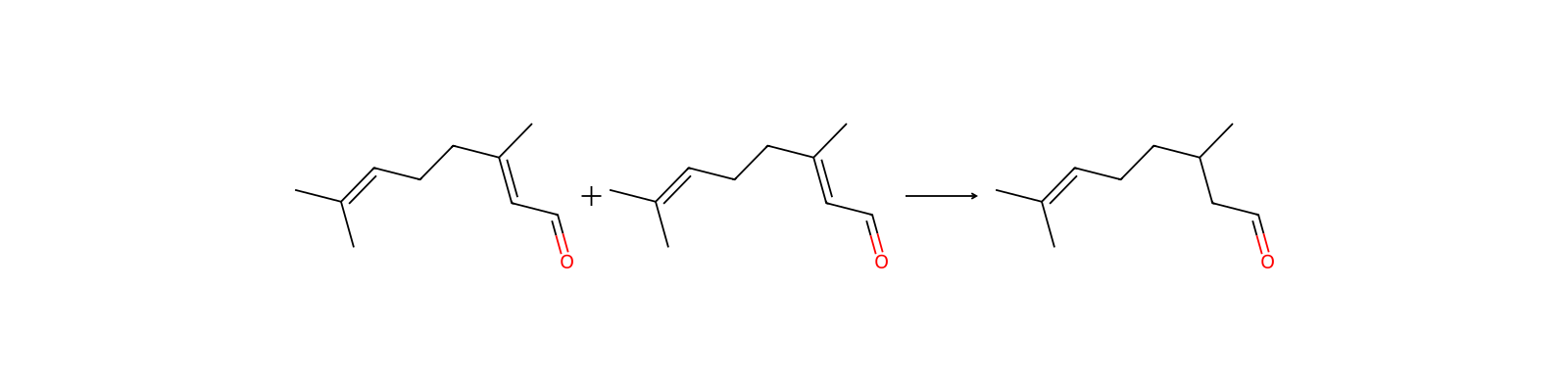
관련 반응
95건



화합물 노트
불러오는 중…