데이터를 보충하는 중입니다. 잠시 후 페이지를 새로 고치면 최신 내용을 볼 수 있습니다
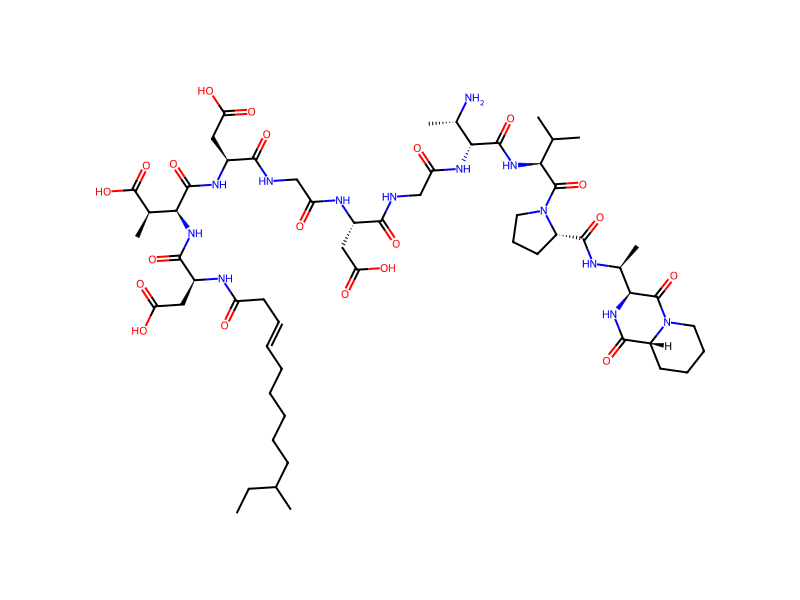
기본 정보
- CAS
1402-82-0- 표준 SMILES
CCC(C)CCCCC/C=C/CC(=O)N[C@@H](CC(=O)O)C(=O)N[C@H](C(=O)N[C@@H](CC(=O)O)C(=O)NCC(=O)N[C@@H](CC(=O)O)C(=O)NCC(=O)N[C@@H](C(=O)N[C@H](C(=O)N1CCC[C@H]1C(=O)N[C@@H](C)[C@@H]1NC(=O)[C@H]2CCCCN2C1=O)C(C)C)[C@H](C)N)[C@@H](C)C(=O)O- InChIKey
XBNDESPXQUOOBQ-LSMLZNGOSA-N- 분자식
- C58H91N13O20
- 평균 분자량
- 1,290.437 g/mol
- 단동위원소 질량
- 1,289.65033231
이름 및 식별자
- 우선 이름
- Amphomycin
- IUPAC
- N-[(3E)-10-Methyldodec-3-enoyl]-L-alpha-aspartyl-3-methyl-L-alpha-aspartyl-L-alpha-aspartylglycyl-L-alpha-aspartyl-N-[(2R,3S)-3-amino-1-({(2S)-1-[(2S)-2-({(1S)-1-[(3S,9aR)-1,4-dioxooctahydro-2H-pyrido[1,2-a]pyrazin-3-yl]ethyl}carbamoyl)pyrrolidin-1-yl]-3-methyl-1-oxobutan-2-yl}amino)-1-oxobutan-2-yl]glycinamide
- 현지명
- 암포마이신
- 영어명
- Amphomycin
- 분자식
- C58H91N13O20
- 분자량
- 1290.43
이름 및 동의어
암포마이신amfamycinNsc267431Amphomycin
데이터베이스 식별자
- CAS
1402-82-0- PubChem CID
- 91663250
- DTXSID
DTXSID101017657- ChEMBL
CHEMBL2103921- UNII
- 4P63B997RT
- EC Number
- 215-760-0
물성
물리화학적 성질
- 끓는 점
- 854.06 °C · 854.06°C (rough estimate)
- 밀도
- 1.0985 · 1.0985 (rough estimate)
- 굴절률
- 1.67 · 1.6700 (estimate)
- 저장 조건
- -20 °C · Store at -20°C
- 용해도
- DMSO에 용해됨
- 물리적 상태
- 고체
- 색상
- 크리스탈
안전 및 규제
안전 정보는 참고용이며, 공급업체의 물질안전보건자료(SDS), 관련 법규 및 전문가 평가를 대체하지 않습니다.
안전 데이터
- 독성
- LD50 orl-mus: 500 mg/kg 85GDA2 4(1),317,80
화학 및 산업
응용 분야
용도Amphomycin is a lipopeptide antibiotic produced by Streptomycetes and Actinoplanes, initially reported by researchers at Bristol-Myers in 1953 from Streptomyces canus. Amphomycin was marketed as a complex of closely related analogues in the 1950s and 1960s. Structure elucidation was not completed until 2000. Amphomycin is active against Gram positive bacteria, inhibiting peptidoglycan synthesis and blocking cell wall development. Amphomycin is closely related to a number of “lost” antibiotics, aspartocin, crystallomycin, glumamycin, friulimicin, laspartocin, tsushimycin and zaomycin. Interest in amphomycin was re-awakened with the discovery of friulimicin activity against antibiotic resistant strains.
상·하류 제품 정보
상류 원료
공급사14 곳
Career Henan Chemica Co+86-0371-86658258 +86-13203830695 · [email protected]
Shaanxi Cuikang Pharmaceutical Technology Co., Ltd+86-13119157289 · [email protected]
孟成科技(上海)有限公司400-820-6829 · [email protected]
MedBio脉铂医药021-69568360 18916172912 · [email protected]
上海维亦特生物科技有限公司15317051735 · [email protected]
BOC Sciences16314854226; +8616314854226 · [email protected]
浙江珲达生物科技有限公司0571-89903022 18679456698 · [email protected]
관련 반응
0건
현재 필터 조건에 해당하는 반응 기록이 없습니다.
화합물 노트
불러오는 중…