
망간(II) 아세테이트 테트라하이드레이트
Manganese acetate tetrahydrate
기본 정보
- CAS
6156-78-1- 표준 SMILES
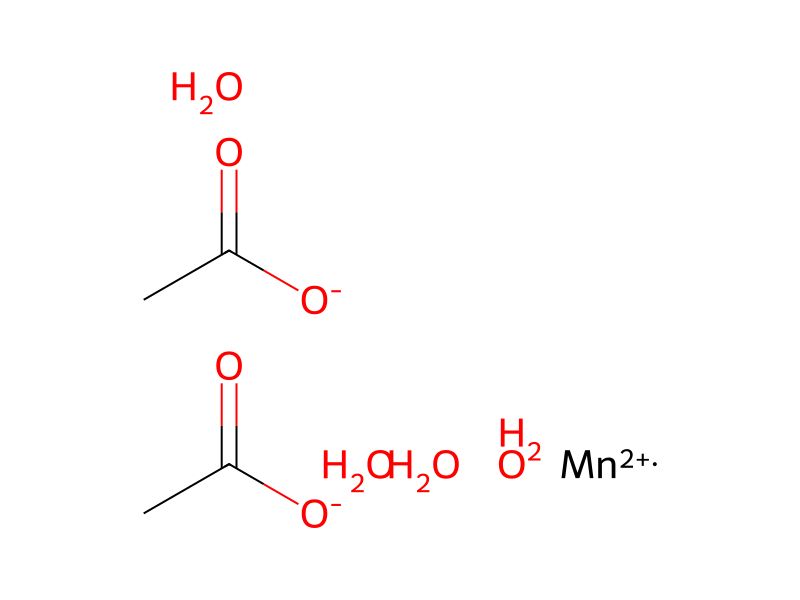
CC(=O)[O-].CC(=O)[O-].O.O.O.O.[Mn+2]- InChIKey
CESXSDZNZGSWSP-UHFFFAOYSA-L- 분자식
- C4H6MnO4 . 4H2O
- 평균 분자량
- 245.09 g/mol
- 단동위원소 질량
- 245.00691
개요
Manganese triacetate is a chemical compound of manganese. Manganese is a naturally occurring metal with the symbol Mn and the atomic number 25. It does not occur naturally in its pure form, but is found in many types of rocks in combination with other substances such as oxygen, sulfur, or chlorine. Manganese occurs naturally in most foods and small amounts are needed to stay healthy, as manganese ions act as cofactors for a number of enzymes. (L228, L229)
이름 및 식별자
- 우선 이름
- Manganese acetate tetrahydrate
- IUPAC
- manganese(2+);diacetate;tetrahydrate
- 현지명
- 망간(II) 아세테이트 테트라하이드레이트
- 영어명
- Manganese(II) acetate tetrahydrate
- 분자식
- C4H14MnO8
- 분자량
- 245.09
이름 및 동의어
6156-78-1Manganese acetate tetrahydrateManganese(II) acetate tetrahydrateManganous acetate tetrahydrateManganese diacetate, tetrahydratemanganese diacetate tetrahydrateMANGANUM ACETICUMUNII-9TO51D176NDTXSID002105669TO51D176NDTXCID30133057RefChem:59029
이름 더 보기
망가니즈아세트산사수화물(망간아세트산사수화물)망간(II)아세테이트테트라하이드레이트망가니즈아세트산사수화물(망간아세트산사수화물)(MANGANESEACETATETETRAHYDRATE)MANGANESE ACETATEMANGANESE(II) ACETATECo-MnManganeseAcetateAracetate tetrahydrateManganese acetate, GR 99%+MANGANESE(II) ACETATE 4 H2OTetrahydrate of acetic acid
C4H14MnO8manganese (II) acetate tetrahydrate4-BENZOYLBENZENEBORONICACIDACETIC ACID, MANGANESE(2+) SALT, TETRAHYDRATEManganese(II); acetate tetrahydrateManganeseacetatetetrahydratemanganous;diacetate;tetrahydrateMANGANUM ACETICUM [HPUS]
물성
구조 계산 물성
- 극성 표면적
- 84.3 Ų
- 수소 결합 공여자 수
- 4
- 수소 결합 수용자 수
- 8
- 회전 가능 결합 수
- 0
- 무거운 원자 수
- 13
- 형식 전하
- 0
- 복잡도
- 25.5
실험 및 물리화학적 성질
Chemical ClassesMetals -> Organic Acids, Metal Salts
Density1.59 @ 20°C
Melting Point80 °C
Physical DescriptionLight red transparent solid; [Merck Index] Light pink hygroscopic crystals; [Acros Organics MSDS]
물리화학적 성질
- 녹는점
- 300 °C · >300 °C(lit.)
- 밀도
- 1.589 g/mL · 1.589 g/mL at 25 °C(lit.)
- 증기압
- 1 hPa · <1 hPa (25 °C)
- 저장 조건
- 30 °C · Store below +30°C.
- 용해도
- 233 g/l · 233g/l
- 물리적 상태
- 크리스탈
- Specific Gravity
- 1.589 · 1.589
- 색상
- 분홍색
- 수소이온지수(pH)
- 7 · 7.0 (50g/l, H2O, 20℃)
- 수용성
- 물, 메탄올, 에탄올 및 아세트산에 용해됩니다.
- Merck
- 14 · 14,5724
- BRN
- 3730728 · 3730728
- InChI
- 1S/2C2H4O2.Mn.4H2O/c2*1-2(3)4;;;;;/h2*1H3,(H,3,4);;4*1H2/q;;+2;;;;/p-2
안전 및 규제
안전 정보는 참고용이며, 공급업체의 물질안전보건자료(SDS), 관련 법규 및 전문가 평가를 대체하지 않습니다.
GHS 분류
GHS Classification
This chemical does not meet GHS hazard criteria for 35.1% (26 of 74) of reports.
Warning
H315 (63.5%): Causes skin irritation [Warning Skin corrosion/irritation]
P261, P264, P264+P265, P271, P280, P302+P352, P304+P340, P305+P351+P338, P319, P321, P332+P317, P337+P317, P362+P364, P403+P233, P405, and P501 (click each P-code to see the statement)
Aggregated GHS information provided per 74 reports by companies from 9 notifications to the ECHA C&L Inventory. Each notification may be associated with multiple companies.
Danger
유해성 정보
Regulatory Information
Chemical: Acetic acid, manganese(2+) salt, tetrahydrate
Acetic acid, manganese(2+) salt, tetrahydrate: Does not have an individual approval but may be used under an appropriate group standard
Other Safety InformationIMAP assessments - Soluble manganese compounds: Human health tier II assessment
Hazards SummaryAn irritant; Possible reproductive and fetal toxicant; [Acros Organics MSDS] See Manganese(II) acetate. See Manganese and linked occupational diseases.
Hazard Classes and Categories
Skin Irrit. 2 (63.5%)
Acute toxicity (ingestion) - category 4
안전 및 보호
Exposure Control and Personal Protection0.2 [mg/m3], as Mn (inhalable fraction), 0.02 mg/m3, as Mn (respirable fraction)[German Research Foundation (DFG)]
Minimum Risk LevelChronic Inhalation: 0.0003 mg/m3 (L134)
화학 및 산업
약리 정보
Metabolism/Metabolites
Manganese is absorbed mainly via ingestion, but can also be inhaled. It binds to alpha-2-macroglobulin, albumin, or transferrin in the plasma and is distributed to the brain and all other mammalian tissues, though it tends to accumulate more in the liver, pancreas, and kidney. Manganese is capable of existing in a number of oxidation states and is believed to undergo changes in oxidation state within the body. Manganese oxidation state can influence tissue toxicokinetic behavior, and possibly toxicity. Manganese is excreted primarily in the faeces. (L228)
FDA Pharmacological Classification
MANGANESE ACETATE TETRAHYDRATE
Magnetic Resonance Contrast Activity [MoA]; Paramagnetic Contrast Agent [EPC]
MANGANUM ACETICUM
Osmotic Laxative [EPC]; Magnesium Ion Exchange Activity [MoA]; Inhibition Small Intestine Fluid/Electrolyte Absorption [PE]; Stimulation Large Intestine Fluid/Electrolyte Secretion [PE]; Increased Large Intestinal Motility [PE]; Calculi Dissolution Agent [EPC]; Osmotic Activity [MoA]; Inhibition Large Intestine Fluid/Electrolyte Absorption [PE]
용도 및 제조
Uses
Used as a mordant in dyeing, to make a brown pigment, and as a drying agent for paints and varnishes; [Merck Index]
Painting (Pigments, Binders, and Biocides) [Category: Paint]
응용 분야
용도Manganese(II) acetate tetrahydrate may be used in the sol gel synthesis of doped TiO2 containing different amounts of Mn2+.
일반 설명Manganese(II) acetate tetrahydrate is a hydrated salt of manganese. Kinetic studies suggest that its dehydration takes place in two-step reaction involving the loss of two water molecules. Its crystal structure has been investigated by X-ray studies. Its crystals exhibit monoclinic crystal system and space group P21/c.
관련 반응
46건







화합물 노트
불러오는 중…