
1-Fluoronaphthalene
데이터를 보충하는 중입니다. 잠시 후 페이지를 새로 고치면 최신 내용을 볼 수 있습니다

기본 정보
- CAS
321-38-0- 표준 SMILES
Fc1cccc2ccccc12- InChIKey
CWLKTJOTWITYSI-UHFFFAOYSA-N- 분자식
- C10H7F
- 평균 분자량
- 146.16 g/mol
- 단동위원소 질량
- 146.05317844
개요
1-fluoronaphthalene appears as needles. (NTP, 1992)
이름 및 식별자
- 우선 이름
- 1-Fluoronaphthalene
- IUPAC
- 1-fluoronaphthalene
- 영어명
- 1-Fluoronaphthalene
- 분자식
- C10H7F
- 분자량
- 146.16
이름 및 동의어
1-FLUORONAPHTHALENE321-38-0Naphthalene, 1-fluoro-alpha-Fluoronaphthalene0920702UT7NSC-4690DTXSID7059808RefChem:75827DTXCID1038454206-287-0Fluoronaphthalene.alpha.-Fluoronaphthalene
이름 더 보기
48720-uuoronaphthaLDuloxetine-81-FluoronaphthFluorophthalene
Duloxetine EP Impurity G1-fluoro naphthalene1-FluornaftalenDuloxetine IMpurity GNSC 46901-fluoronapthaleneEINECS 206-287-01-fluoro-naphtalene
데이터베이스 식별자
- CAS
321-38-0- PubChem CID
- 9450
- DTXSID
DTXSID7059808- UNII
- 0920702UT7
- EC Number
- 206-287-0
- Nikkaji
- J9.228B
물성
구조 계산 물성보충 중
- XLogP
- 3.7
- 극성 표면적
- 0 Ų
- 수소 결합 공여자 수
- 0
- 수소 결합 수용자 수
- 1
- 회전 가능 결합 수
- 0
- 무거운 원자 수
- 11
- 형식 전하
- 0
- 복잡도
- 133
실험 및 물리화학적 성질
PolymersOther Classes -> Halogenated Polyaromatics
SpringerMaterials Properties13C nuclear magnetic resonance spectrum
Density1.1322 at 68 °F (NTP, 1992) - Denser than water; will sink
Boiling Point419 °F at 756 mmHg (NTP, 1992)
Melting Point16 °F (NTP, 1992)
Vapor Pressure0.09 [mmHg]
Physical Description
1-fluoronaphthalene appears as needles. (NTP, 1992)
CBI
Solid; [CAMEO] Colorless liquid; [Alfa Aesar MSDS]
물리화학적 성질
- 녹는점
- -13 °C · -13 °C (lit.)
- 끓는 점
- 215 °C · 215 °C (lit.)
- 밀도
- 1.1322 g/mL · 1.1322 g/mL at 20 °C (lit.)
- 굴절률
- 20 · n20/D 1.593(lit.)
- 인화점
- 150 °F · 150 °F
안전 및 규제
안전 정보는 참고용이며, 공급업체의 물질안전보건자료(SDS), 관련 법규 및 전문가 평가를 대체하지 않습니다.
GHS 분류
GHS Classification
This chemical does not meet GHS hazard criteria for 5.5% (3 of 55) of reports.
Warning
H315 (94.5%): Causes skin irritation [Warning Skin corrosion/irritation]
P261, P264, P264+P265, P271, P280, P302+P352, P304+P340, P305+P351+P338, P319, P321, P332+P317, P337+P317, P362+P364, P403+P233, P405, and P501 (click each P-code to see the statement)
Aggregated GHS information provided per 55 reports by companies from 12 notifications to the ECHA C&L Inventory. Each notification may be associated with multiple companies.
유해성 정보
Regulatory Information
Naphthalene, 1-fluoro- is listed on the EPA's Chemical Data Reporting (CDR) system. Manufacturers and importers of Naphthalene, 1-fluoro- are required to report information about their production and use of this chemical to the EPA under the Toxic Substances Control Act (TSCA). (40 eCFR Part 711)
Status: Active Update: 05-12-2022 https://echa.europa.eu/registration-dossier/-/registered-dossier/18128
DOT LabelPoison
Fire HazardsExcerpt from ERG Guide 153 [Substances - Toxic and/or Corrosive (Combustible)]:
Health HazardsExcerpt from ERG Guide 153 [Substances - Toxic and/or Corrosive (Combustible)]:
Hazards SummaryA skin and strong eye irritant; [Alfa Aesar MSDS] See Naphthalene.
Reactive GroupFluorinated Organic Compounds
Reactivity Profile
Simple aromatic halogenated organic compounds, such as 1-FLUORONAPHTHALENE, are very unreactive. Halogenated organics generally become less reactive as more of their hydrogen atoms are replaced with halogen atoms. Materials in this group may be incompatible with strong oxidizing and reducing agents. Also, they may be incompatible with many amines, nitrides, azo/diazo compounds, alkali metals, and epoxides.
화학 및 산업
용도 및 제조
U.S. Production2023: <50,000 lb
Industry UsesNot Known or Reasonably Ascertainable
General Manufacturing Information
All Other Basic Organic Chemical Manufacturing
Naphthalene, 1-fluoro-: ACTIVE
응용 분야
용도1-Fluoronaphthalene is a fluorinated naphthalene derivative that is metabolized by fungal monooxygenase-epoxide hydrolase. It is also used as a pharmaceutical intermediate. It is Duloxetine impurity.
제조 방법
The preparation of 1-Fluoronaphthalene is as follows:1) Diazotization reaction: 1500 g of hydrochloric acid (mass concentration: 25%) and 300 g of naphthylamine were added to a 3000 mL three-necked flask, stirred and heated to 75 ° C to dissolve, and the temperature was lowered to below 5 ° C, and 148 g was slowly added at this temperature. Sodium nitrite, stirred at low temperature for 0.3 hours after the addition, to obtain a diazonium salt solution;2) Substitution reaction: 360 g of fluoroboric acid solution (concentration: 45%) was added to the resulting solution obtained in the step 1), stirred for 0.25 h, filtered, and the filter cake was dried at a temperature of 50 ° C for 0.2 h to obtain Dry naphthylamine diazonium salt fluoroborate double salt;3) Hot air decomposition: the dried diazonium salt fluoroborate double salt is slowly added to the reactor through which hot air (hot air temperature is 85-90 ° C), and the dried powdered naphthylamine diazonium salt fluoroborate double salt is The hot air blows up the dispersion and absorbs the heat for thermal decomposition to obtain a 1-fluoronaphthalene solution containing a small amount of solid impurities;4) Purification treatment: the 1-fluoronaphthalene solution obtained in the step 3) is first washed with pure water for 3 to 6 times, then neutralized with a soda ash to a pH of 6.8 to 7.2, and finally the oil layer is separated by filtration, and the filtrate is taken. The distillation treatment gave 210 g of a naphthalene-based fluorine-containing intermediate 1-fluoronaphthalene in an amount of 99.8%.
관련 반응
45건


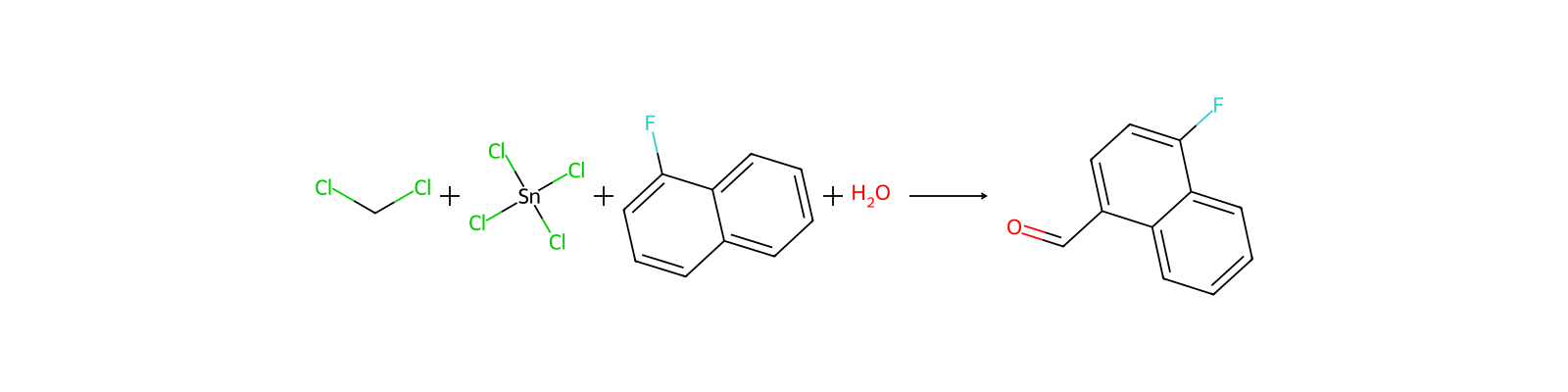


화합물 노트
불러오는 중…