
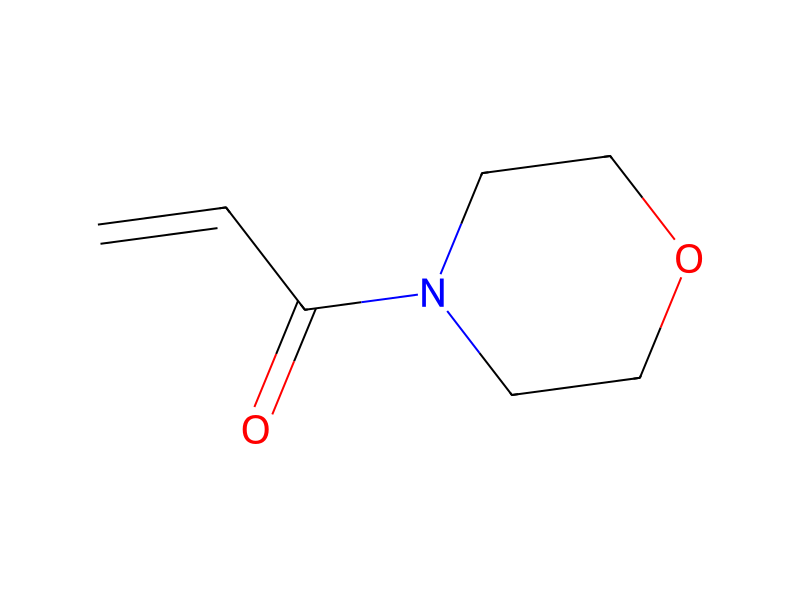
기본 정보
- 표준 SMILES
C=CC(=O)N1CCOCC1- InChIKey
XLPJNCYCZORXHG-UHFFFAOYSA-N- 분자식
- C7H11NO2
- 평균 분자량
- 141.17 g/mol
- 단동위원소 질량
- 141.07897859
이름 및 식별자
- 우선 이름
- Acryloylmorpholine
- IUPAC
- 1-morpholin-4-ylprop-2-en-1-one
- 현지명
- 아크릴로일 모폴린
- 영어명
- 4-Acryloylmorpholine
- 분자식
- C7H11NO2
- 분자량
- 141.17
이름 및 동의어
5117-12-4acryloylmorpholineACRYLOYL MORPHOLINE4-(1-oxo-2-propenyl)-morpholineDTXSID0044947K0Y58P61JANSC-1622212-Propen-1-one, 1-(4-morpholinyl)-DTXCID8024947RefChem:1076142418-140-1610-626-1
이름 더 보기
아크릴로일모폴린아크릴로일몰포린1-(4-모폴리닐)-2-프로펜-1-온아크릴로일 모폴린1-(모폴린-4-일)프로펜온4-(1-옥소-2-프로펜일)모폴린4-아크릴로일모폴린N-아크릴로일모폴린4-아크릴로일모르폴린ACMOyyyy-m-d4-AcryLAcrylmorpholideAcryloylmorpholin
4-Acryloylmorpholine1-Morpholinoprop-2-en-1-oneN-AcrylylmorpholineN-AcryloylmorpholineMorpholine, 4-(1-oxo-2-propenyl)-1-(Morpholin-4-yl)prop-2-en-1-one1-morpholin-4-ylprop-2-en-1-one4-(1-Oxo-2-propenyl)morpholine
데이터베이스 식별자
- CAS
5117-12-4- PubChem CID
- 98723
- DTXSID
DTXSID0044947- ChEMBL
CHEMBL3187188- UNII
- K0Y58P61JA
- EC Number
- 418-140-1、610-626-1
- Nikkaji
- J87.318G
물성
구조 계산 물성
- XLogP
- -0.1
- 극성 표면적
- 29.5 Ų
- 수소 결합 공여자 수
- 0
- 수소 결합 수용자 수
- 2
- 회전 가능 결합 수
- 1
- 무거운 원자 수
- 10
- 형식 전하
- 0
- 복잡도
- 139
물리화학적 성질
- 녹는점
- 35 °C · −35 °C(lit.)
- 끓는 점
- 158 °C · 158°C 50mm
- 밀도
- 1.122 g/mL · 1.122 g/mL at 25 °C(lit.)
- 증기압
- 1.03 · 1.03-1.64Pa at 25-29.9℃
- 굴절률
- 20 · n20/D 1.512(lit.)
- 인화점
- 230 °F · >230 °F
- 저장 조건
- 2 · 2-8°C
- 용해도
- 물에 용해됨
- 물리적 상태
- 액체
- 산도 계수 (pKa)
- -1.08 · -1.08±0.20(Predicted)
- 색상
- 무색~황색
- 수용성
- 1000 g/L · 1000g/L at 20℃
- BRN
- 119302 · 119302
- 화장품 원료 기능
- 가소제
- InChI
- 1S/C7H11NO2/c1-2-7(9)8-3-5-10-6-4-8/h2H,1,3-6H2
- InChIKey
- XLPJNCYCZORXHG-UHFFFAOYSA-N
- SMILES
- C=CC(=O)N1CCOCC1
- LogP
- -0.46 at · -0.46 at 20.5-21℃
- NIST
- N-acryloylmorpholine(5117-12-4)
- EPA
- 4 · Morpholine, 4-(1-oxo-2-propenyl)- (5117-12-4)
화학적 성질
4-Acryloylmorpholine has a melting point of 35 °C and is clear liquid at room temperature. At 25 °C, it has a density of 1.122 g/mL. It needs to be stored at 2-8°C.
안전 및 규제
GHS 분류
GHS Classification
Danger
H302: Harmful if swallowed [Warning Acute toxicity, oral]
P260, P261, P264, P264+P265, P270, P272, P280, P301+P317, P302+P352, P305+P354+P338, P317, P319, P321, P330, P333+P317, P362+P364, and P501 (click each P-code to see the statement)
Danger
H302 (100%): Harmful if swallowed [Warning Acute toxicity, oral]
P260, P261, P264, P264+P265, P270, P271, P272, P280, P301+P317, P302+P352, P304+P340, P305+P354+P338, P316, P317, P319, P321, P330, P333+P317, P362+P364, P403+P233, P405, and P501 (click each P-code to see the statement)
유해성 정보
Regulatory Information
Chemical: Morpholine, 4-(1-oxo-2-propenyl)-
PMN - indicates a commenced PMN (Pre-Manufacture Notices) substance.
Status: No longer Valid Update: 10-11-2008 https://echa.europa.eu/registration-dossier/-/registered-dossier/9420
Acryloyl morpholine: Does not have an individual approval but may be used under an appropriate group standard
Other Safety InformationEvaluation - Morpholine, 4-(1-oxo-2-propenyl)- (acryloyl morpholine)
Hazard Classes and Categories
Acute Tox. 4 (100%)
Acute Tox. 4 (100%)
Acute toxicity - category 4
Acute toxicity (Oral) - Category 4
Acute Tox. 4 *
안전 데이터
- wgk
- 2
- tsca
- TSCA listed
- HS 번호
- 29349990
- risk_code
- 22-41-43-48/22
- hazard_code
- Xn
- safety_code
- 23-26-36/37/39
- 기존화학 물질
- 2000-3-1524
- Hazard Classifications
- Acute Tox. 4 OralEye Dam. 1Skin Sens. 1STOT RE 2 Oral
- 스토리지 클래스
- 10 - Combustible liquids
화학 및 산업
용도 및 제조
General Manufacturing Information2-Propen-1-one, 1-(4-morpholinyl)-: ACTIVE
응용 분야
용도접착제, 자외선 경화 수지, 산업용 코팅, UV 인쇄 잉크, 오일 회수 폴리머, 의약 및 필수 화학 물질에 사용됩니다.
개요4-Acryloylmorpholine (4-AM) is a water-soluble monomer, an acrylamide derivative containing a heterocyclic tetrahydrooxazine substituent. Homo- and copolymers of 4-АМ have several valuable properties. They are soluble both in water and in many organic solvents such as alcohols, chloroform, tetrahydrofuran, and dioxane, are non-toxic, and are used for solid-phase synthesis of peptides in chromatography, as materials for composite semipermeable membranes, in catalysis, and for biomedical purposes. Various functional groups are introduced into poly-4-AM to expand its application fields. Random copolymers of 4-АМ with carboxylic acids (acrylic, 4-pentenoic, undecenoic, 2-acrylamido-2-methyl-1-propanesulfonic), behaving as anionic polyelectrolytes, and copolymers with N-hydroxysuccinimide ester of acrylic acid, acting as polymeric carriers, have been synthesized[2-3].
용도4-Acryloylmorpholine is used in adhesives, UV curable resins, industrial coatings, UV printing ink, oil recovery polymer, medicinal and commodity chemicals.
상·하류 제품 정보
상류 원료
공급사50 곳
国药集团化学试剂有限公司86-21-63210123 · [email protected]
梯希爱(上海)化成工业发展有限公司021-67121386 · [email protected]
衢州润东化工有限公司0570-8789886 18892685668 · [email protected]
上海阿拉丁生化科技股份有限公司400-6206333 13167063860 · [email protected]
Shandong chuangyingchemical Co., Ltd.18853181302 · [email protected]
武汉欣扬瑞和化学科技有限公司153-07155313 15307155313 · [email protected]
河北创海生物科技有限公司+86-86-13131129325 · [email protected]
爱斯特(成都)生物制药股份有限公司+86-28-85122536 85324413 · [email protected]
Dayang Chem (Hangzhou) Co.,Ltd.+86-0571-88938639 17705817739 · [email protected]
上海迈瑞尔生化科技有限公司4006356688 18621169109 · [email protected]
天津中信凯泰化工有限公司022-66880623 · [email protected]
阿法埃莎(中国)化学有限公司400-6106006 · [email protected]
安耐吉化学&3A(安徽泽升科技股份有限公司)400-0056266 · [email protected]
吉良化学21-62165282 · [email protected]
山东西亚化学有限公司13355009207 13355009207 · [email protected]
玛雅试剂+86 (573) 82222445 (0)18006601000 452520369 · [email protected]
四川库利南科技有限公司400-1166-196 18981987031 · [email protected]
深圳市飞鸣科技有限公司0755-85232577 · [email protected]
天津希恩思生化科技有限公司400 638 7771 · [email protected]
Xiamen AmoyChem Co., Ltd+86-86-5926051114 · [email protected]
Connect Chemicals GmbH+49 2102 2077 19 · [email protected]
Hebei Qige Biological Technology Co. Ltd+86 +8618733132031
艾科试剂4008-755-333 18080918076 · [email protected]
赛默飞世尔科技(中国)有限公司800-810-5118 · [email protected]
TCI AMERICA800-4238616 · [email protected]
TOKYO CHEMICAL INDUSTRY CO., LTD.03-36680489 · [email protected]
TCI Europe320-37350700 · [email protected]
深圳振强药物研发有限公司0755-66853366 13670046396 · [email protected]
安徽科迪达化工有限公司0554-2106669 · [email protected]
杭州宇昊化工科技有限公司0571-82693216 · [email protected]
上海麦克林生化科技股份有限公司15221275939 15221275939 · [email protected]
杭州杰恒化工有限公司0571-87396432 · [email protected]
上海永叶生物科技有限公司86-021-61559134 15921386130 · [email protected]
青岛瑞那斯高分子材料有限公司0532-0532-86867058 18562606086 · [email protected]
湖北巨胜科技有限公司027-59599241 18871490274 · [email protected]
池州凯隆进出口贸易有限公司[email protected]
Sigma-Aldrich西格玛奥德里奇(上海)贸易有限公司021-61415566 800-8193336 · [email protected]
Henan Alfa Chemical Co., Ltd+8618339805032 · [email protected]
厦门志信化学有限公司+86-5922680277 +86-13806087780 · [email protected]
上海岚克医药科技发展有限公司0086-21-58956006
北京华威锐科化工科技有限公司89508211 18501085097 · [email protected]
上海源叶生物科技有限公司13636370518 · [email protected]
湖北阡陌生物科技有限公司0711-3812399 18062309155 · [email protected]
山东西亚化学有限公司4009903999 13395398332 · [email protected]
安徽优雅化工有限公司+86-02586655873 +86-13962173137 · [email protected]
成都华纯科技有限公司400-1166-196 15982826727 · [email protected]
郑州艾克姆化工有限公司0371-0371-55629727 13323845623 · [email protected]
广东翁江化学试剂有限公司0751-2886750 13927877953 · [email protected]
上海沃见生物科技有限公司[email protected] 1801605789
广州卡芬生物科技有限公司18029243487 2355327168 · [email protected]
관련 반응
28건


연결된 노트
불러오는 중…