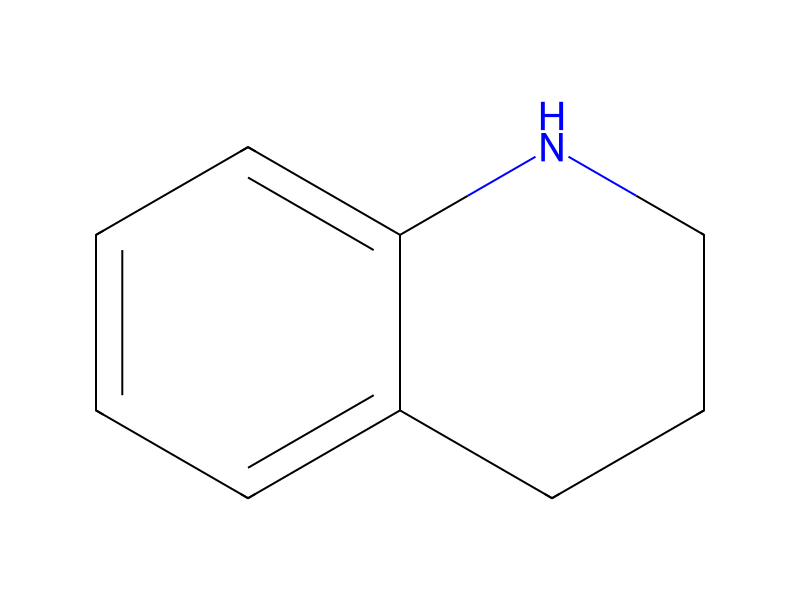
[Cl:1][C:2]1[CH:17]=[CH:16][C:15]([Cl:18])=[CH:14][C:3]=1[O:4][C:5]1[C:10]([C:11]([OH:13])=O)=[CH:9][N:8]=[CH:7][N:6]=1.[I-].ClC1C=CC=C[N+]=1C.C(N(CC)CC)C.[NH:35]1[C:44]2[C:39](=[CH:40][CH:41]=[CH:42][CH:43]=2)[CH2:38][CH2:37][CH2:36]1.C(=O)(O)[O-].[Na+]>ClCCl>[Cl:1][C:2]1[CH:17]=[CH:16][C:15]([Cl:18])=[CH:14][C:3]=1[O:4][C:5]1[C:10]([C:11]([N:35]2[C:44]3[C:39](=[CH:40][CH:41]=[CH:42][CH:43]=3)[CH2:38][CH2:37][CH2:36]2)=[O:13])=[CH:9][N:8]=[CH:7][N:6]=1To a solution of 200 mg (0.7 mmol) 4-(2,5-dichloro-phenoxy)-pyrimidine-5-carboxylic acid in 2 mL dichloromethane were added 197 mg (0.77 mmol) 2-chloro-1-methylpyridinium iodide (commercially available, CAS RN 14338-32-0), 0.2 mL (1.4 mmol) triethylamine and 103 mg (0.77 mmol) 1,2,3,4-tetrahydroquinoline (commercially available, CAS RN 635-46-1). The solution was stirred 2 hours at room temperature. The reaction mixture was poured on saturated aqueous sodium bicarbonate solution and extracted three times with dichloromethane. The combined organic layers were dried over magnesium sulfate and concentrated under vacuum. The residue was purified by preparative HPLC (Phenomenex Gemini column) using a gradient of acetonitrile:water (containing 0.05% formic acid) (10:90 to 98:2) to give 5.6 mg (2%) of the desired compound. MS (ESI): m/z=400.2 [M+H]+.