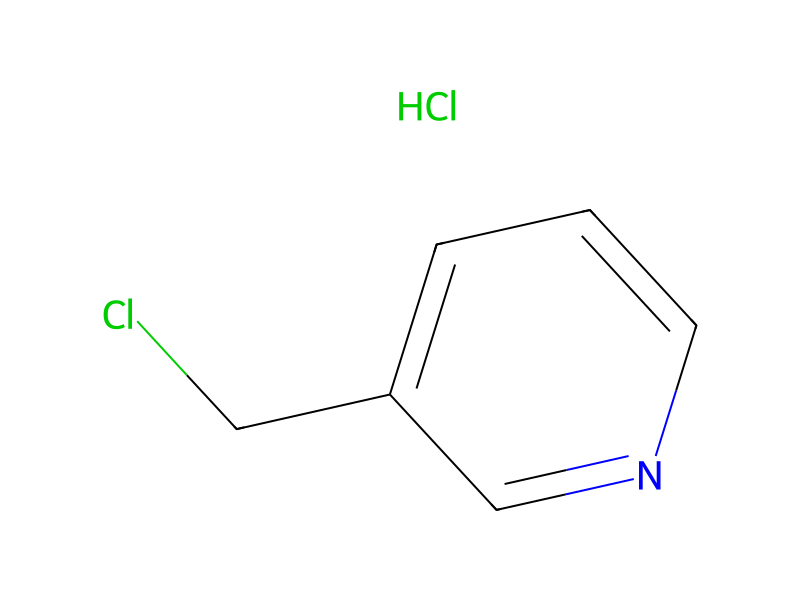
[F:1][C:2]1[CH:7]=[CH:6][C:5]([C:8]2[C:17]3[C:12](=[N:13][C:14]([C:18]([F:21])([F:20])[F:19])=[CH:15][CH:16]=3)[N:11]=[CH:10][CH:9]=2)=[CH:4][C:3]=1[OH:22].C(=O)([O-])[O-].[Cs+].[Cs+].Cl.Cl[CH2:31][C:32]1[CH:33]=[N:34][CH:35]=[CH:36][CH:37]=1>CN(C=O)C>[F:1][C:2]1[CH:7]=[CH:6][C:5]([C:8]2[CH:9]=[CH:10][N:11]=[C:12]3[C:17]=2[CH:16]=[CH:15][C:14]([C:18]([F:19])([F:20])[F:21])=[N:13]3)=[CH:4][C:3]=1[O:22][CH2:31][C:32]1[CH:33]=[N:34][CH:35]=[CH:36][CH:37]=12-Fluoro-5-(7-trifluoromethyl[1,8]naphthyridin-4-yl)phenol (prepared as described in Example 35 part a), 50.0 mg, 0.16 mmol), caesium carbonate (159 mg, 0.49 mmol) and 3-(chloromethyl)pyridine hydrochloride (31.9 mg, 0.20 mmol) were stirred together in DMF (3 mL) at room temperature under nitrogen overnight. The mixture was partitioned between dichloromethane (3 mL) and water (3 mL), then was filtered through a PTFE cartridge. The separated organic phase was concentrated in vacuo, and residue was purified by flash chromatography on silica gel, eluting with 1:1 dichloromethane:ethyl acetate, then with ethyl acetate, affording 5-[4-fluoro-3-(pyridin-3-ylmethoxy)phenyl]-2-trifluoromethyl[1,8]naphthyridine as a colourless oil, which solidified upon trituration with isohexane (45.1 mg, 70%). δH (400 MHz, CDCl3) 5.22 (2H, s), 7.06-7.12 (2H, m), 7.30-7.38 (2H, m), 7.52 (1H, d, J 4.3), 7.79 (1H, d, J 8.6), 7.81-7.83 (1H, m), 8.39 (1H, d, J 8.6), 8.64 (1H, dd, J 1.6 and 4.7), 8.69 (1H, d, J 2.0), 9.26 (1H, d, J 4.3). m/z (ES+) 400 [MH]+.