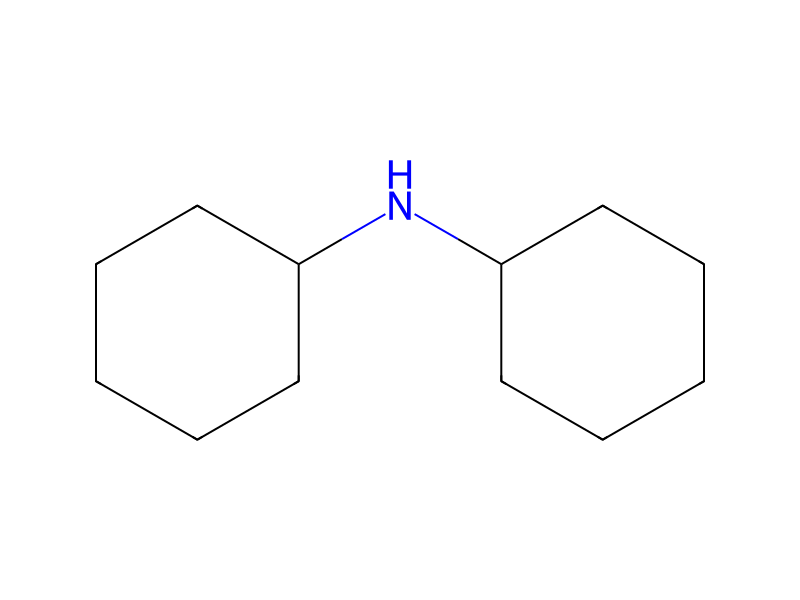
[CH:1]1([NH:7][CH:8]2[CH2:13][CH2:12][CH2:11][CH2:10][CH2:9]2)[CH2:6][CH2:5][CH2:4][CH2:3][CH2:2]1.[Cl:14][C:15](Cl)([O:17]C(=O)OC(Cl)(Cl)Cl)Cl.[OH:26][N:27]1[C:31](=[O:32])[CH2:30][CH2:29][C:28]1=[O:33].[CH:34]1([NH:40][C:41](Cl)=[O:42])[CH2:39][CH2:38][CH2:37][CH2:36][CH2:35]1>N1C=CC=CC=1.O>[CH:8]1([N:7]([CH:1]2[CH2:2][CH2:3][CH2:4][CH2:5][CH2:6]2)[C:15]([Cl:14])=[O:17])[CH2:9][CH2:10][CH2:11][CH2:12][CH2:13]1.[CH:34]1([N:40]([CH:1]2[CH2:6][CH2:5][CH2:4][CH2:3][CH2:2]2)[C:41]([O:26][N:27]2[C:31](=[O:32])[CH2:30][CH2:29][C:28]2=[O:33])=[O:42])[CH2:39][CH2:38][CH2:37][CH2:36][CH2:35]1According to the procedure described in H. Eckert et al., Angew. Chem. Int. Ed. Engl. 26, 894-895 (1987), dicyclohexylcarbamoyl chloride was synthesized from dicyclohexylamine and triphosgene [chemical name: bis(trichloromethyl)carbonate]. N-hydroxysuccinimide (5.3 g, 0.05 mol) was dissolved in 100 g of sufficiently dried pyridine. To the solution was added dropwise 13.7 g (0.05 mol) of cyclohexylcarbamoyl chloride. After stirring at room temperature overnight, the reaction solution was diluted with water and extracted with ethyl acetate. The organic layer was washed with water, dried over magnesium sulfate, decolored with active carbon and then concentrated. The deposited crystal was filtered and washed with a small amount of ether to obtain 4.6 g of N-(dicyclohexylcarbamoyloxy)succinimide represented by the following formula. Yield: 31.0%