홈MCP워크벤치Skills
홈워크벤치알림마이페이지
llms.txt · MCP 가이드개인정보처리방침 · 이용약관 · 지원v1.8.0
  1. 홈
  2. /반응

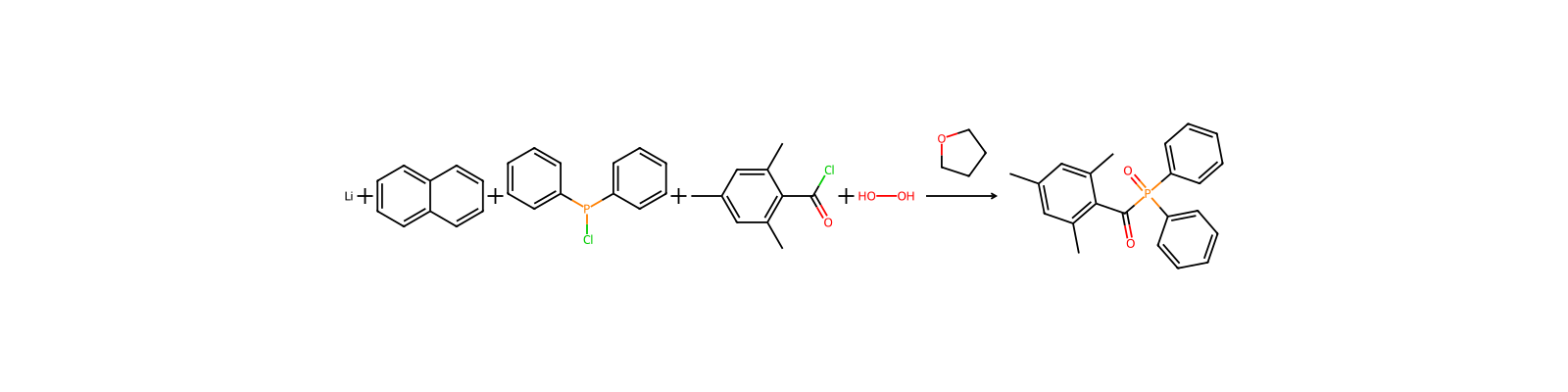
Hydrogen Peroxide → 2,4,6-Trimethylbenzoyl diphenylphosphine oxide

HRID 10932
노트
인쇄 미리보기

반응식

HRID 10932 반응식
[Li].C1C2C(=CC=CC=2)C=CC=1.Cl[P:13]([C:20]1[CH:25]=[CH:24][CH:23]=[CH:22][CH:21]=1)[C:14]1[CH:19]=[CH:18][CH:17]=[CH:16][CH:15]=1.[CH3:26][C:27]1[CH:35]=[C:34]([CH3:36])[CH:33]=[C:32]([CH3:37])[C:28]=1[C:29](Cl)=[O:30].[OH:38]O>C1COCC1>[CH3:26][C:27]1[CH:35]=[C:34]([CH3:36])[CH:33]=[C:32]([CH3:37])[C:28]=1[C:29]([P:13](=[O:38])([C:20]1[CH:25]=[CH:24][CH:23]=[CH:22][CH:21]=1)[C:14]1[CH:19]=[CH:18][CH:17]=[CH:16][CH:15]=1)=[O:30]
참가 물질실험 절차후처리출처 및 근거반응 노트

참가 물질

7

반응물 5

HCID 784Hydrogen PeroxideHCID 931NaphthaleneHCID 66180ChlorodiphenylphosphineHCID 970382,4,6-Trimethylbenzoyl chlorideHCID 3028194Lithium

생성물 1

HCID 1664802,4,6-Trimethylbenzoyl diphenylphosphine oxide

시약·촉매·용매 1

HCID 8028
Tetrahydrofuran
용매

실험 절차

Under argon and with exclusion of moisture, 2.76 g of lithium (0.40 mol) are suspended at room temperature in 100 ml of THF and this suspension is charged with 0.10 g (0.00078 mol) of naphthalene. This mixture is then stirred for 10 minutes at room temperature. With occasional cooling and vigorous stirring, 45.2 g (0.0 mol) of P-chlorodiphenyl phosphine are added dropwise to the dark brown suspension at 10–25° C. After stirring for 4 hours, the red solution is filtered via a glass frit (G2 porosity) into a sulfonation flask with exclusion of moisture and using argon as protective gas. 38.0 g (0.2 mol) of 2,4,6-trimethylbenzoyl chloride are added dropwise, with stirring and cooling, at 10–20° C. over 1 hour and the mixture is then stirred for another 30 minutes. The organic phase is concentrated by evaporation in a Rotavap and the residue is taken up in 100 ml of toluene and charged, with vigorous stirring at a temperature from 50–60° C., with 23.0 g (0.20 mol) of hydrogen peroxide (30%). The reaction is complete after stirring for 30 minutes. The reaction emulsion is poured on water and washed with an aqueous saturated sodium hydrogencarbonate solution and then dried over magnesium sulfate and filtered. The filtrate is concentrated by evaporation in a Rotavap. The residue is crystallised from petroleum ether/ethyl acetate and dried in a vacuum drying oven at 40° C., yielding 55.0 g (79% of theory) of the title compound in the form of a yellow powder having a melting point of 89–90° C.
후처리

  1. temperatureWith occasional cooling
  2. stirringAfter stirring for 4 hours
  3. filtrationthe red solution is filtered via a glass frit (G2 porosity) into a sulfonation flask with exclusion of moisture and
  4. stirringwith stirring
  5. temperaturecooling, at 10–20° C. over 1 hour
  6. stirringthe mixture is then stirred for another 30 minutes
  7. concentrationThe organic phase is concentrated by evaporation in a Rotavap
  8. additioncharged
  9. stirringafter stirring for 30 minutes
  10. additionThe reaction emulsion is poured on water
  11. washwashed with an aqueous saturated sodium hydrogencarbonate solution
  12. dry with materialdried over magnesium sulfate
  13. filtrationfiltered
  14. concentrationThe filtrate is concentrated by evaporation in a Rotavap
  15. customThe residue is crystallised from petroleum ether/ethyl acetate
  16. customdried in a vacuum
  17. customdrying oven at 40° C.

출처 및 근거

ORD 기록
ord-916bc1de34d74789ad6be2392b25c84c
출처 데이터셋
uspto-grants-2006_08
DOI
10.6084/m9.figshare.5104873.v1
특허 번호
US07094931B2

반응 노트

불러오는 중…

이 페이지에서참가 물질실험 절차후처리출처 및 근거반응 노트