Propylamine → 5-Chloro-2-nitro-N,N'-dipropylbenzamidine
HRID 1167134
반응식

[CH2:1]([NH:4][C:5](=O)[C:6]1[CH:11]=[C:10]([Cl:12])[CH:9]=[CH:8][C:7]=1[N+:13]([O-:15])=[O:14])[CH2:2][CH3:3].O=S(Cl)Cl.[NH2:21][CH2:22][CH2:23][CH3:24]>C1COCC1>[Cl:12][C:10]1[CH:9]=[CH:8][C:7]([N+:13]([O-:15])=[O:14])=[C:6]([CH:11]=1)[C:5]([NH:21][CH2:22][CH2:23][CH3:24])=[N:4][CH2:1][CH2:2][CH3:3]참가 물질
5
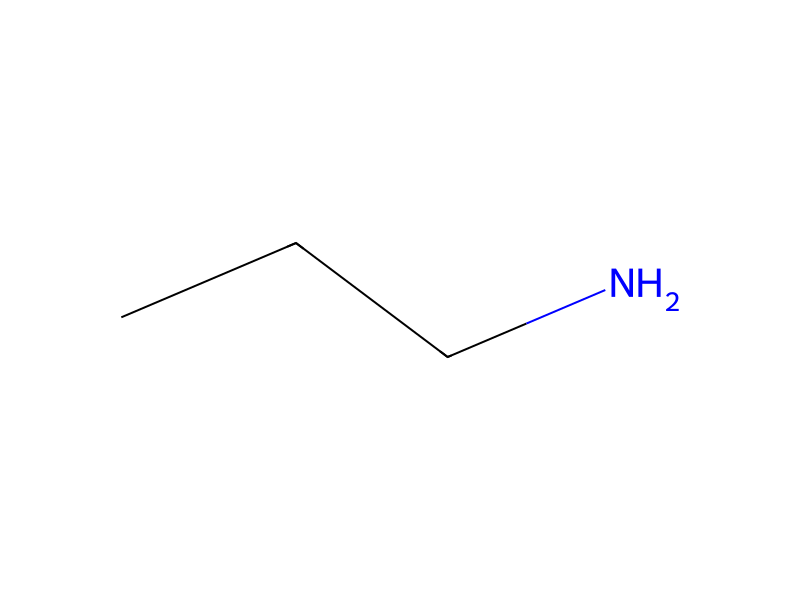




실험 절차
In a sulfonation flask 32.8 g (0.125 mol) 5-chloro-2-nitrobenzoic acid propylamide are dissolved in 74.4 g (0.625 mol) SOCl2 and heated at reflux temperature for 4 hours. Then the excess SOCl2 is removed in a water jet vacuum and the crude imidoylchloride is dissolved in 30 ml of absolute THF. The resulting solution was added dropwise to a stirred solution of 15.4 g (0.26 mol) 1-aminopropane in 30 ml THF. The mixture is stirred for 5 hours at reflux temperature and then the solvent is removed in a water jet vacuum. The residue is taken up in ethylacetate and the organic phase is washed twice with water and saturated sodiumcarbonate solution. After drying of the organic phase, the solvent is removed in a water jet vacuum and the raw material purified by column chromatography over silica gel (eluant: hexane/THF=3:1). Yield: 27.8 g 5-chloro-2-nitro-N,N′-dipropylbenzamidine in the form of brown crystals; m.p. 63-64° C.