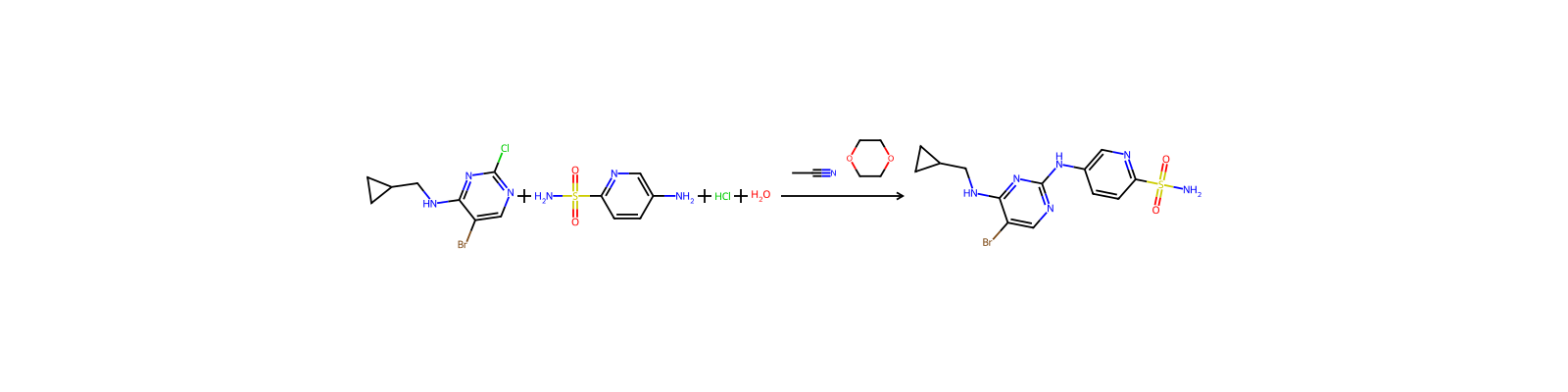
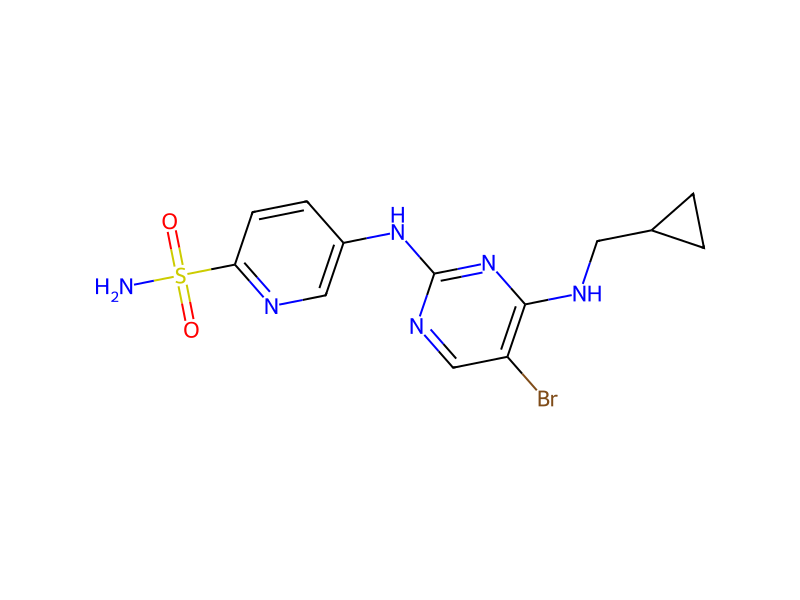
[Br:1][C:2]1[C:3]([NH:9][CH2:10][CH:11]2[CH2:13][CH2:12]2)=[N:4][C:5](Cl)=[N:6][CH:7]=1.[NH2:14][C:15]1[CH:16]=[CH:17][C:18]([S:21]([NH2:24])(=[O:23])=[O:22])=[N:19][CH:20]=1.Cl.O>C(#N)C.O1CCOCC1>[Br:1][C:2]1[C:3]([NH:9][CH2:10][CH:11]2[CH2:13][CH2:12]2)=[N:4][C:5]([NH:14][C:15]2[CH:16]=[CH:17][C:18]([S:21]([NH2:24])(=[O:23])=[O:22])=[N:19][CH:20]=2)=[N:6][CH:7]=1263 mg (1.0 mmol) of (5-bromo-2-chloro-pyrimidin-4-yl)-cyclopropylmethyl-amine is dissolved in 2 ml of acetonitrile and added to a suspension of 172 mg (1.0 mmol) of 5-amino-pyridine-2-sulfonic acid amide (representation according to W. T. Caldwell, E. C. Kornfeld J. Am. Chem. Soc. 1942, 64, 1695-1698) in 1 ml of acetonitrile, 0.25 ml of a 4 molar solution of hydrochloric acid in 1,4-dioxane as well as 0.25 ml of water. The reaction mixture is stirred under reflux overnight. After cooling, the precipitate that is formed is filtered off and washed with warm water. After drying, 286 mg (0.72 mmol, 72% of theory) of the product 5-[5-bromo-4-(cyclopropylmethyl-amino)-pyrimidin-2-ylamino]-pyridine-2-sulfonic acid amide is obtained.