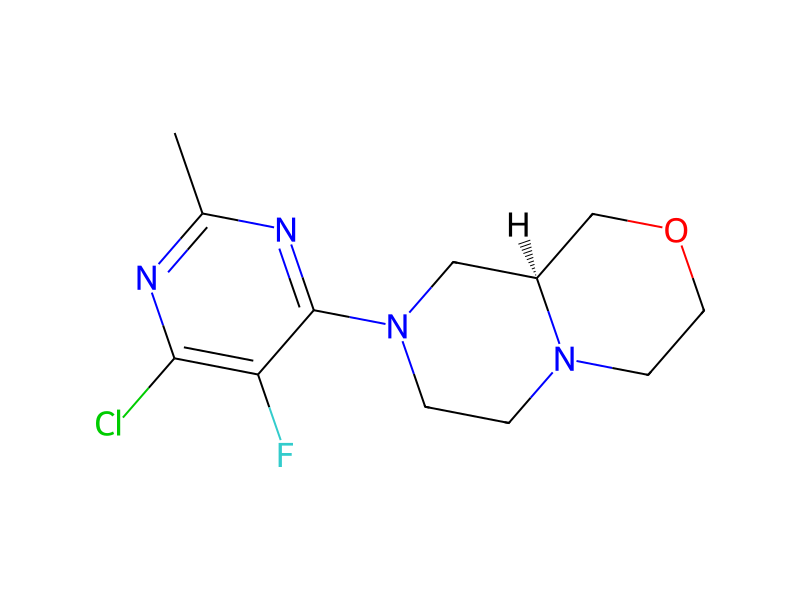
Cl[C:2]1[N:7]=[C:6]([CH3:8])[N:5]=[C:4]([N:9]2[CH2:18][CH2:17][N:16]3[C@H:11]([CH2:12][O:13][CH2:14][CH2:15]3)[CH2:10]2)[C:3]=1[F:19].O.[NH2:21][NH2:22]>O1CCOCC1>[F:19][C:3]1[C:4]([N:9]2[CH2:18][CH2:17][N:16]3[C@H:11]([CH2:12][O:13][CH2:14][CH2:15]3)[CH2:10]2)=[N:5][C:6]([CH3:8])=[N:7][C:2]=1[NH:21][NH2:22]To a solution of (9aS)-8-(6-chloro-5-fluoro-2-methyl-4-pyrimidinyl)octahydropyrazino[2,1-c][1,4]oxazine (assumed 31.03 g, 108.2 mmol) in dioxane (430 mL) was added hydrazine monohydrate (31 mL). The mixture was heated and stirred at 80° C. overnight, and then at 85° C. for 7 h. The mixture was cooled to room temperature and concentrated in vacuo. The residue was dissolved in DCM (500 mL) and washed with saturated aq. NaHCO3 (200 mL). The aqueous phase was extracted with a fresh portion of DCM (100 mL), and this organic phase was washed with saturated aq. NaHCO3 (100 mL). The combined organic phase was dried over anhydrous Na2SO4, filtered, concentrated in vacuo, and dried under high vacuum overnight to provide (9aS)-8-(5-fluoro-6-hydrazino-2-methyl-4-pyrimidinyl)octahydropyrazino[2,1-c][1,4]oxazine (27.98 g, 92% yield for 2 steps) as a light yellow solid. LCMS: (M+H)+: 283.3.