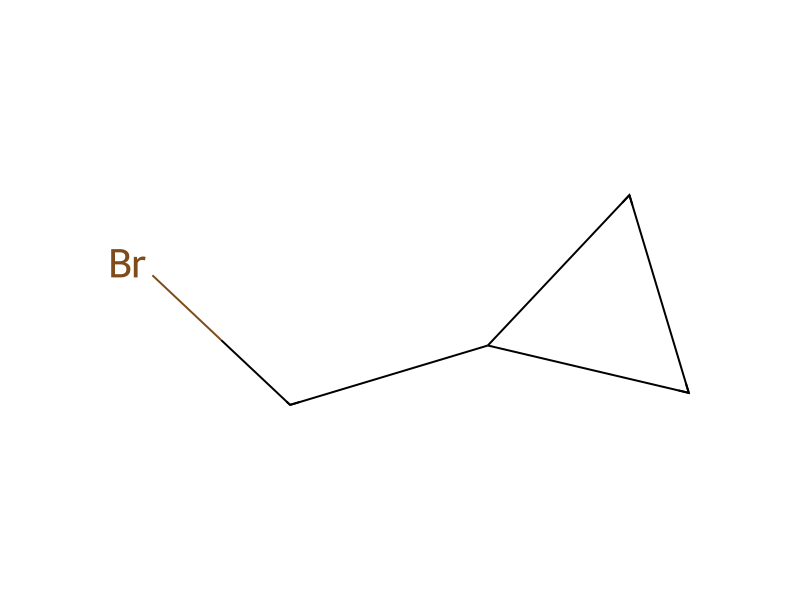
[C:1]([O:5][C:6](=[O:20])[NH:7][C@@H:8]1[C:14](=[O:15])[NH:13][C:12]2[CH:16]=[CH:17][CH:18]=[CH:19][C:11]=2[NH:10][CH2:9]1)([CH3:4])([CH3:3])[CH3:2].C[Si]([N-][Si](C)(C)C)(C)C.[Li+].Br[CH2:32][CH:33]1[CH2:35][CH2:34]1>O1CCCC1>[C:1]([O:5][C:6](=[O:20])[NH:7][C@@H:8]1[C:14](=[O:15])[N:13]([CH2:32][CH:33]2[CH2:35][CH2:34]2)[C:12]2[CH:16]=[CH:17][CH:18]=[CH:19][C:11]=2[NH:10][CH2:9]1)([CH3:4])([CH3:2])[CH3:3]To a solution of 0.6 g (2.2 mmol) (S)-(2-oxo-2,3,4,5-tetrahydro-1H-benzo[b][1,4]diazepin-3-yl)-carbamic acid tert-butyl ester in 10 ml of tetrahydrofuran at −75° C. 2.2 ml (2.2 mmol) of lithium bis(trimethylsilyl)amide solution (1M in tetrahydrofurane) was added. After stirring for 30 min at −75° C. the mixture was allowed to reach room temperature and 0.35 g (2.6 mmol) of bromomethyl-cyclopropane was added. The mixture was stirred for 2.5 hours at room temperature and concentrated in vacuo. The residue was distributed between 1M NaHSO4 solution and ethyl acetate. The combined organic layers were re-extracted with water and dried (MgSO4) to yield 0.285 g (40%) of ((S)-1-cyclopropylmethyl-2-oxo-2,3,4,5-tetrahydro-1H-benzo[b][1,4]diazepin-3-yl)-carbamic acid tert-butyl ester.
불러오는 중…