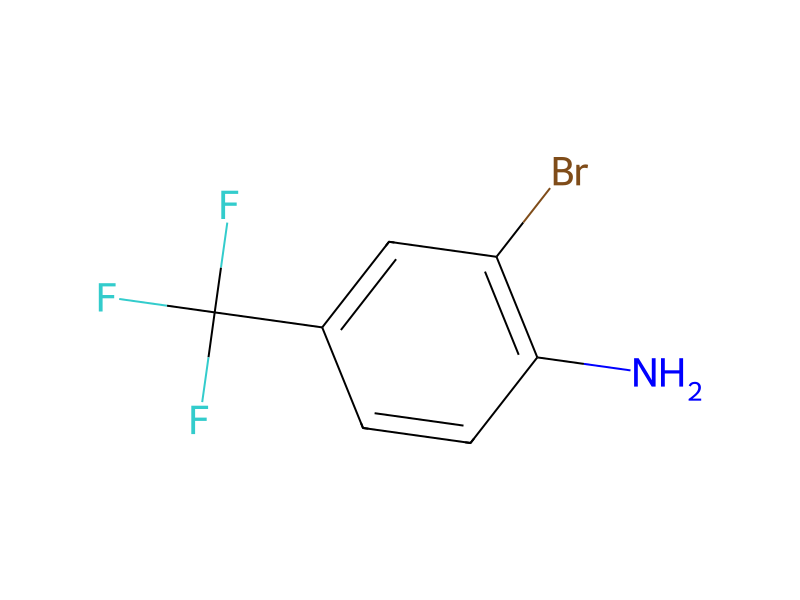
4-Amino-3-bromobenzotrifluoride (15.0 g, 62.5 mmol) was dissolved in N,N-dimethylformamide (400 mL). Thereafter, sodium hydride (5.0 g, 126 mmol) was added to the above obtained solution under cooling on ice, and the thus obtained mixture was then stirred at room temperature for 2 hours. Thereafter, an N,N-dimethylformamide (30 mL) solution of the tert-butyl 3-(chloromethyl)-2,5-dihydro-1H-pyrrole-1-carboxylate (9.20 g, 42.0 mmol) synthesized by a method described in the known methods (European Journal of Organic Chemistry, 4264-4276; 2008 etc.) or a method similar thereto was further added to the reaction solution under cooling on ice, and the thus obtained mixture was then stirred at room temperature for 3 hours. Subsequently, water was added to the reaction solution, and the mixed solution was then extracted with ethyl acetate. The organic layer was washed with brine, and was then dried over anhydrous sodium sulfate, followed by concentration in vacuo. The obtained residue was purified by silica gel column chromatography (hexane ethyl acetate=3:1) to obtain tert-butyl 3-(((2-bromo-4-(trifluoromethyl)phenyl)amino)methyl)-2,5-dihydro-1H-pyrrole-1-carboxylate (6.46 g, 37%) in the form of a colorless amorphous product.