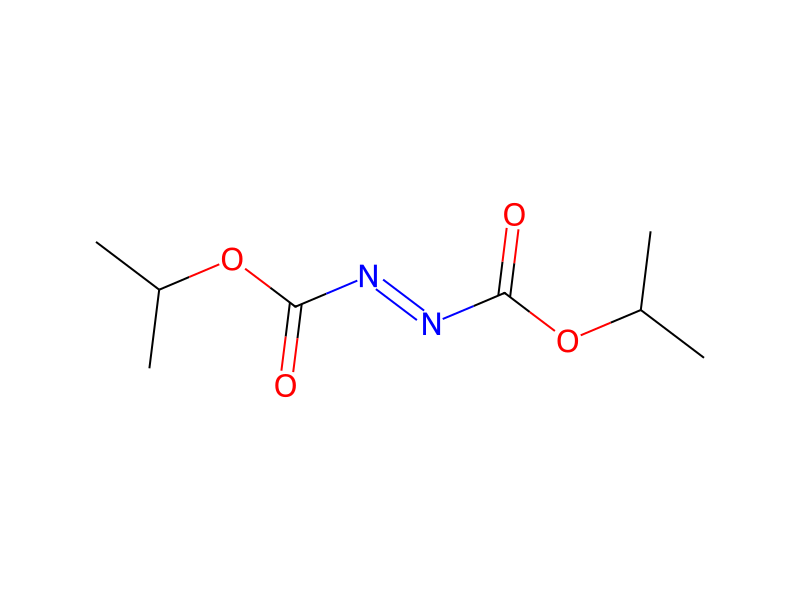
[OH:1][CH:2]1[CH2:7][CH2:6][C:5]([CH3:12])([C:8]([O:10][CH3:11])=[O:9])[CH2:4][CH2:3]1.[N+:13]([C:16]1[CH:24]=[CH:23][C:19]([C:20](O)=[O:21])=[CH:18][CH:17]=1)([O-:15])=[O:14].C1C=CC(P(C2C=CC=CC=2)C2C=CC=CC=2)=CC=1.CC(OC(/N=N/C(OC(C)C)=O)=O)C>C1COCC1>[N+:13]([C:16]1[CH:17]=[CH:18][C:19]([C:20]([O:1][CH:2]2[CH2:3][CH2:4][C:5]([C:8]([O:10][CH3:11])=[O:9])([CH3:12])[CH2:6][CH2:7]2)=[O:21])=[CH:23][CH:24]=1)([O-:15])=[O:14]To a solution of methyl 4-hydroxy-1-methylcyclohexane-1-carboxylate (5.8 g, 33.68 mmol, 1.00 equiv) and 4-nitrobenzoic acid (11.26 g, 67.38 mmol, 2.00 equiv) in 80 mL of anhydrous THF was added PPh3 (17.67 g, 67.37 mmol, 2.00 equiv) at room temperature. Then DIAD (13.62 g, 67.36 mmol, 2.00 equiv) was added dropwise and the resulting solution was stirred for 2 h at room temperature. The reaction was quenched water, extracted with 3×150 mL of ethyl acetate. The combined organic layers were dried over sodium sulfate and concentrated under vacuum. The residue was applied onto a silica gel column with ethyl acetate/petroleum ether (1/50) to give 4-(methoxycarbonyl)-4-methylcyclohexyl 4-nitrobenzoate (5.5 g, 51%) as a white solid.