Chlorodiphenylphosphine → 8-(Diphenylphosphino)quinoline
HRID 1515169
반응식

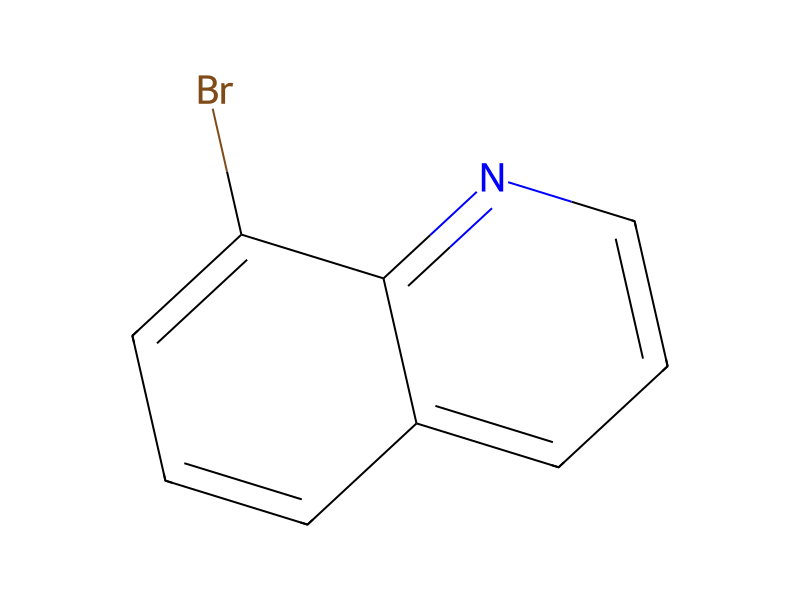
Br[C:2]1[CH:3]=[CH:4][CH:5]=[C:6]2[C:11]=1[N:10]=[CH:9][CH:8]=[CH:7]2.[Li]CCCC.Cl[P:18]([C:25]1[CH:30]=[CH:29][CH:28]=[CH:27][CH:26]=1)[C:19]1[CH:24]=[CH:23][CH:22]=[CH:21][CH:20]=1>C1COCC1>[C:25]1([P:18]([C:19]2[CH:20]=[CH:21][CH:22]=[CH:23][CH:24]=2)[C:2]2[CH:3]=[CH:4][CH:5]=[C:6]3[C:11]=2[N:10]=[CH:9][CH:8]=[CH:7]3)[CH:26]=[CH:27][CH:28]=[CH:29][CH:30]=1참가 물질
5




실험 절차
To a stirred solution of 8-bromoquinoline (20.8 g, 100 mmol) in dry THF (200 mL) under nitrogen was added n-BuLi (62.5 mL, 1.6 M in hexanes, 100 mmol) at −78° C. and the mixture was stirred for 30 minutes. Chlorodiphenylphosphine (17.9 mL, 100 mmol) was then added and the solution was allowed to warm up to room temperature and stirred for 2 h. The solution was then cooled to −78° C. and quenched by addition of saturated aqueous NH4Cl solution (100 mL). After warming up to room temperature, the solution was filtered, the precipitated solid collected, taken up in CH2Cl2 (200 mL) and filtered over silica gel eluting with further portions of CH2Cl2 (4×200 mL). The combined filtrates were evaporated to give 1 as a light yellow solid (19 g, 60% yield). 1H NMR (400.13 MHz, CDCl3) δ 8.37 (dd, 1H, J=4.0, 1.6 Hz, C2—H), 8.17 (dd, 1H, J=8.0, 1.6 Hz, C3—H), 7.82 (d, 1H, J=8.4 Hz, C5—H), 7.44 (t, 1H, J=7.6 Hz, C6—H), 7.40 (dd, 1H, J=8.0, 4.0 Hz, C4—H), 7.3-7.2 (m, 10H, Ph-H), 7.14 (ddd, 1H, J=7.2, 3.6, 1.6 Hz, C7—H) ppm; 13C NMR (100.61 MHz, CDCl3) δ 149.8, 149.6 (d, J=17.2 Hz), 138.4 (d, J=12.1 Hz), 137.4 (d, J=11.1 Hz), 136.2, 134.4, 134.2 (d, J=21.2 Hz), 128.8, 128.4 (d, J=19.2), 127.9, 126.57, 121.41 ppm; 31P NMR (161.97 MHz, CDCl3) δ 15.0 ppm.