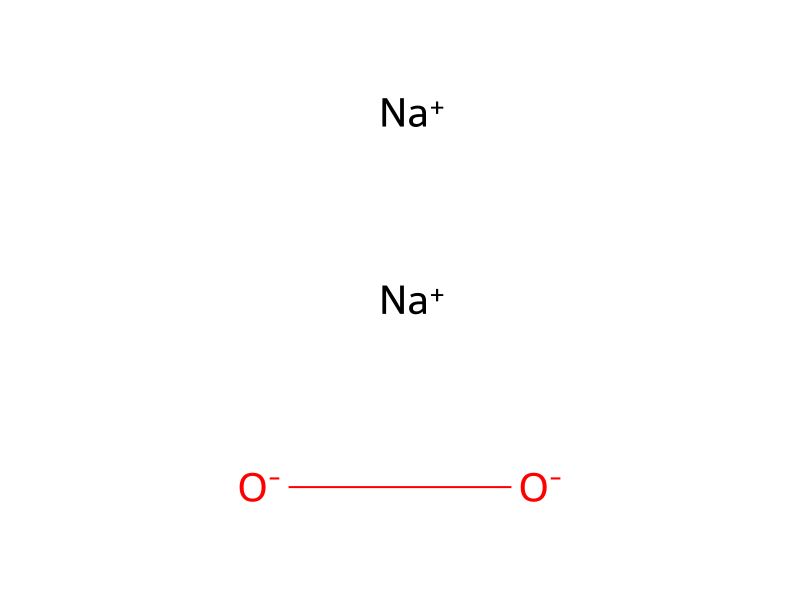
A solution of sodium peroxide prepared by the addition of 15.7 grams of 47.8 percent hydrogen peroxide to 17.6 grams of sodium hydroxide dissolved in 175 ml. of water was stirred in a 3 necked round-bottom flask equipped with stirrer, thermometer and an addition funnel at 0°C. while 70.6 grams of a mixture containing 80 percent α-bromolauroyl halide (a mixture of α-bromolauroyl chloride and of α-bromolauroyl bromide) and 20% lauroyl chloride dissolved in 200 grams of toluene was rapidly added. The resulting mixture was stirred at 0°C. for 4 hours whereupon 43.2 grams of lauroyl chloride was added dropwise. After stirring for about 35 minutes at 0°C. the pH of the reaction mixture was observed to have dropped from 14 to 6. At this point 9 grams of a 20 percent aqueous solution of sulfuric acid was added dropwise causing the pH of the mixture to be lowered to about 1.0-1.5. The reaction mixture was transferred to a separatory funnel and placed in a crushed ice bath. After standing for about 30 minutes, the layers were separated and the upper toluene solution layer was found to contain 29.3 percent peroxide calculated as 2-bromolauroyl lauroyl peroxide. This represented a yield of 86.2 percent based on either α-bromolauroyl bromide or lauroyl chloride. The assay of the 2-bromolauroyl lauroyl peroxide was carried out iodometrically. The method used employed a 0.001 percent solution of ferric chloride hexahydrate dissolved in glacial acetic acid to insure complete decomposition of the diacyl peroxide. This method is described by L. S. Silbert and D. Swern in the Journal of the American Chemical Society, Volume 81, page 2364 (1959). The half-life at 45°C. of the mixture containing predominantly 2-bromolauroyl lauroyl peroxide was about 5 hours as compared to a half-life of about 6 hours for pure 2-bromolauroyl lauroyl peroxide when measured under identical conditions. Half-lives were determined by taking samples containing approximately 30 percent diacyl peroxide dissolved in toluene weighed into pressure bottles which contain chloroform, to provide solutions containing 1.5 percent diacyl peroxide. After a purge with nitrogen the bottles were capped and exposed to 45°C. temperature in a constant temperature bath for varying cooled of time. At one hour intervals samples were withdrawn, colled to room temperature, uncapped and treated successively with a saturated solution of sodium iodide and 0.001 percent solution of ferric chloride hexahydrate dissolved in glacial acetic acid. After standing in the dark for 15 minutes, water was added and the sample titrated until free of color with a standardized solution of sodium thiosulfate. The halflife is defined as the time required for the decomposition of one-half of the initial amount of peroxide present. The decomposition of diacyl peroxides is a first order reaction. As such, the first order kinetic expression for the rate of disappearance of species, A, at constant temperature is applicable. This may be expressed as: ##EQU6## or