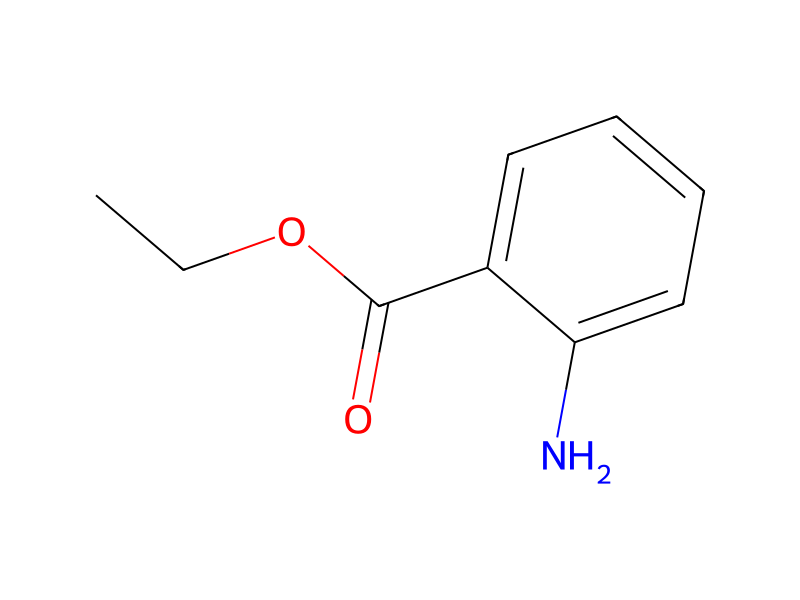
A solution of 3-cyclopropyl-3-oxo-propionic acid methyl ester (6.2 g, 0.038 mols), 2-amino benzoic acid ethyl ester (4.95 g, 0.03 mols) and p-toluene sulfonic acid (0.04 g, 0.2 mmols) in toluene (25 ml) was heated at 125° C. for 2 h; 15 ml of solvent was then distilled. To the residual orange solution was added sodium ethoxide (2 M, 15 ml) in ethanol (reaction mixture turns red). This red mixture was stirred at 120° C. for 2 h; 15 ml of solvent was again distilled. The reaction mixture was left to cool to room temperature, diluted with ethyl acetate (1 litre), extracted with HCl 0.1 M and water. The combined organic extracts were dried over sodium sulfate and concentrated in vacuo to leave an orange residue which was washed once with cold ethyl acetate to yield 2-cyclopropyl-4-oxo-1,4-dihydro-quinoline-3-carboxylic acid ethyl ester (3.87 g, 53%) as an off-white solid. LCMS m/z 244.14 [M+H]+ @ RT 0.78 min, 89%, m/z 230.11 [Acid+H]+ @ RT 1.27, 11%. δH (400 MHz, (CD3)2SO) 11.04 (1H, s), 8.06 (1H, dd, J1 1.1, J2 8.1), 7.76-7.66 (2H, m), 7.36 (1H, td, J1 1.1, J2 7.5), 3.89 (3H, s), 2.16 (1H, m), 1.18 (4H, d, J 7.0). Step 2 4-Chloro-2-cyclopropyl-quinoline-3-carboxylic acid ethyl ester