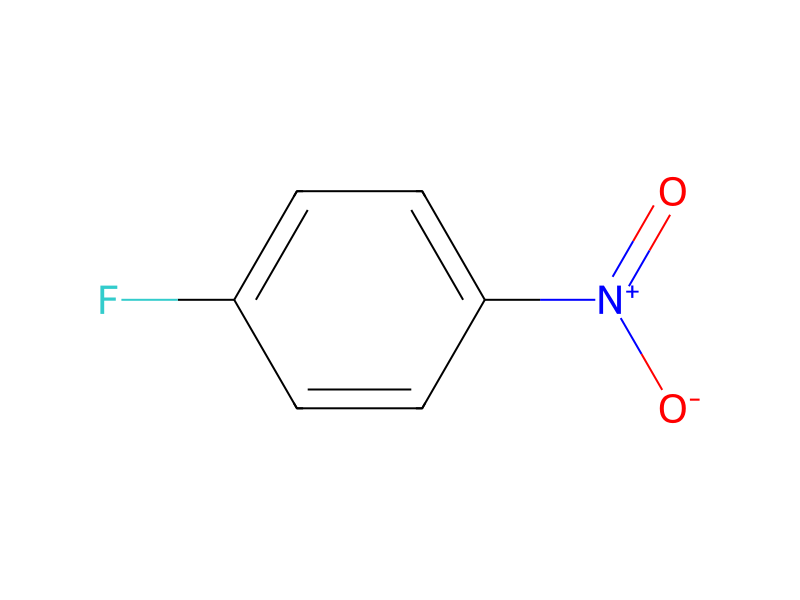
To a solution of 3-(3-pyridinyl)-5-ethylpyrazole (13.2 g, 75.6 mmol) in DMSO (70 mL) was added t-BuOK (9.3 g, 83.2 mmol), and then 4-fluoronitrobenzene (8.8 mL, 83.2 mmol). The mixture was heated to 80° C. for 1 hr. After being cooled to room temperature, the mixture was quenched with water (300 mL). The resulting slurry was stirred for 30 min and filtered. The cake was washed with water and dried in oven under house vacuum at 40° C. overnight. The solid was then treated with a 1:2 mixture of ethyl acetate and hexane (150 mL) and the slurry was filtered. The solid was washed with the same solvent system and dried in an oven under house vacuum to give 1-(4-nitrophenyl)-3-(3-pyridinyl)-5-ethylpyrazole (18.5 g, 82%). 1H NMR (CDCl3, 400 MHz) 9.09 (s, 1H), 8.60 (d, J=4.0 Hz, 1H), 8.38, 7.76 (ABq, J=9.04 Hz, 4H), 8.17(m, 1H), 7.36 (m, 1H), 6.67 (s, 1H), 2.84 (q, J=7.5Hz, 2H), 1.36 (t, J=7.5 Hz, 3H).