Trityl chloride → N-Acetyl-5'-O-(triphenylmethyl)cytidine
HRID 1654970
반응식

[C:1]([NH:4][C:5]1[CH:19]=[CH:18][N:8]([C@@H:9]2[O:17][C@H:14]([CH2:15][OH:16])[C@@H:12]([OH:13])[C@H:10]2[OH:11])[C:7](=[O:20])[N:6]=1)(=[O:3])[CH3:2].[C:21](Cl)([C:34]1[CH:39]=[CH:38][CH:37]=[CH:36][CH:35]=1)([C:28]1[CH:33]=[CH:32][CH:31]=[CH:30][CH:29]=1)[C:22]1[CH:27]=[CH:26][CH:25]=[CH:24][CH:23]=1>>[C:1]([NH:4][C:5]1[CH:19]=[CH:18][N:8]([C@@H:9]2[O:17][C@H:14]([CH2:15][O:16][C:21]([C:22]3[CH:27]=[CH:26][CH:25]=[CH:24][CH:23]=3)([C:34]3[CH:35]=[CH:36][CH:37]=[CH:38][CH:39]=3)[C:28]3[CH:29]=[CH:30][CH:31]=[CH:32][CH:33]=3)[C@@H:12]([OH:13])[C@H:10]2[OH:11])[C:7](=[O:20])[N:6]=1)(=[O:3])[CH3:2]참가 물질
3
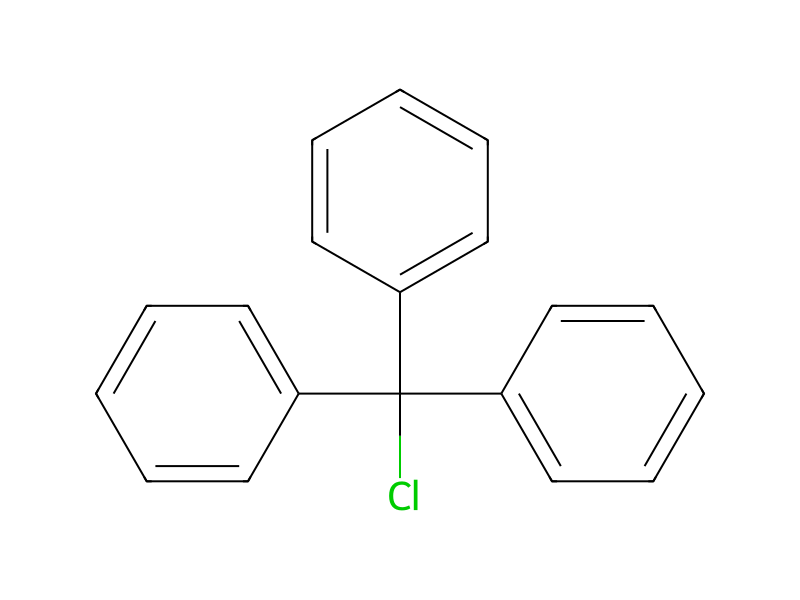


실험 절차
N-Acetylcytidine (see D. M. Brown et al., J. Chem. Soc. 1956, 2384) (1.000 g, 3.5057 mmol), trityl chloride (1.0751 g, 3.8563 mmol) and a small stirring bar were placed in a dry round-bottomed flask fused onto a reflux condenser. The flask was closed with a septum and flushed with argon. Pyridine (10.2 mL) was injected and the mixture was stirred at room temperature for 36 h. The mixture was evaporated, diluted with CH2Cl2, and again evaporated. The gummy residue was washed with water and the residue was dissolved in acetone. The solution was dried (MgSO4) and evaporated. Flash chromatography of the residue over silica gel (4.5×30 cm), using 7% MeOH in CH2Cl2, gave the product (1.4752 g, 80%). (Cf. H. U. Blank et al., Justus Liebigs Ann. Chem. 1970, 742, 16).