반응식

N1C(Cl)=NC(Cl)=NC=1Cl.BrC1C=C(Br)C=C(Br)C=1O.[C:20](=[O:23])([O-:22])[O-:21].[Na+:24].[Na+].[OH-].[Na+]>CC(C)=O.C(C(C)=O)C>[C:20](=[O:21])([OH:23])[O-:22].[Na+:24].[C:20](=[O:22])=[O:21].[C:20](=[O:21])([O-:23])[O-:22].[Na+:24].[Na+:24]참가 물질

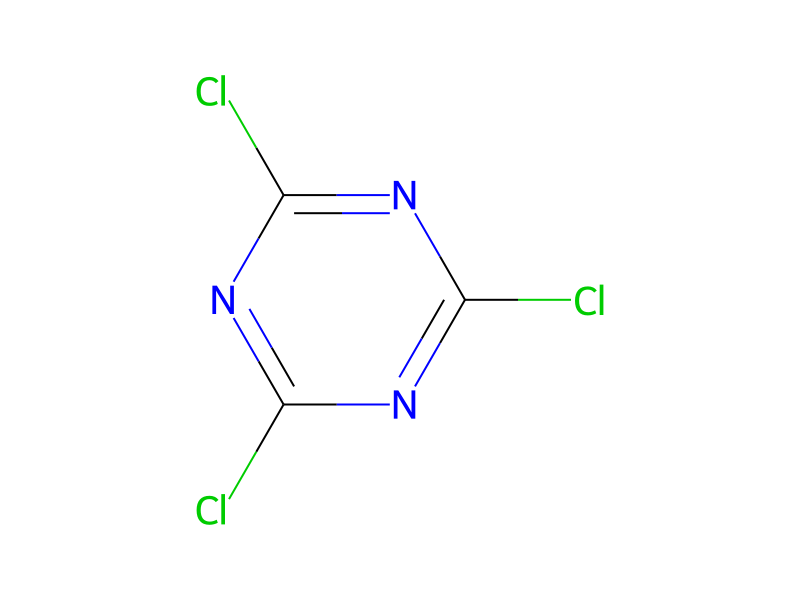






실험 절차
The compound, tris(2,4,6-tribromophenoxy)-s-1,3,5-triazine, was reported in French Patent 1,566,675, in 1969. The compound is useful as a flame retardant. In U.S. Pat. Nos. 3,843,650 and 3,950,306 a process for the production of tris(2,4,6-tribromophenoxy)-s-1,3,5-triazine is described. In addition, two recommended processes utilize the reaction of cyanuric chloride and 2,4,6-tribromophenol in the presence of either sodium carbonate and methyl ethyl ketone or aqueous sodium hydroxide and acetone. The product has poor solubility in ketone solvents and is readily removed by filtration. When sodium hydroxide is used as the base, water is formed as a by-product; sodium bicarbonate or carbon dioxide is formed when sodium carbonate is used. While workable, the foregoing processes are not as efficient as desired.
후처리
- customis readily removed by filtration
- customwater is formed as a by-product
출처 및 근거
- ORD 기록
- ord-c447a1779a7e43a9ba1f067aee2fdf48
- 출처 데이터셋
- uspto-grants-1999_10
- 특허 번호
- US05965731
연결된 노트
불러오는 중…