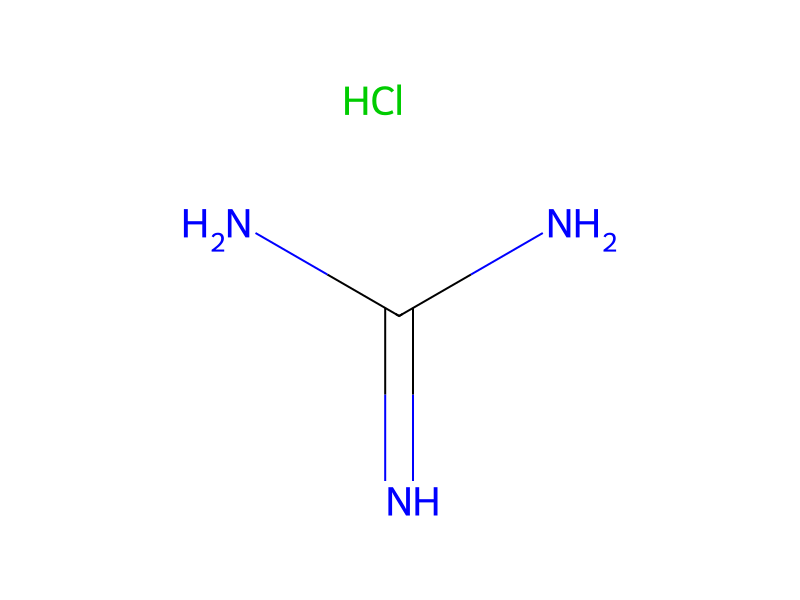
0.795 g (33.1 mmol) of sodium is added at 20° C. under an argon atmosphere to 30 mL of methanol. After complete dissolution, 2.97 g (31.2 mmol) of guanidine hydrochloride are added. After stirring at 20° C. for 0.5 hour, the reaction mixture is filtered under an argon atmosphere. The filtrate is concentrated to dryness under reduced pressure (2.7 kPa) to give a residue that is dissolved in 15 mL of 1,2-dimethoxyethane. 2 g of 3-chlorocarbonyl-2-methyl-1-(quinol-2-yl)-1H-pyrrole hydrochloride, suspended in 15 mL of 1,2-dimethoxyethane, are then added at 20° C. under an argon atmosphere. After stirring at 20° C. for 8 hours, the reaction mixture is concentrated to dryness under reduced pressure (2.7 kPa) to give a residue that is triturated in 100 mL of water for 16 hours. After filtering off and drying the solid residue under reduced pressure (2.7 kPa), a residue is obtained, which residue is purified by flash chromatography [eluent: dichloromethane/methanol/acetonitrile (86/7/7 by volume) and then dichloromethane/methanol/20% aqueous ammonia (96/24/2 by volume)]. After concentrating the fractions under reduced pressure, a beige-coloured solid is obtained, which solid is triturated in 100 mL of N hydrochloric acid for 15 hours. After filtration, the solid residue is recrystallised under hot conditions from 30 mL of methanol to give 0.82 g of 3-guanidinocarbonyl-2-methyl-1-(quinol-2-yl)-1H-pyrrole hydrochloride in the form of a pinkish solid melting at 250° C. Mass spectrum (EI): m/e 293 (M+.), m/e 206 (base peak).