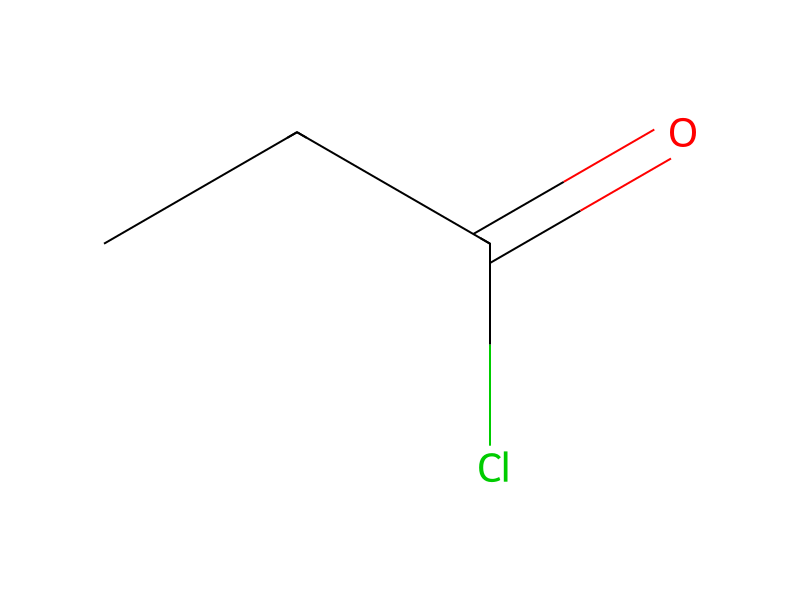
A suspension of 360 g of aluminum chloride in 1 L of methylene chloride was cooled to 0° C., and a solution of 250 g of propanoic chloride in 800 mL of methylene chloride was then added dropwise to the suspension. Following completion of the addition, the mixture was stirred at the same temperature for 30 minutes, and a solution of 443 g of 9,10-dihydrophenanthrene in 800 mL of methylene chloride was then added dropwise. The reaction mixture was stirred for a further one hour, and the reaction then halted by pouring the reaction mixture into ice water. The organic layer was separated, the aqueous layer was extracted with methylene chloride, and the extract was combined with the organic layer. The organic layer was then washed with water, a saturated aqueous solution of sodium bicarbonate, and a saturated aqueous solution of sodium chloride, and was then dried over anhydrous sodium sulfate. The solvent was removed by evaporation and the product subsequently purified by column chromatography to yield 504 g of 1-(9,10-dihydrophenanthrene-2-yl)propan-1-one. 497 g of this 1-(9,10-dihydrophenanthrene-2-yl)propan-1-one was then suspended in 3 L of diethylene glycol, 421 g of hydrazine hydrate was added, and the suspension was stirred, with heating, for one hour at 100° C. The temperature was then raised to 120° C., and following removal of any unreacted hydrazine by evaporation, the temperature was once again lowered. 13.9 g of potassium hydroxide was then added, and with sufficient care taken over foaming, the mixture was heated at 160° C., with stirring, for two hours. The reaction mixture was then returned to room temperature, toluene and water were added, and the organic layer was separated. The organic layer was then washed with a saturated aqueous solution of sodium bicarbonate, water, and a saturated aqueous solution of sodium chloride, and was then dried over anhydrous sodium sulfate. The solvent was removed by evaporation and the product subsequently purified by column chromatography (hexane) to yield 361 g of 2-propyl-9,10-dihydrophenanthrene. To a solution of 330 g of this 2-propyl-9,10-dihydrophenanthrene in 300 mL of 1,2-dichloroethane was added 2.4 L of acetic acid, 12 mL of sulfuric acid, 600 mL of water, 226 g of iodine and 165 g of periodic acid hydrate, and the resulting mixture was stirred for 3 hours with the internal temperature at 50° C. Following cooling, an aqueous solution of sodium hydrogen sulfite was added, and following decomposition of any residual iodine, methylene chloride was added and the organic layer was separated. The organic layer was washed with a saturated aqueous solution of sodium bicarbonate, water, and a saturated aqueous solution of sodium chloride, and was then dried over anhydrous sodium sulfate. The solvent was removed by evaporation and the product subsequently purified by column chromatography (hexane) to yield 245 g of 2-iodo-7-propyl-9,10-dihydrophenanthrene. To a solution of 100 g of this 2-iodo-7-propyl-9,10-dihydrophenanthrene in 300 mL of THF was added 3.3 g of tetrakis(triphenylphosphine)palladium (0) and the mixture was stirred at room temperature. This mixture was then reacted with a Grignard reagent prepared from 79 g of 3,4,5-trifluorobromobenzene and 9.1 g of magnesium. Following stirring for 2 hours at room temperature, the mixture was allowed to cool to room temperature, water was added, the product was extracted into toluene, and the organic layer was washed sequentially with water and a saturated aqueous solution of sodium chloride before being dried over anhydrous sodium sulfate. The crude product obtained by removal of the solvent by evaporation was purified by silica gel column chromatography (hexane) and then recrystallized 3 times from ethanol to yield 45 g of white crystals of 2-propyl-7-(3,4,5-trifluorophenyl)-9,10-dihydrophenanthrene. Measurement of the phase transition temperature revealed a transition from the crystalline phase to an isotropic liquid phase at 68° C. under rising temperature conditions.